
New York Capital Gains Tax: Rate and Calculation Guide
New York taxes capital gains as ordinary income from 4% to 10.9%, plus NYC residents add city tax. See the brackets, a full worked example, and planning moves.

New York Taxes Gains as Ordinary Income
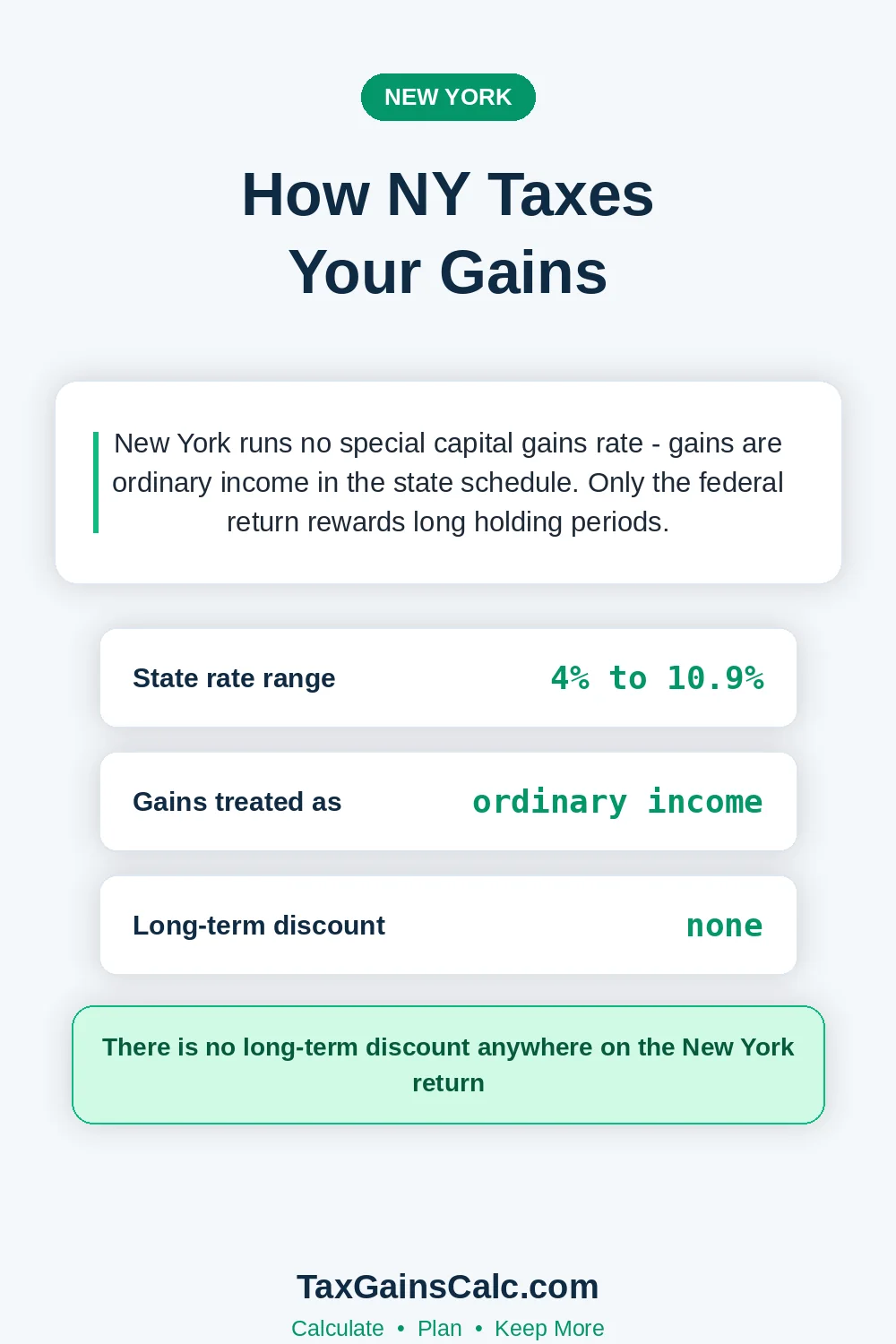
New York treats every capital gain as salary-class income, without any preferential long-term rate in the state code. Rates climb from 4 percent to 10.9 percent, and New York City residents add 3.078 to 3.876 percent on top. A Manhattan seller can approach a combined 40 percent marginal burden. The federal rates that stack underneath are laid out in Topic 409.
New York capital gains tax follows one simple rule that surprises many new residents. The state runs every capital gain through the same tax treatment as salary, with no preferential rates.
None of those federal 0, 15, or 20 percent tiers transfers onto your state return.
This treatment contrasts sharply with the federal system and its holding period rewards.
A patient investor gets nothing special from New York for holding a stock longer. The state simply adds your gain to ordinary income and applies its bracket rates.
The result is a combined burden that demands careful planning before major sales. Federal tax, the Net investment income tax, and New York tax can all stack together.
New York City residents add another layer on top of all three federal and state layers.
This guide walks through the state brackets, the city layer, and a full worked example. It also covers estimated payments, loss treatment, and the rules for mid-year moves.
Investors anywhere in the state can apply every section to their own numbers.
Second-home owners, landlords, and small business sellers all face the same underlying mechanics. The state charges ordinary bracket rates no matter which asset produced the gain.
Only the timing rules and the deduction side differ meaningfully across those situations.
Selling investors should also confirm whether their gain touches any federal exclusions first. The federal home sale exclusion wipes gains before state brackets ever see them.
Sequence matters greatly because federal figures flow into the state return in order.
Every number in this complete guide uses the latest published schedules and thresholds. Brackets adjust annually, so always confirm the current official figures before filing season.
The New York tax rate schedules page publishes the official amounts each year.
How the New York Brackets Work
 New York uses a progressive rate schedule with rates starting at just 4 percent. The top statutory rate reaches 10.9 percent only above twenty-five million in income.
Most investors selling property or portfolios land somewhere in the middle bands instead.
New York also layers a supplemental recapture on very high earners through phased benefit reductions. The practical effect is a slightly higher effective rate than the bracket suggests.
Anyone crossing two hundred thousand should model that rate drift before finalizing plans.
The recapture mechanism also explains why two similar incomes can owe different amounts. The benefit phase-outs create invisible rate increases between the published bracket lines. Good software catches these automatically once your full return gets entered correctly.
| New York Taxable Income (Single) | Marginal Rate |
|---|---|
| First $8,500 | 4.0% |
| $8,501 to $11,700 | 4.5% |
| $11,701 to $13,900 | 5.25% |
| $13,901 to $80,650 | 5.5% |
| $80,651 to $215,400 | 6.0% |
| Above $215,400 (high earners) | 6.85% and up |
Married couples filing jointly receive roughly double the width in the lower bands. The higher bands narrow considerably, so joint filing helps less at upper incomes. New York also phases out some benefits as income climbs past certain points.
College savings contributions and certain retirement plans earn additional state adjustment benefits. Those adjustments lower taxable income before the brackets ever get applied there. Families planning both a large gain and tuition should coordinate the ordering carefully.
Your gain fills these brackets after your other income has already filled them. A wage earner's first dollars of gain often land in the 6 percent band. A retiree with modest income might stack gains entirely inside the lower bands.
The standard deduction and exemptions still reduce the taxable base before brackets apply. The New York standard deduction sits near eight thousand dollars for single filers. Itemizers see only limited extra benefit relative to what the federal return allows.
NYC Residents Pay an Extra Layer
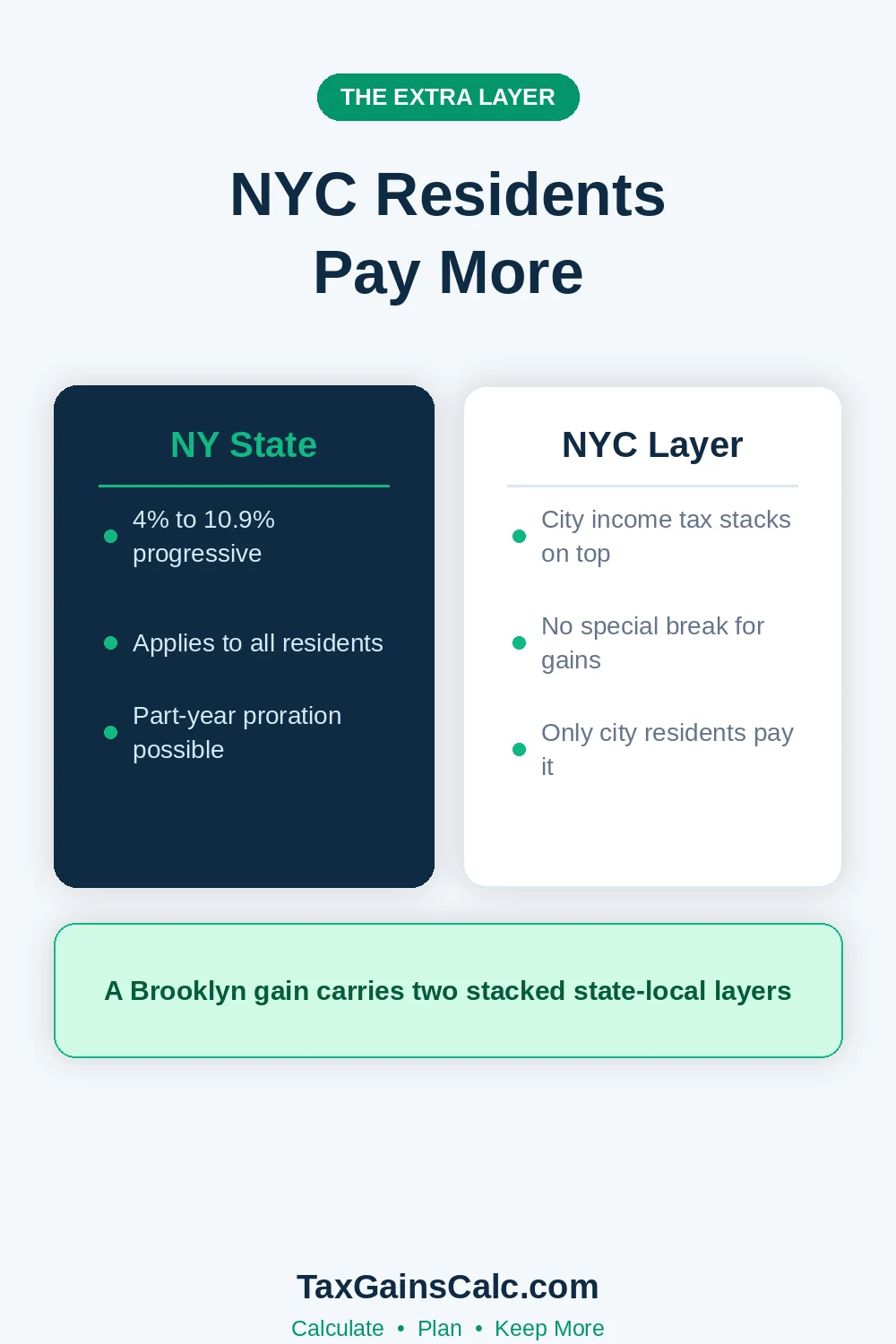 Living in one of the five boroughs adds a separate city income tax. New York City levies its own progressive tax with a 3.876 percent top rate. The city tax applies on top of state tax with no offset between them.
| Layer | Typical Rate Range | Notes |
|---|---|---|
| Federal long-term gains | 0% / 15% / 20% | Holding period driven |
| the 3.8 percent federal surtax | 3.8% | MAGI above $200,000 single |
| New York State | 4% to 10.9% | Ordinary brackets |
| New York City | 3.078% to 3.876% | Residents only |
A Manhattan resident selling a large position can face a combined marginal burden near 40 percent. The exact figure depends on income levels and the character of each gain. Many downstate investors weigh moves to nearby states before timing any major exits.
Deferred compensation and retirement withdrawals complicate the residency math for recent movers considerably. Pension income sourced to New York working years keeps its state tax character. Planning the exit order of income streams saves genuinely real money for retirees.
Commuters who live outside the five boroughs escape the city tax completely. Working in Manhattan does not create city residency for state tax purposes. Only domicile or statutory residence within the five boroughs triggers the city layer.
Residents of Yonkers pay their own surtax on top of the state calculation. The surtax runs up to roughly 1.6 percent for higher earners in the city. Westchester County residents living outside Yonkers escape this additional layer entirely.
Worked Example: Single Filer With a Gain
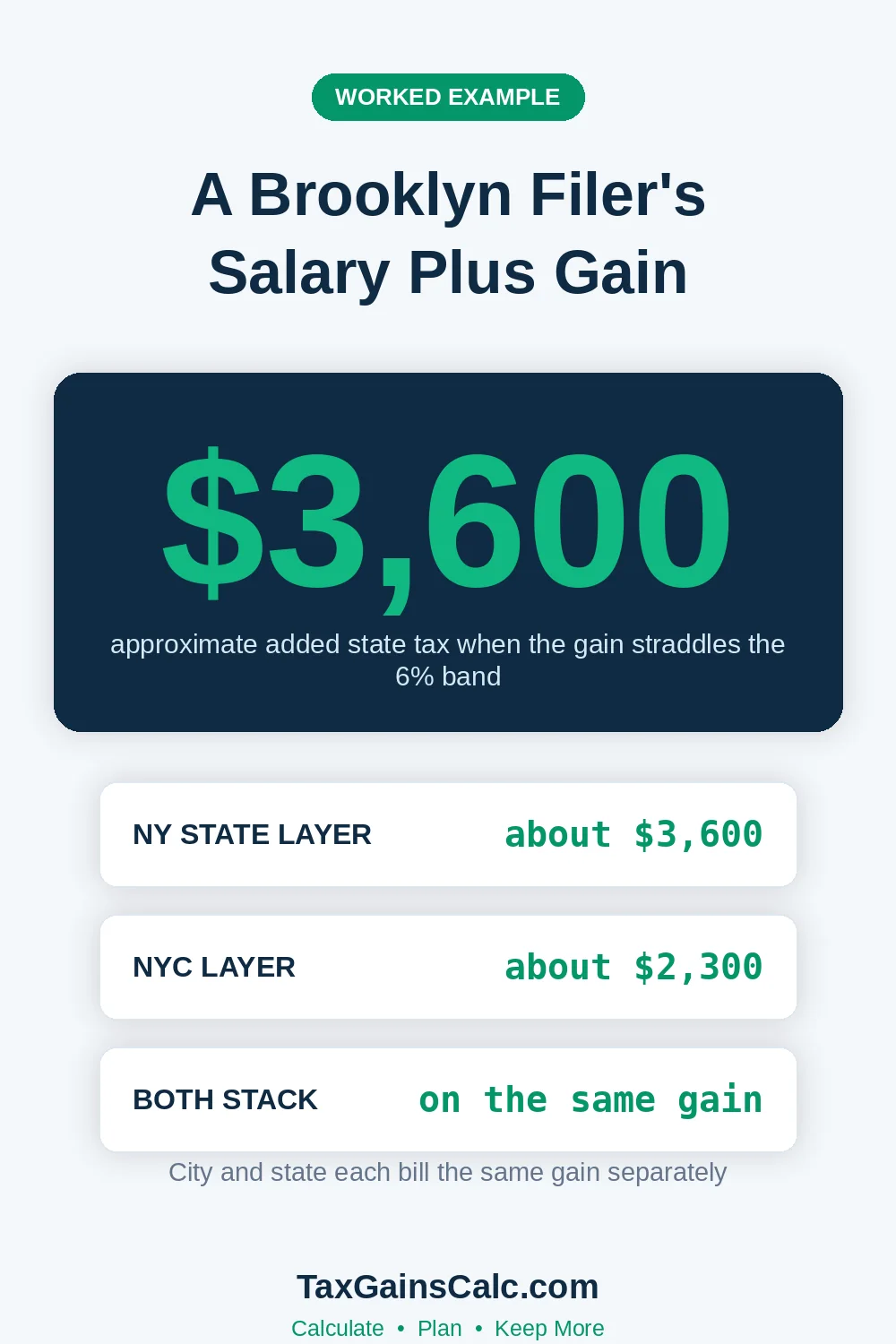 Meet Sarah, a single filer in Brooklyn whose salary totals $110,000 this year. Once the position has seasoned for three years, she sells it and realizes a long-term gain of $60,000. Her combined tax picture shows exactly how the layers stack in practice.
Her gain sits in the 15 percent federal bracket for long-term gains. Her wages plus gain total $170,000, well below the single 20 percent threshold. The federal layer therefore collects $9,000 on the gain before anything else applies.
New York State taxes that same gain inside her ordinary brackets instead. Her state taxable income reaches roughly $162,000 after the state standard deduction. The gain straddles the 6 percent band, adding approximately $3,600 of state tax.
The city adds roughly $2,300 more on the same income at her bracket. Her combined marginal burden on the gain runs near 25 percent all told. The summary table below shows every layer of her final bill.
| Tax Layer | Rate on Gain | Tax on $60,000 Gain |
|---|---|---|
| Federal long-term | 15% | $9,000 |
| New York State | 6.0% marginal | $3,600 |
| New York City | ~3.876% | $2,300 |
| Total | ~24.8% | $14,900 |
Her NIIT exposure depends on total MAGI, which stays safely under $200,000 here. A second large gain could push her over and add 3.8 percent federally. Careful modeling before selling always beats discovering the surtax during filing season later.
Spousal coordination matters equally because MAGI combines across the entire joint return. One spouse's year-end bonus can silently push the other's gain into surtax territory. Quarterly reviews of household MAGI catch these interactions early enough to still act.
If her gain had reached $200,000 instead, every layer above would scale upward. The federal layer would split between 15 and 20 percent bands across the amount. State and city taxes would each add roughly five figures more to the bill.
Estimated Payments for New York Gains
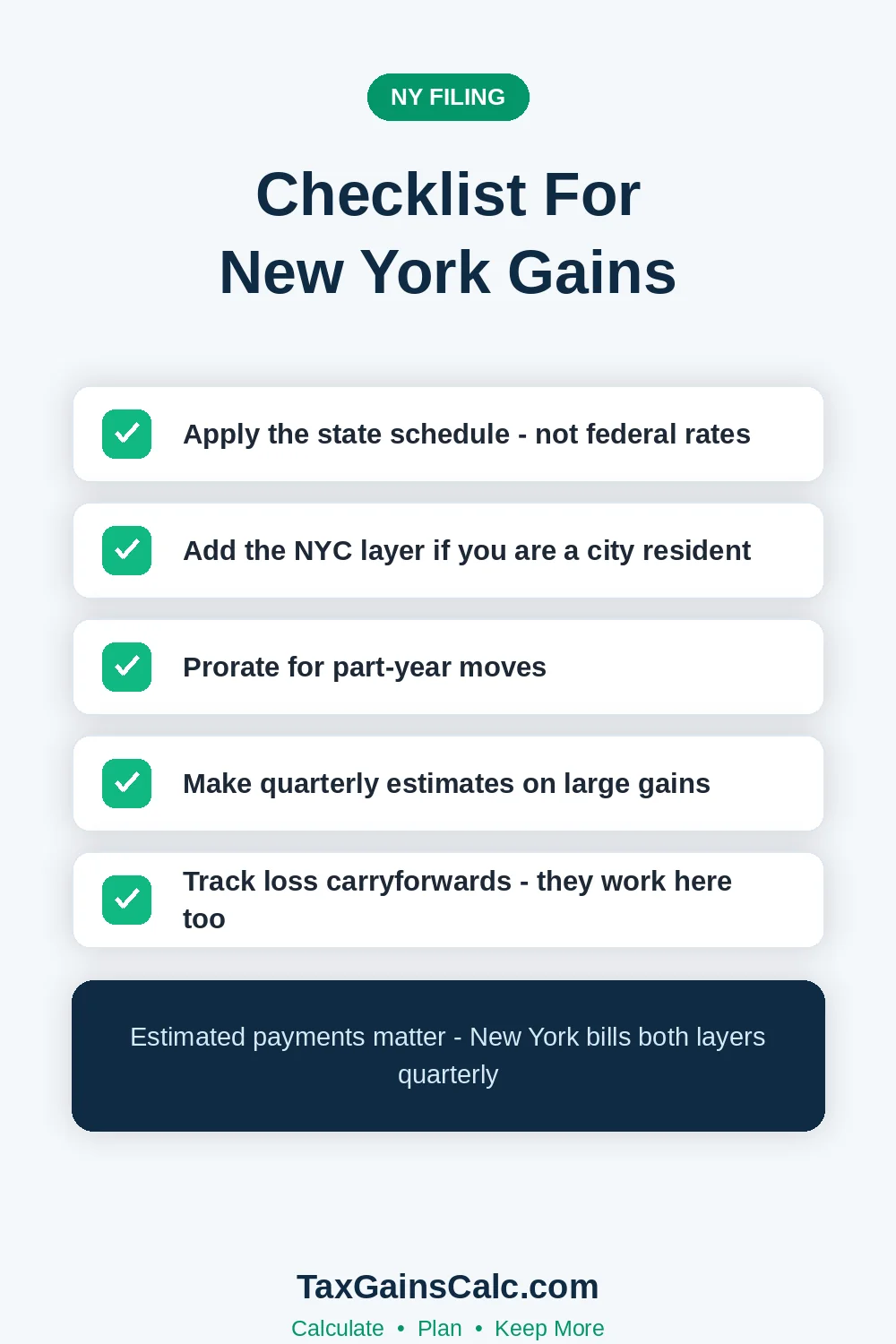 New York expects quarterly estimated payments on gains the same way the IRS does. Large unsold-withholding sales create state underpayment penalties alongside the familiar federal ones. The state follows quarterly dates aligned with the federal calendar throughout the year.
Employers rarely withhold enough state tax to cover any mid-year portfolio sale. Employees can raise withholding instead of paying estimates, which New York treats as evenly paid. That deemed-evenly treatment mirrors the federal rule and rewards late-year withholding moves.
The state safe harbor generally mirrors the federal 100 percent prior-year structure. High earners should check whether New York applies its own higher required percentage. The estimated payments guide explains the shared mechanics in detail.
New York accepts payments online through its official services portal within mere minutes. Payments post to the correct quarterly period when scheduled before the due date. Confirmation numbers deserve saving alongside your complete brokerage records for the year.
New York charges its own underpayment penalty when estimates fall short quarterly. The penalty accrues per period exactly like the federal version does. Our federal underpayment penalty guide explains the shared quarterly logic fully.
Capital Losses on Your New York Return
New York starts its capital gain computation from your federal figures. Federal net gains and losses flow onto the state return with limited adjustments. That $3,000 write-off against ordinary income plus indefinite carryover both function at the state level too.
This alignment makes federal loss harvesting doubly valuable for New York investors. A realized loss cuts federal tax, state tax, and possibly city tax at once. Our loss harvesting guide covers the timing rules carefully.
Carryforward losses need annual tracking on the state return exactly as federally. New York keeps its own running loss schedule separate from federal records. Losing that schedule after several years means reconstructing it from old returns.
Cryptocurrency losses follow the same state treatment as securities losses here. Every disposal still needs federal documentation before state figures can flow. Our complete crypto tax guide covers the federal layer in depth.
One recurring wrinkle involves gains on federal tax-exempt securities and their state treatment. New York taxes gains on bonds that other states exempt from their taxes. Reverse situations also exist where New York exempts what the federal government taxes.
Moving Out of New York Before a Sale
Relocating before a large sale is the most discussed strategy in New York. Changing domicile to Florida or Texas eliminates state and city tax on later gains. The gain must actually accrue while you are a genuine nonresident, though.
New York audits mid-year exits aggressively and scrutinizes every piece of evidence closely. Days outside the state, home locations, and business ties all receive close examination. For the destination half of this decision, see the no-tax state guide.
Statutory residency catches people who keep a permanent home while claiming elsewhere. Spending more than 183 days in New York keeps you fully taxable regardless. Counting days honestly matters far more than most departing residents want to believe.
Auditors use phone records, credit card statements, and even gym check-ins as evidence. Modern location data makes day-counting claims genuinely easy to verify or refute. Keeping your own contemporaneous daily log remains the strongest defense available anywhere.
Successful state audits of former residents often hinge on a single summer stretch. Everyone should know their own exact day count before claiming any exit. Phone apps that track location automatically remove the guesswork from this record.
Nonresidents still owe New York tax on gains from New York real property. Selling a Manhattan condo after moving to Miami still triggers full state tax. The inherited property guide covers estate-side issues that often accompany these sales.
Planning Moves for New York Investors
Spreading large sales across two tax years works whenever the calendar allows patience. Splitting a large gain can keep both years inside friendlier state brackets. Our thresholds guide shows where each federal and state line sits.
Maximize every tax-advantaged account contribution before realizing large taxable gains each year. Retirement contributions reduce both federal and state taxable income at the same time. Which accounts escape capital gains altogether is laid out in the retirement accounts guide.
Charitable giving strategies work especially well against New York's ordinary-rate gain treatment. Donating appreciated shares avoids the state tax layer along with the federal one. Our charitable stock guide walks through the mechanics.
The federal SALT cap also interacts with high-tax states in ways that matter. Capped deductions can push more of your gain into higher federal bracket territory. Our 15 percent bracket guide shows where those lines currently sit.
Compare your state before assuming New York is always the worst outcome. California taxes gains at rates up to 13.3 percent, higher than most New York brackets. Our California guide and state rates comparison provide nearby benchmarks.
Connecticut and Massachusetts also tax gains as ordinary income at meaningful rates. Only a small handful of states treat long-term gains preferentially at all. Our full state ranking post lists every approach side by side.
Finally, run every scenario through a calculator before committing to any plan. The federal layer takes minutes to compute in our capital gains calculator. Pair its output with the state figures above for a truly complete picture.
New York rewards investors who plan before the sale rather than after it. Bracket positioning, sale timing, and residency all respond strongly to advance preparation. Start the planning conversation at least one tax year before any large exit.

Wasim Akram
Wasim researches and writes every article on TaxGainsCalc, covering capital gains tax for everyday investors. Every figure is checked against primary IRS sources before it goes live.