
California Capital Gains Tax: How the State Taxes Gains
California taxes capital gains as ordinary income up to 13.3 percent on top of federal. Combined math, exit audits, and the planning room left.

California Capital Gains Tax: The Direct Answer
California grants long-term gains no preferential rate at the state level, no matter how many zeros the sale carries. Bracket placement, not holding period, sets the state rate.
Gains tax as ordinary income through brackets reaching 12.3 percent at the top.
Incomes above $1 million add the 1 percent mental health surtax on top.
This guide combines the federal and state layers, explains residency audits, and shows what planning room remains.
For high earners, the combined federal and state bill on a big gain approaches 37 percent.
Twenty percent federal, 3.8 percent NIIT, and 13.3 percent state stack into a heavy total fast. Each layer bills separately, so underestimating one understates the real check you will write. Investors planning an exit should run this combined math before agreeing to any sale price.
How California Treats Gains as Ordinary Income
The Franchise Tax Board applies a single bracket structure to every kind of income a filer reports.
Wages, interest, rents, and capital gains alike land in that same progressive schedule, dollar for dollar. The source of the money never changes its state treatment.
A thirty-year holding period earns exactly nothing at the state layer.
The state grants no bonus for patience, however long you held. 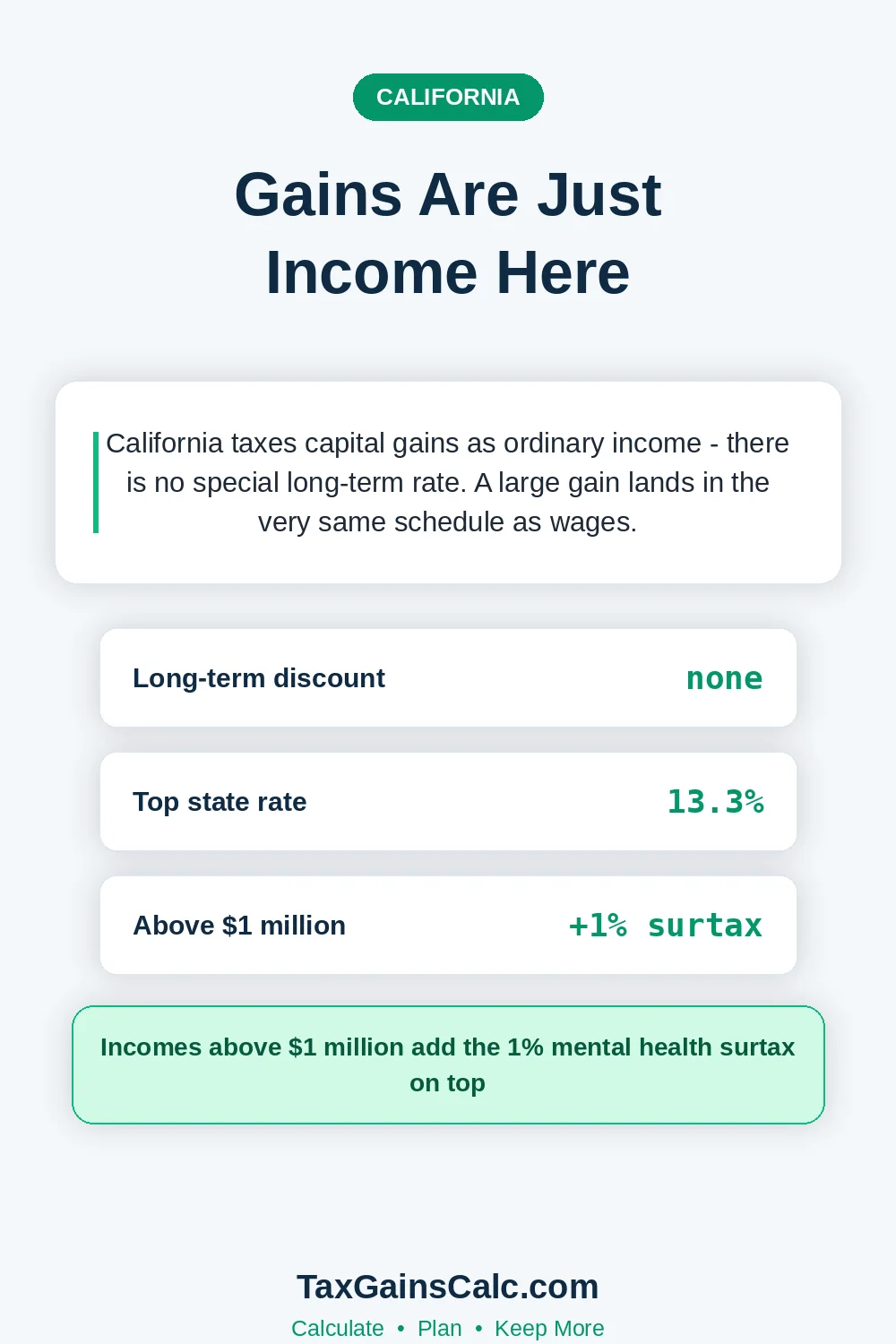 California ignores the federal tiers entirely, because 0, 15, and 20 percent mean nothing to the state calculation.
State brackets climb progressively from roughly 1 percent at the bottom to 12.3 percent at the top. Income above $1 million adds the 1 percent mental health services surtax on top of that.
Both pieces apply to gains exactly as they apply to wages.
Together those two layers create the famous 13.3 percent top marginal rate. That figure includes the mental health surtax, not just the base bracket.
Our state rates guide compares every state's structure.
| Income type | Federal treatment | California treatment |
|---|---|---|
| long-term gains | 0, 15, or 20 percent | ordinary brackets to 13.3 percent |
| short-term gains | ordinary brackets | ordinary brackets |
| wages | ordinary brackets | ordinary brackets |
Worked Example: A $500,000 Gain for a High Earner
Picture an investor with high wages who realizes a $500,000 long-term gain in one sale. On the federal side, most of this gain lands in the 20 percent bracket.
Here is how the two taxing layers add up, piece by piece.
The NIIT then adds 3.8 percent on the full gain amount for this earner. On these numbers, the federal side alone costs nearly $119,000 before California enters.
Roughly $100,000 comes from the rate itself and $19,000 from the surtax.
California then taxes the entire $500,000 gain as ordinary income at its top brackets. At the 13.3 percent effective top, that adds roughly $66,500. No federal 15 or 20 percent ceiling softens the blow at the state level.
Add the layers together and the bill on this one gain approaches $185,000. That works out to nearly 37 percent of the gain itself. Our gains by income guide prices other sale sizes similarly.
| Layer | Effective rate | Tax on $500,000 |
|---|---|---|
| federal long-term | 20 percent band | about $100,000 |
| NIIT surtax | 3.8 percent | about $19,000 |
| California layer | up to 13.3 percent | about $66,500 |
| combined | about 37 percent | about $185,000 |
Why the Federal 0 Percent Band Does Not Help Here
Investors with low income can qualify for the federal 0 percent gains rate. California still taxes those same gains through its ordinary state brackets. The gap between the two returns is the whole planning point here.
The state tax kicks in from dollar one of any gain, at 1 percent and up. Federal planning alone never wipes out the California bill. Any zero-rate harvest still leaves a state bill to pay.
Retirees on modest incomes often forget this asymmetry when filing season arrives. The federal return shows zero tax, then the California return delivers a surprise. A gain that looked free at the federal level still costs real money in Sacramento.
Our zero bracket guide covers the federal strategy with state caveats. Model both layers before harvesting any gains during a low-income California year. A federal win can still lose money once the state takes its share.
Part-Year Residency and California Sourcing Rules
While you are a resident, California taxes gains from every source you have. Once you leave, nonresidents owe California tax only on California-source gains. For securities, the answer hinges on your domicile on the sale date, as explained just below.
Property located in California, plus California business interests, stays taxable no matter where you later live. Sell an apartment building in San Diego from Miami and the state still wants its share. Marketable securities, by contrast, generally take their taxing state from wherever you live when closing happens.
Your move date cleanly splits the tax year into resident and nonresident periods. The part-year return then allocates income between the two periods using the actual dates. Securities gains realized after a new domicile is established escape California entirely.
Our Nevada guide and Texas guide 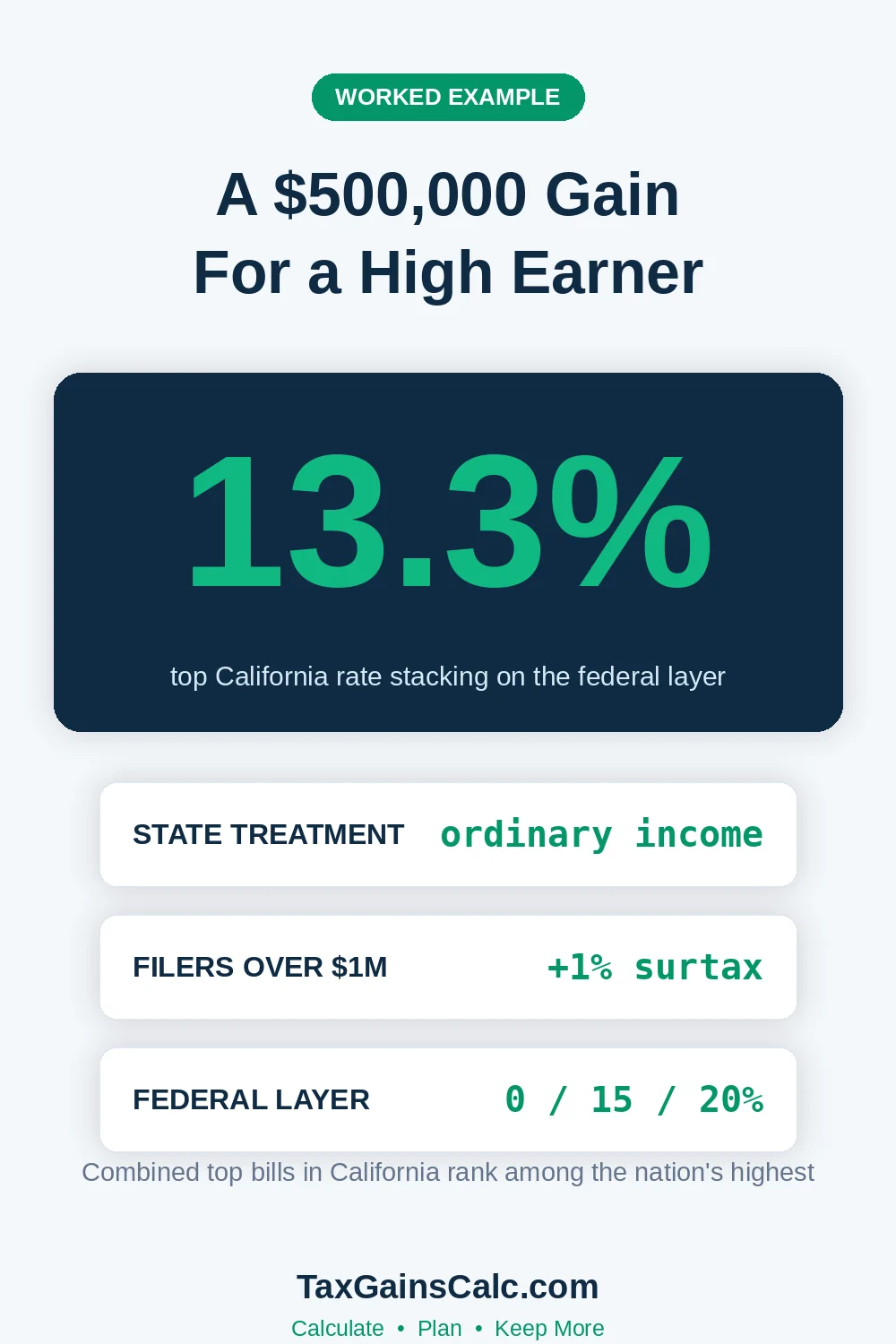 walk through the two most popular destination states. Both guides also include the domicile documentation checklists that movers need before and after the move.
The Reality of California Residency Audits
Departing residents get audited by the Franchise Tax Board with unusual persistence, whatever their income size. No other state agency works a move this hard. Examiners pull calendars, bank records, and sometimes even location data from social media accounts.
The audit can open years after the move itself, long after memories fade. Documentation assembled during the move year is what decides these cases. Contemporaneous records beat reconstructed stories every single time, with no exceptions.
- Keep a contemporaneous day-count log showing your physical locations honestly.
- Move your license, vehicles, voting, and professional relationships immediately.
- File the California part-year return correctly for the departure year.
- Sever business ties gradually and document each step of the transition.
Our avoidance strategies guide covers relocation discipline among other levers. Audits rarely succeed when taxpayers genuinely relocated and kept clean, complete files.
The failures almost always trace back to half-moves that kept California ties alive. A clean break, fully documented from day one, holds up under examination.
The Community Property Interaction at Death
California runs a community property regime for spouses, which changes the death tax picture. Each half of a community asset gets its step-up the moment the first spouse dies. That double reset is a California-specific advantage over separate property states.
The community property guide on this site dissects that entire double reset mechanism in detail. The federal benefit flows identically no matter what the California layer does afterward. The mechanics work the same for stocks, funds, and rental property.
 Survivors in California keep the state layer on future gains only above the reset. The reset erases both federal and state gain that accrued before death. Appreciation after the death date belongs to the survivor alone.
Our surviving spouse guide lays out the timeline and required paperwork. Estate-level planning can multiply these benefits for larger California portfolios. Careful trust design preserves a full step-up at each spouse's death.
Estimated Payments for Large California Gains
California expects quarterly estimates whenever withholding falls short of the year's liability. An April gain of any size needs its June estimated payment to dodge penalties. Both the IRS and the FTB expect money flowing in as income arrives.
The state's underpayment penalty rules run noticeably stricter than the federal versions right from the start. Budget for both sets of deadlines, not just April's. Our estimated payments guide covers both calendars together.
Wage withholding, including bonus withholding, counts as spread evenly through the entire year. Extra withholding on a year-end bonus can rescue a gain that landed earlier mid-year. The withheld amounts count toward the required payment totals on both returns.
That same withholding trick covers the federal side and the California side at once. Salaried investors should remember this before writing large January checks to the FTB. One payroll adjustment quietly fixes a shortfall that would otherwise trigger underpayment penalties.
The California Bracket Shape at a Glance
The California bracket ladder climbs steeply right through its lower income ranges. The differences between adjacent brackets narrow as income moves toward the million-dollar line. Most of the progressivity lands well before the top brackets even appear.
The table below summarizes that shape qualitatively, for planning purposes only. Treat these ranges as rough orientation, then plug your real numbers into a calculator. The Franchise Tax Board website carries the current-year figures every year.
| Income range (single, qualitative) | Marginal zone | Planning note |
|---|---|---|
| low five figures | low single digits | modest layer |
| middle six figures | 9 percent-plus territory | meaningful layer |
| approaching seven figures | 12.3 percent band | top regular bracket |
| above $1 million | 13.3 percent with surtax | mental health addition |
Gains pile on top of whatever bracket your other income already reached. There is no separate, friendlier tax schedule waiting for investment income here. A high earner's entire gain therefore lands near the very top marginal zone.
In a low-income year, gains fill the cheaper California brackets first. Retirees and sabbatical years create exactly these openings, which are worth modeling honestly. That stacking logic mirrors the federal bands, minus any preferential layer at all.
What Planning Levers Still Work in California
Charitable strategies shrink the federal and the state layer at the same time. Donating appreciated shares wipes out the gain and creates itemized deductions. No tax ever lands on the embedded gain, and the charity collects the full value.
Our DAF guide covers the bunching technique completely. California follows the federal lead on trusts and charitable structures when paperwork stays thorough. That conformity generally extends to donor advised funds and similar vehicles.
A 1031 exchange pushes real estate gains past both tax layers. Roll the proceeds into another property and the deferral continues indefinitely, exchange after exchange. California conforms to the federal like-kind rules for real property exchanges.
Qualified Opportunity Zones defer the federal gain but carry California conformity complications. Those complications warrant a tax pro's review before you lean on that deferral. California does not fully conform, so some of the state gain can remain taxable.
Relocation is still the one lever that removes the California layer entirely. Nothing else in the whole planning toolkit touches the state rate that completely. Truly moving your domicile wipes out the entire 13.3 percent on every future gain.
Half-measures invite the audits described above while delivering little real savings. The FTB notices patterns of pretending to leave while still living here. Decide fully and document everything, or stay and plan around the layer across the whole holding period.
One behavioral note belongs at the end of the state tax discussion. Selling decisions made purely on state tax grounds often backfire elsewhere. Selling a business or home to escape one year's tax creates new costs.
 Transaction fees, moving costs, and market timing risks eat thin savings quickly. Run the complete after-everything comparison before acting on any state-driven plan at all.
A California Gains Filing Checklist
Work through these checks before you file any return with realized gains. Each item below prevents a common California filing mistake or a missed adjustment in the sale year. Ten minutes spent here beats months of correspondence with the state later.
- Confirm every gain carries ordinary character on the California schedule.
- Verify the mental health surtax applies only above the million-dollar line.
- Check the part-year split documentation when a move happened mid-year.
- Reconcile estimated payments against the final liability for every quarter.
- Keep federal and state basis records aligned for every disposed lot.
The Franchise Tax Board website publishes current brackets and surtax details. For federal rates and brackets, the IRS Topic 409 reference goes into real depth.
California investors who model both layers up front set realistic after-tax expectations from the start. That discipline beats surprises, which never belong inside five-figure tax bills anyway. Those expectations produce smarter selling choices than any one lever could.

Wasim Akram
Wasim researches and writes every article on TaxGainsCalc, covering capital gains tax for everyday investors. Every figure is checked against primary IRS sources before it goes live.