
New Jersey Capital Gains Tax: Rates and the Exit Tax Myth
New Jersey taxes gains as ordinary income up to 10.75%, bans loss carryforwards, and has no exit tax. Brackets, home sales, and the residency audit reality.

New Jersey Taxes Gains as Ordinary Income
New Jersey runs capital gains through its ordinary rate ladder, from 1.4 to 10.75 percent, with no long-term preference anywhere in the state code. Moving out of New Jersey does not erase tax on gains accrued while you lived there, though part-year allocation narrows the reach. The federal layer beneath New Jersey's rates is explained in Topic 409.
In New Jersey, every capital gain gets taxed just like your regular paycheck. No preferential long-term rate exists anywhere in the state tax code.
Holding investments longer earns federal benefits but delivers zero state savings. The rate you pay depends only on your income that year.
The state applies its progressive bracket schedule to gains stacked on other income.
Rates run from 1.4 percent at the bottom up to 10.75 percent at the top. Most investors selling mid-sized portfolios land in the 5.525 or 6.37 percent bands.
The New Jersey Division of Taxation publishes the official rates referenced throughout this guide.
This guide covers the brackets, the famous exit tax myth, home sales, and estimated payments. It also explains the capital loss carryover trap unique to New Jersey.
Every section gives investors the practical numbers they need before committing to any sale.
New Jersey's system rewards no particular holding behavior at the state level. A gain realized after one week faces the same rate as one after ten years.
Every timing benefit you chase lives on the federal return, not the state one.
How the New Jersey Brackets Work
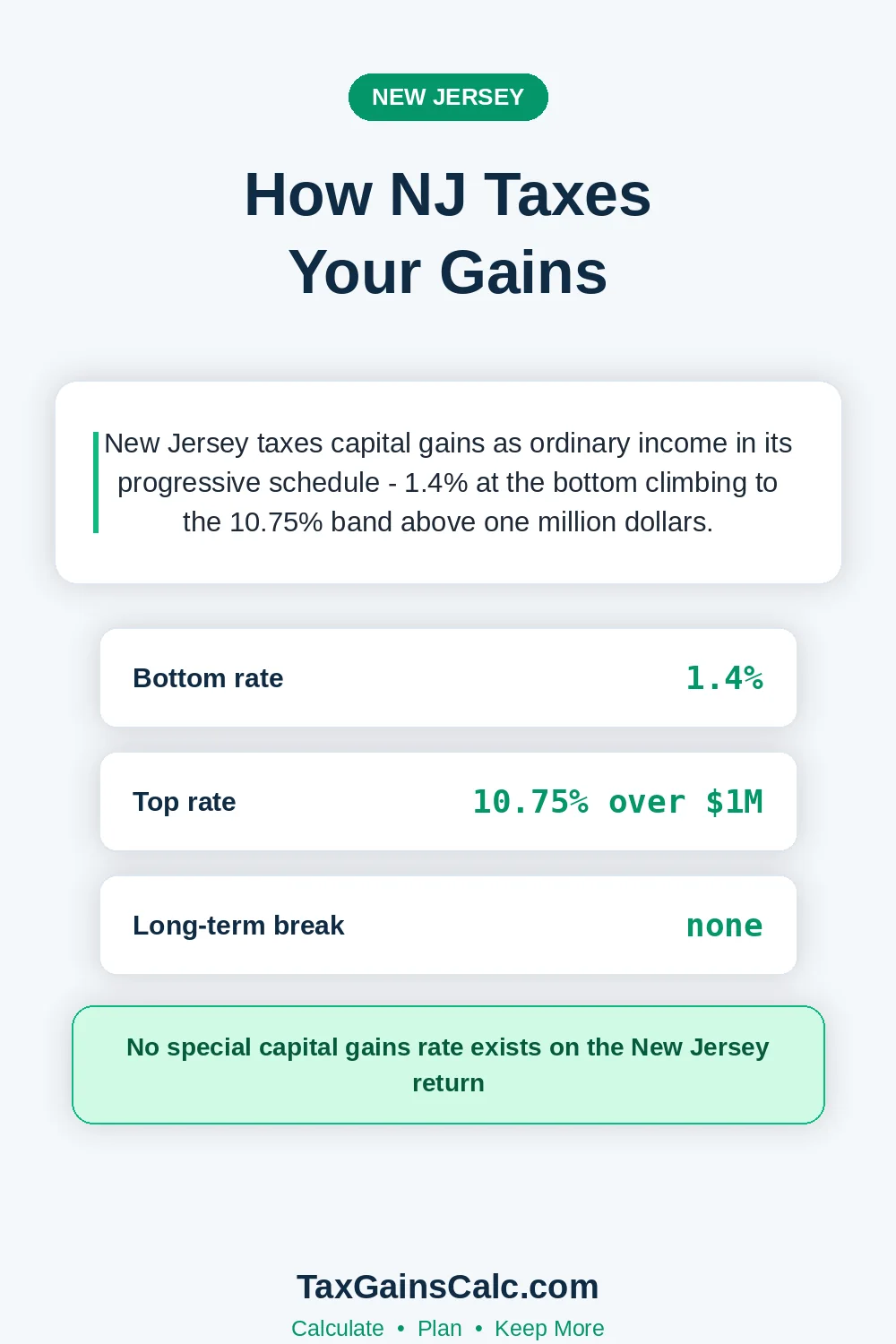 New Jersey's progressive schedule contains more bands than most states maintain. The full single-filer structure appears in the table below for planning.
Married joint filers see doubled widths through most of the schedule.
| New Jersey Taxable Income (Single) | Marginal Rate |
|---|---|
| Up to $20,000 | 1.4% |
| $20,001 to $35,000 | 1.75% |
| $35,001 to $40,000 | 3.5% |
| $40,001 to $75,000 | 5.525% |
| $75,001 to $500,000 | 6.37% |
| $500,001 to $1,000,000 | 8.97% |
| Above $1,000,000 | 10.75% |
The millionaire's tax band above one million dollars applies to all filers equally. A single large business sale can push a lifelong middle-class taxpayer straight into that band.
Spreading large business sales across several years often avoids the 10.75 percent top marginal band entirely.
Standard deductions simply do not exist anywhere in New Jersey's income tax system. The state uses personal exemptions and a property tax deduction in their place.
Renters and homeowners both qualify for property tax relief through separate state mechanisms. Both routes put real money back for qualifying households.
The property tax deduction reaches $15,000 for homeowners who claim state itemized deductions on their return. This quirk makes New Jersey's deduction rules look nothing like the federal versions.
Good software handles the split automatically once your property tax entries are complete and correct. Missing entries throw off the state calculation quietly.
The myth persists because moving costs genuinely stack up in unusual ways. Real estate commissions, transfer fees, and final returns all arrive together at once.
Voters repeating exit tax stories usually encountered that combined bill somewhere.
The Exit Tax Myth Explained
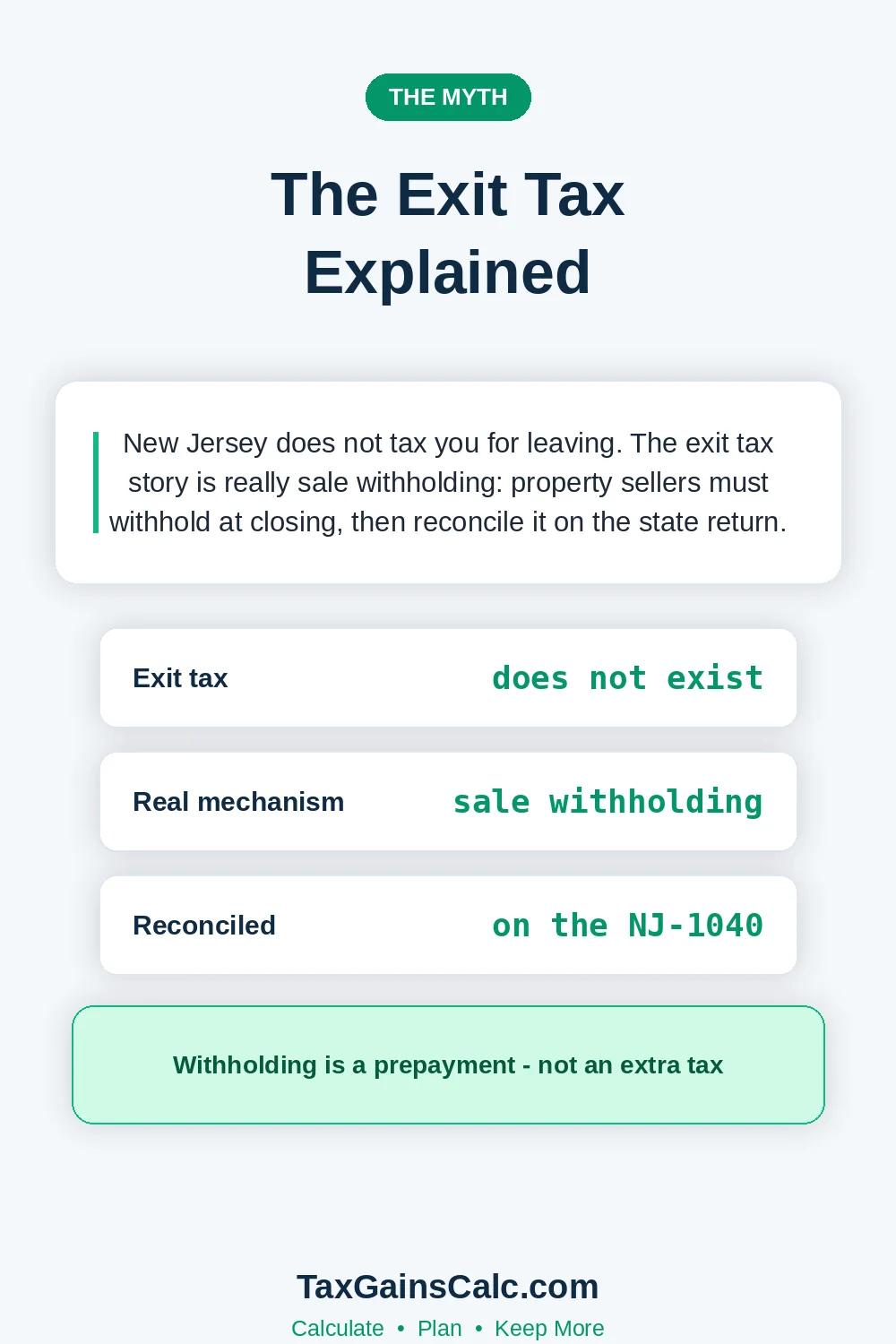 Searches for New Jersey exit tax appear constantly in relocation discussions online. No actual exit tax exists in New Jersey law despite the persistent legend.
The myth likely grew from real costs that feel like an exit tax.
Three genuine costs get bundled into the myth by departing residents. Selling a home triggers final return obligations plus a possible residency audit of the move.
Unrealized gains built over decades face full state tax when they are finally realized in-state.
| Myth Component | Reality | Planning Note |
|---|---|---|
| Exit tax on leaving | Does not exist | No tax on moving itself |
| Final return requirement | Part-year return due | Report only NJ-source income |
| Residency audits | Real and documented | Keep strong day-count records |
| Home sale tax | Federal exclusion still applies | NJ follows the same exclusion |
The residency audit concern deserves respect rather than panic from anyone leaving mid-year. New Jersey audits people claiming exits whenever large income events follow the move too quickly.
Solid documentation of the exact move date defeats those audits quite routinely in practice. Day counts and home records carry the most weight.
Genuine leavers who sell investments once the new domicile is established escape New Jersey tax completely. Florida, Texas, and Tennessee residents pay nothing at all on later New Jersey stock sales. Our no-tax state guide maps out each of those destinations in detail.
Married sellers should confirm that each spouse satisfies the use test on their own. The exclusion requires each person to satisfy the two-year residency requirement. Divorce brings separate eligibility rules that can extend the exclusion in specific cases.
Home Sales and the Exclusion
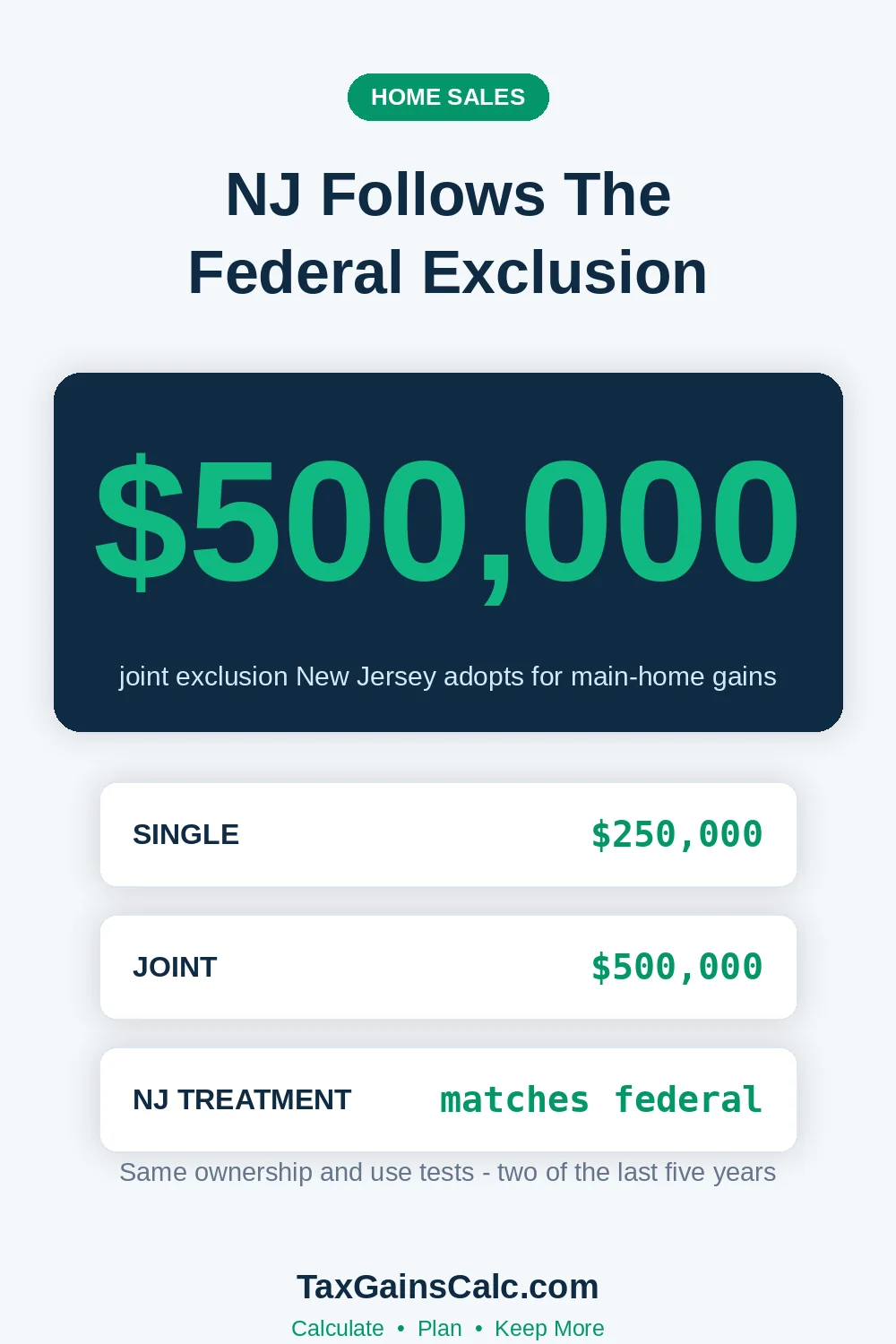 New Jersey follows the federal Section 121 exclusion for principal residences. Single sellers exclude $250,000 of gain, and couples filing jointly exclude $500,000.
New Jersey adopts those two-of-five-years ownership and use tests exactly the way the IRS writes them. The same paperwork supports both the federal and state claims.
Sellers with gains above the exclusion face state tax at their ordinary bracket rate. No preferential treatment softens the home sale gain anywhere in New Jersey's tax law.
The marginal rate depends on where the gain lands that year. Our home sale guide covers the exclusion mechanics.
Nonresident sellers of New Jersey real property face estimated payment requirements at closing. Buyers must withhold a portion of the price from nonresident sellers in most standard closing situations.
The buyer remits that money directly to the state. The withholding gets credited against the final nonresident return afterward within the following tax year.
Keep every improvement receipt and closing document from the original home purchase onward. Those basis adjustments shrink the taxable gain on the federal return and the state return alike.
Receipts for a finished basement or new roof genuinely matter later. The documents checklist spells out every record worth keeping.
Loss harvesting calendars should show separate federal and New Jersey optimization dates. The optimal state timing lands losses against years with actual gains. Federal-only thinking quietly wastes real money in New Jersey every year.
The Capital Loss Carryover Trap
 New Jersey deviates from the federal rules in one costly direction for loss harvesting. The state allows capital losses to offset gains plus $3,000 of ordinary income yearly. Unused losses beyond that point simply expire every single year with no carryforward allowed.
Federal carryforwards persist indefinitely, while New Jersey losses die off completely every single December 31. Harvesting losses in a low-gain New Jersey year therefore wastes the deduction permanently here.
Taxpayers juggling both federal and state considerations should carefully time their losses against actual gains. Plan the state layer first, then the federal side.
| Rule | Federal | New Jersey |
|---|---|---|
| Loss offsets gains | Yes | Yes |
| Offset against ordinary income | Up to $3,000 | Up to $3,000 |
| Carryforward unused losses | Indefinite | Not allowed at all |
| Carryback options | None currently | None |
This asymmetry makes multi-year loss planning genuinely different in New Jersey. Save loss harvesting for years when gains actually exist at the state level. The carryover guide walks through the federal rules that still apply.
Brokerages never withhold New Jersey tax on securities sales for residents. The withholding asymmetry makes state estimated payments essential after large sales. Setting calendar reminders immediately after any sale prevents most penalties.
Estimated Payments and Withholding
New Jersey collects quarterly estimated payments through its NJ-1040-ES voucher system. Four payments a year keep the state from charging interest later.
A big sale with no withholding can trigger state underpayment penalties right beside the federal ones. The quarterly dates follow the familiar April, June, September, and January calendar.
Employer withholding can absorb the gain-driven tax liability when it is raised deliberately. Employees expecting a large sale should file an updated state withholding certificate beforehand. Unlike the federal rules, New Jersey treats withholding as if it were paid evenly through the year.
The state safe harbor generally requires 80 percent of the current year liability. That threshold differs from the familiar 90 percent federal standard. High earners should verify the current percentage before relying on prior-year figures.
Payments go online through the state's official portal within minutes each quarter. Confirmation numbers deserve saving alongside the complete brokerage record set. For the federal side of paying, our payment guide lays out the options.
Nonresident landlords selling New Jersey rentals face the same withholding requirements. Estimated payments at closing protect against penalties during the gap year. The final nonresident return reconciles everything within a few months.
Nonresidents and Part-Year Residents
New Jersey taxes nonresidents on gains from New Jersey real property and business sources. Stock sales after moving out carry no New Jersey tax whatsoever afterward. That key distinction between real property and portfolio assets matters enormously for planning here.
Part-year residents allocate income between resident and nonresident periods carefully. Whatever gains accrued during your resident period stay fully taxable to New Jersey, without proration. Later gains on the same portfolio escape the state entirely after the move.
The state determines residency through your domicile plus the statutory residence test combined. Days in state, home ownership, and business ties all factor heavily into audits. Moving records deserve exactly the same care as the underlying investments themselves.
Sellers planning a two-state year should sequence the biggest gains deliberately. Realizing gains after the domicile change date can eliminate thousands legally. Professional guidance pays for itself in complex multi-state sale years.
Modeling both layers together changes some conclusions that federal-only analysis misses. A strategy that defers federal tax sometimes accelerates state tax instead. Two-layer thinking separates adequate planners from genuinely good ones.
Combining Federal and State Planning
Federal long-term rates reward holding periods that New Jersey completely ignores. Optimal plans satisfy both systems instead of optimizing only one layer. A patient holder saves 15 percent federally while paying the same state rate.
Charitable strategies work well against both layers simultaneously in high-tax states. Donating appreciated securities avoids the gain at federal and state levels together. Our charitable stock guide walks the mechanics.
Retirement account contributions reduce both tax layers with the same dollar. New Jersey follows federal treatment for 401(k) contributions made through employers made through employer plans. The retirement accounts guide details which account types dodge gains tax.
Opportunity zone investments defer federal gains but not New Jersey gains automatically. State conformity with federal deferral programs varies and deserves verification. Our QOZ guide explains the federal program.
Maria's wage income already filled the lower state brackets before her sale. Only the top slice of her gain touches the 6.37 percent band. Lower-income sellers would see even smaller state bills on identical gains.
A Worked Example With a State Sale
Consider Maria, a New Jersey single filer earning $120,000 in wages this year. Next, she sells a stock position held for five straight years and books a $50,000 long-term gain. Her state calculation shows how the brackets apply in practice.
Her New Jersey taxable income reaches roughly $165,000 once exemptions are applied. Her gain fills the 6.37 percent band for most of its overall width.
State tax on that gain lands near $3,200 after normal rounding of the figures. All of the gain stays below the 8.97 percent band threshold.
That same gain carries roughly $7,500 of federal tax, priced at the 15 percent tier. Combined federal and state tax reaches roughly $10,700 on this single sale for her.
The federal long-term benefit already saved her thousands versus what short-term treatment would cost. Holding five years did real work on the federal side.
Had Maria moved down to Florida before the sale, state tax disappears entirely. Moving first and selling only after the domicile switch keeps the entire $3,200 in her pocket.
Our Florida guide maps that destination's full tax picture in detail. That same Florida guide spells out every rule a former resident needs.
Every situation differs, so model your own numbers before deciding anything. While you weigh the move, let our capital gains calculator rerun every figure. Pair its output with the bracket table above for complete planning.

Wasim Akram
Wasim researches and writes every article on TaxGainsCalc, covering capital gains tax for everyday investors. Every figure is checked against primary IRS sources before it goes live.