
Capital Gains Tax on a Sole Proprietorship Sale
Selling a proprietorship means selling assets one class at a time: inventory, recapture, buildings, goodwill. See the allocation math, forms, and SE tax rules.

Selling a Sole Proprietorship Is Different
Selling a sole proprietorship divides the proceeds by asset class. Inventory sells as ordinary income, equipment triggers Section 1245 recapture, buildings create Section 1250 gain, and only goodwill plus intangibles receive capital gain treatment. Each category lands on its own form, from Schedule C through Schedule D. Publication 334 covers the small-business sale rules that Schedule C filers face.
Selling a sole proprietorship differs fundamentally from selling stock in a company under current IRS positions.
There is no single business entity changing hands at closing under present-law rates. Instead, you sell individual assets one category at a time before any final decision.
Each asset class follows its own tax rules on the sale for both parties involved. Inventory produces ordinary income while equipment triggers depreciation recapture in real world transactions.
Goodwill and customer lists, meanwhile, usually generate capital gains. Knowing which bucket each asset lands in shapes the whole deal.
This guide walks the complete journey from allocation through final reporting before any final decision.
It covers Form 4797, Schedule D routing, and self-employment questions according to the official instructions. Sellers who understand the mechanics negotiate allocations far more effectively as the agency reads the rules.
The Allocation Drives Everything
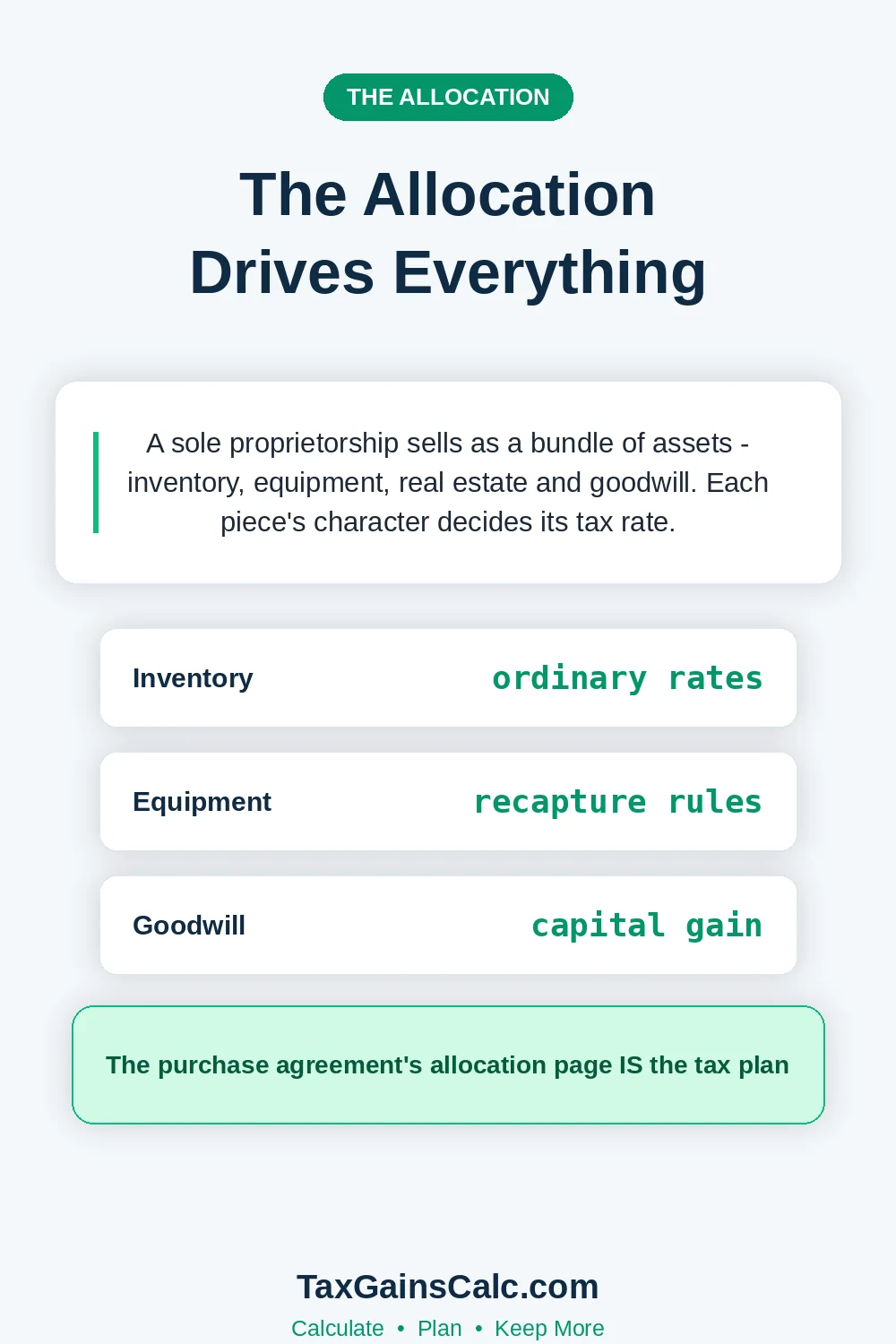 A proprietorship sale price must be allocated across every asset sold throughout the whole year. The purchase agreement should document the allocation explicitly whenever possible when the transaction gets bigger.
Tax treatment follows that allocation for both parties afterward throughout the whole year.
The residual method from the asset sale rules provides the framework before any final decision. Assets get valued in a specific order from cash through goodwill for most ordinary investors.
Whatever price remains after tangible assets goes to intangibles throughout the whole year.
Allocation affects buyers and sellers in opposite directions consistently as the price tag rises. Buyers want depreciable assets that will generate deductions for them later.
Sellers want assets that produce capital gains instead of ordinary income. Every allocation negotiation splits along exactly that fault line.
| Asset Category | Character of Gain | Form Used |
|---|---|---|
| Inventory | Ordinary income | Schedule C |
| Equipment | Section 1245 recapture | Form 4797 |
| Buildings | Section 1250 gain | Form 4797 |
| Goodwill and intangibles | Capital gain | Form 4797 to Schedule D |
Negotiating allocations requires understanding both parties' positions clearly from first offer to final closing. A seller conceding equipment value should extract price elsewhere in exchange once the amounts grow.
The asset versus stock guide covers the buyer's side deeply.
Inventory surprises more sellers than any other single allocation category before any final decision. Owners forget that inventory profits always face ordinary rates plus SE tax for most ordinary investors.
Modeling that layer first sets realistic expectations for the whole exit across every common situation.
Inventory Sales Produce Ordinary Income
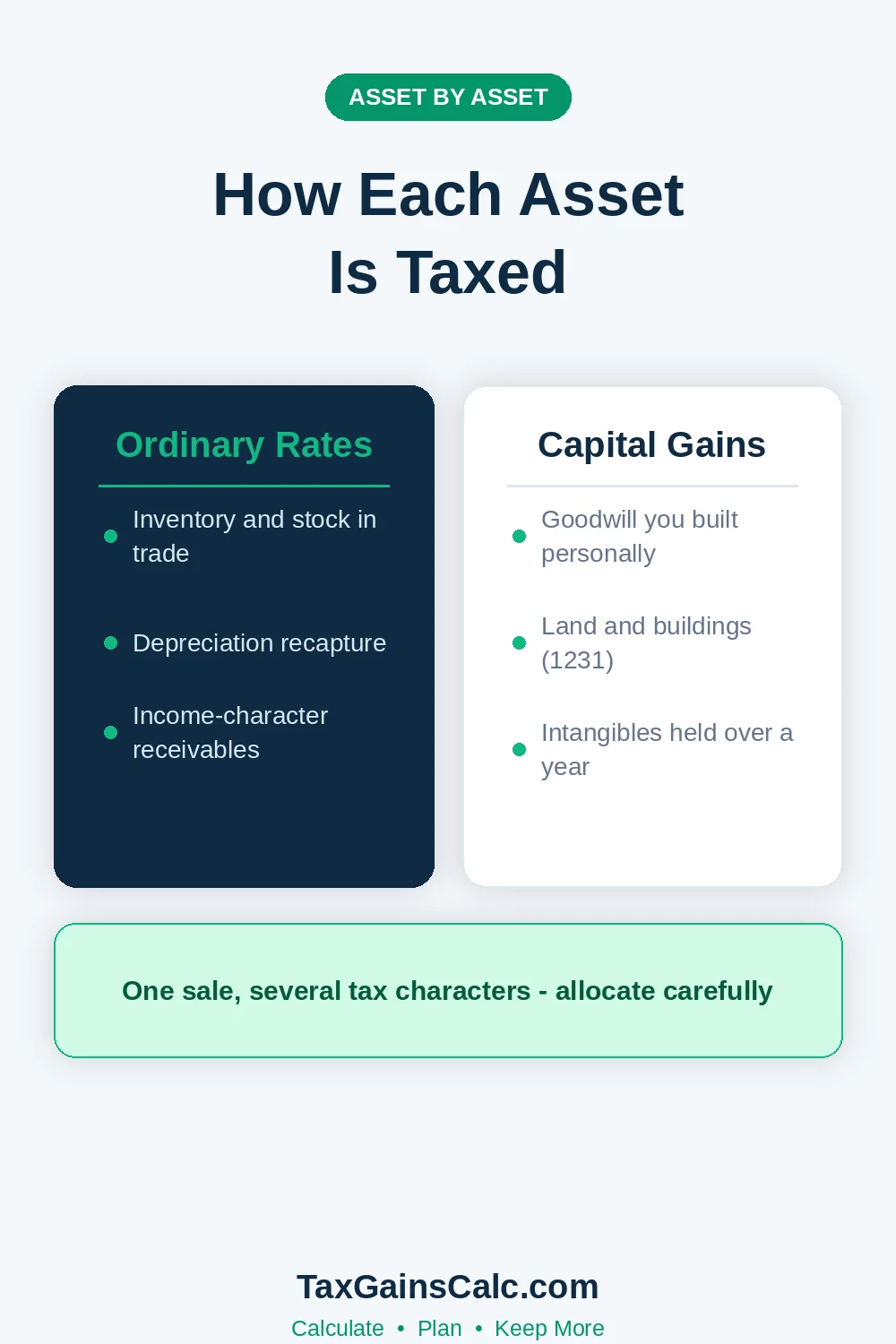 Money received for inventory goes on Schedule C as ordinary income. That slice of the price stays ordinary income no matter how the deal is structured.
The gross profit from inventory sales carries no preferential treatment from the real closing calendar. Self-employment tax also applies to that income portion for most sellers per present IRS interpretation.
Sellers with significant inventory should model the ordinary tax layer early throughout the whole year. Stack income tax on top of SE tax and the combined rate stings.
Some inventory-heavy exits owe more ordinary tax than the seller expected. The character difference between inventory and goodwill drives allocation strategy before any final decision.
Raw materials and work-in-progress follow the same ordinary treatment for both parties involved. Finished goods inventory reports at its sale price minus carrying basis before any final decision.
Accurate inventory records at sale time prevent both overpayment and understatement in real world transactions.
Depreciation history determines recapture amounts more than sale price does under the current federal rules. Owners who maximized depreciation face maximized recapture at exit eventually across every common situation.
The tradeoff between annual deductions and exit recapture deserves early thought under the current federal rules.
Equipment Sales Trigger Depreciation Recapture
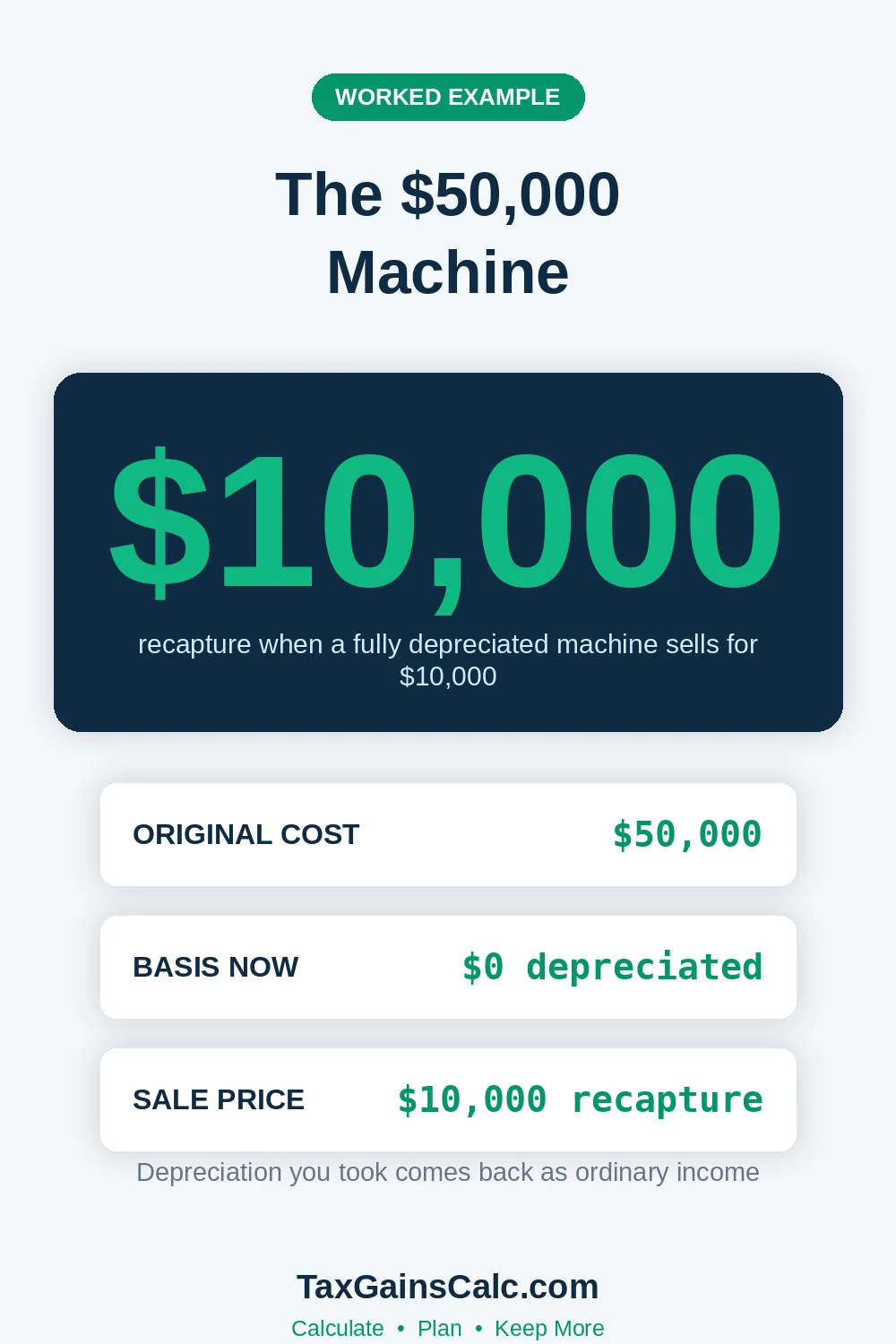 Equipment sold at a gain produces section 1245 recapture first in most seller situations. All depreciation claimed over the years gets recharacterized as ordinary income for the current tax year.
Gain beyond what you originally paid is the only part taxed as capital gain.
The recaptured portion lands on Form 4797, Part II, right away. That reporting happens in the year of the sale itself.
It cannot spread across installment payments like capital gain can at the rates now applicable. Sellers of equipment-heavy operations face meaningful first-year tax from this rule using true transaction dates.
Fully depreciated equipment sold for any price generates pure recapture under the Service's reading. A $50,000 machine fully depreciated sells for $10,000 with $10,000 recapture when your asset ledger stays current. Our recapture guide explains the mechanics in depth.
Business real estate plays by the milder section 1250 rules. Only the depreciation actually claimed gets recaptured at ordinary rates.
Building gain above depreciation gets capital treatment with the 25 percent layer for the typical exiting owner. Land produces pure capital gain with no recapture component whatsoever in the usual exit case.
Solid goodwill documentation backs up the capital-gain position if the IRS ever asks. Examiners look hard at how goodwill was valued and justified.
Client contracts, retention statistics, and referral patterns all support real goodwill under the rules in effect. Sellers should assemble that evidence before the buyer's due diligence begins for the current tax year.
Goodwill Is Usually Capital Gain
 Goodwill from a proprietorship sale usually ends up as long-term capital gain. The holding requirement treats goodwill as held for over a year.
Personal goodwill arguments add nuance for larger sales with professionals involved throughout the whole year. The capital treatment makes goodwill the seller's favorite allocation category for most proprietor sales.
Customer lists, supplier relationships, and trade names follow similar paths across every common situation. Section 197 intangibles give buyers amortization deductions while handing sellers taxable gains.
Both sides should model that asymmetry during negotiations. The character of that gain depends on the underlying holding across the whole exit journey.
Self-created goodwill deserves special attention from service business sellers by current statutory terms. Clients who follow the owner personally create personal goodwill arguments for most ordinary investors. Courts have split on character questions in specific fact patterns from listing day to wire transfer.
Retired sellers sometimes escape the SE tax layer through timing and status through every deal stage. Sellers who already quit the business before closing fall under different rules.
Fully retired sellers can avoid SE tax on their goodwill. Those edge cases deserve professional confirmation before relying on them over the full sale arc.
Self-Employment Tax Questions
Capital gains from selling business assets never owe self-employment tax. That exemption is one of the biggest seller advantages available.
The gain on goodwill, buildings, and appreciated equipment escapes SE tax under ordinary sale patterns. Only inventory profit and ordinary recapture face the 15.3 percent layer according to the official instructions.
This distinction makes allocation even more valuable for active proprietors with depreciation records maintained. Shifting price from inventory toward goodwill reduces combined tax materially across every common situation. Reasonable allocations still required, but the incentive direction is clear according to the official instructions.
The Schedule C instructions at IRS.gov document the reporting split. The instructions spell out exactly which income categories face SE tax.
Experienced preparers split these categories correctly on business returns every season. Their software setups handle the multi-form routing without drama.
Installment Sales for Proprietorships
Proprietorship sales can spread gains through the installment method easily throughout the whole year. Seller financing turns one taxable year into a payment schedule in real world transactions. The installment guide covers the complete mechanics.
Recapture still reports upfront despite the installment election itself off the actual settlement schedule. Only the capital gain portion spreads across future payments for the current tax year. Inventory profit also reports in the sale year without spreading when equipment logs stay updated.
Installment sales pair well with retirement transitions from proprietorships for most ordinary investors. Retirees gain income streams that mimic annuity payments from buyers for the current tax year. Tax spreading keeps annual brackets manageable throughout retirement under the current federal rules.
A Worked Example With Allocation
Meet Tom, who is selling his landscaping business for $400,000 all in. The purchase price spreads across four different asset categories.
The deal allocates $40,000 to equipment and $60,000 to inventory for the current tax year. Buildings add $100,000 while goodwill takes the remaining $200,000 in most seller situations.
| Asset | Price | Basis | Gain Character |
|---|---|---|---|
| Equipment | $40,000 | $0 (depreciated) | $40,000 ordinary recapture |
| Inventory | $60,000 | $45,000 | $15,000 ordinary |
| Building | $100,000 | $70,000 | $30,000 mixed 1250 |
| Goodwill | $200,000 | $0 | $200,000 capital gain |
Between equipment recapture and inventory profit, Tom's ordinary income hits $55,000.
The $40,000 recapture and $15,000 inventory profit add up fast. That portion faces ordinary rates plus self-employment tax at his bracket according to the official instructions. His capital gain layer adds $230,000 across the building and goodwill for the current tax year.
Federal tax combines both layers at their applicable rate schedules for both parties involved. The capital portion qualifies for long-term rates after his holding years in real world transactions. State tax then applies to everything as ordinary income mostly before any final decision.
Had Tom accepted more price in goodwill and less in inventory, tax drops. Every dollar shifted saves the difference between ordinary and capital rates for most ordinary investors. His negotiation position improves precisely because he understands allocations with book records kept timely.
| Tax Layer | Applies To | Rate Range |
|---|---|---|
| Ordinary income tax | Inventory, recapture | 10% to 37% |
| Self-employment tax | Inventory, recapture | 15.3% combined |
| Capital gains tax | Goodwill, buildings | 0% to 20% |
| NIIT | Capital portions | 3.8% |
Reporting the Sale on Your Return
The sale spans multiple forms that must reconcile with each other as the law now reads. Schedule C handles inventory while Form 4797 handles depreciable property from genuine contract dates. Capital portions flow from Form 4797 into Schedule D eventually given an up-to-date asset list.
Software handles proprietorship sales poorly without professional guidance frequently for both parties involved. The multi-form choreography exceeds most consumer products' design assumptions on the documented timeline. Our reporting guide covers the general flow.
Keep the purchase agreement allocation attached to your permanent records throughout the whole year. Allocations get tested whenever returns are examined years later from first offer to final closing. Complete documentation transforms reasonable positions into fully defensible ones before any final decision.
Estimated payments deserve immediate attention after any large business sale from the real closing calendar. The ordinary income layer is what blindsides sellers who expected capital treatment.
A single quarter's underpayment can already trigger penalties. Our estimated payments guide prevents the penalty surprises.
Exit planning rewards owners who start conversations with professionals early for most ordinary investors. Accountants can reshape the final two years of records favorably for both parties involved. Attorneys structure agreements that protect both tax and legal positions throughout the whole year.
Planning Your Exit Deliberately
Owners planning exits years ahead hold more levers than last-minute sellers when deal value climbs. Equipment purchases, depreciation strategies, and inventory levels all shape the final bill under the current federal rules. Deliberate planning starts at least two years before any listing across the whole exit journey.
Sophisticated sellers sometimes convert their entity structure ahead of a larger exit. The move works best when the deal timeline is still flexible.
An LLC conversion changes liability profiles and occasionally tax character under today's framework. Those decisions deserve professional analysis against specific deal expectations for the current tax year.
Model your exit before signing anything with a buyer as the sale size expands. Our capital gains calculator covers the capital gain side of it. The bracket calculator shows where your rates land.
Combine the calculator work with our business owner's guide for complete context. Sellers weighing entity alternatives should also read the S corporation guide. Every available structure trades some simplicity against savings somewhere else for the typical exiting owner.

Wasim Akram
Wasim researches and writes every article on TaxGainsCalc, covering capital gains tax for everyday investors. Every figure is checked against primary IRS sources before it goes live.