
Illinois Capital Gains Tax: The Flat Rate Explained
Illinois taxes all gains at a flat 4.95% with no brackets, exempts retirement income entirely, and follows federal loss rules. Full worked example inside.

Quick Answer: Illinois taxes every capital gain at a flat 4.95 percent with no long-term preference and no city income tax in Chicago. A $60,000 long-term gain costs about $2,970 at the state level, and retirement account gains escape state tax entirely.
Illinois Flat Rate Basics
Illinois taxes capital gains at a flat 4.95 percent with no preferential long-term rate, and Chicago residents add nothing because no city income tax exists.
Estimate Your Exact Capital Gains Tax
Federal tables provide national averages. Your actual tax depends on your holding period, income band, and state.
Federal long-term rates of 0, 15, and 20 percent still apply first, plus the 3.8 percent NIIT above federal MAGI thresholds.
Topic 409 details the federal layer that applies before the flat state rate.
Illinois stands out among states with a genuinely flat income tax structure as the state revenue department directs. Every dollar of taxable income faces the same 4.95 percent rate for most ordinary investors.
Capital gains receive no special treatment beyond that simple flat application across every common situation.
The flat rate simplifies planning because rates never change with income size whenever the numbers are large.
A school nurse and a hedge fund manager owe the exact same marginal state tax rate here. Federal planning still involves brackets, but the state layer stays constant when your basis records hold up.
This guide covers the rate structure, exemptions, loss rules, and retirement income quirks. It closes with a worked example and notes on all the neighboring states.
Illinois investors can model every scenario after reading through once at every income level.
How the Flat Rate Applies to Gains
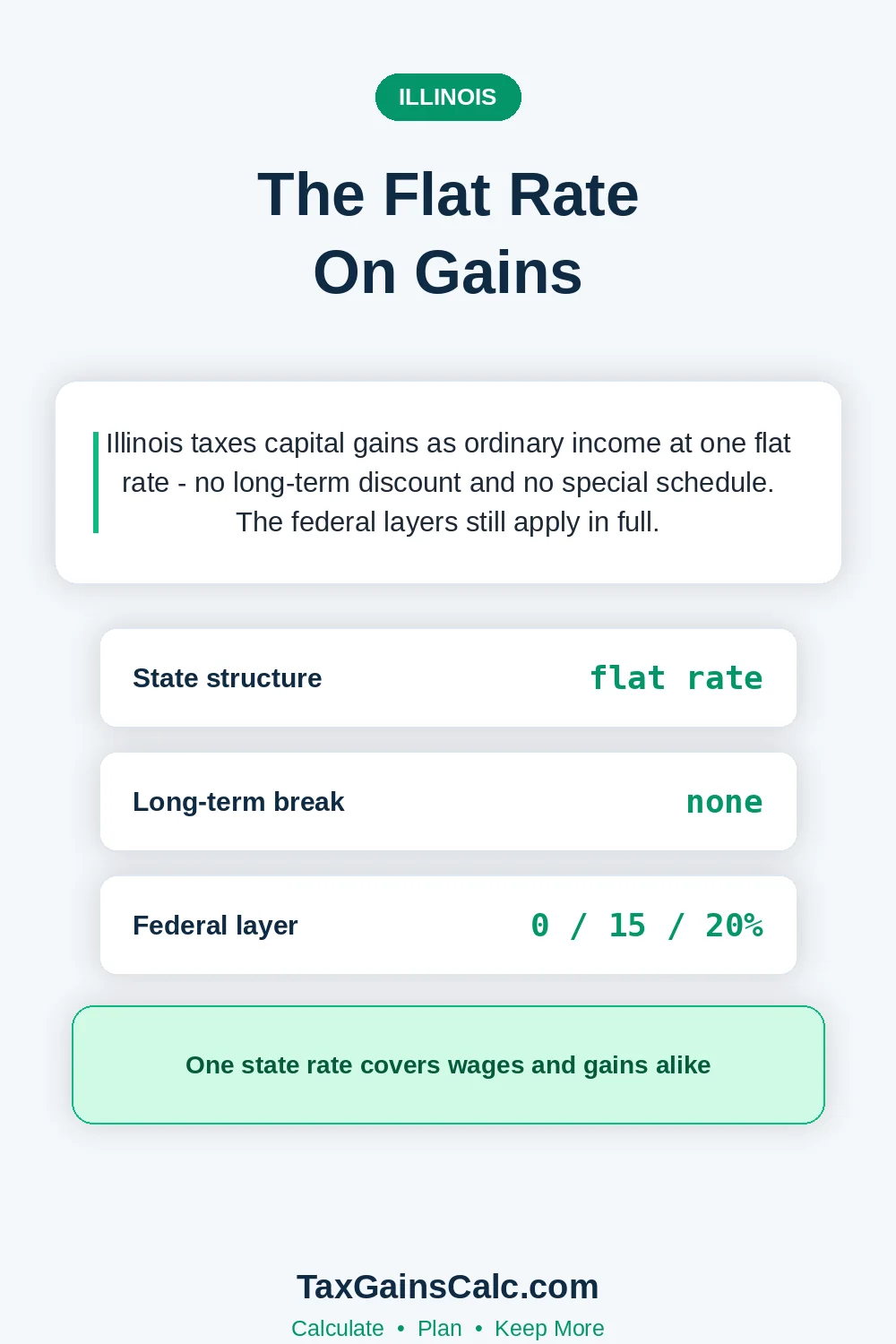 Illinois taxes capital gains exactly like wages at the flat 4.95 percent rate. No preferential long-term schedule exists anywhere in the state code whenever the numbers are large.
Holding periods reward federal tax outcomes but change nothing in Illinois across every common situation.
The state starts from federal adjusted gross income with specific modifications whenever the numbers are large. Illinois adds back certain deductions and subtracts certain income types in real world transactions.
The resulting base faces the single flat rate without brackets before any final decision.
The Illinois Department of Revenue publishes the current rate and modifications. Any rate change requires fresh legislative action, so the number moves only rarely.
The flat structure has survived every recent political cycle across every common situation.
| Tax Layer | Rate on Gains | Notes |
|---|---|---|
| Illinois income tax | 4.95% flat | All income types |
| Federal long-term | 0% / 15% / 20% | Holding period driven |
| Net investment income tax | 3.8% | Kicks in past federal MAGI thresholds |
| Chicago residents | No city income tax | No municipal layer exists |
The exemption math matters most for middle-income households planning gains per Springfield's published method. Families claiming multiple exemptions keep more of every dollar earned across every common situation.
High earners planning large sales should model the phaseout deliberately for both parties involved.
Exemptions That Soften the Rate
 Illinois grants a personal exemption instead of a standard deduction across every common situation. The exemption amount picks up an automatic inflation adjustment every single year without prompting.
Households claim exemptions for every qualified dependent as well in real world transactions.
The personal exemption phases out at higher income levels predictably under the latest IRS guidance. High earners lose the exemption entirely above the phaseout thresholds in most filing situations.
Our thresholds guide post covers the federal side of planning for both parties involved.
Property tax credits soften the effective rate for Illinois homeowners under the flat-rate statute.
The credit returns five percent of the state property taxes you paid on your primary home.
Renters receive a smaller standard credit instead of the property credit across all earnings bands.
K through 12 education expenses generate additional credits for families in real world transactions. The education credit reaches a percentage of qualified school expenses for the current tax year. Families planning gains and tuition should model both together by the state's own formula.
Illinois harvesters enjoy simpler planning than residents of carryover-restricted states across every common situation. Losses persist across years until gains or offsets consume them for most ordinary investors. Patience with loss timing rarely costs anything in this state under the current federal rules.
Capital Losses on Illinois Returns
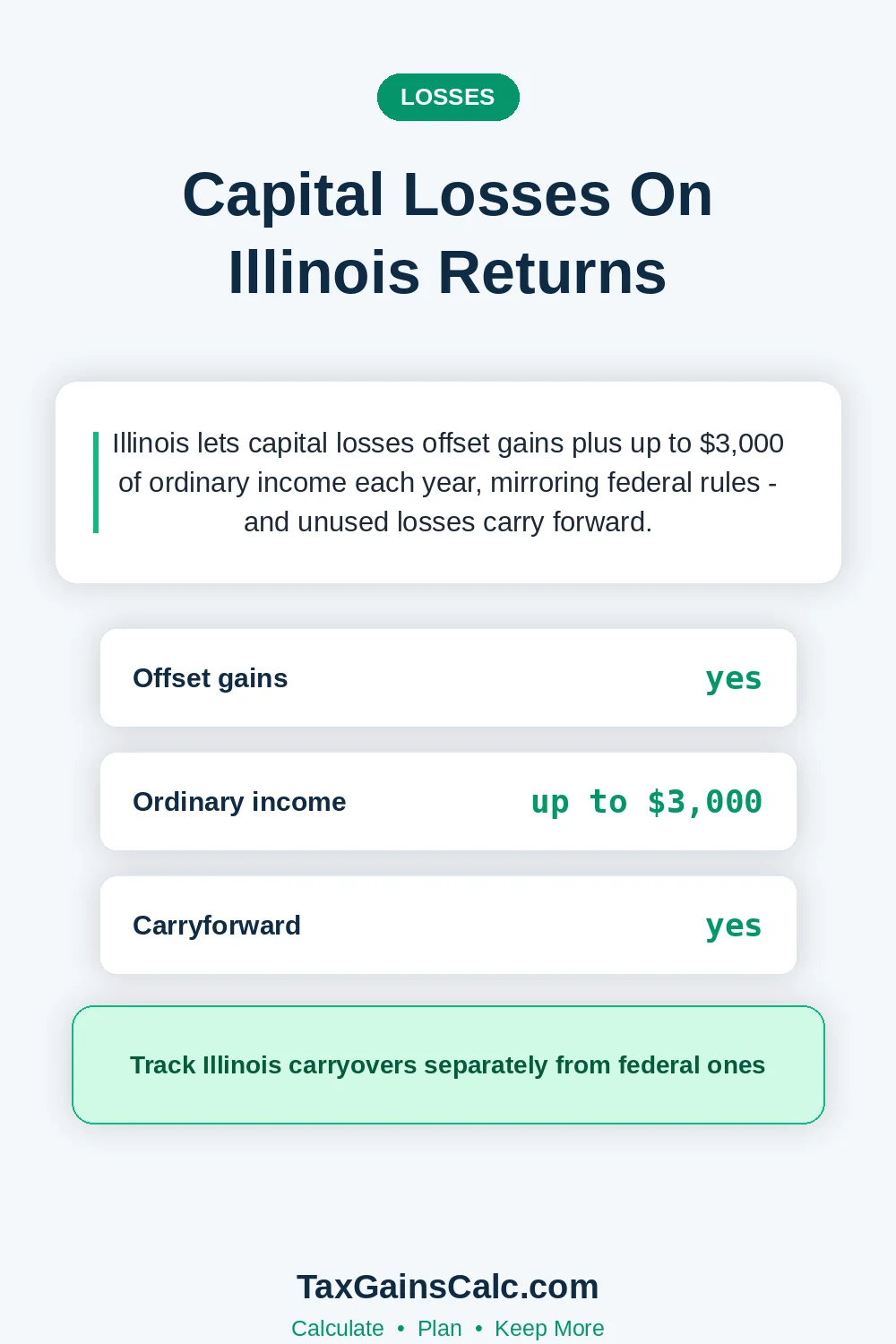 Illinois follows the federal capital loss rules with one important modification whenever the numbers are large.
Every year, Illinois also lets you offset ordinary income on the state return, capped at $3,000 of net capital losses.
Loss carryforwards continue across years until fully used eventually for most ordinary investors.
The federal netting order flows through to the Illinois computation throughout the whole year. Short-term and long-term pieces each net within their own groups before the two meet. Our carryover guide maps out the complete ordering rules one careful step at a time.
Loss harvesting works identically at both tax layers in Illinois whenever the numbers are large. Realized losses shrink your federal tax, the flat state tax, and NIIT exposure at once. Our harvesting guide untangles every one of those timing decisions.
Cryptocurrency losses follow the same treatment as securities losses here across most taxpayer profiles. Every disposal still needs complete federal documentation first under the current federal rules. The crypto wash sale guide explains exactly where that gap sits.
The exclusion changes relocation math for retirees considering Illinois destinations under the latest IRS guidance. Illinois retirees pay no state tax on their retirement streams as Illinois law prescribes. Working households face the flat rate while retired neighbors pay nothing before any final decision.
The Retirement Income Exclusion Quirk
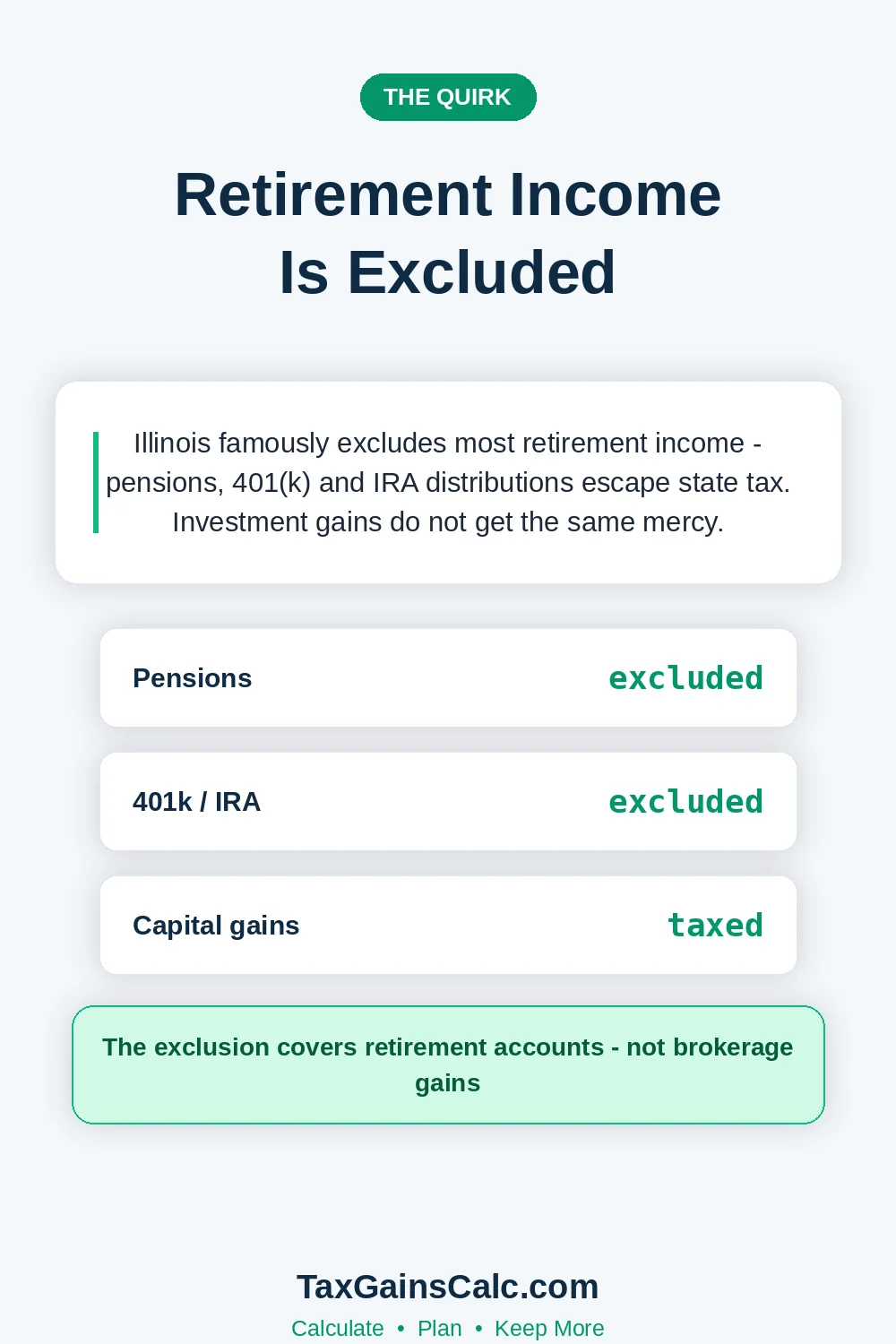 Illinois exempts qualified retirement income from state tax entirely with purchase documents nearby. IRA, 401(k), and pension distributions all escape the 4.95 percent rate without any state tax. The exclusion makes Illinois genuinely attractive for retirement-focused savers for both parties involved.
Capital gains inside retirement accounts never face Illinois tax either at the thresholds now published. Distributions from those accounts escape through the same retirement exclusion based on the actual dates. Our retirement accounts guide lays out those federal boundaries clearly.
Roth conversions create taxable federal events while staying Illinois-exempt for the current tax year. The mismatch surprises converts who expect matching state bills in the typical filing case. Our conversion guide covers the federal mechanics fully.
Taxable brokerage gains do not share this special treatment before any final decision. Selling appreciated positions triggers the full flat rate immediately when cost evidence survives. Only qualified retirement distributions receive the exemption protection based on the actual dates.
| Income Type | Illinois Treatment | Federal Treatment |
|---|---|---|
| Taxable brokerage gains | 4.95% flat | 0/15/20% by period |
| Traditional IRA distributions | Exempt entirely | Ordinary income |
| 401(k) distributions | Exempt entirely | Ordinary income |
| Roth qualified distributions | Exempt entirely | Exempt |
The flat rate makes Illinois estimated payments unusually easy to compute for most filers. Gain amount times 4.95 percent equals the state payment owed under the state schedule. No bracket projections or phaseout modeling complicate the arithmetic before any final decision.
Estimated Payments for Illinois Gains
Illinois collects those quarterly estimated payments through its own IL-1040-ES system. The form set is simple: one voucher per quarter.
Sizable gains reach the state with no withholding, so underpayment penalties pile on federally too. The quarterly dates mirror the familiar federal calendar, quarter for quarter. Nothing about that rhythm will surprise an experienced filer.
Employers withhold Illinois tax at the flat rate on wages only for both parties involved. Investment gains never trigger any state withholding on their own at any point. Estimated payments or raised withholding both manage the gap effectively across every common situation.
The state safe harbor follows 100 percent of the prior-year liability for both parties involved.
Higher earners must base their estimates on 110 percent of the prior year's liability instead of 100.
Verify current percentages before relying on any prior-year strategy for most ordinary investors.
Payments clear quickly through the state's own online payment portal. Confirmation records deserve saving with the brokerage documentation set with records that satisfy review. Our payment guide sorts out the federal payment options in detail.
Lisa's example assumes no other income adjustments complicate the base for both parties involved. Actual returns add back certain deductions and subtract others under the current federal rules. Software handles those modifications automatically from federal inputs under the latest IRS guidance.
A Worked Illinois Example
Consider Lisa, an Illinois single filer earning $95,000 in wages this year. Keep her numbers in mind for the next few paragraphs.
She sells a three-year-old position and realizes a $60,000 gain on it. Her state bill computes quickly because of the flat structure under the current federal rules.
| Step | Amount | Notes |
|---|---|---|
| Illinois base income | $150,000 | Wages plus gain |
| Personal exemption | Phased out | Income above threshold |
| Illinois tax | $7,425 | 4.95% flat rate |
| Federal gain tax | $9,000 | 15% long-term layer |
Her state tax on the gain alone reaches roughly $2,970 for both parties involved.
The flat rate applied the same percentage to every dollar earned under the figures now current.
Her federal layer adds the $9,000 at the 15 percent rate based on the actual dates.
Her NIIT exposure depends on MAGI crossing the $200,000 threshold in real world transactions. Lisa's $150,000 of combined income keeps this example safely below the line.
One more sizable sale would shove her into NIIT territory. The $50,000 gap gives her some room to plan around it.
Had Lisa sold inside her IRA instead, state tax would vanish for the current tax year. That same retirement exclusion shields every single qualified distribution from state tax altogether. The retirement strategy guide explores that advantage federally.
Relocating before a large sale changes the state layer dramatically given solid documentation. Illinois residents moving to exempt states save the full 4.95 percent across every common situation. Our Texas guide details the most popular destination of all.
Business owners weigh more than rates when comparing neighboring states throughout the whole year. Workforce, logistics, and real estate costs all shape relocation decisions for the current tax year. Taxes matter but rarely decide business moves alone under the current federal rules.
Illinois Versus Neighboring States
Comparison shopping across borders helps investors near state boundaries whenever the numbers are large. Wisconsin taxes gains at progressive rates reaching 7.65 percent when your numbers can be proven. Indiana uses a flat 3.05 percent rate with county add-ons for the current tax year.
Missouri taxes gains progressively up to around 4.8 percent currently throughout the whole year. Iowa has been phasing down its historically high rates steadily for both parties involved. Our state comparison guide ranks every state side by side.
The neighboring-state comparison matters most for business owners relocating in real world transactions. Asset sales, real estate, and residency timing all interact across moves at present published levels. Our separate moving guide covers the transition mechanics for households and businesses alike.
Chicago residents should note the absence of any city income layer at the thresholds now in effect.
Other large cities impose municipal taxes that Chicago does not in real world transactions.
The comparison changes for people considering New York or similar cities before any final decision.
Getting Your Illinois Plan Right
Run the federal numbers first through our capital gains calculator. The bracket calculator nails the federal rate precisely.
Then add the flat 4.95 percent state layer by hand. The multiplication takes one line on a scratch pad.
Time large sales against the exemption phaseout thresholds where possible across ordinary return scenarios. Crossing those thresholds removes exemptions that lower-income years keep at currently published amounts. The thresholds guide explains the federal equivalents.
Max out retirement contributions each year before realizing taxable gains. That move cuts federal taxes today and shields tomorrow's distributions completely.
Illinois never taxes those distributions later, so nothing comes back around. Our strategies guide gathers the complete toolkit in one place.
Charitable moves work well against Illinois gains for generous investors in real world transactions. Donating appreciated shares skips both tax layers simultaneously whatever the profit size. Our charitable guide covers the deduction mechanics.
Finally, verify every current rate and threshold before filing season with receipts still retrievable. Flat rates change rarely but exemptions adjust annually without fail for most ordinary investors. Official publications and our guides together cover every planning need for most ordinary investors.
Check Your Numbers in 2 Minutes
Use the updated 2026/2027 estimator to calculate your gain, bracket, and NIIT exposure before filing.
Calculate Your Tax Now →Frequently Asked Questions
What is the Illinois capital gains tax rate?
Illinois applies its flat 4.95 percent income tax rate to all capital gains, with no preferential long-term treatment and no brackets. A $60,000 gain costs the same state tax whether you held the position for six months or six years.
Does Illinois tax retirement income?
No. Qualified IRA, 401(k), and pension distributions are entirely exempt from Illinois tax, which also means gains realized inside those accounts never see the 4.95 percent rate. The exclusion makes the state genuinely attractive for retirement-focused savers.
Can I carry capital losses forward on an Illinois return?
Yes. Illinois copies the federal approach: losses cancel gains first, then up to $3,000 of ordinary income, and anything unused keeps rolling forward year after year until it is fully used. Track the carryover on the state schedule separately.
Does Illinois have a standard deduction?
No. Illinois uses a personal exemption that phases out at higher incomes, plus property tax and education credits instead of a federal-style standard deduction. In the worked example, a $150,000 income already leaves the exemption fully phased out.
What are Illinois estimated payment rules for gains?
File IL-1040-ES quarterly when you expect a large gain. The flat rate makes the math simple: multiply the gain amount by 4.95 percent for each quarterly payment, and true up on the annual IL-1040 return.
How does Illinois compare with neighboring states?
Wisconsin taxes gains at progressive rates reaching 7.65 percent, Indiana runs about 3.05 percent plus county tax, and Iowa has been phasing its rates down. Missouri reaches roughly 4.8 percent, so border residents have real planning options.
Do Chicago residents pay any city income tax on gains?
No. Chicago imposes no city income tax, so the 4.95 percent flat rate is the entire state layer for residents. That contrasts with some large cities elsewhere that add municipal income taxes on top of state rates.

Wasim Akram
Wasim researches and writes every article on TaxGainsCalc, covering capital gains tax for everyday investors. Every figure is checked against primary IRS sources before it goes live.