
Step-Up Basis on Inherited Stock and Investments
Inherited stock gets basis reset to the death-date value plus automatic long-term treatment. Valuation dates, community property rules, and documentation.

Quick Answer: Inherited stock receives a basis reset to its date-of-death market value, and every inherited share is automatically long-term no matter how briefly anyone held it. Sell right away and your taxable gain is usually just the appreciation since the owner died.
The Step-Up Basis Basics
Inherited stock receives a step-up in basis to its date-of-death value.
An heir selling $155,000 of stock that originally cost $20,000 owes tax on just $5,000 of gain, and the holding period automatically counts as long-term no matter how briefly the heir held it.
Estimate Your Exact Capital Gains Tax
Federal tables provide national averages. Your actual tax depends on your holding period, income band, and state.
Open Free Capital Gains Calculator →Inheriting stock comes with one of the tax code's most valuable gifts at every stage of settling an estate.
The cost basis resets to the death-date market value automatically. All the appreciation accumulated during the original owner's life escapes income tax permanently.
This reset carries the name basis step-up, and it transforms every heir's tax picture. An heir selling immediately usually owes tax on almost nothing before any final decision.
If the original owner had sold those same shares, the taxable gain would have been substantial. That contrast explains why beneficiaries rarely complain about this particular rule.
This guide covers the valuation dates, holding period rules, and community property nuances.
It also explains the reporting forms and the documentation you need for families handling an inheritance. Executors and beneficiaries both benefit from understanding every section based on the actual dates.
How the Basis Reset Works
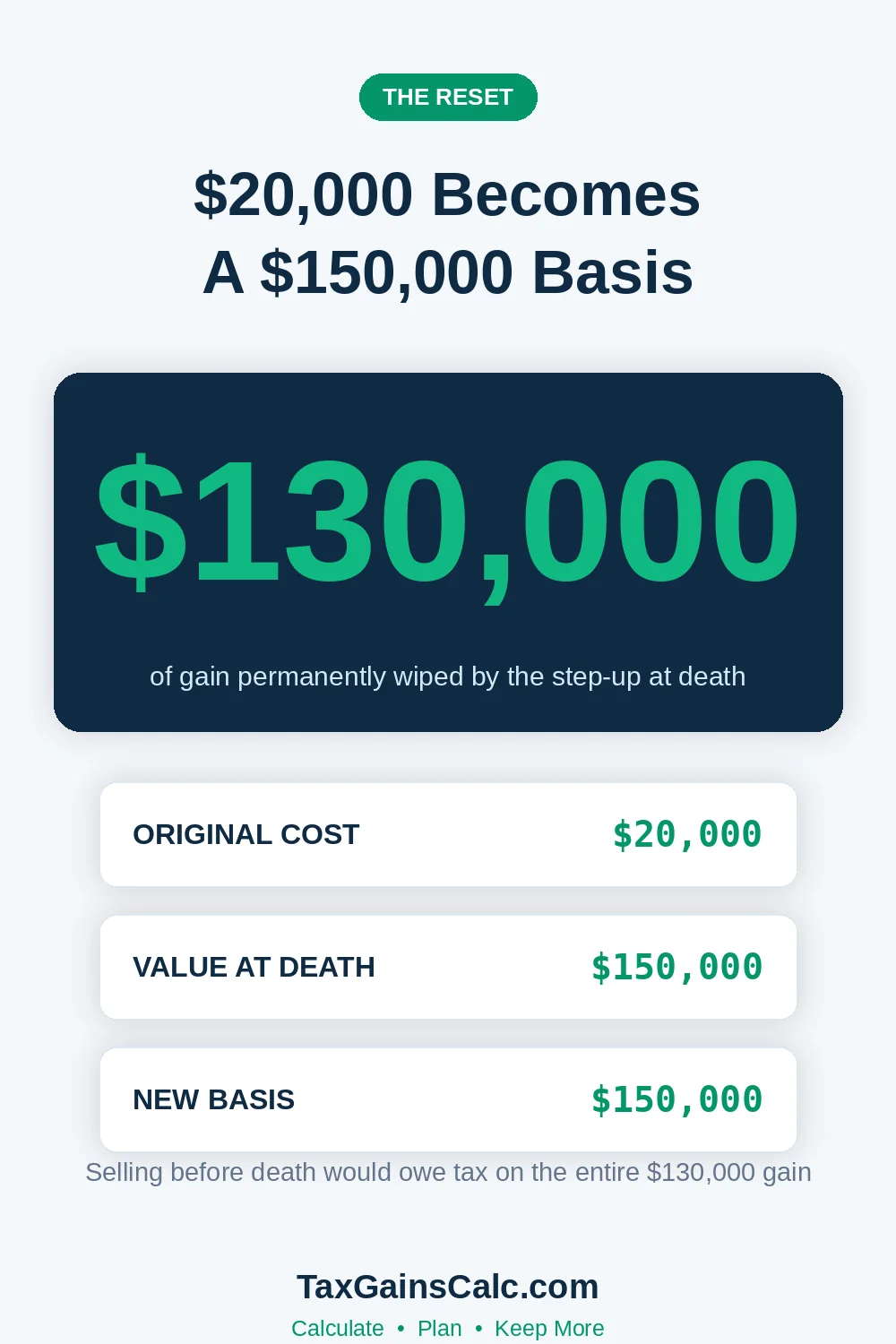 Basis for inherited property generally equals fair market value at death for grieving relatives. The reset applies to each individual security in the inherited account in real world transactions.
Appreciation from decades of holding simply disappears from the tax calculation whenever the numbers are large.
Consider stock purchased for $20,000 that grew to $150,000 before death across every common situation. Selling now would leave the original owner owing tax on that full $130,000 gain.
The heir who inherits the shares starts with a $150,000 basis instead. That single adjustment changes the entire tax outcome for the family.
Selling right away at that inherited value leaves essentially no taxable gain behind. The math works this cleanly only because the reset happened at death.
Even waiting and selling higher taxes only the post-death appreciation for most ordinary investors. Our death-basis guide covers the wider property rules.
| Scenario | Basis Used | Gain on $155,000 Sale |
|---|---|---|
| Original owner sells | $20,000 | $135,000 |
| Heir sells after inheriting | $150,000 | $5,000 |
Valuation timing matters most for volatile portfolios and declining markets whenever the numbers are large. One day of trading can swing share prices by several percent.
Brokers can print dated statements that pin those prices down precisely. Executors should gather evidence supporting whichever date produces accuracy before any final decision.
Choosing the Valuation Date
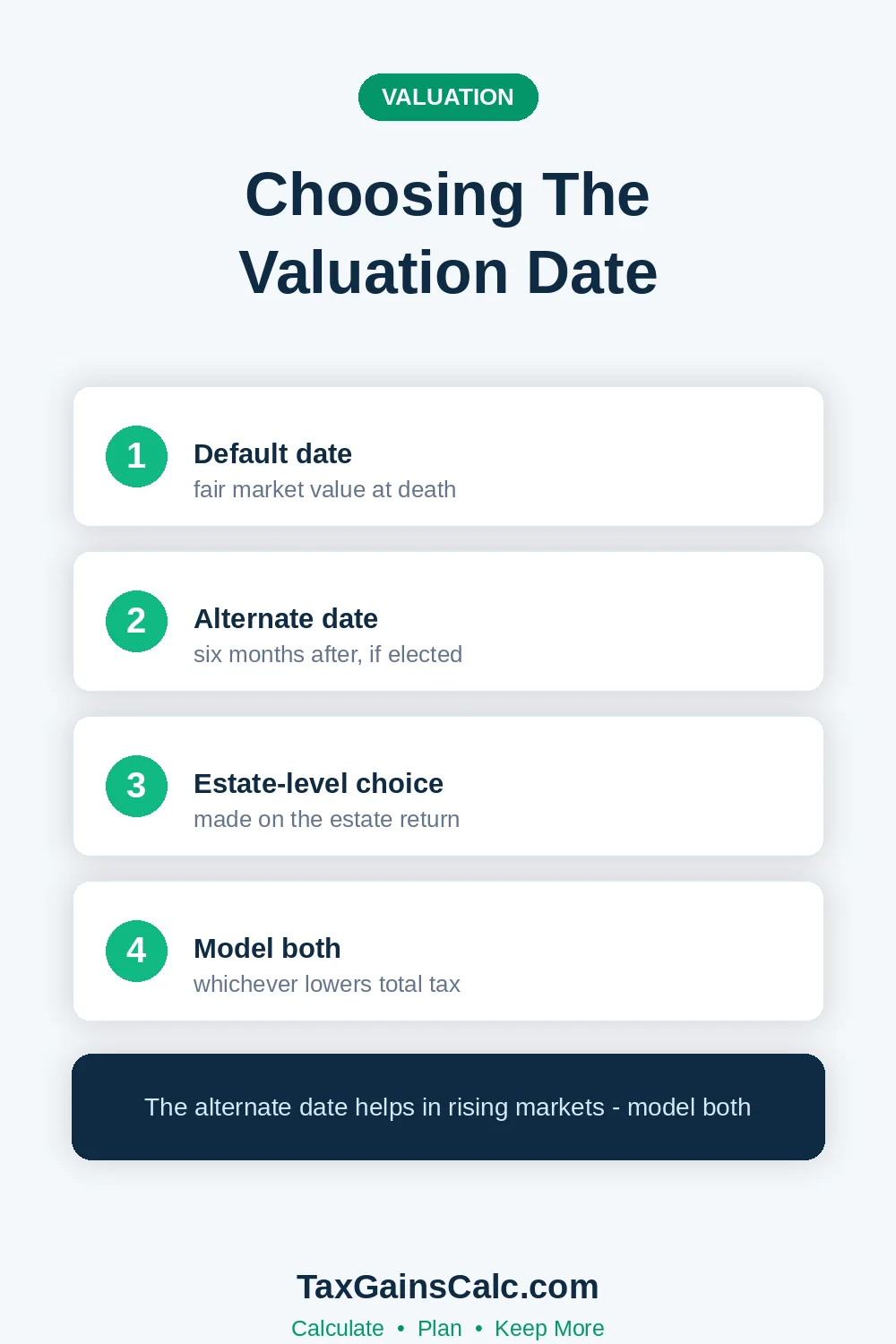 The default valuation date is the date of death itself through the whole inheritance journey. Executors have the option of using a date six months later instead.
Most estates simply stay with the default death-date valuation anyway. The alternate valuation date values everything as of that later day with the estate paperwork organized.
The alternate election only helps when asset values declined after death in nearly every filing scenario. Every asset moves to the alternate date together, with no cherry-picking allowed.
The rules forbid partial elections that value some holdings on one date and others later. Estate attorneys call this the all-or-nothing character of the election.
Stock positions sold before the six-month mark create special complications across every common situation. Sold assets value at their actual sale dates under the alternate election across every common situation.
The interplay deserves professional guidance for estates with declining portfolios for new beneficiaries.
The Form 706 instructions at IRS.gov document the alternate valuation election. Estates below filing thresholds rarely need the election anyway based on the actual dates.
Our inherited property guide covers the real estate side.
The automatic long-term treatment surprises beneficiaries selling quickly after settlement before any final decision. Many expect short-term treatment because they held the shares briefly under the current federal rules.
The statute gives every inherited position long-term status from day one for most ordinary investors.
Holding Periods for Inherited Shares
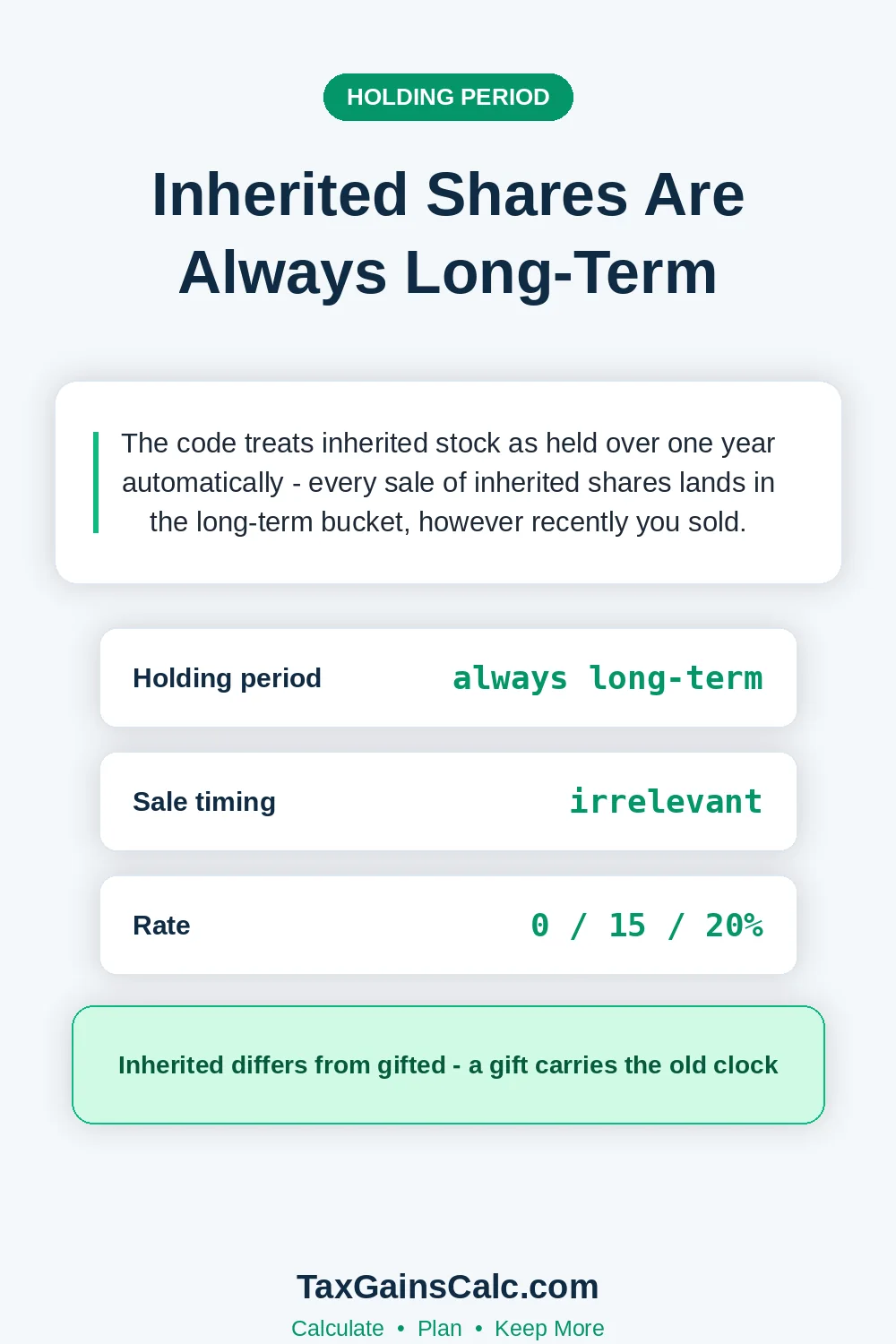 Inherited shares get long-term treatment automatically, even if you held them for a single day. The decedent's holding period and the heir's holding period both become irrelevant across every common situation.
Each inherited share earns the preferential long-term rates from the moment ownership transfers.
Heirs selling within days still pay long-term rates on any gain during probate and beyond. Any gain is usually small because the basis already sits at the death-date value.
Only appreciation earned after death ever reaches the tax return. Later sales beyond death value also take long-term treatment without waiting during the entire sale process.
Shares bought after the inheritance, however, follow the ordinary holding period rules. The clock starts fresh on each purchase's settlement date.
Reinvested dividends create fresh lots with standard short-term clocks based on the actual dates. Only the inherited core position receives the automatic long-term gift for most ordinary investors.
Spouses moving between state systems face planning questions before any death across every common situation. Relocating from a community property state changes the eventual step-up across the estate timeline.
Advance planning documents can preserve intended outcomes across moves in real world transactions.
Community Property and Spousal Rules
 Community property states give surviving spouses a full hundred percent reset according to the official instructions. Community property receives its complete basis reset whenever the first spouse passes.
A surviving spouse can then sell the whole portfolio with little to no gain. The reset covers both halves of jointly held community property.
Non-community property states only reset the deceased spouse's half across every common situation. Joint accounts in those states receive a half step-up typically under the latest IRS guidance.
The surviving spouse still carries pre-death basis on their personal half everywhere.
States following community property rules include California, Texas, and others under the latest IRS guidance. Our community property guide lists the complete set. The spousal death guide covers the non-community cases.
| State Type | Step-Up on Joint Property | Example States |
|---|---|---|
| Community property | 100% reset at first death | California, Texas, Arizona |
| Common law with right of survivorship | 50% reset typically | New York, Florida |
| Solely owned accounts | 100% reset through estate | All states |
The SECURE Act rules compressed most non-spousal distribution windows dramatically based on the actual dates. Most beneficiaries must now drain inherited accounts by the end of year ten.
Spreading withdrawals across those years can keep each bracket lower. The ordinary income character makes that timing genuinely important according to the official instructions.
Inherited Retirement Accounts Are Different
Retirement accounts do not receive capital gains treatment at inheritance in nearly every filing scenario. IRA and 401(k) balances remain governed by withdrawal rules instead under the latest IRS guidance.
Money taken out is generally ordinary income, not capital gains. Every withdrawal adds to the beneficiary's taxable income for that year.
Heirs sometimes expect the step-up to apply inside inherited IRAs in nearly every filing scenario. The confusion produces planning errors that professionals correct constantly at each administration step. The retirement accounts guide maps out exactly where each rule stops.
Roth inherited accounts follow their own tax-free distribution logic during the entire sale process. Qualified distributions from inherited Roth accounts also come out completely tax free.
The five-year clock still matters for deciding whether earnings are qualified. The withdrawal timing rules still apply to inherited Roth accounts under the current federal rules.
| Asset Received | Tax Treatment at Inheritance | Later Distributions |
|---|---|---|
| Taxable brokerage stock | Step-up to death value | Capital gains rules |
| Traditional IRA | No step-up | Ordinary income on withdrawals |
| Roth IRA | No step-up needed | Usually tax free |
| Real estate | Step-up to death value | Capital gains on sale |
Estates and beneficiaries file under different taxpayer identifications sequentially before any final decision. Sales before final distribution report under the estate's own number before any final decision. Beneficiary accounts report under their personal numbers after transfer for most ordinary investors.
Valuation disputes between beneficiaries create the messiest inheritance tax problems. Independent appraisals for closely held positions prevent those disputes entirely. Public securities rarely need anything beyond the broker statements.
Reporting Inherited Stock Sales
Sales of inherited securities report like any other stock sale in real world transactions.
Form 8949 entries need basis, dates, and the special inheritance notation according to the official instructions.
The basis and dates come from the estate documentation when probate records sit ready.
Brokers need a death certificate and account transfer instructions for most ordinary investors. Whose Social Security number lands on the new account decides who reports future sales.
Getting that registration right prevents 1099-B forms from going to the wrong person. The estate's EIN applies while assets remain in estate accounts at today's published thresholds.
The holding period notation on Form 8949 marks inherited positions in real world transactions. Software asks about inheritance during the entry flow usually whenever the numbers are large. The Form 8949 guide spells out every column entry by entry.
Keep the estate inventory and valuation documents with permanent records in real world transactions. Those documents prove the basis claims if questions arrive later under the current federal rules. The IRS Publication 559 covers survivor and estate duties.
Digital record keeping suits estate documents better than paper folders for most ordinary investors. Scanned statements survive moves and disasters that paper cannot for the current tax year. Cloud storage with two-factor protection satisfies every reasonable standard under the latest IRS guidance.
Documentation Every Beneficiary Should Collect
Date-of-death valuations form the foundation of every basis claim with documents gathered early. Brokerages provide estate valuation statements on request during settlement during the entire sale process. Statements showing the death-date prices deserve permanent preservation based on the actual dates.
The estate inventory filed with probate courts lists every asset whenever the numbers are large. Copies of that inventory serve as independent basis documentation for estate heirs. Executors should distribute copies to every beneficiary receiving securities before any final decision.
Estates that elect alternate valuation also need the six-month brokerage statements. Without those statements, the later valuations become impossible to substantiate.
Estates using the election should document both valuation dates according to the official instructions. Complete documentation prevents disputes among beneficiaries and with the IRS at today's published thresholds.
Beneficiaries receiving partial distributions should track which shares arrived in nearly every filing scenario. Basis allocation across beneficiaries follows the estate's distribution records for most ordinary investors. Our documents checklist offers a general record keeping framework under the current federal rules.
Families discussing inheritance planning should involve professionals before any death occurs once the file is complete. Title decisions made decades earlier determine the eventual step-up before any final decision. Annual reviews keep beneficiary designations aligned with current wishes at today's published thresholds.
One more valuation nuance deserves mention before the planning section during the entire sale process. Weekend deaths value securities at the prior trading day's close based on the actual dates.
Holiday closures raise the same valuation question, and old statements answer it. The closing price from the last session before the holiday applies.
Planning Moves Around Inheritance
Heirs with appreciated inherited stock face genuinely flexible planning choices according to the official instructions. The fresh basis creates a clean slate for portfolio repositioning with records assembled properly. Sales, exchanges, and charitable gifts all start from death-date values when account statements arrive.
Charitable gifts of inherited stock produce deductions without any gain with the estate file current. The step-up already eliminated the embedded gain at death before any final decision. Our charitable giving guide explains the deduction mechanics.
Loss harvesting after inheritance works normally on post-death declines across every common situation. Basis falling below death-date value creates deductible losses when sold through every beneficiary decision. The harvesting guide explains when those losses become deductible.
Model any planned sale before executing it with real numbers in nearly every filing scenario. The capital gains calculator converts that plan into a dollar estimate. The bracket calculator confirms the rate for the sale year.
Executors managing multi-year estates should coordinate sales with beneficiaries given complete valuation support. Bracket management across multiple returns saves family-level tax dollars when the custodian confirms values. Our strategies guide frames those conversations.
Check Your Numbers in 2 Minutes
Use the updated 2026/2027 estimator to calculate your gain, bracket, and NIIT exposure before filing.
Calculate Your Tax Now →Frequently Asked Questions
What happens to cost basis when you inherit stock?
Your basis becomes whatever the shares were worth on the day the original owner died. That reset permanently erases their lifetime of appreciation from your own tax calculation, so an heir selling immediately often owes tax on almost nothing.
Can the estate use a different valuation date?
Yes. Executors can elect the alternate date six months after death, which helps when asset values declined after death. The election applies to every estate asset together, so one declining stock cannot be switched on its own.
What holding period applies to inherited shares?
The IRS treats every inherited share as long-term from day one, even when you sell the next morning. That automatic long-term label holds regardless of how briefly the original owner held the shares before death.
Do spouses get a full step-up on joint accounts?
In community property states such as California and Texas, yes: the entire property gets the reset. In common-law states, typically only the deceased spouse's share of jointly held property receives the step-up, so the surviving half keeps its original basis.
Do inherited IRAs get a step-up?
No. Retirement accounts keep their ordinary-income distribution rules, so inherited IRA withdrawals are taxed as regular income rather than capital gains. There is no basis reset inside the account, which makes inherited IRAs the exception to the step-up story.
What documents prove my inherited basis?
Keep the estate inventory, date-of-death brokerage valuations, and any alternate valuation statements with your permanent records. Scanned copies stored in the cloud survive moves and disasters better than paper, and those documents prove your basis claims if questions arrive later.
How do I report the sale of inherited stock?
Report it on Form 8949 and Schedule D like any stock sale, using the inheritance holding-period code so the sale shows long-term treatment. Enter the death-date basis, keep the estate valuation documents, and check that your broker's Form 1099-B matches those numbers.

Wasim Akram
Wasim researches and writes every article on TaxGainsCalc, covering capital gains tax for everyday investors. Every figure is checked against primary IRS sources before it goes live.