
Texas Capital Gains Tax: What Investors Really Pay
Texas charges no income tax, so gains face federal rates only. See the savings math, property and sales tax offsets, and domicile proof rules.

Texas Capital Gains Tax: The Direct Answer
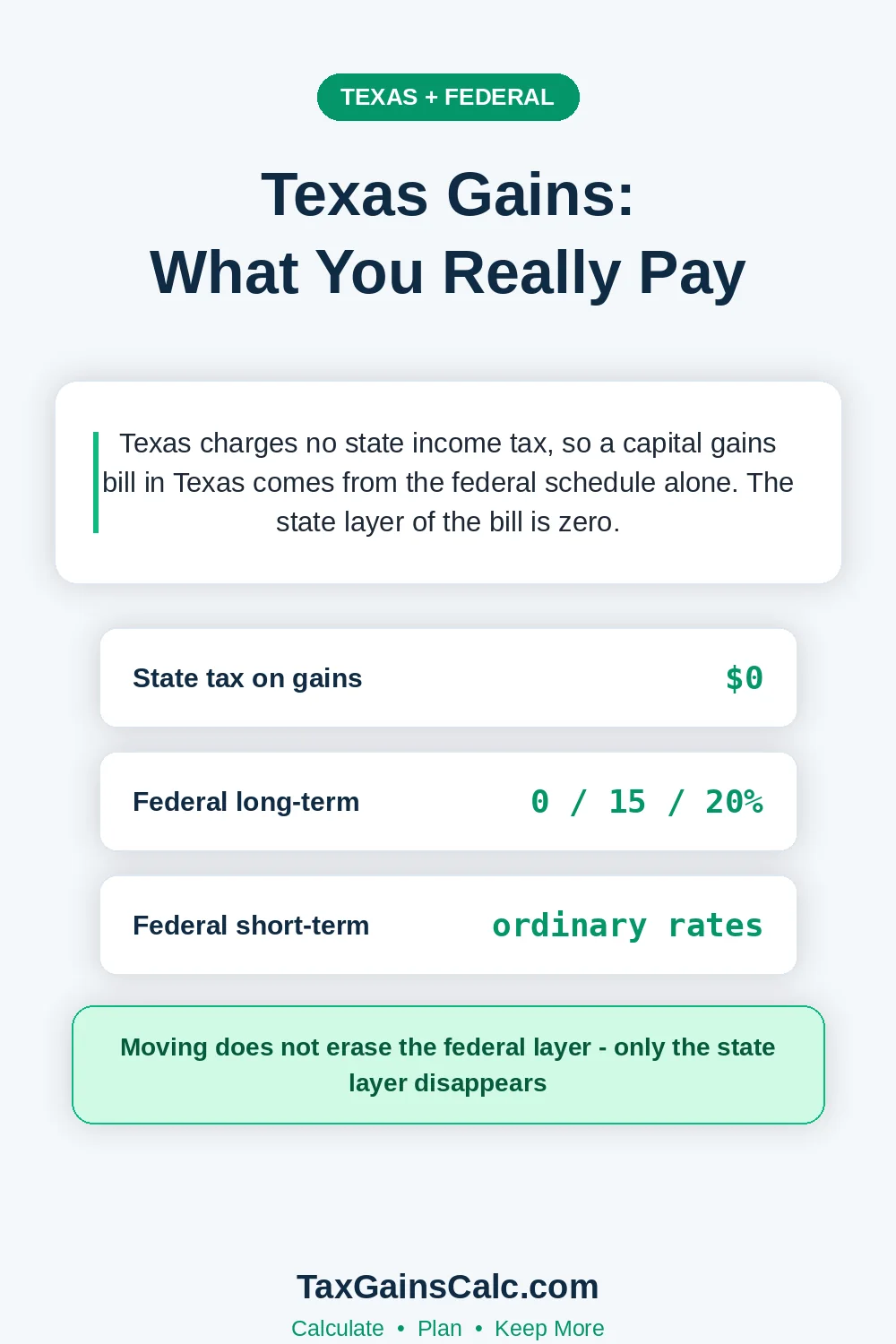
Texas charges no personal income tax, so your capital gains face federal rates only.
The state collects nothing on stock sales, business exits, or rental property gains.
Washington's 0, 15, and 20 percent long-term tiers are the only rates that touch you.
This guide shows what that means in real dollars and what Texas charges instead.
The savings against high-tax states can reach six figures on genuinely large sales. But Texas funds itself through property taxes, sales taxes, and business franchise fees.
Smart movers model the full tax picture rather than celebrating the income tax line alone.
The Federal Rates a Texas Investor Pays
Federal long-term brackets apply identically whether you live in Dallas or Denver.
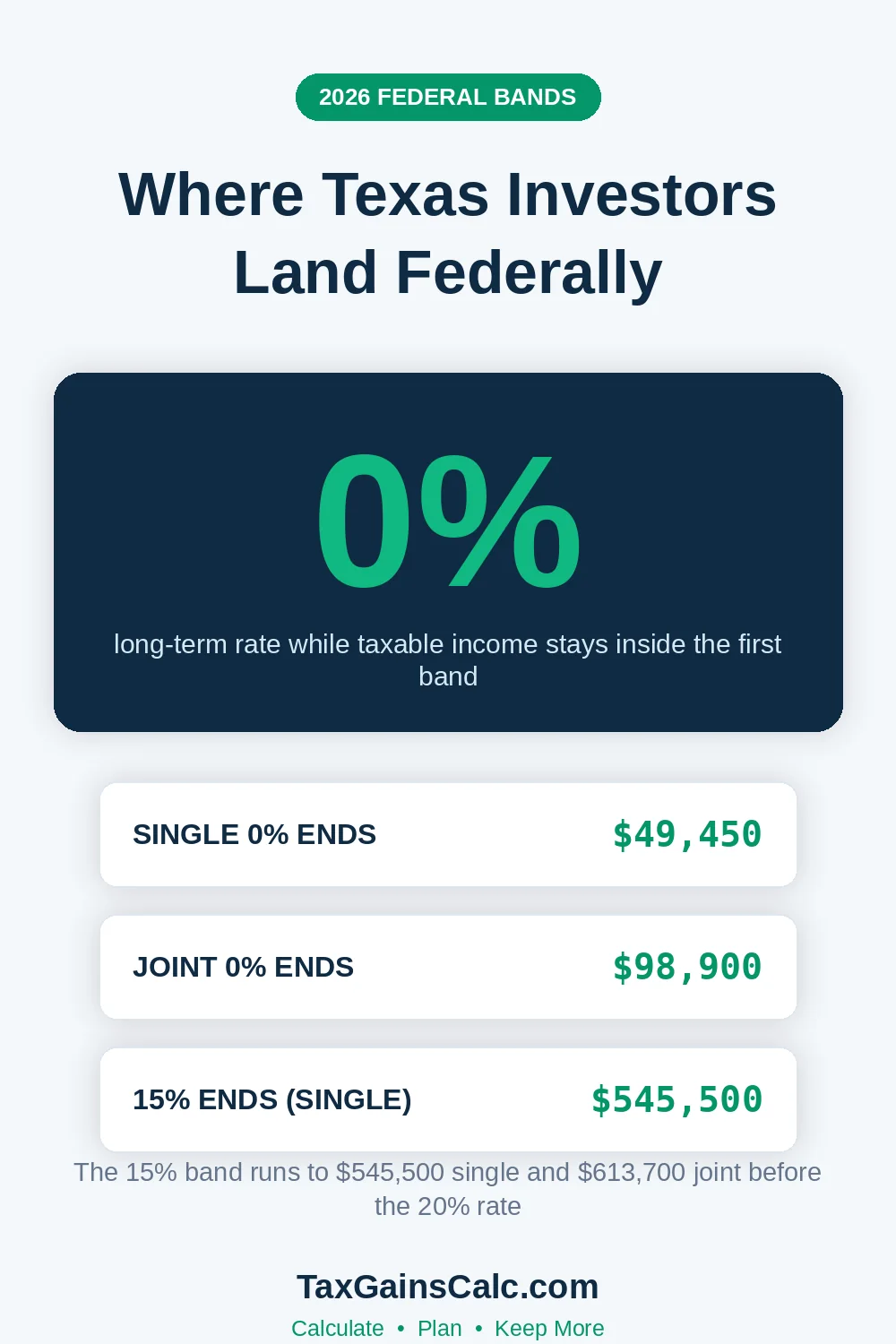
Long-term gains stay federally tax-free for single filers until taxable income crosses $49,450.
For joint filers, that zero rate stretches all the way up to $98,900 taxable. The 15 percent band then runs to $545,500 for single filers and $613,700 jointly.
 Above those ceilings the 20 percent rate takes over on remaining gains.
A 3.8 percent NIIT surcharge kicks in once MAGI tops $200,000 for singles.
Joint filers cross their $250,000 NIIT line at the same point they always did. None of these federal numbers change because of a Texas address.
| Federal layer | Single | Married filing jointly |
|---|---|---|
| 0% rate until | $49,450 taxable | $98,900 taxable |
| 15% rate until | $545,500 taxable | $613,700 taxable |
| 20% rate | above that | above that |
| NIIT trigger | $200,000 MAGI | $250,000 MAGI |
Worked Example: A $400,000 Gain in Houston
Picture one Houston investor earning $150,000 in wages plus a long-term gain of $400,000.
The gain stacks on top of wages, so the 0 percent band is already spent.
Once the deduction comes out, roughly $395,550 of the gain ends up in the 15 percent column. The final slice climbs into the 20 percent territory at the very top.
The federal bill lands somewhere between $56,000 and $60,000 depending on deductions. The NIIT adds its 3.8 percent on the gain portion above the MAGI threshold.
Now run the identical sale for a California resident with the same income. Sacramento would pile tens of thousands of extra dollars onto that same federal total.
Our gains by income bracket guide prices out comparable sales in other states. The Texas number never changes with the sale size, because the state layer stays zero. Only the federal bracket math moves as gains grow larger.
What Texas Collects Instead
Texas pays its bills through three main channels that investors should understand.
Property taxes rank among the highest burdens in the country relative to home values.
The state sales tax rate sits at 6.25 percent before local additions. Combined rates in many cities push past 8 percent on most purchases.
| Texas revenue source | Typical rate | Touches investors? |
|---|---|---|
| Property tax | among the highest nationally | yes, on homesteads |
| State sales tax | 6.25 percent | yes, on spending |
| Local sales additions | up to about 2 percent | yes, on spending |
| Franchise tax | varies by revenue | only on businesses |
The franchise tax deserves a special note for business owners planning exits. This gross-receipts-style tax applies to companies above the small-filing threshold.
It does not touch personal investment sales, stock portfolios, or your home sale. Selling your appreciated positions creates no Texas filing obligation of any kind.
Proving Texas Domicile After a Move
Saving state tax requires a genuine domicile change, not just a mailing address. Other states audit departing residents and look for real evidence of relocation. Texas residency gets proven through actions that paint a consistent picture over time.
- Get a Texas driver license and register your vehicles in the state promptly.
- Claim a homestead and shift your banking, insurance, and professional relationships.
- Register to vote and spend the clear majority of your year physically present.
California audits former residents for years after they leave the state. Day counts, membership records, and even social media location data appear in those exams.
Our legal avoidance strategies guide details the paperwork discipline a clean relocation requires. A clean paper trail turns a stressful audit into a short correspondence.
Part-Year Residency and Sourcing Rules
 Moving mid-year creates the trickiest capital gains timing questions for investors. Gains on sales executed while you are a Texas resident face no Texas tax.
Gains that accrued while you lived elsewhere may still face the former state. Each old state writes its own sourcing rules for investment income.
California taxes residents on all gains during residency and nonresidents only on California sources. California real estate and California business interests stay taxable regardless of where you live.
Marketable securities generally follow residency, which makes timing stock sales especially valuable. Our California capital gains guide details those sourcing rules.
Comparing Texas With Other Low-Tax States
Texas sits in good company at the zero-income-tax tier of states. Seven other states also collect no personal income tax on gains.
Each state substitutes different revenue sources that hit households differently. Our no-capital-gains-tax states guide compares all of them in one table.
Florida pairs the zero income tax with no estate tax at the state level. Nevada leans on gaming revenue and keeps property taxes moderate by national standards.
Washington breaks the pattern by levying a 7 percent excise on big gains. Texas property taxes run higher than most of these peers, so model housing costs carefully.
| State | Income tax on gains | Notable offset |
|---|---|---|
| Texas | none | high property taxes |
| Florida | none | moderate sales tax |
| Nevada | none | gaming and commerce taxes |
| Washington | 7% excise on large gains | no income tax on wages |
Housing costs deserve equal billing with taxes in any relocation spreadsheet. Texas home prices run well below coastal metros, which compounds the savings further. Cheaper housing also means a smaller homestead usually replaces a larger one elsewhere.
Your property tax rate may be higher while your absolute bill still drops substantially. Model the actual replacement home rather than comparing percentage rates in the abstract.
A Note for Business Owners Planning Exits
Texas business sales raise questions beyond the personal capital gains calculation. The franchise tax applies to the company's revenue in its final operating year.
 Deal structure matters more than usual for owners leaving high-tax states beforehand. Selling after an established Texas move keeps the gain entirely free of the old state's tax.
Owners who rush the move in the sale year invite the toughest audits. Give the relocation at least one full clean year before a major exit when possible.
Exit planning by entity type gets full treatment in the small business capital gains guide on this site. The Texas Comptroller publishes the current franchise tax thresholds for businesses.
What Retirees Should Model Before Moving
Retirees often gain the most from a Texas move and forget the trade-offs. Social Security benefits stay untaxed, and retirement distributions face no state layer.
Required minimum distributions from IRAs escape state tax completely after the move. Our withdrawal order guide shows how to sequence accounts around a move.
Property taxes on a paid-off Texas homestead can surprise retirees used to lower costs. Counties offer homestead exemptions and over-65 freezes that substantially soften the burden.
Model your specific county before assuming the standard statewide averages apply to you. The right county choice changes the arithmetic more than most moving guides admit.
How Property Taxes Vary by County
Property tax burdens in Texas swing enormously between counties and school districts. Harris County averages differ wildly from suburban Fort Bend or rural Hill Country rates. School district levies drive most of the bill, which is why districts matter most.
Two identical homes across a district line can carry very different annual tax bills. The homestead exemption removes a meaningful slice of assessed value from taxation.
The over-65 exemption freezes the school district portion of the bill entirely. Veterans with disability ratings unlock additional exemptions that stack on top of the rest.
Check the county appraisal district website for the exact rates on any target property. Investors who rent out Texas property pay the same high levies without exemptions.
Non-homestead investment property carries the full unhomesteaded rate in every county. Our rental property capital gains guide covers the sale side later.
Municipal Bonds After a Texas Move
High-tax-state investors fill portfolios with municipal bonds for their state tax exemption. That logic evaporates the moment Texas becomes your permanent home address. Texas muni funds offer no state advantage because there is no state tax left to avoid.
National muni funds still deliver federal exemption but often at lower yields than corporates. Review every muni position after the move and compare taxable equivalent yields honestly.
Treasury interest, which escapes state tax everywhere, may now beat comparable muni offerings. The right portfolio for a Texas resident differs from the one built for California.
Common Mistakes Investors Make After Moving
The most expensive error is selling a large position the same year as the move. Old states treat that pattern as strong evidence the move was never genuine.
Give the relocation a clean calendar year before executing any planned exit. The waiting period also lets your documentation trail mature into something credible.
Another frequent mistake involves keeping the old state's professional relationships fully intact. A California doctor who still staffs Sacramento clinics monthly undermines every other evidence point.
Work patterns, not just intentions, determine where tax authorities believe you actually live.  Structure your calendar so your physical presence matches your stated domicile claim.
Investors also forget to update withholding and estimated payment states after moving. Federal estimated payments continue unchanged, but state estimates should stop at the old state.
Filing a part-year return incorrectly creates notices that follow you for years. Our estimated payments guide covers the quarterly calendar completely.
Finally, movers sometimes sell Texas property quickly and repurchase elsewhere without thinking. Gains on Texas real estate face only federal tax, which makes holding periods federal questions.
The two-year Section 121 window for homes still applies exactly as it does anywhere. Plan any home sale around those federal rules rather than assuming the move reset them.
A Texas Relocation Planning Checklist
Run down this checklist during the twelve months leading up to your move. Each step either strengthens your position or surfaces a hidden cost early.
- Price the property tax on your target home, including the homestead exemption effect.
- Build the domicile evidence file as you execute the move, not afterward.
- Time large gains after the move date whenever the sale calendar allows.
- File part-year returns correctly in the old state for the move year.
- Revisit investment location choices, since municipal bond funds may stop making sense.
Wherever you land, the IRS capital gains topic guide still governs every federal rule. Texas removes one layer of the bill and leaves every federal lever intact.
That combination rewards investors who pair the move with genuine year-round residency. Run your own numbers before the moving truck ever arrives rather than after the sale closes. Texas rewards investors who commit fully to genuine year-round residency with real documentation.

Wasim Akram
Wasim researches and writes every article on TaxGainsCalc, covering capital gains tax for everyday investors. Every figure is checked against primary IRS sources before it goes live.