
Crypto Wash Sale Rule: Does It Apply in 2026?
The wash sale rule still skips crypto as property. Where the law stands, broker reporting changes, catch-all doctrines, and safe harvesting.

Crypto Wash Sale Rule: The Direct Answer
As the law stands today, bitcoin and nearly every other token sit entirely outside the wash sale rule. Section 1091 reaches stock and securities sales only, so property holdings escape the disallowance it imposes.
The IRS classifies crypto as property, which leaves tokens outside the rule today. Selling a loser and rebuying minutes later still produces a recognized loss under current law.
That opening has hard edges that aggressive traders too often forget. Sizeable positions make those limits worth respecting in practice.
Legislative proposals, broker reporting changes, and catch-all doctrines all point in one direction. This guide explains where the law stands, where the risks live, and how to harvest responsibly.
What Section 1091 Actually Says
The wash sale statute strips losses from stock and securities sales directly at the transaction level. Buying substantially identical securities back quickly is what sets that disallowance in motion.
The loss simply never exists for tax purposes once the trade matches that pattern.
The law's window stretches from thirty days before the sale all the way through thirty days after it. Congress drafted the rule for securities markets in a much earlier era.
Lawmakers never had digital tokens anywhere on their radar then.
Notice 2014-21, the IRS's foundational guidance on this question, classifies convertible virtual currency as property. Property simply does not fit the statute's definition of stock or securities.
That single classification choice is what opens the harvesting door for token traders.
 No Treasury regulation has ever pulled tokens under the wash sale umbrella. No enacted statute has closed that gap either, despite proposal after proposal in Congress.
That silence has held through every recent session on Capitol Hill so far.
Our wash sale guide covers the securities rule completely. Our crypto 8949 guide shows how token losses get reported.
The two regimes genuinely diverge, even though the trading behavior behind them looks nearly identical. That split has remained intact across several filing years now.
Which Digital Assets Sit Outside the Rule
For federal tax purposes, bitcoin, ether, and most other native tokens all count as property. Selling any of them below cost produces a currently recognized loss right away.
The timing matters because that recognition lands inside the current tax year.
Buying the very same token straight back does not erase that loss under today's law. The loss first absorbs other crypto gains, then securities gains, and finally ordinary income itself.
Nothing about that sequence changes just because crypto happens to be involved.
Tokenized stock products may themselves qualify as securities, which changes their treatment entirely. Wrapped versions of traditional shares can carry genuine wash sale exposure.
Treat any product tied to real equity with extra caution before harvesting.
Token products built like ETFs raise the very same securities questions. Both the wrapper and the underlying asset matter when you classify any product.
Check each layer separately before deciding how any loss gets treated.
| Asset type | Wash sale applies? | Harvesting note |
|---|---|---|
| bitcoin and native tokens | no, under current law | loss recognized immediately |
| tokenized traditional stock | possibly, as securities | treat conservatively |
| tokenized ETF products | possibly, as securities | treat conservatively |
| stablecoins traded above peg | no, as property | small losses still count |
The Catch-All Doctrines That Still Apply
The economic substance doctrine specifically targets transactions that lack any real business purpose. Round-trip trades existing only to dodge tax practically beg for that challenge.
Regulators and courts both look for something more than a tax angle.
Prearranged repurchases with a single counterparty make the substance problem considerably worse. Courts have reshuffled deals that existed purely to produce tax results.
A friendly buyback agreement is exactly the kind of pattern judges tend to unwind.
Many practitioners now see same-second automated reentries as outright audit bait. An actual market order, filled at a real price, demonstrates genuine economic behavior. The small spread saved is rarely worth the questions such entries raise.
Documented purpose and genuine price discovery strengthen your claim to the loss. Aggressive automation with no economic footprint does the opposite for that claim. Paper trails and human-scale trading habits are what hold up under review.
Straddle rules and related-party rules draw further boundaries around harvesting activity too. Losses washed between related parties run into their own separate disallowance sections. Those code sections operate entirely apart from Section 1091 and its 30-day window.
Structured products that mimic wash-sale repurchases can trip the constructive sale rules. Experienced harvesters deliberately steer well clear of every one of these doctrinal boundaries. Knowing where each doctrine starts keeps a harvesting plan defensible.
How Broker Reporting Changed the Game
Form 1099-DA took effect in 2025 for sales made through custodial brokers. Brokers now track individual tax lots and report proceeds alongside basis information. That basis reporting is new, and it shows the IRS far more than before.
Some platforms voluntarily apply wash-sale-style logic to their own 1099-DA reporting. Neither the statute nor the IRS requires them to do it. Our 1099-DA reporting guide walks through that framework in detail.
Custodial reports now flow straight into the IRS's matching systems. Mismatches between those reports and your return get flagged automatically. 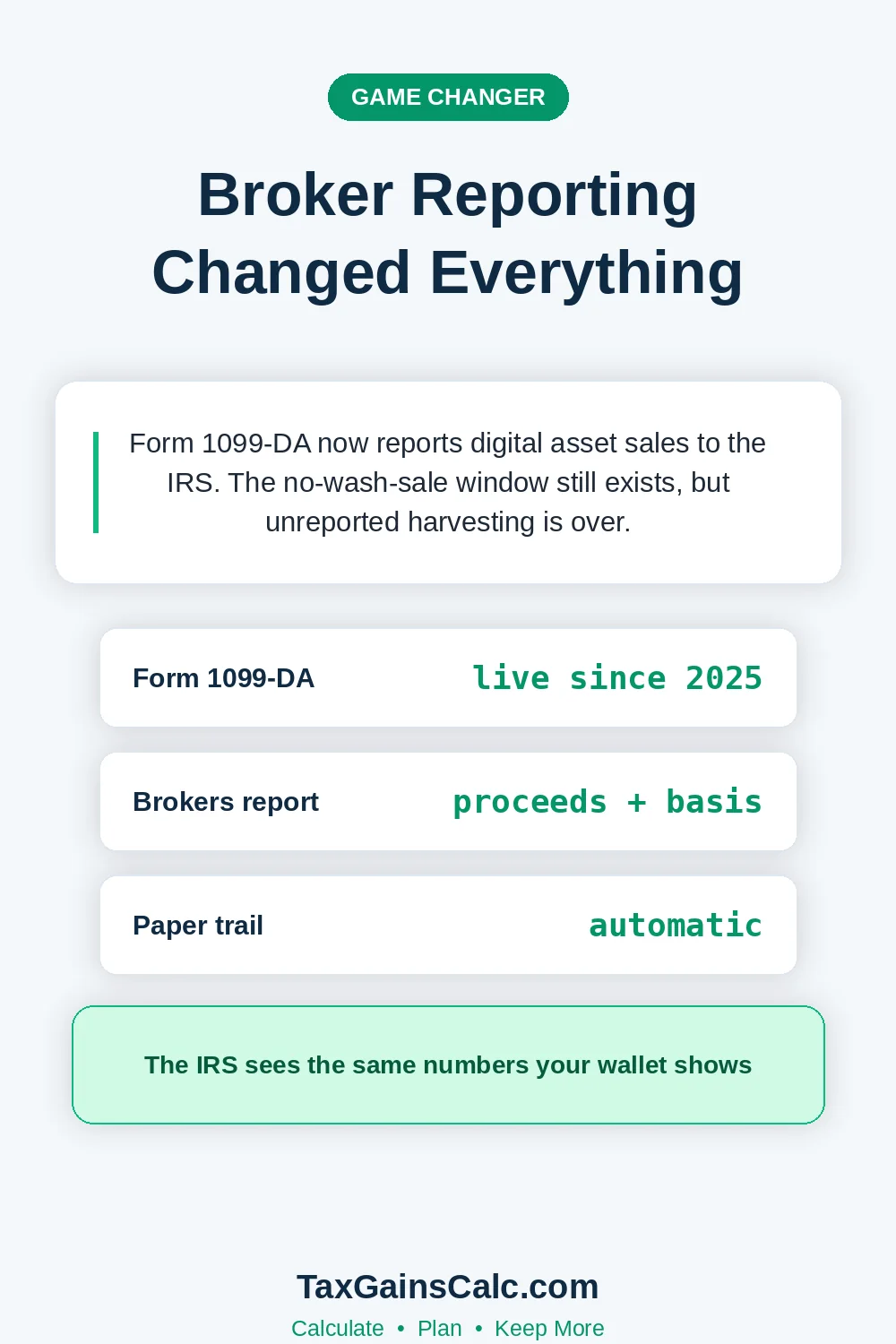 Losses that never appear on a broker statement still belong on your return.
Self-custody wallet activity still generates no third-party reporting of any kind today. Your own logs become the only proof of basis you have. Our crypto basis guide lays out the record-keeping requirements in full.
Congress repealed the DeFi broker reporting push during 2025, unwinding the planned expansion. Noncustodial wallets and most protocols still issue no tax forms at this point. Decentralized trading therefore leaves no 1099 trail behind for the time being.
Our DeFi tax guide explains that repeal's boundaries. Your self-reporting duties came through that repeal completely untouched. You still report every digital asset transaction exactly as before.
How Crypto Loss Harvesting Works Without the Rule
Harvesting crypto losses runs on the same netting logic that securities use. Selling a loser books the loss at the transaction's own timestamp. The very same forms and worksheets move those figures onto the return.
An immediate repurchase restores the whole position and keeps the loss recognized. Year-end netting then applies that loss against whatever gains you booked. That netting sequence works the same way at almost every income bracket level.
- Sell the losing position and recognize the loss in the same transaction.
- Rebuy immediately if you want continuous market exposure maintained.
- Net the loss against crypto gains first, then securities gains.
- Apply any remainder against ordinary income up to the annual limit.
- Carry forward everything unused into future tax years indefinitely.
Our harvesting guide covers the securities version of the same mechanics. Our carryover guide explains the multi-year rules.
The crypto version works identically, minus the wash sale boundary that constrains stock. That missing boundary is the entire difference between the two playbooks.
Worked Example: A December Harvest With Instant Rebuy
Picture a wallet that holds ether purchased for $30,000 and now worth only $18,000. Come December, that position shows a $12,000 unrealized loss. Numbers of this size are precisely what make year-end loss harvesting worth considering.
You sell the entire ether position and recognize the loss immediately. Minutes later, you rebuy the same ether at the going market price. The figures in the table just below trace every step of that exchange.
The recognized loss first absorbs gains from your earlier token trades. Whatever remains then moves on to stock gains sitting in your brokerage account. That ordering comes straight from the code's netting mechanics, not from crypto-specific rules.
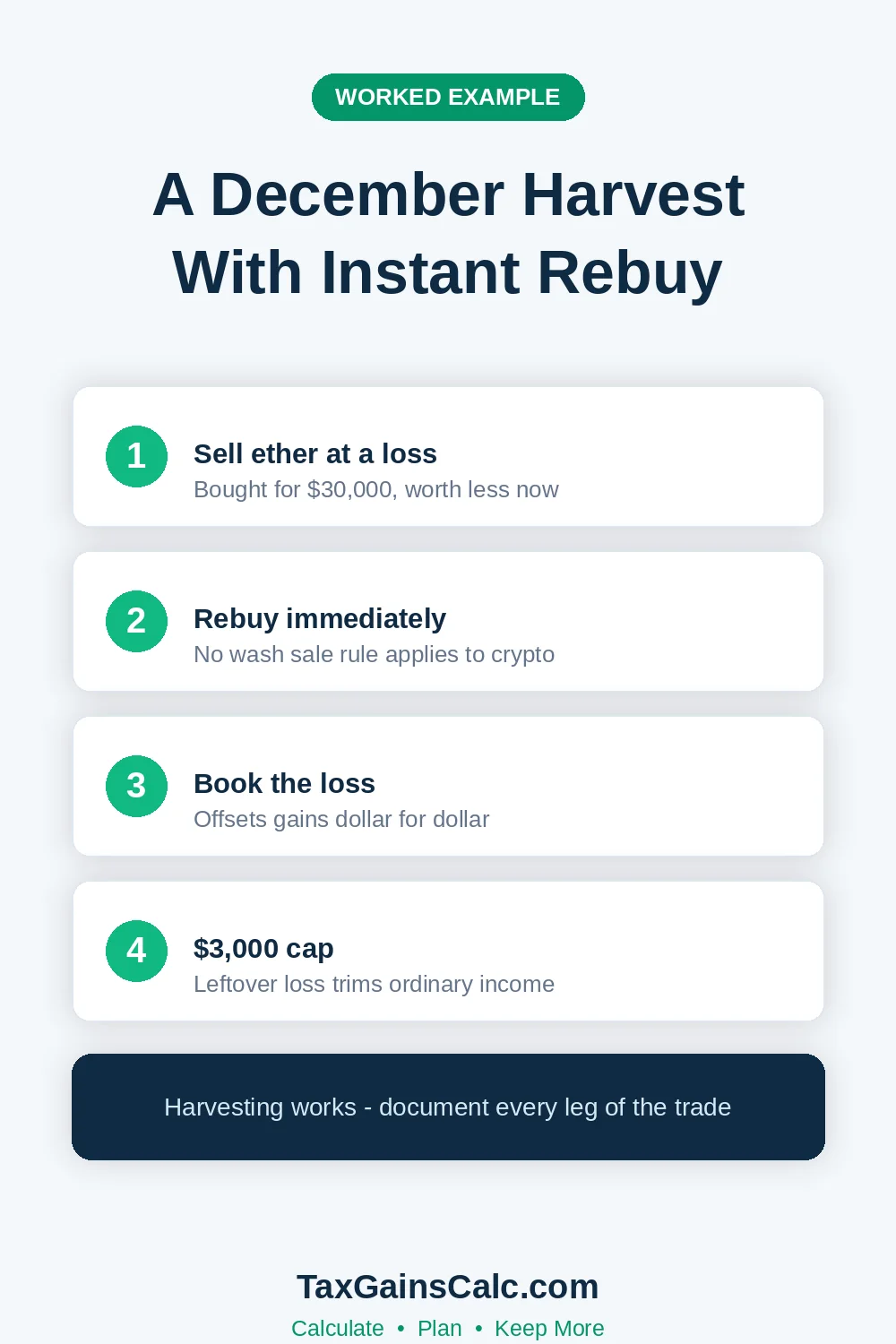 Any leftover remainder then reduces ordinary income, capped at the $3,000 annual limit. Anything beyond that carries forward into future years with no expiration. That carryover happens automatically once this year's netting has completely finished its work.
| Step | Action | Tax effect |
|---|---|---|
| sell ether | recognize $12,000 loss | loss enters netting |
| rebuy instantly | restore exposure | no disallowance today |
| net against gains | crypto then securities | reduces taxable gains |
| ordinary deduction | up to $3,000 | carryover continues |
Run that exact same trade with stock and the loss disappears entirely. The token version survives only because property sits beyond Section 1091's reach.
That single distinction preserves every dollar of the full $12,000 loss in this example. Our crypto gains guide covers the broader taxation rules.
The Legislative Direction Worth Watching
Bills extending the wash sale boundary to digital assets keep reappearing in Congress session after session. Several of those bills have spelled out exactly that expansion, word for word. The language rarely changes much from one version to the next.
As of this writing, none of them has completed the legislative process. The direction of these proposals has stayed remarkably consistent over time. Every version introduced so far points the same way: toward pulling tokens under the rule.
Harvesting done under today's law stays legitimate even if the rules change later. A future wash sale rule cannot retroactively disallow losses you already recognized. A completed sale locks that result in place as settled tax history.
Any new rules would apply only to sales made after their effective dates. So position your planning where a future change touches only future decisions. Harvesting you complete this year simply cannot be pulled back into the debate.
Broker platforms could adopt stricter logic of their own even before any statute passes. If that happens, platform-reported losses might diverge from your own calculations. A gap between the two numbers is something you would need to resolve.
Keep independent records that back up your position under either regime. Those records decide which number survives if the two ever conflict. Our 8949 reporting guide shows the filing mechanics.
A Risk Ladder for Different Harvesting Patterns
No two harvesting patterns carry the same audit and substance risk profile. The ladder below ranks those common approaches from most conservative to most aggressive. Where a given pattern sits on that ladder determines how defensible it stays.
| Pattern | Risk level | Notes |
|---|---|---|
| sell and rebuy via real market orders | lowest | real price discovery throughout |
| sell and rebuy across different venues | low | spread records, real trades |
| same-second automated reentry | moderate | substance questions arise |
| prearranged round-trip with one counterparty | highest | economic substance exposure |
 Conservative harvesting costs a bit more in spread and fees on both federal and state returns. Those extra costs buy documentation and substance that hold up under review. That durability matters most when a reviewer starts asking questions.
Aggressive patterns save pennies while opening the door to real doctrinal trouble. That trade-off rarely makes sense for a deduction this size. The ladder keeps its value whether or not any future rule ever passes.
A Crypto Harvesting Checklist for Year-End
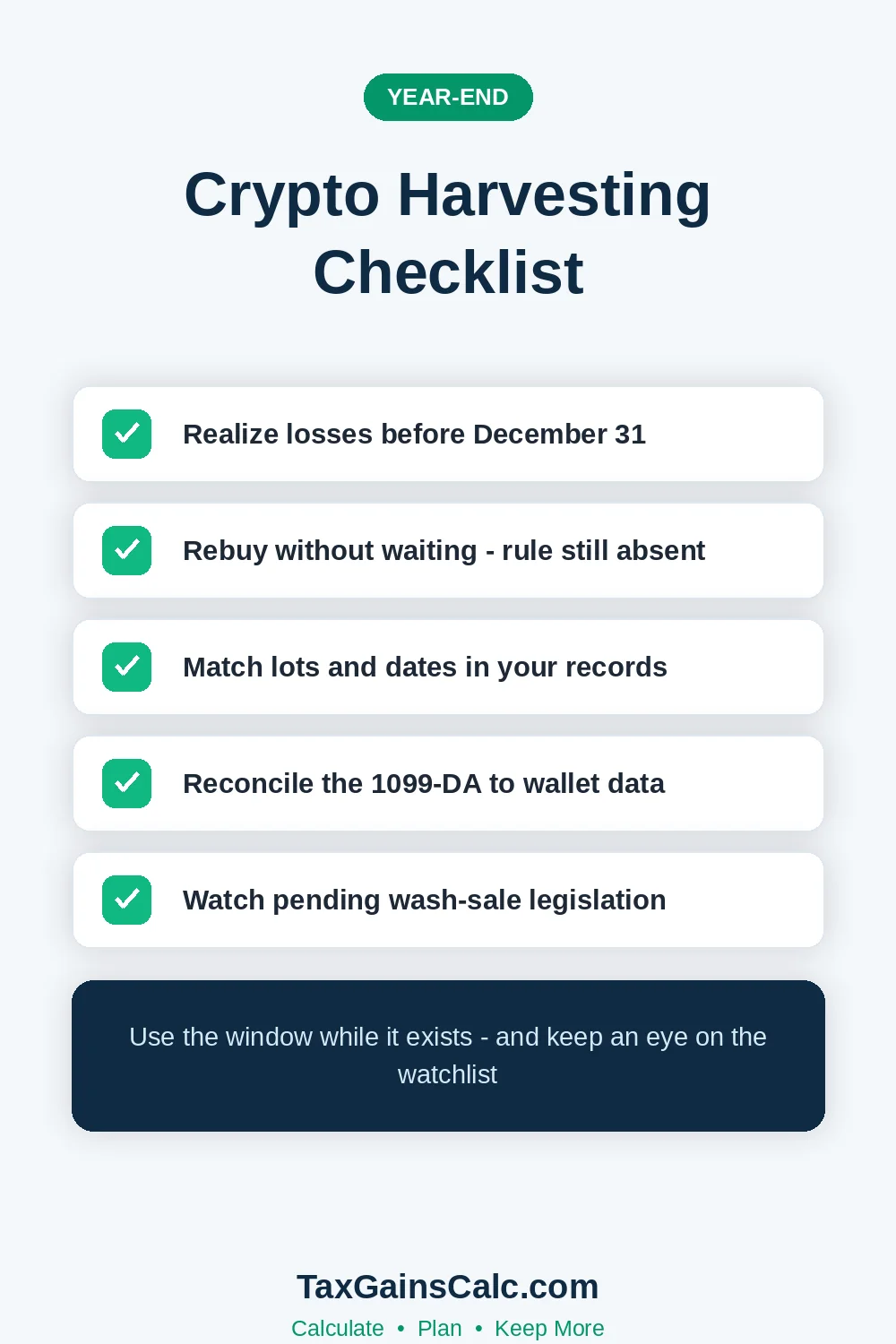
Work through each check below before you sit down for any December harvesting session. Every one of them protects the deduction you are about to claim. Skipping even a single step here puts the whole benefit at unnecessary risk.
- Classify every asset honestly as property or possible security first.
- Confirm your basis records match wallet and platform histories completely.
- Use real market orders with real price discovery for every leg.
- Document the purpose and mechanics of each harvesting transaction.
- Reconcile custodial 1099-DA figures against your own calculation before filing.
The IRS digital assets hub collects the current guidance in one place. The capital gains topic guide sets out every rate feeding into that arithmetic.
Crypto investors who harvest with discipline keep every dollar the law currently allows. That same discipline leaves them ready for any eventual rule change. Clean habits today mean no scrambling when Congress finally acts.

Wasim Akram
Wasim researches and writes every article on TaxGainsCalc, covering capital gains tax for everyday investors. Every figure is checked against primary IRS sources before it goes live.