Home Sale Documents Checklist: Records That Cut Tax
Every record that cuts your taxable home sale gain: purchase closing costs, improvement receipts, depreciation records, and Section 121 proof.

Home Sale Documents Checklist: The Direct Answer
Your taxable home sale gain shrinks only as far as your documentation proves. Three document types do that heavy lifting here: the closing statement, improvement receipts, and basis records.
Each one raises basis or lowers the amount the sale brings in.
Missing records convert fully deductible costs into taxable gain you simply donate to the IRS. The checklist below sorts every document into three phases: buying, owning, and selling.
Work through them in order and the file assembles itself.
Most homeowners overpay for one boring reason: the original purchase statement from years back is simply gone. Reconstruction rules exist for exactly this mess, yet rebuilt records never prove as much as original paperwork does.
Collect every item this checklist covers before the house ever reaches the market. After that point, every missing receipt costs you real money.
Phase One: Documents From the Purchase
Your basis story starts with the original closing statement, so guard that document for decades. Misplace it, and reconstruction becomes your only fallback. 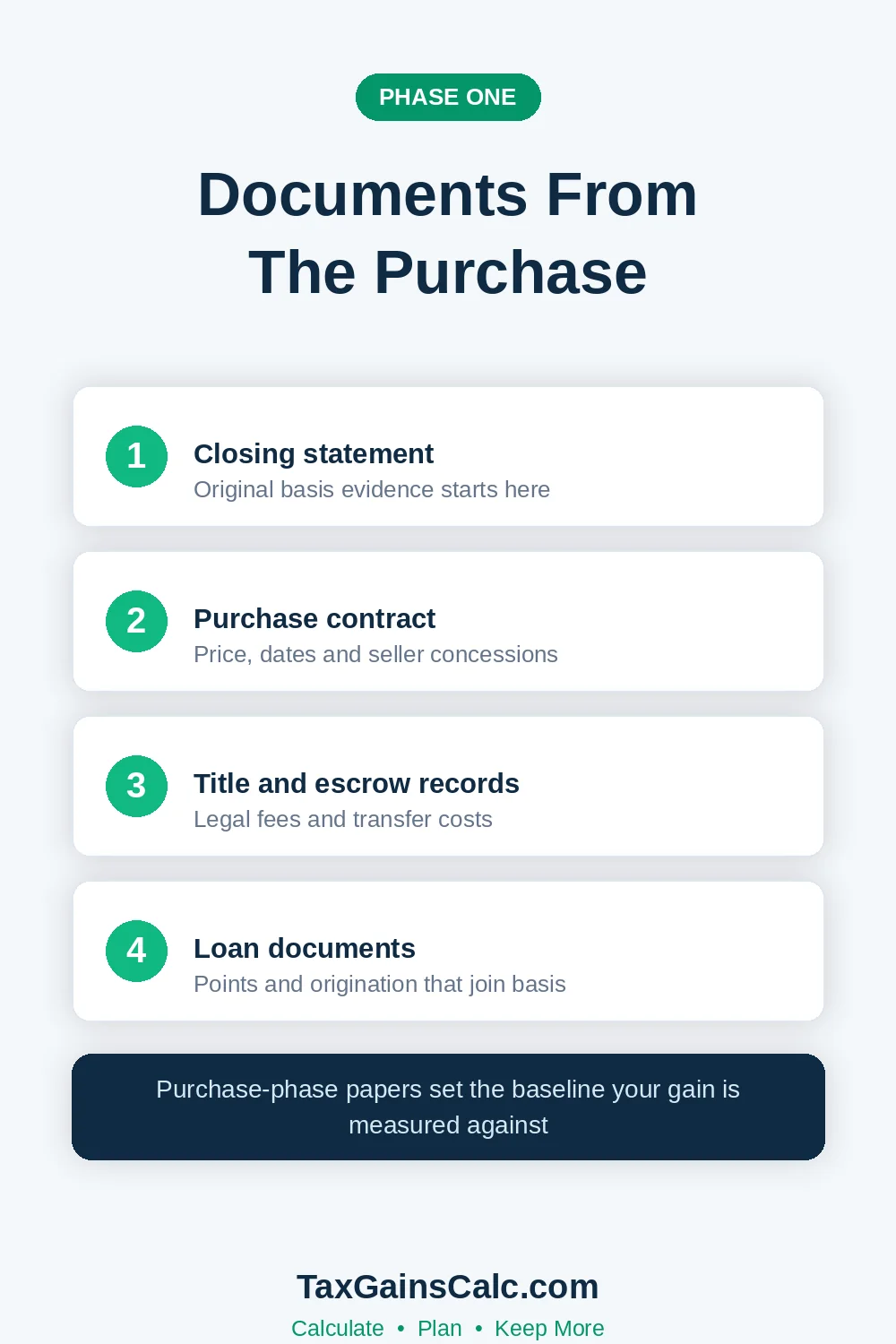 It records the purchase price plus the closing costs that add to basis.
Title insurance, legal fees, transfer taxes, and recording fees all belong in your basis file. Settlement charges listed on the closing disclosure flow straight into your basis.
Any closing line that reflects your purchase cost deserves the same treatment.
Keep the deed, the survey, and any seller-paid inspection reports in one labeled folder. Prorated property taxes split the year's bill, so note exactly which share you actually paid.
That split decides what the sale year lets you deduct.
Our cost basis guide explains which closing lines adjust basis. Treat that purchase file as the foundation every later document attaches to, from improvement receipts to the final settlement sheet.
File it alongside the deed so nothing wanders off.
Phase Two: Improvement Records During Ownership
Documented capital improvements raise your basis dollar for dollar, and every receipt you keep hardens the claim. A new roof, room addition, HVAC replacement, or renovated kitchen all qualify.
Keep paperwork even for projects you barely remember funding a decade later.
Landscaping that adds permanent value qualifies right alongside structural work too. Think mature trees or a new driveway, not seasonal flower beds.
Repairs that only restore function, like patching or repainting, never add anything to basis.
| Improvement (adds basis) | Repair (no basis change) |
|---|---|
| new roof replacement | patching a few loose shingles |
| kitchen renovation | repainting the same walls |
| HVAC system install | replacing a failed capacitor |
| room addition | fixing a leaking faucet |
Contractor invoices showing itemized labor and material lines hold up best. A one-line total with no detail raises auditor eyebrows.
Store them by year, with photos of the finished work attached. Date-stamped phone photos work fine as proof of completion.
Permits and final inspection sign-offs prove the work actually happened. Pull copies from your contractor or the local building department.
Our home exclusion guide shows how improvements interact with exclusions.
Depreciation Records for Office and Rental Stints
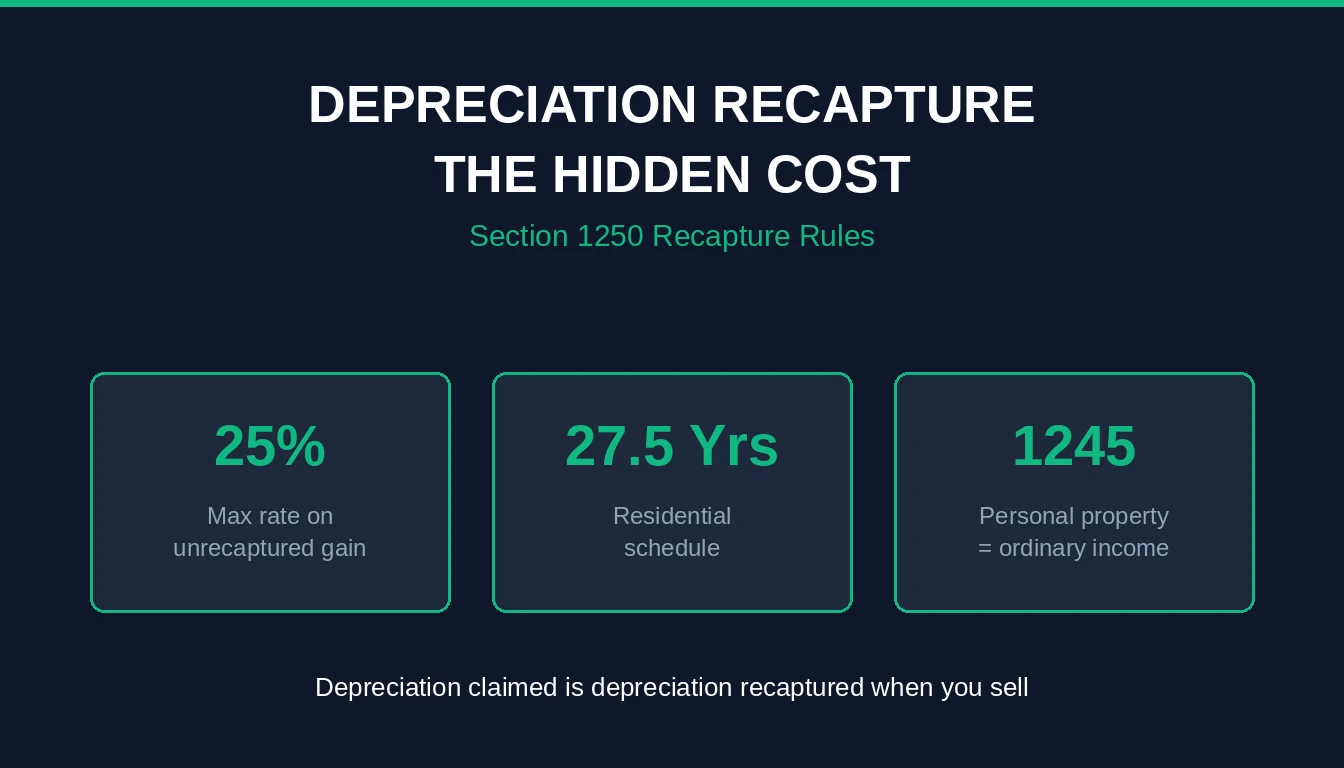
Depreciation deducted for the home from May 6, 1997 onward attaches a permanent recapture cost to the sale. Home office deductions and rental stints both create depreciation that counts as claimed.
You owe recapture on that figure even if the deduction saved you little.
That recaptured depreciation lands on the unrecaptured Section 1250 line, where rates run as high as 25 percent. Even the Section 121 exclusion cannot touch that depreciation portion. Plan for that bill before you price the sale.
Hunt down every Form 8829, rental schedule, and depreciation ledger before you list. Your preparer cannot price recapture without those actual figures. Our recapture guide prices the depreciation bill precisely.
Missing depreciation creates a trap because the law treats it as claimed regardless. Rebuild those numbers before the buyer signs a single page. Once papers are signed, the missing records only hurt you.
Phase Three: Documents From the Sale Itself
The closing statement from your own sale cuts the amount realized, line by line. Staging costs, transfer taxes, title charges, and agent commissions all come straight off the taxable gain your return reports. Keep every receipt from closing week, even the small ones.
Repair credits you give the buyer belong on that same settlement sheet. They work like selling expenses and shave the amount realized. Every legitimate line lowers the gain figure your Form 8949 and Schedule D end up showing.
The closing agent files Form 1099-S, which tells the IRS your gross proceeds. You receive your own copy of that form in the mail. Our 1099-S guide explains what that form means for sellers.
 Your return still has to compute the actual gain, with basis attached. The form shows proceeds; your basis math shows the real gain.
Reporting the bare 1099-S figure without basis invites a matching notice. The IRS computers compare those figures automatically every filing season.
| Sale document | What it proves | Where it goes |
|---|---|---|
| settlement statement | selling expenses | amount realized calculation |
| Form 1099-S copy | gross proceeds reported | IRS matching reference |
| repair credit invoices | buyer concessions | reduces amount realized |
| improvement receipts | basis additions | basis calculation |
Documents That Prove Your Section 121 Claim
The home sale exclusion shelters $250,000 for single owners and $500,000 for qualifying married couples. You qualify by owning the home and living in it during two of the five years just before selling.
Utility bills, registration records, and old tax filings all document the use test. Even months of statements help when dates get questioned. Our Section 121 guide explains both tests completely.
Married couples must each pass the use test to claim the full $500,000. Document both spouses' residence carefully if one of you traveled heavily for work. Hotel receipts and employer records can fill in those gap months later.
Keep records tying both spouses to the residence for every year the qualifying window spans. Paperwork for only one spouse leaves the other half of the claim exposed.
The IRS occasionally samples home sale filings to verify exclusion claims. A tidy paper trail makes those letters easy to answer.
Worked Example: Documentation Cutting a Gain
Picture a home selling for $500,000 after a long, well-documented ownership run. The owners kept every receipt along the way.
The original purchase price was $220,000, with another $4,000 in documented closing costs. Watch what those receipts do to the math.
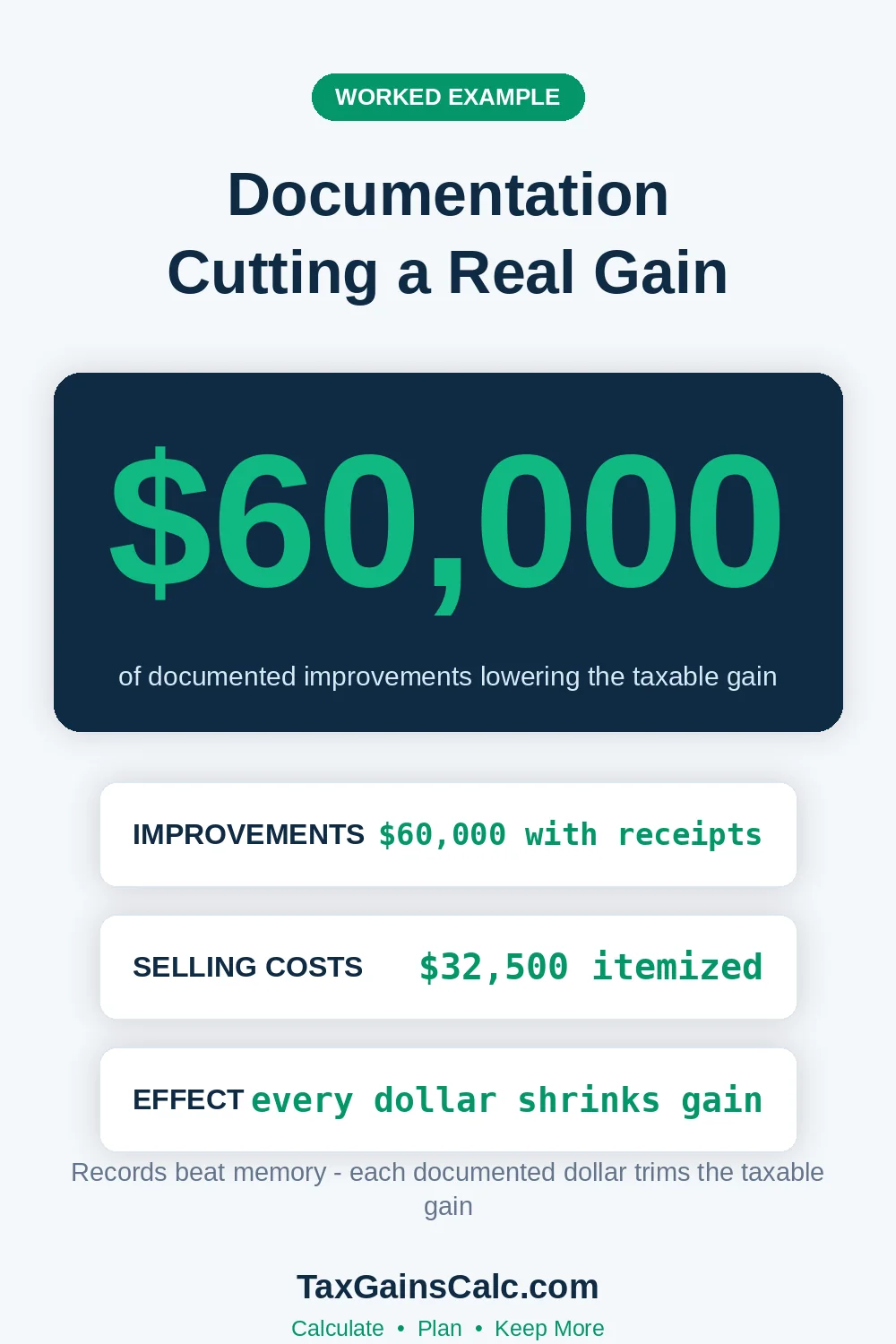
Improvements total $60,000, with a receipt on file for every major project. Roof, kitchen, and systems each carried their own paperwork.
Selling costs run $32,500, all itemized on the settlement statement. Agent commissions usually supply the biggest share of that figure.
With thin records, the owner could claim only the purchase price as basis, federal and state alike. The documented version properly adds the closing costs and every improvement dollar into basis. The difference between the two: $64,000 of basis you either prove or lose.
Full documentation pushes basis to $284,000, while selling expenses shave the amount realized down to $467,500. The taxable gain therefore lands at $183,500 before the exclusion ever gets a chance to apply. Every figure in the table below traces back to a receipt you kept.
| Line | Poor records | Full records |
|---|---|---|
| amount realized | $500,000 | $467,500 |
| basis claimed | $220,000 | $284,000 |
| taxable gain | $280,000 | $183,500 |
| gain after $250k exclusion | $30,000 | $0 |
Those records turned a $30,000 taxable gain into a fully excluded sale. The exclusion covered the rest, down to zero.
Our calculation guide reproduces the arithmetic step by step. 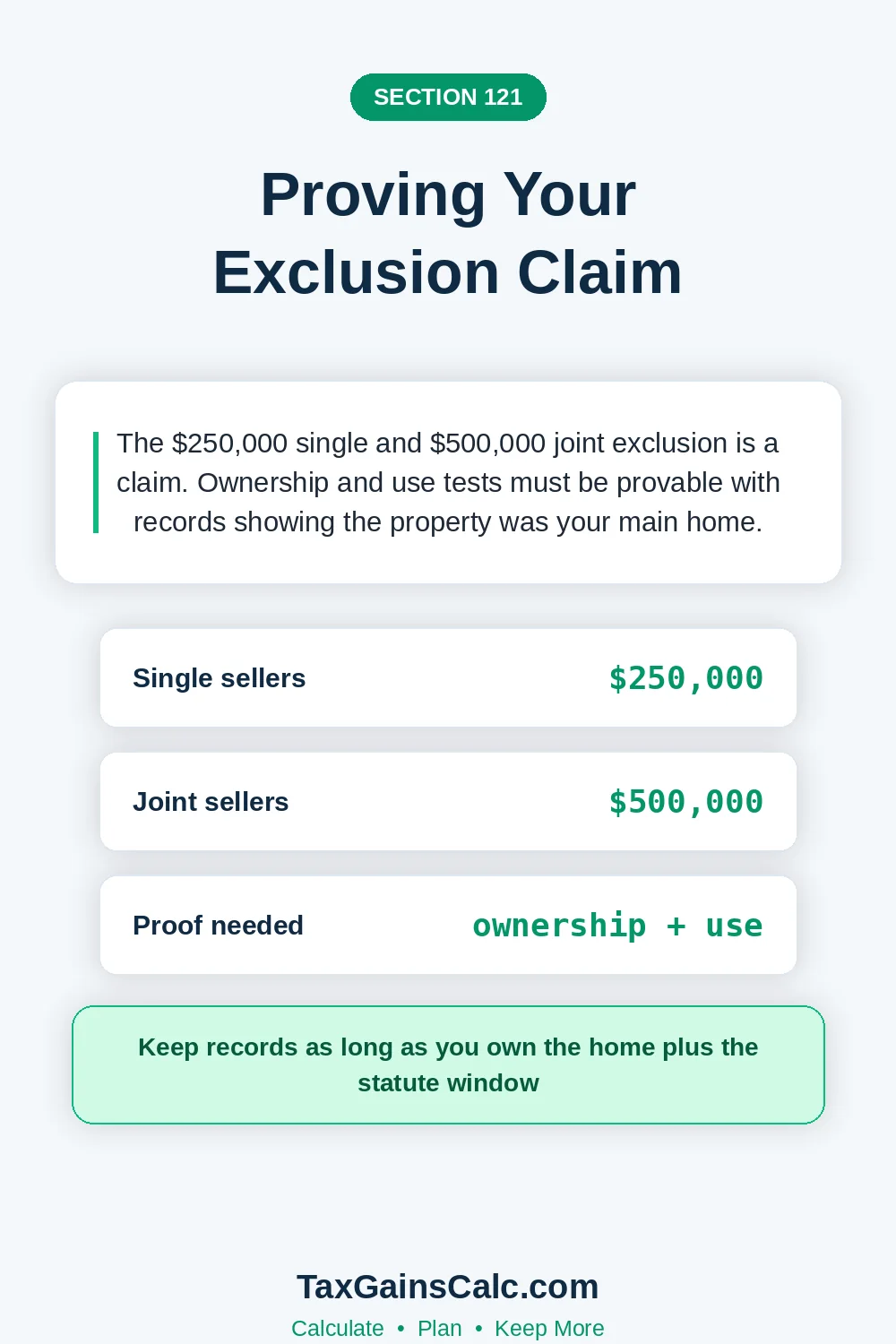 The exclusion did the final work only because the records did the first work.
How Long to Keep Every Home Sale Record
Hold onto purchase documents until three years have passed since you filed the sale-year return. That window gives the IRS time to match your reported gain to its copies.
Basis records deserve seven years or more, since audits can open surprisingly late. Audit windows for basis questions stretch well past the normal three.
Improvement receipts should ride along on that same extended timeline. Toss them early and you weaken the very basis you claimed.
Digital copies satisfy the retention rules once originals start to deteriorate. A legible scan counts; just keep backups in two places.
Scan everything into one folder structure, organized first by year, then by category, so nothing ever hides. Photograph each major project at completion and file the images beside their invoices. Future you, three years from now, will find it instantly.
Cloud storage also survives the house fires that destroy paper files completely. Paper originals can burn; a synced account cannot. Our selling guide assembles the full preparation timeline.
What Happens When Records Are Already Gone
Reconstruction still rescues real dollar value when the originals vanished decades ago. You will not recover everything, but partial still counts.
Contractor archives, permit offices, and appraisal districts can usually supply replacement documents. Most will copy their files for a small fee.
County assessor improvement histories often list major permitted projects, complete with dates. Search your county's parcel lookup before paying for anything.
Old insurance claims can document roofs and systems replaced years earlier. Claim files often include adjuster photos and contractor estimates.
Reconstructed basis gets far less benefit of the doubt than documented basis. An auditor's first question is always where the paper came from.
Reasonable estimates beat nothing, though auditors discount whatever lacks support. Expect haircut numbers on anything you cannot source.
Start reconstruction with county records, which are both free and authoritative. Then branch out to contractors and insurers for the rest. Our checklist approach works even when applied retroactively.
The Document Gaps That Cost Sellers the Most
Three document gaps show up in nearly every home sale file we review. Each one quietly converts deductible costs into extra taxable gain at the closing table. All three stay fixable if you start well before your closing date.
- Improvement receipts from the first five years of ownership, when the biggest projects happen.
- Refinance statements that document cash-out proceeds and new closing costs.
- Rental period depreciation schedules for the years a basement or whole home was rented.
Refinancing confuses many owners about which refinance closing costs ever adjusted basis. Both categories sit on the same settlement statement, side by side.
Cash-out proceeds sitting in your bank account never added a cent to basis. Money you pocketed is not money spent on the house.
The refinance fees that appeared on settlement statements often did adjust basis across the whole holding period. Sort that refinance paperwork into two piles before anything else: money you took out versus costs you paid.
Insurance claim files create a documentation opportunity most owners never think to use. The paperwork already lists dates, contractors, and amounts paid.
A hail-damage roof replacement paid by insurance still counts as your own improvement. Who paid the contractor doesn't change what the work added.
That insurance claim file already proves the work, the cost, and the dates, so you skip hunting down contractors. Our real estate sale guide covers more edge cases like these.
 One final habit protects sellers who plan multiple future real estate transactions. Photograph every room annually with dates embedded in the filenames.
The archive documents condition and improvements without any extra effort later. Sellers who adopt the habit build their files automatically across every ownership period.
A Pre-Listing Document Sprint for Sellers
Run this sprint during the two full weeks before the listing goes live. Most sellers can finish the whole thing in two focused weekends.
Each completed item either reduces gain or protects the exclusion claim. Skip one and the IRS gets to guess instead.
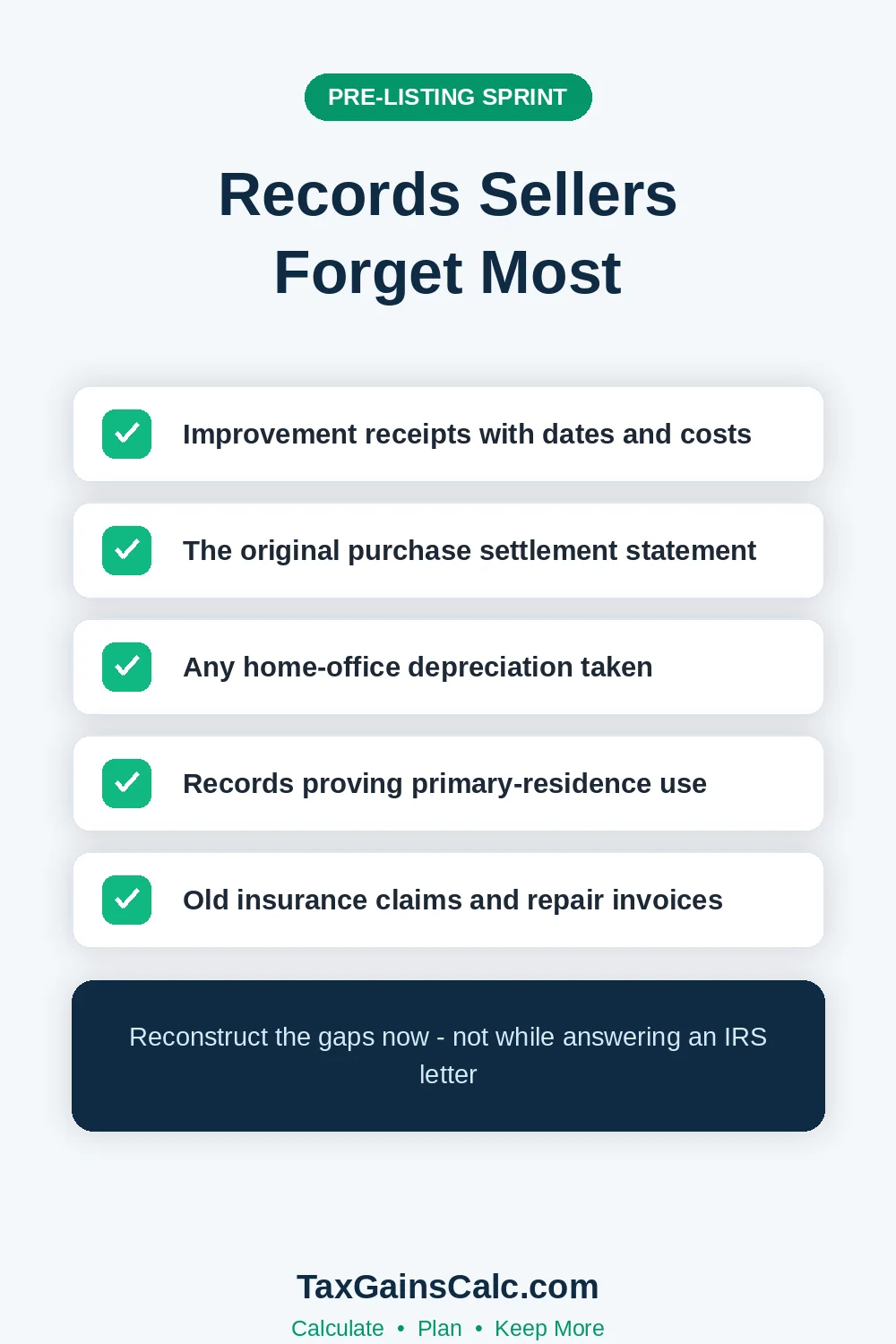
- Locate the original purchase closing statement and every refinance statement.
- Assemble improvement receipts by year, including permits and completion photos.
- Reconstruct any depreciation claimed from office or rental use periods.
- Confirm both spouses' use-test records when claiming the married exclusion.
- Create the digital archive before the closing agent requests anything.
The IRS home sale publication lists the reporting lines your records support. The basis details live in Topic 703 for deeper reference.
Sellers who finish this sprint list with confidence instead of dread. That peace of mind is worth the weekend of sorting. The documents you gather this month decide the tax bill two years from now.

Wasim Akram
Wasim researches and writes every article on TaxGainsCalc, covering capital gains tax for everyday investors. Every figure is checked against primary IRS sources before it goes live.