
Do I Owe Capital Gains Tax? A Self-Assessment Checklist
Run your sale through this five-question checklist: taxable event, basis, holding period, rate band, and offsets. Know what you owe before you file.

Start With the Taxable Event
You owe capital gains tax only after a taxable disposal: selling stocks, funds, bonds, or crypto, swapping one coin for another, or spending crypto, each above your basis. Checking balances, moving tokens between your own wallets, inheriting assets, and gifting them away trigger nothing this year. Topic 409 lays out the federal framework in plain language on IRS.gov.
Do I owe capital gains tax is the question investors ask most frequently each spring. The honest answer always starts with one single yes-or-no checkpoint before any math.
A capital gains tax only becomes possible when a taxable disposal actually occurred during the year.
A disposal means selling, swapping, spending, or otherwise giving up an appreciated asset entirely.
Checking an account balance or moving assets between your own accounts triggers nothing taxable. The self-assessment therefore begins by listing every disposal event from the past year.
This distinction saves enormous worry for people who simply moved money around internally. Repositioning holdings between two accounts you own is never treated as a sale.
The gain stays unrealized, and unrealized gains have never owed federal income tax.
Write down each event with its date before moving further down this checklist. The date controls the holding period and sometimes the applicable rate schedule too.
A simple five-minute event inventory makes every single later step dramatically faster and cleaner.
Investors with brokerage copies of every trade already hold most of this data. Export the annual realized gain and loss report before you write anything manually.
The export usually lists dates, proceeds, and basis inside one reusable spreadsheet file.
Business owners should separately inventory sales of equipment, vehicles, and partnership interests too. Those assets mix depreciation recapture with gain in ways the checklist flags later.
A separate column for business property keeps all the eventual forms organized correctly.
Rental property owners carry one more layer because depreciation reduces their basis yearly. The recapture portion gets taxed quite differently from the ordinary gain on appreciation.
Our detailed depreciation recapture guide explains that split in detail.
Events That Trigger Tax Versus Events That Do Not
 The table just below sorts typical investor moves into taxable and tax-free columns. Scan your own complete year against both columns before calculating anything at all.
Most people honestly discover they had fewer taxable events than they originally feared.
The vague fear itself often stops people from selling for entirely irrational reasons. A clear written checklist converts vague dread into a short concrete task list. Investors who run it once usually repeat the whole exercise every quarter afterward.
| Taxable Event | Non-Taxable Event |
|---|---|
| Selling stocks, funds, or bonds | Checking prices or account balances |
| Swapping one crypto coin for another | Moving crypto between your own wallets |
| Selling a home or rental property | Adding a beneficiary to an account |
| Spending crypto on goods or services | Receiving an inheritance outright |
| Exercising and immediately selling stock options | Gifting appreciated assets to charity |
Notice that gifting appears on the non-taxable side with one serious caveat attached. The recipient inherits your original basis and holding period along with the asset.
The gain does not vanish, it simply moves onto someone else's return instead.
Charitable gifts follow a much friendlier rule than personal gifts ever receive. Donating appreciated property directly to charity skips the embedded gain completely at sale. Our charitable giving guides cover the deduction rules that make this strategy work.
Crypto remains the single biggest source of genuinely surprise taxable events today. Every coin-to-coin swap counts as a complete sale under current IRS positions. The crypto capital gains guide digs into every one of those swap rules.
Reinvested dividends create taxable events too, even though no cash ever reached your hands. Fund capital gain distributions count as taxable income in the year they arrive. For the reporting side of those distributions, see the Form 1099-DIV guide.
Calculate the Actual Gain First
 Once a disposal exists, the calculation needs three inputs rather than a single one. You need gross proceeds, cost basis, and any selling costs like commissions or fees. The taxable gain is simply proceeds minus basis minus all allowable selling costs.
Basis questions cause the most errors in this step for newer investors everywhere. Reinvested dividends, stock splits, and inherited property all adjust basis in specific ways. Our cost basis methods guide walks through every common adjustment.
Home sales add their own set of basis adjustments many sellers forget. Improvements, purchase closing costs, and certain settlement fees all increase your original basis. Our checklist of home sale documents shows which receipts to save for basis proof.
Never round figures aggressively at this stage when actual records still exist somewhere. Small basis errors compound into much larger reporting mismatches against the brokerage copies. Reconcile every single figure against the 1099-B or 1099-DA before filing anything.
Brokers must now report cost basis on most securities they hold for you. Their reported numbers are usually correct but not always complete for transferred positions. Positions moved between brokers sometimes arrive with missing basis that you must supply.
Missing basis records can often be reconstructed without too much real pain involved. Old brokerage statements, purchase confirmations, and dividend histories rebuild the entire trail. Transfer agents also maintain shareholder records for stock purchased directly decades ago.
Check Your Holding Period Next
 The holding period decides which entire rate schedule applies to your calculated gain. Assets held twelve months or less create short-term gains taxed like wages. Assets held longer than one full year receive the preferential long-term schedule instead.
The counting convention is precise and genuinely worth memorizing for boundary situations. Count from the day after purchase straight through to the date of sale. A stock bought May 1, 2025 and sold May 2, 2026 is long-term.
This single date check often matters more than any other planning lever available. Choosing the wrong side of the one-year line can shift your rate by ten points or more. The holding period guide untangles boundary cases such as repurchase timing.
| Holding Period | Gain Type | Taxed At |
|---|---|---|
| 12 months or less | Short-term | Ordinary brackets, 10% to 37% |
| More than 12 months | Long-term | 0%, 15%, or 20% |
| Collectibles, any period | Long-term capped | 28% maximum rate |
| Inherited assets | Automatic long-term | Regardless of decedent's period |
Find Your Rate for 2026
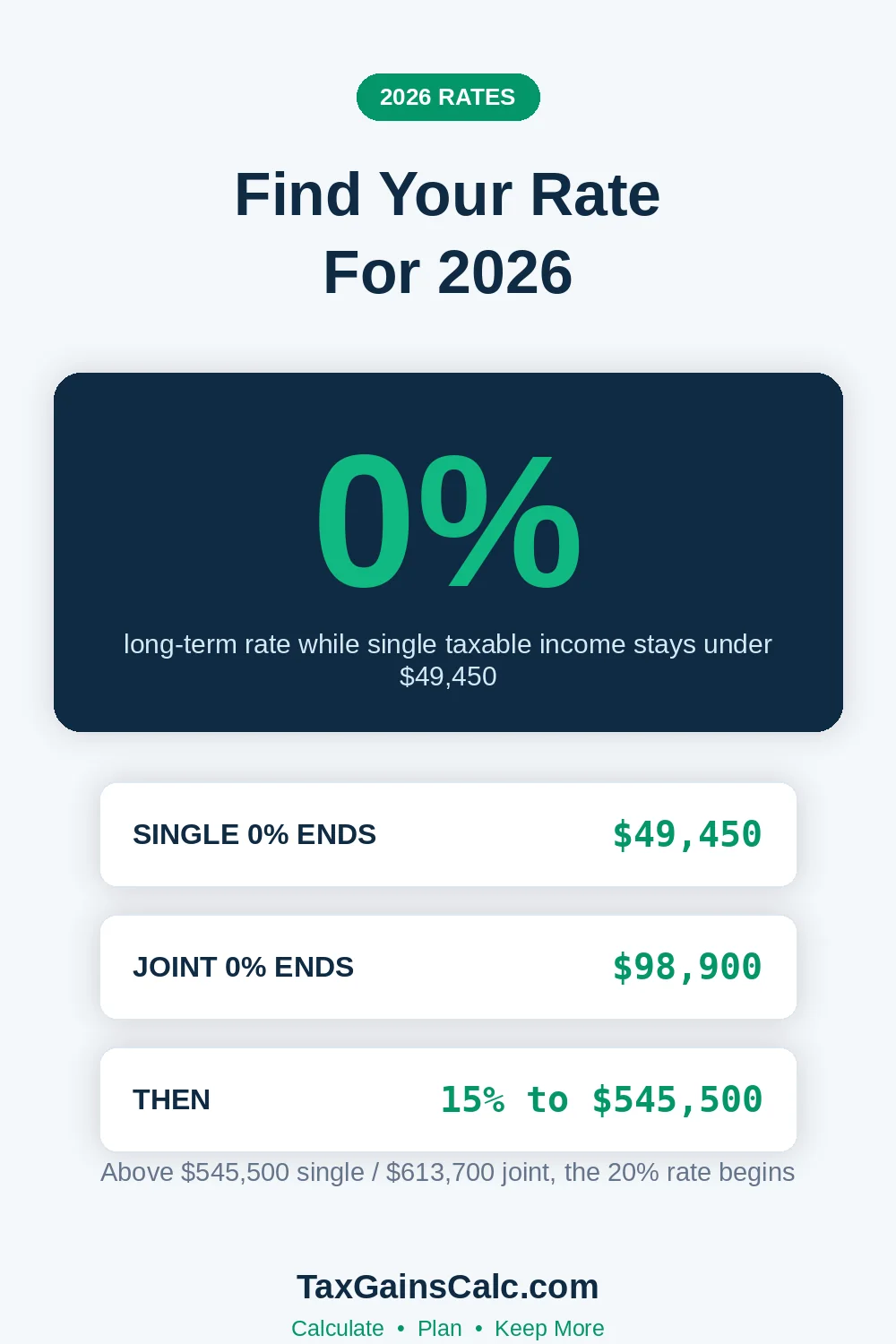
 Long-term rates depend on your total taxable income rather than the gain alone. Stacking wages, business income, and the gain together determines your applicable bracket. The 2026 thresholds shown below reflect the latest published IRS inflation adjustments.
These bracket thresholds matter most for people holding flexible income sources. Business owners and retirees control their taxable income far more than salaried workers. That timing control is what makes bracket management a genuinely useful planning tool.
| Long-Term Rate | Single Filer AGI | Married Filing Jointly AGI |
|---|---|---|
| 0% | Under $49,450 | Under $98,900 |
| 15% | $49,451 through $545,500 | $98,901 through $613,700 |
| 20% | Beyond $545,500 | Beyond $613,700 |
Each rate applies in income layers rather than jumping all at once. A gain that crosses a threshold gets taxed at both rates along the way. Our rates breakdown shows the layered math with complete examples.
Short-term gains instead stack directly on top of your existing ordinary income brackets. A large short-term gain can shove other income upward into costlier brackets as well. That bracket stacking effect makes mid-year sale timing genuinely valuable for careful planners.
Retirees managing annual withdrawals should pay special attention to the zero percent band. With deliberate income planning, part or even all of a long-term gain can land at zero. Our zero bracket harvesting guide demonstrates this exact technique with real numbers.
Married couples sometimes manage their rates better through filing status and timing choices. The single versus joint thresholds differ by less than double in several bands. Our detailed single versus married comparison guide quantifies those differences.
Run the Special Overlays
Several extra layers can attach to a gain once the base rate is known. The NIIT adds 3.8 percent when MAGI exceeds $200,000 for single filers. Joint filers face the same surtax above $250,000 of modified adjusted gross income.
Collectibles including most gold coins and artwork cap at a 28 percent long-term rate. Depreciated rental property carries a 25 percent unrecaptured section 1250 layer on depreciation. State income taxes then apply on top of every single one of those figures.
High-tax states treat all gains exactly like salary with zero preferential schedule. California rates reach 13.3 percent, while nine states levy nothing on gains at all. Our state comparison guide lays out every state's rates in one place.
Part-year residents face allocation questions that can complicate otherwise simple gains significantly. States split gains based on when the gain actually accrued in some cases. Solid documentation of residency dates becomes essential for any mid-year state move.
State domicile tests look at where your life centers rather than mere paperwork. Days spent in each state, home ownership, and family locations all count heavily. States aggressively audit people claiming exits right before very large asset sales.
The IRS Publication 550 remains the authoritative source for investment income questions. Bookmark the whole publication whenever an unusual asset type raises character questions. Ten quiet minutes of reading there settles most classification debates permanently.
Apply Exclusions and Offsets
Several powerful exclusions can shrink or even eliminate the entire calculated bill. The home sale exclusion erases $250,000 of gain for singles and double that jointly. The Section 121 guide details the ownership and use rules that unlock it.
Losses first cancel out gains, one dollar against another, before any rate applies. Beyond that, another $3,000 of leftover loss can absorb ordinary income each year. Remaining losses carry forward indefinitely under the loss carryover rules.
Qualified small business stock can exclude 50 to 100 percent of eligible gains entirely. Opportunity zone investments defer and sometimes fully eliminate gains on qualifying reinvestments. Both tax-advantaged paths carry strict holding requirements that deserve early planning attention.
Charitable remainder trusts offer a different flavor of gain management for larger estates. The trust sells appreciated assets without immediate tax and pays you steady income. Our CRT guide explains the trade-offs honestly.
Losses and exclusions apply in a strict statutory order that changes outcomes significantly. The netting rules group short-term and long-term amounts separately before combining them. The IRS digital assets guidance covers the crypto-specific netting questions directly.
Your Self-Assessment Scorecard
Run every single sale through this five-question scorecard before concluding anything at all. Each question maps back to a section of this guide for deeper reading. Investors who complete it faithfully rarely face April surprises on their gains.
| Question | If Yes | If No |
|---|---|---|
| Did a disposal occur? | Continue the checklist | No tax possible this year |
| Do you know the basis? | Compute the gain | Reconstruct records first |
| Held longer than 12 months? | Long-term schedule applies | Ordinary brackets apply |
| MAGI above $200,000 single? | Add 3.8% NIIT review | Skip the surtax layer |
| Any exclusion or loss available? | Apply before calculating | Proceed with gross gain |
The same scorecard works equally well for stocks, crypto, property, and business sales. More complex situations simply repeat the same five questions per individual disposal. One systematic afternoon of honest review typically covers an entire year of activity.
Print the table or recreate it in your notes app for quarterly use. Checking quarterly beats checking annually because the correction windows stay open much longer. Quarterly estimated payment decisions also get much easier with a running scorecard.
Couples should run this scorecard jointly because assets often span both returns. Transfers between spouses carry basis forward and rarely change the eventual taxable gain. Divorce changes the transfer picture entirely and usually warrants sitting down with a pro.
Modern tax software handles the mechanical forms once your inputs are correct. This checklist exists because software cannot know what you forgot to enter. Garbage inputs produce confident-looking garbage returns that audits eventually always discover anyway.
When Zero Tax Still Needs Reporting
Discovering a zero bill does not always end your reporting duty entirely. The sales still get reported on Form 8949 with Schedule D, offsets or not. Brokers report their side of every sale regardless of your final calculated number.
That digital asset checkbox on Form 1040 deserves a truthful answer every year. Answering yes after any crypto activity is required even when nothing was taxable. Complete silence on that question draws far more attention than the activity itself.
Document exactly how you reached zero so future years can reproduce the math. Loss carryforwards, exclusions, and basis adjustments all need durable written paper trails. Our reporting guide plus the Schedule D walkthrough cover the filing mechanics completely.
Finally, sketch out next year's exposure while every current figure still sits fresh in memory. Our capital gains calculator totals up the whole bill in seconds. Investors planning large sales should also read the legal reduction strategies guide before year end.

Wasim Akram
Wasim researches and writes every article on TaxGainsCalc, covering capital gains tax for everyday investors. Every figure is checked against primary IRS sources before it goes live.