
Capital Gains Tax on Cryptocurrency 2026: Trading, Mining, Staking & What the IRS Actually Tracks
Complete guide to cryptocurrency capital gains tax in 2026. Learn which crypto transactions are taxable, how short-term and long-term rates apply to Bitcoin and altcoins, reporting mining and staking income, DeFi tax implications, and strategies to reduce your crypto tax bill.

The Crypto Tax Wake-Up Call That Keeps Coming
I got an email from a guy named Derek back in April. He had been trading crypto for about three years — Bitcoin, Ethereum, a pile of altcoins — and he wanted to know why his capital gains tax on cryptocurrency looked nothing like what his cousin had warned him about. Derek assumed crypto was taxed once, at the end, like a stock portfolio. Instead he had triggered a taxable event almost every time he touched his wallet, and nobody had told him.
Here is the reality of cryptocurrency taxes that most people do not understand until it is too late: the IRS does not treat crypto like money. It treats it like property. Every disposal — selling, swapping, spending — is a sale of property, and the difference between what you paid and what it was worth when you got rid of it is a capital gain or loss. That single classification drives everything else in this guide.
What Counts as a Taxable Crypto Transaction
Let me break this down because this is where people get confused fast. The IRS treats cryptocurrency as property, so the question is never "did I cash out to my bank." The question is "did I dispose of any coins." Here are the situations where the answer is yes.
Selling crypto for fiat. You buy Bitcoin at $30,000 and sell it at $65,000. You have a $35,000 gain, long-term if you held over a year, short-term if you did not.
Trading one cryptocurrency for another. This is the big trap. You swap 2 Bitcoin for 60 Ethereum, and the IRS treats it as if you sold your Bitcoin for cash at market price and then used that cash to buy Ethereum. The gain on the Bitcoin sale is fully taxable even though you never touched dollars. If you have been moving between alts all bull market, you have been racking up reportable gains on every single swap.
Using crypto to buy goods or services. That $5 latte you bought with Bitcoin? You have to calculate gain or loss on the Bitcoin you spent. If the BTC was worth more than your basis, you generated taxable income by buying coffee. Nobody enjoys this math, but it is the law, and it applies to every purchase big or small.
Mining rewards. When you mine cryptocurrency, the fair market value of the coins at the time you receive them is taxable as ordinary income. That becomes your basis. When you later sell the mined coins, any additional appreciation is capital gain.
Staking rewards. Same deal as mining. When you stake Ethereum or any other proof-of-stake coin and receive rewards, the value at receipt is ordinary income. Sell those reward coins later and the second layer of tax shows up.
Airdrops and hard forks. If you receive new coins from an airdrop, that is ordinary income at fair market value on the day you have dominion and control over them. A hard fork that leaves you holding new coins works the same way when you can actually transfer them.
DeFi activities. Providing liquidity to a pool, earning yield from lending protocols, receiving governance tokens — most of these generate income events or disposal events, sometimes both in one transaction. DeFi reporting is still the wildest corner of this space; treat every protocol interaction as presumptively taxable until you have confirmed otherwise.
And here is the other side of the ledger, because moving coins around is not always a taxable act:
| Taxable event | Not a taxable event |
|---|---|
| Selling crypto for dollars or any fiat | Buying crypto with cash from a bank account |
| Swapping one coin for another, any amount | Moving coins between wallets you control |
| Spending crypto on goods or services | Holding through every dip and rally |
| Receiving mining, staking, or yield rewards | Receiving a gift of crypto (the giver may owe gift tax) |
| Earning airdrops and hard-fork coins | Donating appreciated crypto to a charity |
Keep that right-hand column close. Half the panic messages I get in April are about transactions that were never taxable in the first place.
Short-Term vs Long-Term: The Rate Difference That Matters
Whether your crypto gains are short-term or long-term capital gains makes an enormous difference in what you owe. If you held the cryptocurrency for one year or less before disposing of it, the gain is short-term and taxed at your ordinary income rate, which can be as high as 37% in 2026. If you held it for more than one year, it is a long-term gain and qualifies for the preferential rates of 0%, 15%, or 20%.
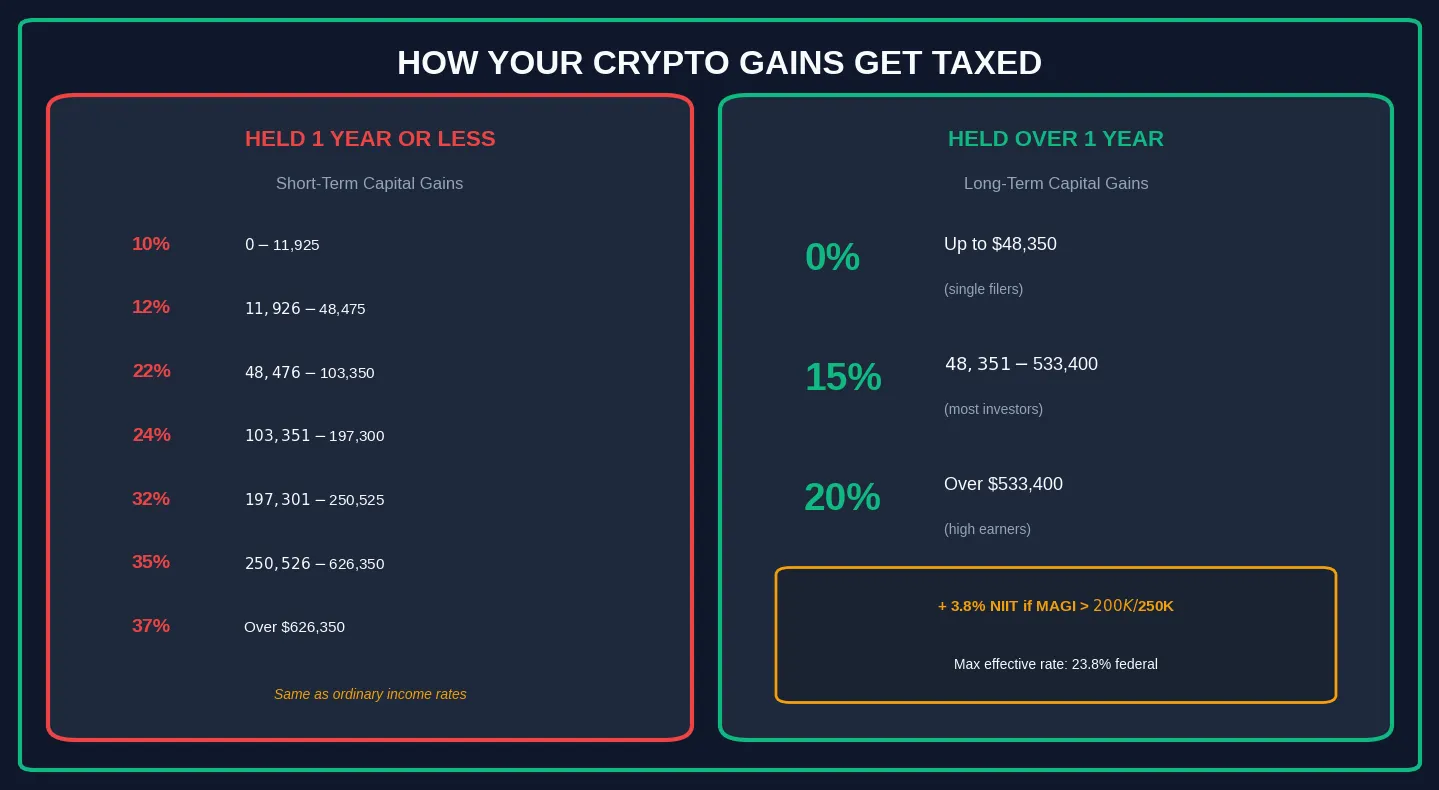
Let me show you how big this gap is with real numbers. Say you bought $20,000 worth of Bitcoin and sold it eleven months later for $50,000. That is a $30,000 short-term gain, and if you are in the 32% bracket, you owe $9,600 in federal tax. But if you wait just one more month — thirteen months total — that same gain becomes long-term. At the 15% rate, you owe $4,500. You save $5,100 by waiting about thirty days. Thirty days. That is a free $5,100 just for being patient.

The 0% long-term rate bracket applies to single filers with taxable income up to $49,450 and married couples up to $98,900 in 2026. If your total income including the crypto gain falls within those ranges, your long-term crypto gains are literally tax-free at the federal level. This is a strategy worth planning around, especially if you are considering selling a large position in a year when your income is lower than usual.
Capital Gains Tax on Cryptocurrency in 2026: The 1099-DA Gets Teeth
Tax year 2025 handed every US crypto broker a new form: the 1099-DA, which reported your gross proceeds from digital asset sales. Useful, but half-blind — the form knew what you sold for, not what you paid. For 2026 that changes. Brokers must now report cost basis on the 1099-DA for digital assets acquired after January 1, 2026, and the IRS will start matching those numbers against your return. The reconciliation window where everyone's records stayed quietly private is closing.

Two companion rules from the 2025 tax act matter just as much. First, you can now track basis per wallet instead of blending everything into one universal pool across all your accounts. Coins that came from an exchange without basis history no longer poison the numbers on your other platforms. Second, transfers between wallets or accounts you control are explicitly codified as non-taxable — they were never sales under IRS guidance, and now the statute says so. Do not panic when your 1099-DA lists destination wallet addresses; a transfer is not a disposal, and the form's transaction log is not a list of sales.
The gaps still matter. DeFi protocols, self-custody wallets, and overseas platforms issue no 1099-DA at all, which is exactly why the "no form, no tax" instinct remains as wrong in 2026 as it ever was. And where a broker's reporting falls short, backup withholding can enter the picture. Reconcile every 1099-DA against your own transaction log before you file — if the broker's basis number looks wrong, because coins migrated in from another platform, correct it on your 8949 rather than swallowing it.
Calculating Cost Basis for Crypto
Your cost basis is what you paid for the cryptocurrency plus any fees. Seems straightforward, but it gets complicated fast because most people buy at different prices over many months, split coins across wallets, and trade one asset for another. Every one of those batches is its own tax lot with its own basis and its own holding clock.
The IRS allows several methods for identifying which shares you sold: specific identification, first-in-first-out (FIFO), last-in-last-out (LIFO), and highest-in-first-out (HIFO). FIFO is the default. Specific identification lets you pick which lot you are selling, which is usually the best outcome — selling the lot with the highest basis lowers your gain, and selling the lot with the longest holding period converts the gain to long-term treatment. The catch is documentation: you need to identify the specific lot at the time of sale, in your records, not retroactively in April. Our mutual fund cost basis methods guide covers these same mechanics in a fund context if you want side-by-side examples.
Here is a practical example. You bought Bitcoin in three batches: 0.5 BTC at $28,000, 0.3 BTC at $41,000, and 0.2 BTC at $55,000. Today you sell 0.4 BTC at $60,000. Under FIFO, your basis is the first 0.4 BTC: the 0.5 BTC lot covers it, so basis is 0.4 × $28,000 = $11,200, and your gain is $24,000 − $11,200 = $12,800. Under HIFO, you sell the $55,000 lot first: 0.2 BTC at $55,000 plus 0.2 BTC at $41,000, giving basis of $19,200 and a gain of only $4,800. Same sale, $8,000 difference in taxable gain, purely from lot selection.

What If You Did Not Track Your Basis?
This is where a lot of people find themselves, and it is not a great place to be. If you cannot document what you paid, the IRS can treat your entire sale proceeds as gain. Reconstructing basis after the fact is possible — old exchange statements, bank records showing deposits to Coinbase, blockchain history showing when coins arrived — but it is hours of tedious work that a simple spreadsheet habit would have avoided.
Exchange records can help reconstruct your basis, but many people trade across multiple platforms, and coins that moved between them carry basis histories that never traveled with the coins. That is precisely the problem the 2026 per-wallet basis rule is designed to contain. Start whatever reconstruction you need now, before the filing season, not the week before your CPA's deadline.
How to Report Crypto on Your Tax Return
Capital gains from crypto go on Form 8949 and then flow to Schedule D, exactly like stock capital gains. Every disposal gets a line: what you sold, when you bought it, when you sold it, proceeds, basis, gain or loss, and whether the gain was short-term or long-term. One hundred swaps in a bull market means one hundred lines. Your Form 1040 also asks, under penalty of perjury, whether you received, sold, or exchanged any digital assets during the year — answer it honestly, every year.
Mining and staking income gets reported differently. It goes on Schedule C if you are doing it as a business, or on Schedule 1 as other income if it is casual. The distinction matters for self-employment tax: a serious mining operation pays SE tax on its rewards, a hobby miner does not, but the IRS applies strict factors when deciding which side of that line you are on. From 2026 onward, also check any 1099-DA against your own numbers before you file — brokers now report basis for coins acquired after January 1, 2026, and mismatched numbers between your return and the form are the kind of thing that generates automated notices.
For the full walkthrough of these forms, our guide on how to report capital gains on your tax return covers every line and box.
The NIIT Stacking on Top
If your modified adjusted gross income exceeds $200,000 (single) or $250,000 (married filing jointly), the Net Investment Income Tax adds another 3.8% on top of your capital gains. Crypto gains count as net investment income, so a big sale in a high-income year can push your effective federal rate to 23.8% on long-term gains or 40.8% on short-term ones before your state takes its share. Our state capital gains tax rates guide shows what your state adds, and in California the combined load on a short-term crypto gain can exceed half the profit.
Wash Sale Rules and Crypto: The Rule That Still Does Not Apply
Here is something that catches crypto traders constantly — just not in the direction most articles claim. The wash sale rule disallows a loss if you buy a substantially identical security within 30 days before or after the sale. For stocks, this is pretty clear: selling Apple at a loss and buying Apple back the next day is a wash sale. For crypto, you can sell Bitcoin at a loss, buy it back five minutes later, and claim the loss deduction. That remains one of the few structural tax advantages crypto holds over traditional investments.
Let me be precise, because a lot of secondary sources get this wrong: the wash sale rule lives in Section 1091 and reaches only stock and securities. The IRS has classified digital assets as property since Notice 2014-21, and as of 2026 no law has extended wash sale treatment to property. You may see claims that the Inflation Reduction Act closed this in 2023 — it did not. Congress has floated the idea repeatedly, and a future bill could change the answer overnight, so verify the current state of the law before you build a strategy around it.
The edge cases are where real care is needed. A spot Bitcoin ETF is a security, so trading an ETF at a loss does engage the wash sale rule even though direct coin-to-coin trades do not. Sell the ETF and rebuy actual Bitcoin, or the reverse, and you are mixing the two regimes — talk to a professional before assuming either way. Our detailed guide on the wash sale rule covers the 30-day window and the substantially-identical question on the securities side.
Tax-Loss Harvesting With Crypto
Because the wash sale rule still does not reach crypto, tax-loss harvesting strategies work here with a freedom stock traders would envy. You can sell a losing position, bank the loss, and buy the same coin right back — the loss stands, and your market exposure never skips a beat. A few practitioners still rotate into a different coin out of caution while Congress keeps revisiting the issue, and if that is your preference, sell your losing Ethereum and park the proceeds in Solana for a month. Same economic goal, zero ambiguity in the file.
Crypto is actually a better candidate for tax-loss harvesting than stocks in one way: the volatility creates more opportunities. In a typical year, Bitcoin might swing 50-70% between its high and low. That means frequent dips where you can harvest losses, especially if you are dollar-cost averaging and have multiple tax lots at different basis levels. I had a client who harvested about $35,000 in crypto losses in a single year by systematically selling losing positions in December and rebuying immediately. Those losses offset his gains from selling some winning stock positions, and his total tax bill dropped by over $7,000.

Strategies That Actually Reduce Your Crypto Tax Bill
Hold for Over a Year
I know I sound like a broken record, but the rate difference between short-term and long-term is so dramatic that it overshadows every other strategy. Wait the full year. If you are up 200% on a coin and the one-year mark is three weeks away, just wait. The tax savings alone justify the patience.
Harvest Losses Strategically
Go through your portfolio in late November or early December. Identify positions that are underwater. Sell them to lock in the loss, then rebuy the same coin or rotate into a different one — both routes stay open while wash sale rules keep clear of crypto. You can deduct up to $3,000 in net capital losses against ordinary income each year, and excess losses carry forward indefinitely.
Offset Gains With Losses Across Asset Classes
Crypto losses can offset stock gains and vice versa. Capital gains and losses are netted together across all your investments, so if you had a great year in the stock market but some crypto losses, those crypto losses directly reduce your stock gain tax bill. If crypto was your winning sector this year, the same netting lets harvested stock losses soften the gain.
Use Tax-Advantaged Accounts
A growing number of retirement platforms now allow you to buy Bitcoin and other cryptocurrencies in a self-directed IRA. Gains inside an IRA are tax-deferred — no capital gains tax, no reporting, no Form 8949. You still owe income tax when you withdraw in retirement, but you avoid the annual tax drag on trades. Not ideal for everyone, but worth considering if you are a frequent crypto trader.
Track Everything From Day One
Seriously. Use a crypto tax software like CoinTracker, Koinly, or TaxBit. Connect all your exchanges and wallets. Let the software track your basis, your gains, your income from staking and mining. Trying to reconstruct three years of crypto transactions from scratch is a nightmare I would not wish on anyone. With brokers reporting basis on the 2026 1099-DA, your own ledger is now the cross-check, not the only source. The cost of the software is deductible as a tax preparation expense, and it pays for itself many times over in accurate basis tracking alone.

Report Everything, Even If You Did Not Get a 1099
The IRS receives more information about crypto transactions than ever before. The 2021 Infrastructure Act requires exchanges to report transaction data, the 1099-DA now carries cost basis for 2026 acquisitions, and the IRS has used John Doe summons to obtain customer records from major exchanges. DeFi and self-custody activity still arrives with no form attached — but the digital asset question on Form 1040 is answered under penalty of perjury. If you had taxable crypto transactions and you do not report them, the matching algorithms are increasingly likely to find out. Penalties for underreporting run 20% of the tax owed for negligence and 40% for fraud. Not reporting is not a strategy. It is a risk.
Frequently Asked Questions
Do I owe capital gains tax on crypto if I never cashed out to dollars?
Yes. The taxable moment is the disposal, not the conversion to dollars. Swapping Bitcoin for Ethereum, spending crypto on a purchase, or trading one altcoin for another all count as sales of property at fair market value. Only buying crypto with cash and holding it in a wallet you control stays outside the tax net.
Are transfers between my own crypto wallets taxable?
No. Moving coins between wallets or accounts you control is not a disposal, and the 2025 tax act codified that treatment directly in the statute. Your basis and holding period travel with the coins. A 1099-DA may list the destination wallet address, but a transfer logged there is not a sale you need to report as a gain.
Does the wash sale rule apply to cryptocurrency?
Not in 2026. Section 1091 covers stock and securities, and the IRS treats crypto as property, so selling at a loss and rebuying immediately remains allowed for direct coin holdings. Spot Bitcoin ETFs are securities and do fall under the rule, so mixing ETF and coin trades needs professional input. Legislation to change this has been proposed more than once, so check current law before your year-end harvest.
What is Form 1099-DA and does it include my cost basis?
It is the broker reporting form for digital asset transactions introduced under the Infrastructure Act reporting rules. For 2025, brokers reported gross proceeds only. Starting with 2026 transactions, brokers must also report cost basis for digital assets acquired after January 1, 2026. Reconcile every 1099-DA against your own records, because coins transferred in from other platforms can leave the broker's basis incomplete or wrong.
How are staking rewards taxed?
Rewards are ordinary income at their fair market value on the day you receive them, reported alongside your other income. That receipt-day value becomes the basis of the reward coins. When you later dispose of them, the difference between the sale price and that basis is a capital gain or loss, short-term or long-term depending on how long you held the rewards.
What happens if I do not report small crypto gains?
The digital asset question on Form 1040 is answered under penalty of perjury, and the IRS matches 1099-DA filings against returns automatically. Underreported amounts trigger accuracy penalties of 20% of the tax owed, rising to 40% in fraud cases, plus interest. There is no de minimis exemption for crypto disposals — even a $40 swap is reportable.
The Bottom Line
Cryptocurrency taxes are more complex than most investors expect because almost every transaction is taxable, the record-keeping burden is heavy, and the rules keep evolving. The biggest thing you can do for yourself is hold positions for over a year to qualify for long-term rates, track your cost basis from the moment you buy, and harvest losses strategically. Swapping coins is not a tax-free move — it is a disposal event, and the IRS expects you to report it. Mining and staking income is ordinary income at fair market value when you receive it. NIIT and state taxes can push your combined rate past 40% if you are a high earner. And wash sale rules still stay off crypto, so the sell-and-rebuy loss play remains available — until Congress says otherwise. Plan your trades, keep your records, and file accurately. With the 1099-DA now carrying basis, the IRS is watching this space more closely than ever.
Fact-Checked & Reviewed
This article was written and fact-checked by Wasim Akram, Founder & Lead Researcher at TaxGainsCalc. Every rate, threshold, and rule referenced is verified against IRS publications and current tax law as of the date published. Tax laws change frequently — always consult a qualified tax professional for advice specific to your situation.
Disclaimer: This article is for informational purposes only and does not constitute tax, legal, or financial advice. Tax laws and regulations change frequently, and the information presented here may not reflect the most current updates. You should consult with a qualified CPA, tax attorney, or financial advisor before making any tax-related decisions. TaxGainsCalc is not responsible for any actions taken based on the information provided in this article.
Continue Reading

Wasim Akram
Wasim researches and writes every article on TaxGainsCalc, covering capital gains tax for everyday investors. Every figure is checked against primary IRS sources before it goes live.