
Capital Gains Tax vs Dividend Tax: Key Differences Explained
Both use 0%, 15%, and 20% rates, but timing control, qualification windows, and special rules differ. Compare capital gains and dividend taxes side by side.

Two Different Taxes for Two Income Types
Capital gains tax applies only when you sell an asset, while dividend tax applies whenever a company pays you. Both receive preferential rates of 0, 15, or 20 percent, but the qualifying clocks differ: more than one year of holding for gains, a 61-day window for dividends. Topic 404 covers the dividend side of this comparison in official terms.
Capital gains tax vs dividend tax confuses investors because both sound like investment income. They are taxed under related but genuinely different rule sets at the federal level.
Mixing them up produces wrong expectations and sometimes genuinely wrong tax filings overall.
Capital gains only arise once an asset actually sells above your basis. Dividends arrive as distributions paid to you while you still own the shares.
That timing difference drives almost every other rule distinction between the two taxes.
This guide compares both taxes across rates, holding periods, reporting forms, and planning moves. Each section below ends with the practical takeaway that investors actually need most. Real numbers used throughout make all the comparisons concrete rather than merely theoretical.
Everything starts with the disposal because the tax system only taxes realized events. Paper gains inside an untouched portfolio never appear on any return anywhere on any federal return.
Investors who never sell can defer this tax for their entire lives.
What Counts as a Capital Gain
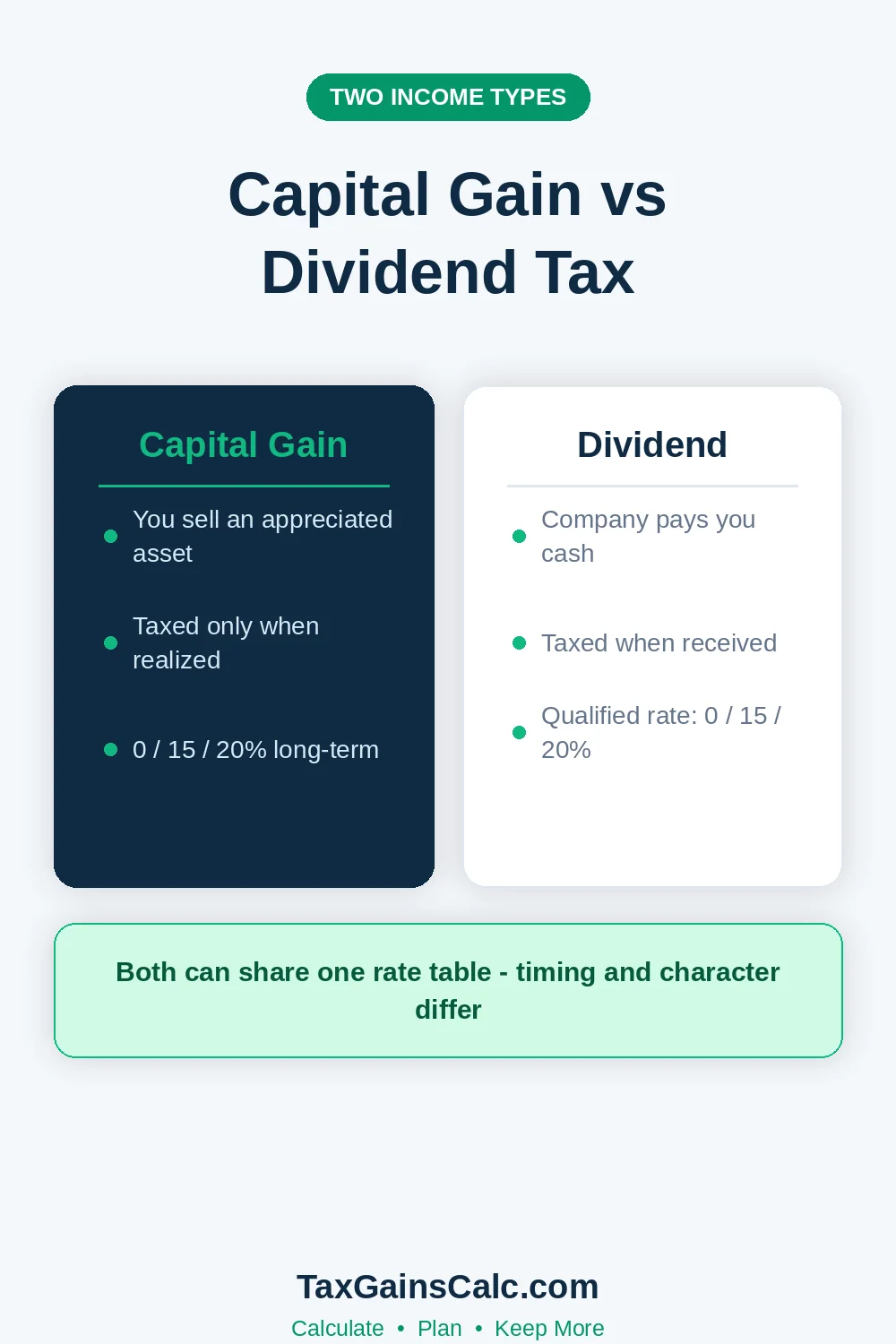 A valid capital gain requires both a disposal event and a realized profit calculation. Selling stock, swapping crypto, or selling property all create that taxable gain moment.
Until that moment arrives, appreciation remains unrealized and completely untaxed.
The taxable gain equals sale proceeds minus basis minus any allowable selling costs. Basis starts at purchase price but adjusts through splits, reinvestments, and improvements later.
The calculation guide spells out that formula with worked examples.
The holding clock attached to each position then sorts every gain into one of two rate buckets. Assets held one year or less take ordinary rates while longer holdings get preferential treatment.
The holding period rules deserve a careful read before major sales.
Dividends behave differently because companies initiate them through board declarations each quarter. Shareholders simply receive the cash and owe tax on the receipt itself on the payment date.
No selling decision or basis calculation ever enters the dividend picture anywhere in the process.
What Counts as a Dividend
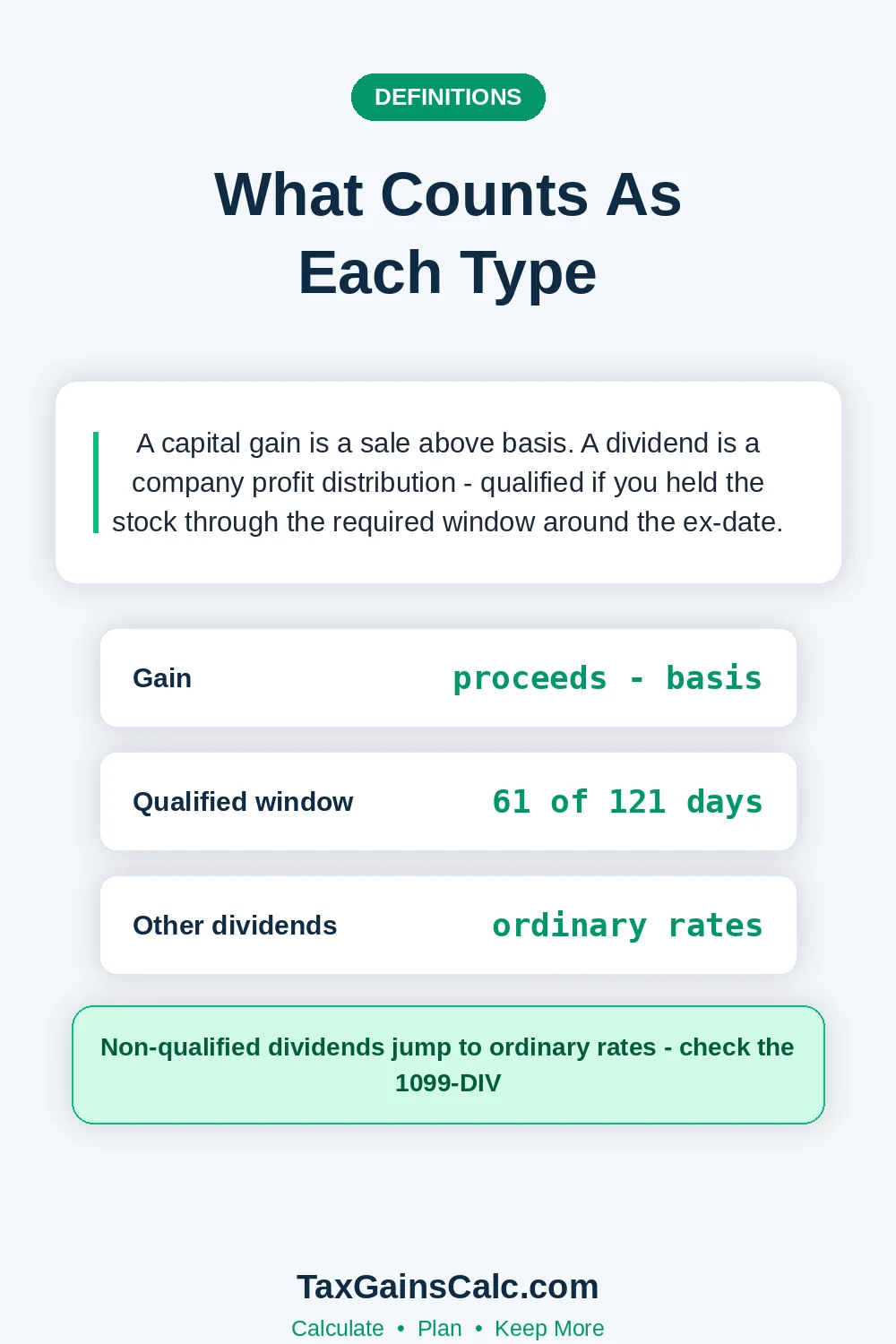 Dividends are corporate distributions paid from company earnings to current shareholders. Ordinary dividends include most REIT distributions, bond fund payouts, and foreign company payments too.
Qualified dividends instead receive preferential treatment when specific holding period rules are met.
Qualification demands holding the actual stock for sixty-one full days minimum. The measuring window spans a 121-day stretch that starts before the ex-date.
Investors who trade around ex-dates lose the preferential rate on those specific payouts.
One hybrid category deserves its own mention: the capital gain distributions that mutual funds pay out. Funds pass through their own realized gains to shareholders as long-term amounts.
Reporting mechanics for those payouts live in our 1099-DIV guide.
| Feature | Capital Gains | Dividends |
|---|---|---|
| Trigger | Sale or disposal | Company distribution |
| Preferential condition | Held over 12 months | Held over 60 days |
| Preferential rates | 0% / 15% / 20% | 0% / 15% / 20% |
| Ordinary treatment | Short-term gains | Non-qualified dividends |
| NIIT applies | Yes | Yes |
The alignment happened deliberately through legislation rather than through any administrative accident back in 2003 originally. Congress chose to tax both preferential categories under one shared schedule under one unified schedule. Any future rate reform would likely preserve that unified structure again based on this history.
Where the Rates Align
IRS Topic 409 lays out the shared rate structure for both. Income thresholds match because both schedules follow the same qualified dividend rules. Every current threshold sits inside our rates breakdown.
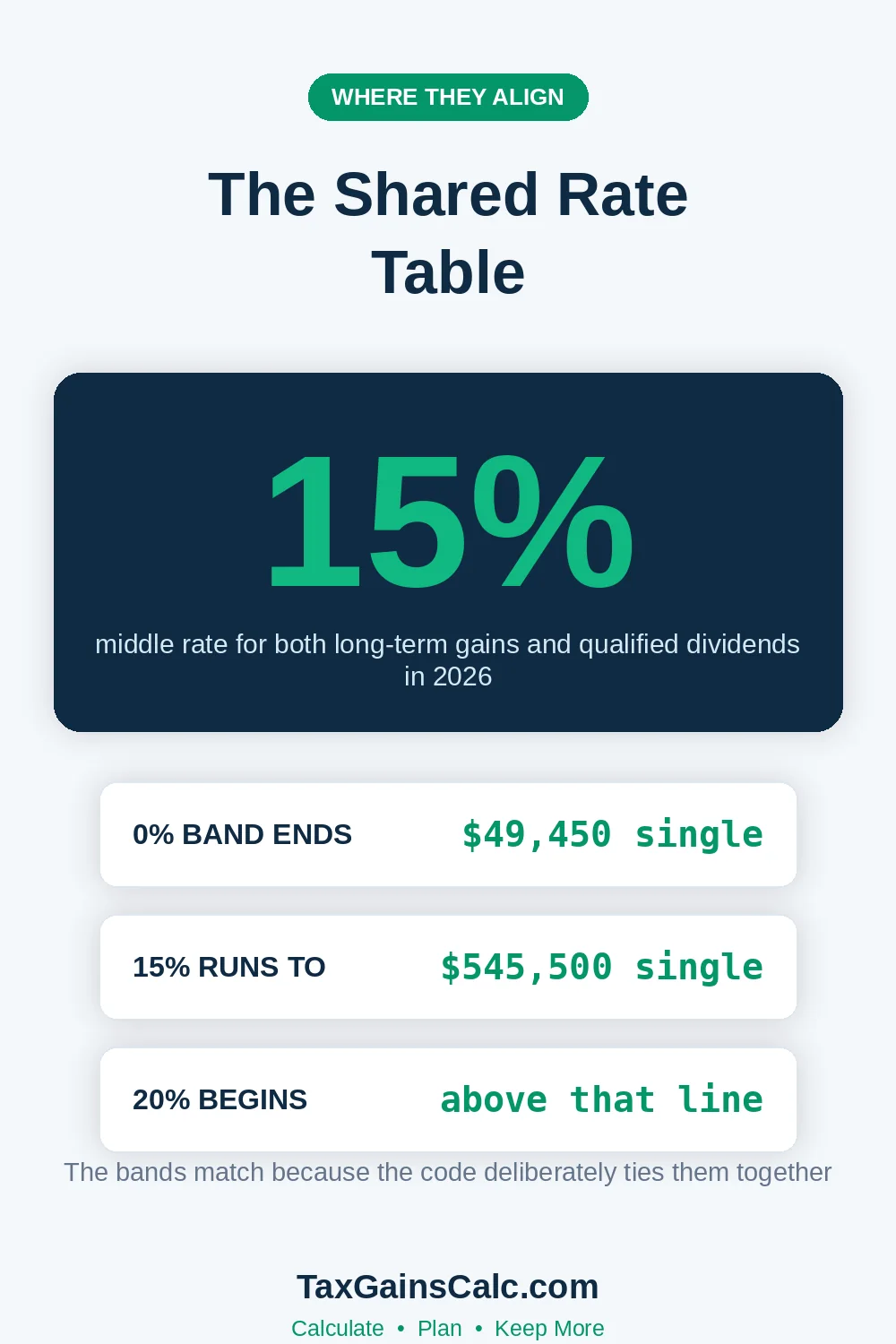 For 2026, the zero percent band tops out near forty-nine thousand five hundred dollars single. The 15 percent band extends to $545,500 before the 20 percent rate begins. Married joint filers receive roughly double those widths across both schedules compared with single filers.
This alignment means portfolio decisions rarely change the marginal rate between the two. Selling an appreciated share and receiving its dividend usually land in the same bracket. The differences appear in timing control and special asset classes instead.
Special asset classes create most of the divergence in everyday practice. Real estate, collectibles, and small business stock all carry their own gain rules. Dividend special cases instead cluster around foreign income and fund distributions in practice each year.
Where the Two Taxes Diverge
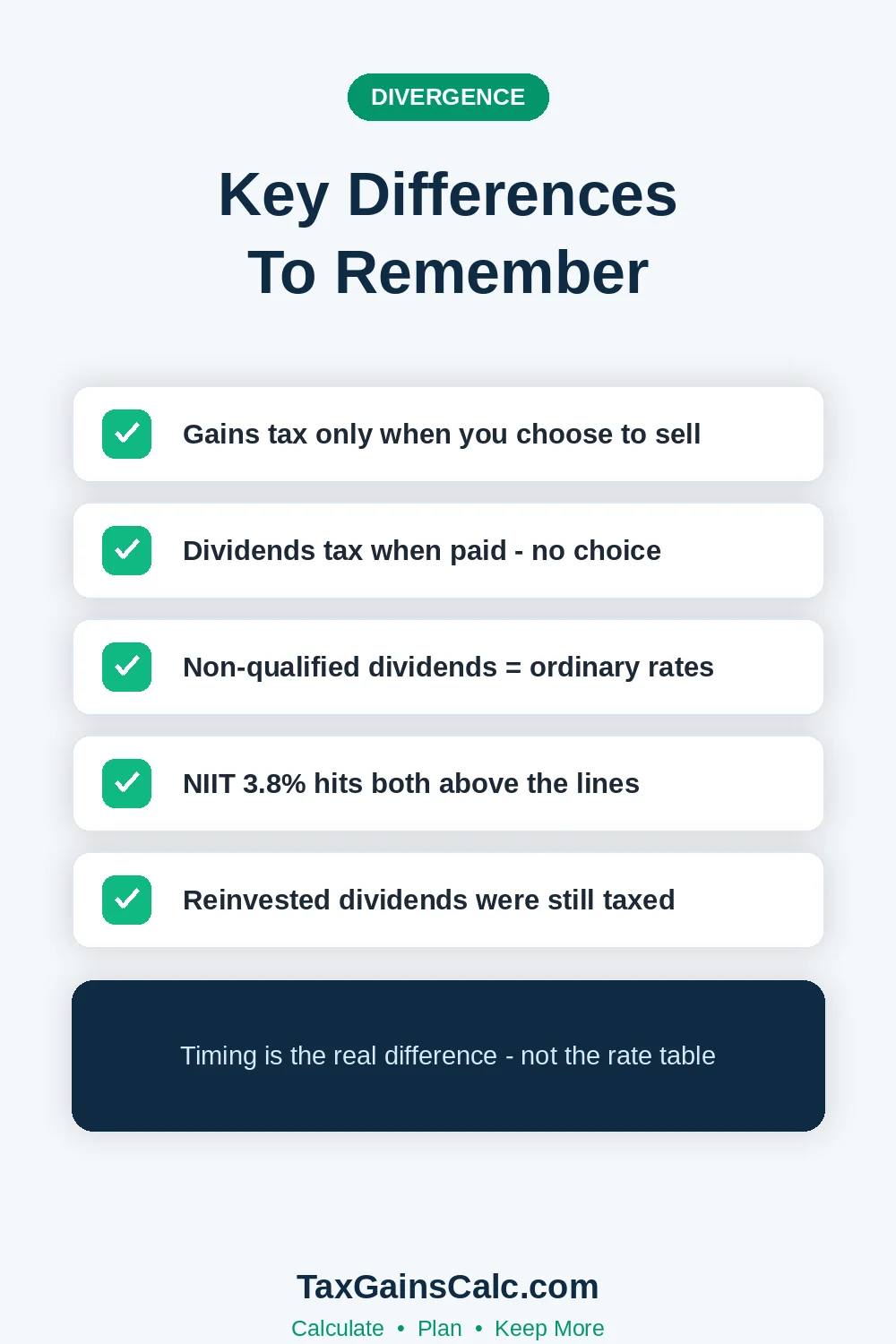 Timing control is the biggest practical difference investors should internalize. You completely decide when to sell and therefore when to recognize the gain. Companies decide when to pay dividends, leaving recipients no timing control.
That control difference shapes every harvesting and deferral strategy available. Gains can be deferred for decades or managed into low-income years with careful advance planning. Dividends arrive on the company's schedule regardless of your tax situation no matter what you prefer.
Certain gains also carry special rates that dividends never touch. Collectibles cap at 28 percent while unrecaptured real estate depreciation reaches 25 percent instead. Small business stock exclusions and opportunity zone benefits apply only to gains specifically.
Dividends have their own special cases that gains never encounter in a few specific situations. Foreign withholding taxes complicate international dividend income on many returns on many international returns. REIT dividends often carry mixed ordinary and capital components requiring allocation that needs careful reporting.
The surtax computation also runs through a separate form with its own worksheet. Form 8960 collects every investment income type and applies the threshold test and applies the surtax. Software computes it automatically once all income sources are entered correctly during the filing process.
How the 3.8 Percent Surtax Treats Both
The net investment income tax treats both income types identically at high incomes. Gains, qualified dividends, ordinary dividends, and interest all count as net investment income. Singles owe the surtax past $200,000 of MAGI, and joint filers past $250,000.
Neither income type escapes through character planning alone at high incomes at those income levels. Retirees sometimes avoid the surtax by keeping MAGI below the thresholds. Our NIIT guide covers the stacking mechanics completely.
State treatment diverges from the federal alignment in most places. Most states tax both gains and dividends as ordinary income. A handful of states exempt dividends or social security while taxing gains fully.
David also holds the option of selling in December versus January strategically in this same example. Crossing year boundaries changes which return reports the gain and when. That flexibility exists for gains and never for declared dividends in every similar situation.
A Worked Example Comparing Both
Meet David, who pulls in $95,000 of wage income for this tax year as a single filer. He has a stock position with $20,000 of appreciation that also pays dividends. His choices illustrate exactly how the two taxes interact.
David's first option is selling the entire position during the current tax year. His second option is waiting until next year to complete the same sale. His third option is holding indefinitely while collecting dividends along the way.
Each option produces a different federal bill despite touching the same economics. The table below prices all three paths at his actual income level. Every figure assumes no other portfolio changes happen during the year.
| Action | Income Created | Federal Rate | Tax |
|---|---|---|---|
| Sell for $20,000 gain (LT) | $20,000 gain | 15% | $3,000 |
| Receive $2,000 qualified dividend | $2,000 dividend | 15% | $300 |
| Sell within 1 year instead | $20,000 gain | 24% ordinary | $4,800 |
His long-term sale and his qualified dividend land at the same 15 percent rate. Selling early instead converts the gain to ordinary rates at 24 percent under the ordinary brackets. The dividend had no such option because its rate was already completely locked.
His total income from both sources stays below the NIIT thresholds here. One more sizable sale in this same example would shove the stack past $200,000 fast. Planning the sale order across years manages that threshold deliberately.
The example also shows why timing control carries real dollar value. Waiting just five months converted $1,800 of extra tax into zero extra tax. Dividends offered no equivalent lever because companies control the payment dates in this entire example.
Record keeping requirements differ between the two income types in meaningful ways. Gains demand basis documentation while dividends require only the broker statements. Our basis guide covers the gain-side records.
Reporting Both on Your Return
All gains flow through Form 8949 into Schedule D on every relevant return. Dividends appear on Form 1040 line 3b with qualified amounts on line 3a. The two flows never merge despite landing in the same tax computation.
Brokers report sales on Form 1099-B and dividends on Form 1099-DIV on two separate forms. Crypto platforms now issue their 1099-DA covering digital asset disposals recently. Our form comparison guide maps every reporting path.
Fund investors receive one combined statement covering both income types. Capital gain distributions land on Schedule D line 13 automatically in most software. Ordinary fund dividends instead report as ordinary dividend income on the Form 1040.
| Planning Lever | Works on Gains | Works on Dividends |
|---|---|---|
| Timing the recognition | Yes, fully controllable | No, company decides |
| Loss offsetting | Yes, dollar for dollar | No |
| Account placement | Yes, retirement shelters | Yes, retirement shelters |
| Holding window rules | 12 months for long-term | 61 days for qualified |
Investors holding both types should model the interaction rather than each separately before making any moves. Gains stack on dividends when determining the marginal rate for each. Sequencing decisions become genuinely valuable once portfolios reach meaningful sizes at larger portfolio sizes.
Planning Moves for Each Type
Gain planning centers on timing, offsetting losses, and exclusion strategies. Holding past twelve months, harvesting losses, and using the home exclusion all reduce gains. Our reduction strategies guide covers the full toolkit.
Dividend planning centers on account placement and qualification windows. Income-producing assets belong in retirement accounts where distributions face no annual tax. Holding windows past 61 days protect qualified treatment around ex-dividend dates.
Fund selection matters more for dividend-heavy portfolios than most investors realize. Actively traded funds distribute more gains than index funds historically. Our ETF comparison guide quantifies that difference.
Retirees managing the zero percent band should sequence both income types deliberately. Fill that band with qualified dividends before realizing any gains the same year. Our harvesting guide and retirement guide posts show the full sequencing.
Model every scenario before changing your portfolio structure in any way. A few minutes in the capital gains calculator prices the federal bill. The thresholds guide shows exactly where each rate line sits.
Bookmark this complete comparison for the next time a portfolio decision arrives. The underlying rules change slowly but their interaction changes quite quickly. A five-minute review here prevents most avoidable mistakes entirely.
One last habit ties this entire comparison together for busy investors. Check your projected dividend income before scheduling any large sale each year. The two numbers together determine your true marginal rate on everything.
That single coordination step catches most threshold surprises before they happen. It costs nothing and takes five minutes with any brokerage statement. Every investor from beginner to professional benefits from the same check.
Investors comparing these taxes should also weigh their own portfolio composition carefully. A dividend-heavy income portfolio faces different decisions than an appreciation-heavy growth portfolio. Most real portfolios contain both and therefore need both playbooks.

Wasim Akram
Wasim researches and writes every article on TaxGainsCalc, covering capital gains tax for everyday investors. Every figure is checked against primary IRS sources before it goes live.