
Colorado Capital Gains Tax: The Flat Rate Stack
Colorado taxes capital gains as ordinary income at its flat rate on top of federal. Combined examples, part-year rules, and the planning room left.

Colorado Capital Gains Tax: The Direct Answer
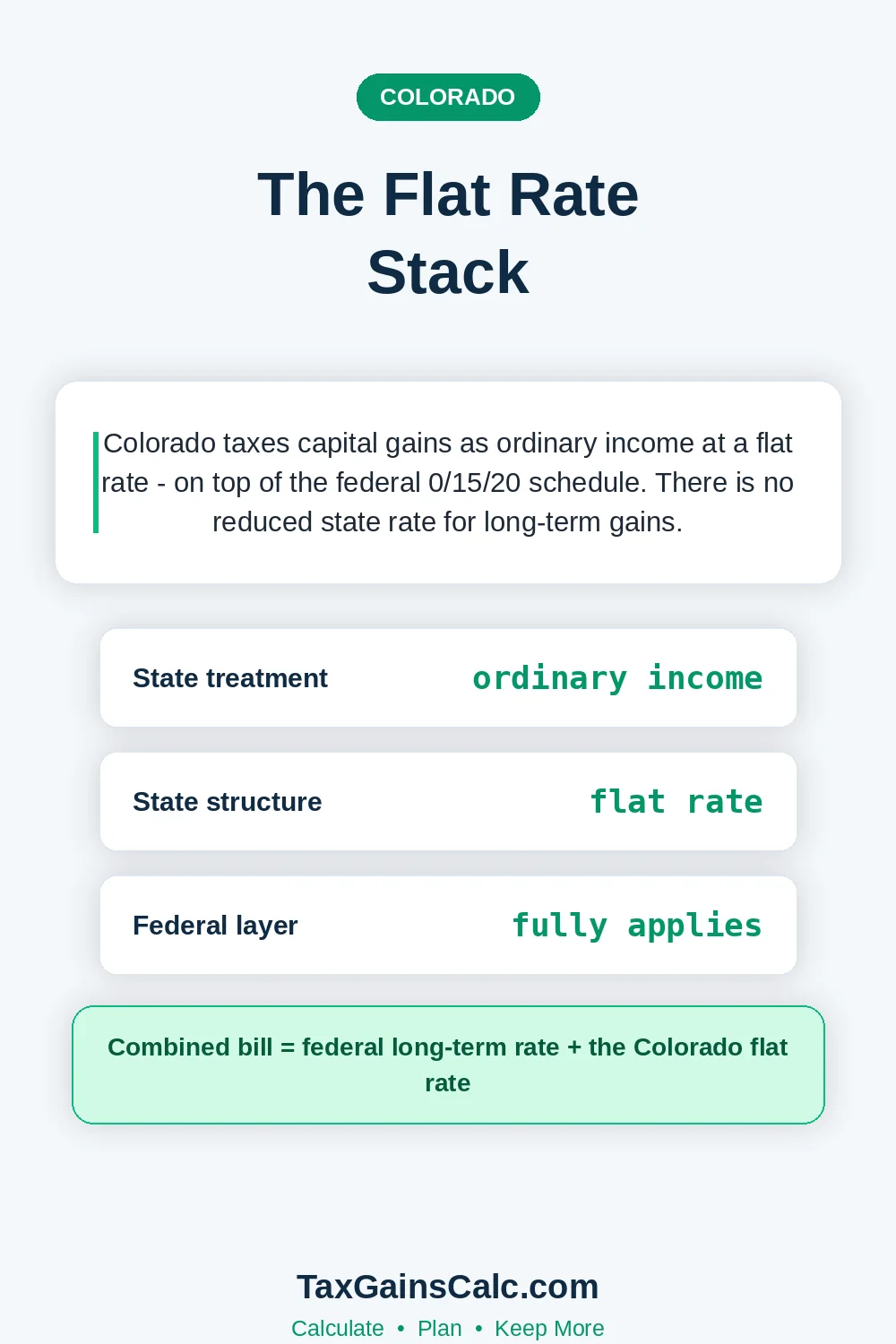
Colorado treats every capital gain as ordinary income taxed at one flat state rate.
Both layers land on the same return, so plan for the stack. There is no preferential long-term schedule and no 0 percent band at the state level.
Your federal rate stacks on top of the state layer on every dollar of gain.
This guide combines the two layers with worked examples and honest planning notes.
The flat structure keeps Colorado simpler than progressive states like California, which layers multiple rates. One rate means one calculation for every dollar you realize.
Simplicity does not mean cheap, because the state rate applies from the first dollar. Investors planning large exits should model the combined rate before setting an asking price.
How the Colorado Flat Rate Works
Colorado starts from federal taxable income and applies a handful of state adjustments. Recent voter-approved referenda have pushed the state rate down in steps.
Those triggers fire on their own schedule, so the rate can move again.
 Confirm the exact rate on Colorado's official revenue site before you file anything. Our examples use the recent flat rate with a clear caveat about annual changes.
Colorado's code draws no characterization line between long-term and short-term gains at all.
A gain taxed at 15 percent federally still counts as ordinary income in Colorado. One flat schedule covers every income type that flows into the state base.
The state applies the same flat rate to wages, gains, and retirement income alike.
Our state rates comparison guide places Colorado among its neighbors.
| Income type | Federal treatment | Colorado treatment |
|---|---|---|
| long-term gains | 0, 15, or 20 percent | flat rate as ordinary income |
| short-term gains | ordinary brackets | flat rate as ordinary income |
| wages | ordinary brackets | flat rate |
Worked Example: The Combined Rate on a $100,000 Gain
Take a Denver investor who realizes a single $100,000 long-term gain during 2026.
We will stack the layers one at a time. The federal government prices most of that gain at the 15 percent band.
Federal tax on the gain itself lands near $15,000 at that band.
Schedule D and its worksheet produce that figure for most filers. Colorado then applies its flat rate to the same gain as ordinary income.
Colorado adds roughly $4,400 more in tax to that same $100,000 figure. We held every other line of this return steady on purpose.
Stacked together, the effective rate hits about 19.4 percent before the NIIT even enters the picture.
The 3.8 percent NIIT stacks a further layer keyed to federal MAGI thresholds. Wealthier investors can see the combined federal and state math approach 23 percent.
That surtax applies on top once investment income and MAGI cross statutory limits.
| Layer | Rate applied | Tax on the gain |
|---|---|---|
| federal long-term | 15 percent band | about $15,000 |
| Colorado flat | recent flat rate | about $4,400 |
| combined so far | about 19.4 percent | about $19,400 |
| NIIT where applicable | 3.8 percent | $3,800 more |
Our 15 percent bracket guide explains the federal band placement. The Colorado layer behaves identically whether the federal rate lands at 15 or 20 percent.
Multi-year modeling stays unusually straightforward in Colorado because of that predictability. Any bracket change shows up federally while the state line stays fixed.
Why Colorado Offers No Preferential Gain Rate
Some states cut their rates or add exclusions to reward long-term holding. Their rate schedules carve out a discount for patient investors.
Colorado extends no such preference to stocks, funds, or business interests. The ordinary-income label applies to every gain the state taxes.
A one-day gain and a thirty-year gain receive identical treatment here. Colorado never asks how long you owned the asset.
Only the federal layer of the calculation cares about holding periods. Federal law sorts long-term from short-term before the state ever calculates.
Pension and IRA income can qualify for retirement subtractions after the age thresholds. Each subtraction carries its own qualifying conditions under state law.
Investment gains of any kind never make the subtraction list, though. A realized gain still owes the full flat rate at every age.
Our retiree guide covers what Colorado retirement income actually avoids. No capital gain qualifies for those retirement-friendly subtractions. The state treats those distributions and gains as entirely separate categories.
Worked Example: Wages Plus a Gain for a Denver Filer
Now picture an unmarried earner collecting $150,000 of wages alongside a $100,000 gain. The wages fill the ordinary brackets first, and the gain stacks on top after. Once the standard deduction is applied, federal taxable income for this filer lands near $233,900.
The gain lands fully inside the 15 percent federal band at that income. The federal return shows a $15,000 tax bill for the gain. Only the gain itself gets priced at that federal band.
The state builds its taxable income base from the federal figure, plus adjustments. Most of those adjustments mirror lines you have already completed federally. 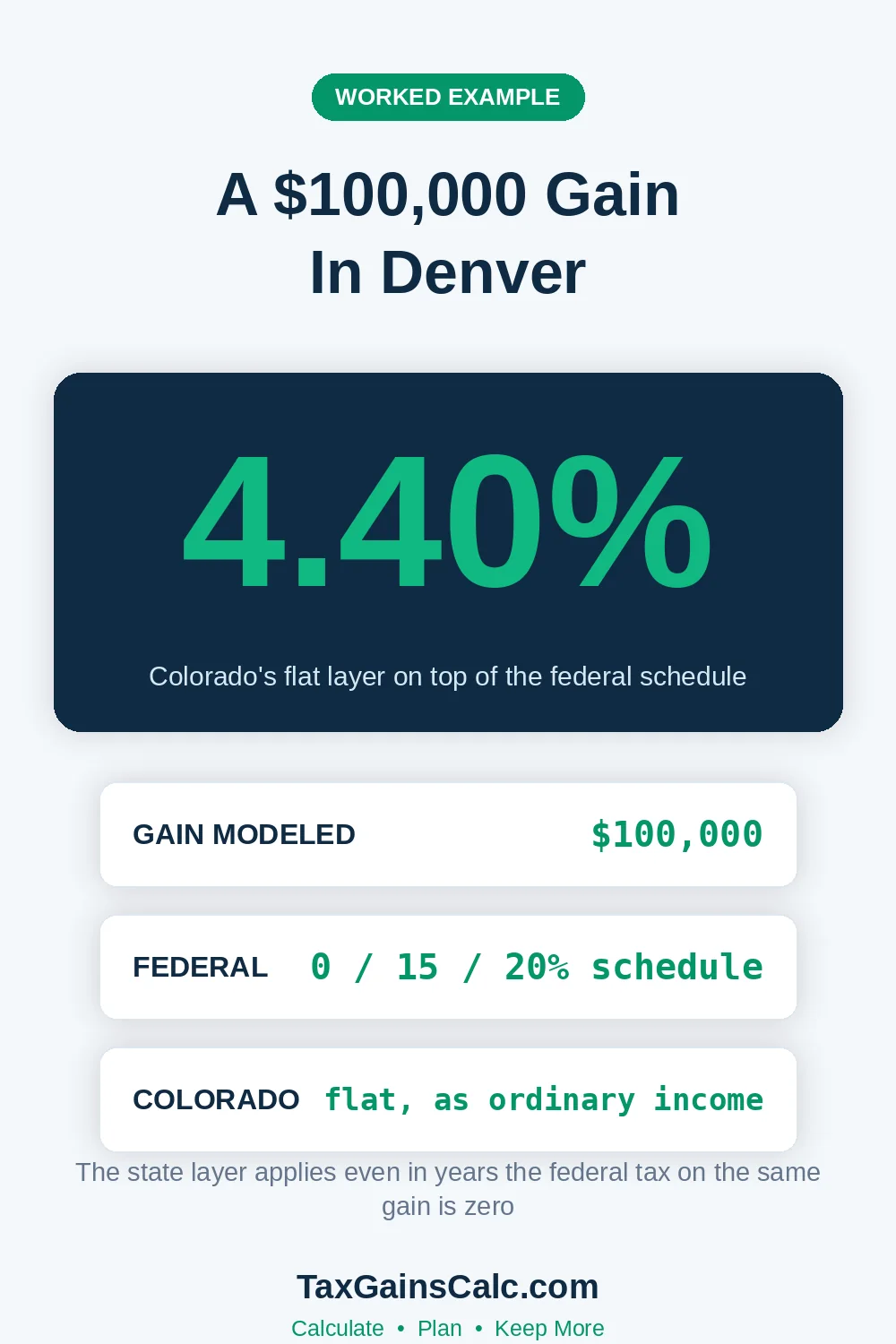 The flat state rate applies across the whole state base including the gain.
Colorado's contribution stays about $4,400 no matter where the federal band lands. The flat rate ignores character, holding period, and bracket placement alike.
All told, that gain costs roughly $19,400 before anyone raises the NIIT question. Only filers above the NIIT thresholds need to add that federal layer.
Part-Year Residency and Sourcing in Colorado
Nonresidents still owe Colorado tax on gains from Colorado real estate. The property's location decides the tax, not the owner's address.
For securities, your residency during the closing year decides who taxes the gain. Securities sales sit in different buckets depending on where you lived then.
Moving mid-year splits the calculation into resident and nonresident chunks. Each side of the move gets taxed under its own residency rules. Our Nevada guide shows the opposite end of the state tax spectrum.
If you are leaving Colorado, schedule gains around the actual departure date. A dated closing statement or brokerage confirmation can prove the timing.
Once a new domicile is established, later securities gains fall outside Colorado completely. Domicile means the state you treat as your permanent home base.
Colorado keeps taxing its own real estate no matter where the seller moves. A ski condo sold from Texas still generates a Colorado filing duty.
Proving the move date matters just as much as making the move. Keep closing papers and move records together in one place.
What Planning Room Still Exists in Colorado
Low-income Colorado residents can still run the federal 0 percent harvesting play. The trick depends on keeping total income under the federal 0 percent cutoffs. The federal band saves its layer even though Colorado taxes the gain anyway.
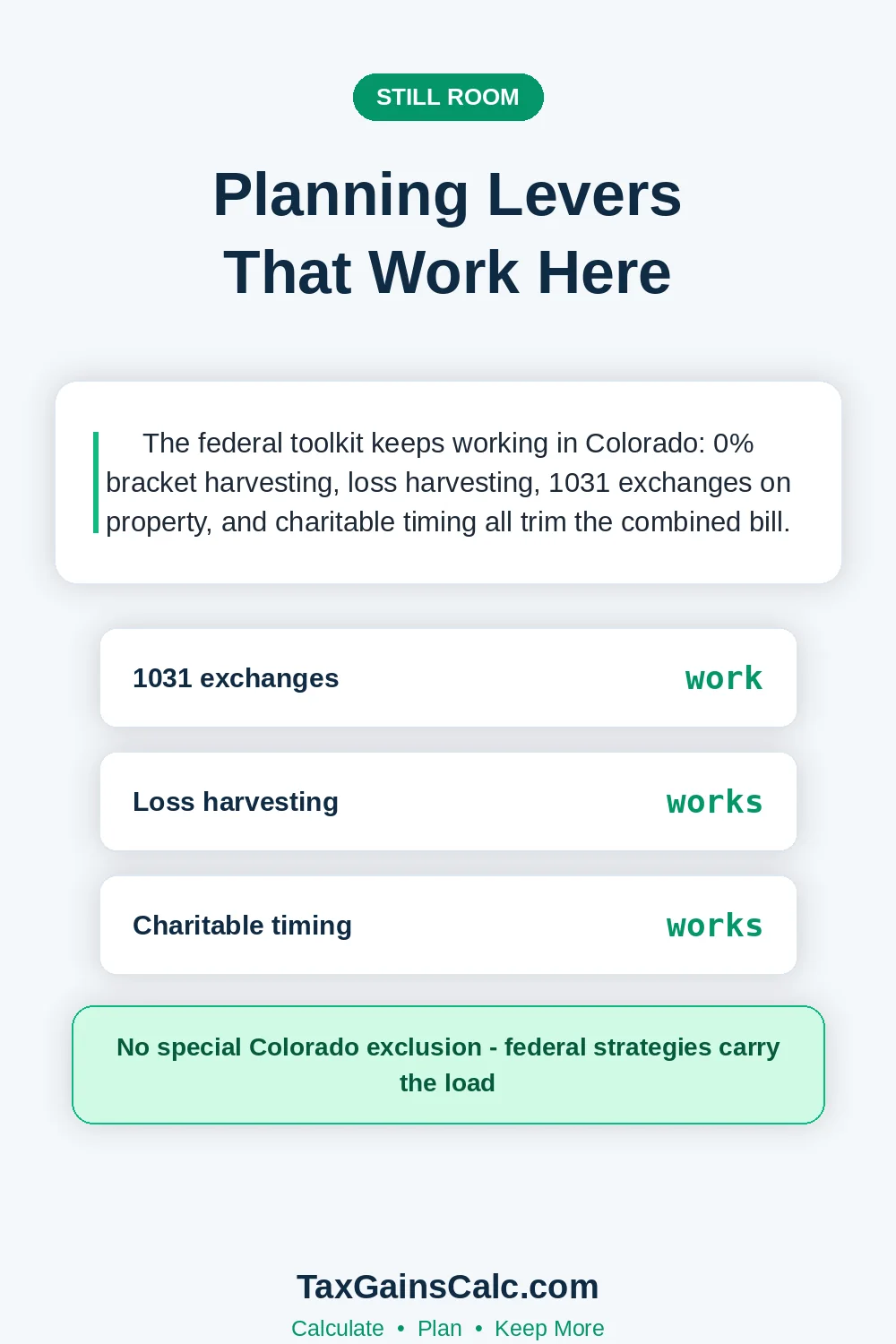 A filer inside the 0 percent federal band pays only the flat state layer. Our zero bracket guide covers that federal strategy.
- Harvest gains during low-income years to capture the federal 0 percent band.
- Use charitable bunching to reduce both federal AGI and the Colorado base.
- Time securities sales after any planned interstate move to a no-tax state.
- Consider installment structures for business sales spanning multiple tax years.
Property sellers also hold a 1031 exchange deferral lever for real estate exits. Swapping into like-kind property postpones both the federal and state recognition. Our 1031 exchange guide explains the property deferral rules completely.
Colorado extends the same deferral to properly executed exchanges at the state level. The gain resurfaces on a Colorado return whenever you finally sell for cash. Deferral does not eliminate the eventual state layer, but it delays it indefinitely.
The Charitable and 1031 Levers Colorado Investors Use
Charitable remainder trusts trim the Colorado base right alongside the federal layer. The deduction flows through federal AGI and shrinks the state starting point.
Colorado tracks the federal treatment of trust contributions and distributions. Conformity can shift with legislation, so confirm the rules for your tax year.
Our CRT guide explains the federal mechanics first. Donor-advised funds reach a similar AGI reduction while demanding far less structure. The state base moves the same way under either giving vehicle.
Goodwill from a business exit lands in the same flat state layer. Colorado never splits goodwill into a friendlier rate category. Our goodwill guide covers the character questions involved.
Qualified small business stock gets no special Colorado treatment, either. The federal QSBS exclusion still applies fully even though Colorado offers no state parallel. QSBS sellers should track the federal benefit and the state cost separately.
Colorado Versus Its Neighbors and the No-Tax States
On the state tax spectrum, Colorado's flat rate occupies the middle ground. It beats the high-rate coastal states and trails the no-tax ones.
Wyoming next door charges nothing, while Kansas treats gains like any other income. The table below lines up those neighbors side by side.
Utah runs a flat rate built much like Colorado's approach. Their single rate also covers gains with no separate long-term schedule.
States without an income tax simply erase the layer instead of trimming it. Texas and Wyoming drop that layer to an outright zero.
| State | Gain treatment | Notes for investors |
|---|---|---|
| Colorado | flat rate, ordinary character | no preferential rate |
| Wyoming | no state income tax | neighboring zero-tax option |
| Utah | flat rate | similar structure |
| Texas | no state income tax | zero state layer |
Any relocation comparison needs property taxes, sales taxes, and local housing prices too. Compare those everyday costs against the state tax savings you would bank. Our Texas relocation guide models the full picture for one destination.
Large exits can see a state layer gap measured in tens of thousands. Exit size drives the whole comparison more than any other variable.
Model your own situation before crowning any single state the winner. Our calculator handles the federal side while you compare state layers.
Estimated Payment Notes for Colorado Investors
Colorado wants quarterly estimated payments whenever withholding does not cover the liability. The state sets its own estimated payment schedule that mirrors the federal quarters. A large mid-year gain creates the same June and September obligations federally and locally.
Penalties for underpayment accrue each quarter, so January's wait gets expensive. Each skipped quarter adds its own slice of penalty to the bill. Our estimated payments guide walks the full quarterly calendar.
Estimates are figured from the Colorado taxable income you expect for the year. Project wages and the gain together when you complete the state worksheet. A gain you realize in December still belongs to the current tax year.
 Investors selling late in the year should make a January state payment early. That payment lands before most filing deadlines and trims the penalty clock immediately.
Regular paycheck withholding gives salaried investors an even-payment alternative instead. Nothing is due until April if your employer withholds enough along the way.
Employers spread bonus withholding across the full year as though it arrived evenly. A year-end bonus can therefore patch a gain realized weeks earlier.
Withholding on a December bonus can swallow a November gain whole. What makes it work is December timing, not the bonus amount.
That single payroll move covers the federal and state layers at once. Check that the extra withholding actually lands on the year's final paycheck.
A Colorado Filing Checklist for Investors With Gains
Walk down this list for any return year that includes realized gains. Work top to bottom and note anything that needs a follow-up.
Every item blocks one common Colorado filing mistake or missed adjustment. Ten minutes here beats a corrected return and an explanation letter later.
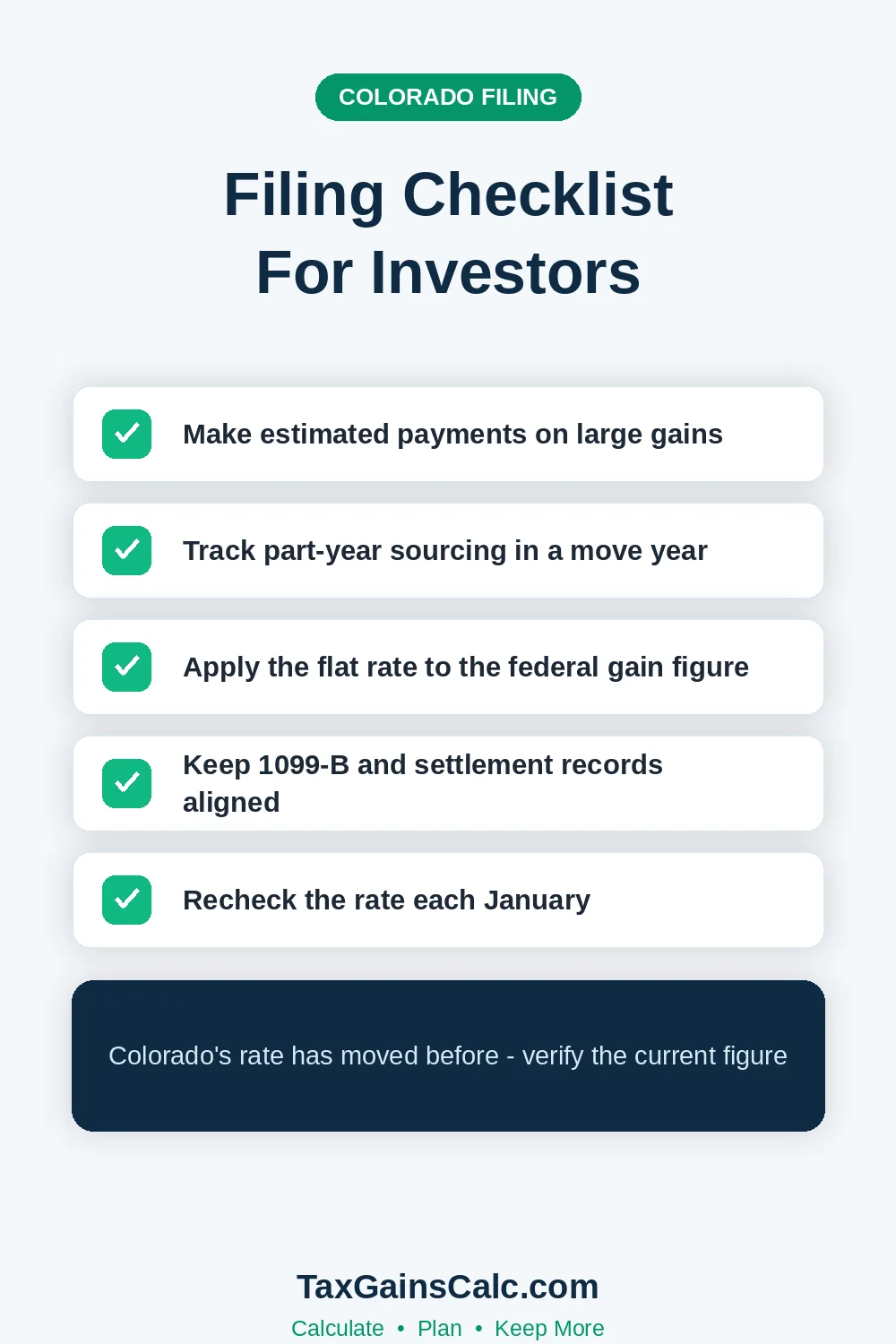
- Verify the current flat rate on the state revenue site before computing.
- Reconcile the state base against federal taxable income with all adjustments.
- Confirm whether any retirement subtraction applies to your distributions this year.
- Check estimated payment requirements when a large gain arrives mid-year.
- Document any part-year split carefully with move dates and supporting records.
The Colorado Department of Revenue publishes current rates and adjustment schedules. For the federal side, the IRS topic guide on capital gains lays out the layer rules.
Colorado investors who understand the flat structure file faster and with fewer state errors. The simplicity genuinely helps once the combined-rate expectations are set correctly from the very start.
Set those expectations with a simple one-page model before any major sale goes under contract. The model should include the NIIT question and any state layer you might owe.

Wasim Akram
Wasim researches and writes every article on TaxGainsCalc, covering capital gains tax for everyday investors. Every figure is checked against primary IRS sources before it goes live.