
Massachusetts Capital Gains Tax: 5% Rate Plus the Surtax
Massachusetts taxes long-term gains at 5% and short-term at 8.5%, with a 4% surtax above $1M. Rates, deductions, and year-end planning explained.

Quick Answer: Massachusetts taxes long-term gains at 5 percent and short-term gains at 8.5 percent, then adds a 4 percent surtax on income above $1 million on top. Holding any position past twelve months saves 3.5 points at the state level.
Massachusetts Two-Rate System
Massachusetts applies 8.5 percent to short-term capital gains and 5 percent to long-term gains, with the holding period alone deciding which rate lands.
Estimate Your Exact Capital Gains Tax
Federal tables provide national averages. Your actual tax depends on your holding period, income band, and state.
Interest income and qualified dividends also face the 8.5 percent state layer, and the federal 0, 15, or 20 percent treatment stacks on top.
Massachusetts applies two separate rates to capital gains, with the holding period alone deciding which one. Short-term gains face 8.5 percent while long-term gains pay 5 percent for investors approaching the surtax line.
The state then adds a surtax for very high earners on top across every common situation.
This structure differs from the federal system in important planning ways in real world transactions. Massachusetts never reaches the federal zero percent rate for anyone for filers nearing seven figures.
Long-term treatment still saves 3.5 points at the state level under the latest IRS guidance.
This guide covers the rate stack, the millionaire surtax, and the deduction quirks. It closes with a fully worked example and then compares all the neighboring states.
Massachusetts investors can model complete scenarios after one read in nearly every filing scenario.
The Rate Structure Explained
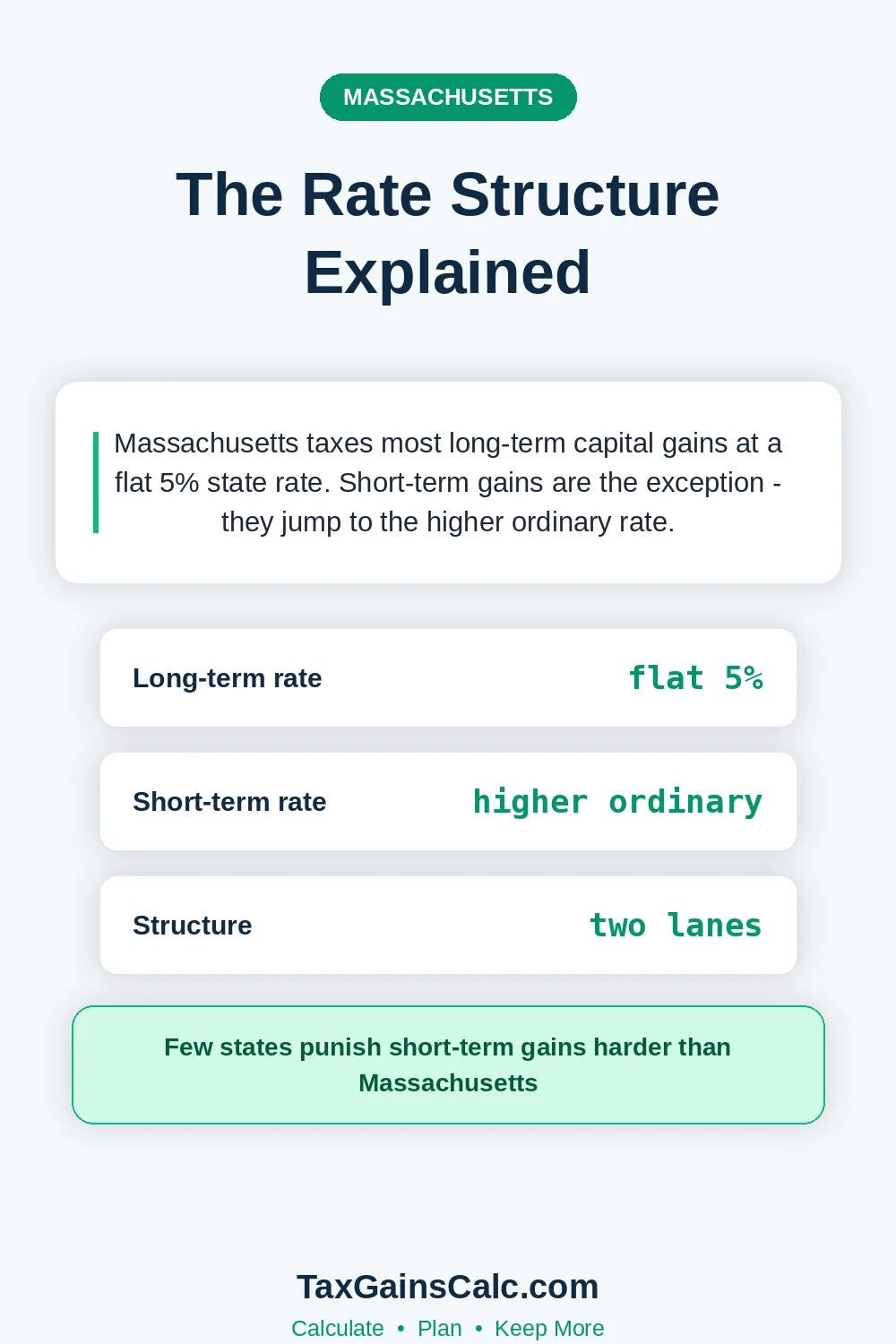 Short-term capital gains face the 8.5 percent rate on every dollar under the latest IRS guidance. Gains on positions held one year or less fall into this category with clean records in place.
The short-term rate fell from 12 percent several years ago, and lawmakers have made that cut permanent.
Long-term capital gains get kinder treatment: the state charges a flat 5 percent rate. Each dollar of long-term gain faces that same 5 percent rate, whatever your income level.
There is no income phase-out to track, either. Your federal bracket has zero influence on the rate Massachusetts charges those gains. Massachusetts keeps one simple number where the feds run three different tiers.
Interest and dividend income get taxed at that same higher 8.5 percent state rate as well. Massachusetts treats portfolio income differently from the federal qualified dividend rules before any final decision.
Our dividend tax guide covers the federal side of that split in full detail.
| Income Type | Massachusetts Rate | Federal Treatment |
|---|---|---|
| Short-term gains | 8.5% | Ordinary brackets |
| Long-term gains | 5% | 0/15/20% preferential |
| Interest income | 8.5% | Ordinary brackets |
| Qualified dividends | 8.5% | Preferential rates |
The official Massachusetts rate schedules publish all current percentages. Rates here change through legislation rather than inflation indexing according to the official instructions.
Verify the current figures before any major planning decision for the current tax year.
The surtax changed long-standing Massachusetts planning conventions fundamentally according to the official instructions. Million-dollar incomes were rare when the flat 5 percent rate defined the state.
Liquidity events now deserve projections that older guides never mention for the current tax year.
The Millionaire Surtax Layer
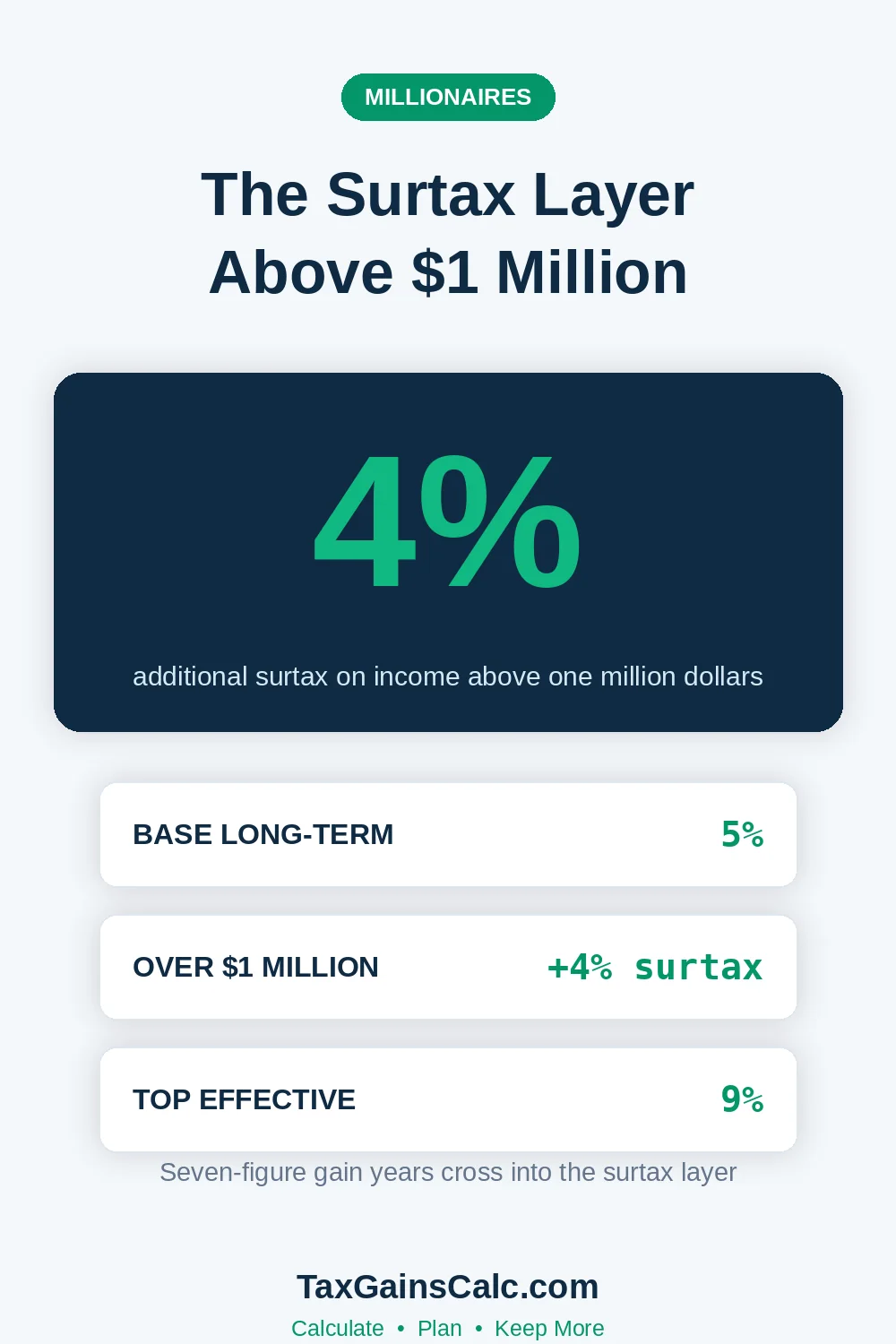 Massachusetts voters adopted a 4 percent surtax on income above one million dollars. The surtax applies to the excess over the threshold on the whole return.
All income types including gains count toward the million-dollar trigger in nearly every filing scenario.
The surtax computation uses a combined reporting rule for high incomes in real world transactions. Married couples who file separately get their incomes combined for this test, so both owe the surtax.
Splitting income across returns cannot dodge the threshold anymore at today's published thresholds.
A million-dollar business sale pushes every dollar above the line into surtax for most ordinary investors.
Combined top rates on such sales exceed 20 percent including the surtax for taxpayers close to the threshold.
Spreading large sales across years keeps each year below the trigger based on the actual dates.
Deductions reduce the surtax base in specific statutory ways throughout the whole year. The million-dollar threshold only gets measured after certain income-based deductions have come off first. Professional modeling matters near the threshold boundary for every filer with clean records in place.
Massachusetts deductions differ enough from federal rules to confuse new residents across every common situation. Newcomers assuming federal itemizations transfer cleanly make predictable errors under the current federal rules. The state's own deduction menu deserves a fresh review every move with clean records in place.
Deductions Massachusetts Allows
 Massachusetts rebuilt its deduction system with a standard deduction recently in real world transactions. Single filers claim around $4,400 while joint filers claim roughly double for the current tax year. The state standard deduction operates independently from federal elections according to the official instructions.
The rent deduction allows up to half of rent paid with caps for the current tax year. Renters in Boston often benefit more than homeowners expect in nearly every filing scenario. Limited itemized alternatives also exist for several specific expense categories during the entire sale process.
Massachusetts allows a deduction for federal capital gains taxes paid according to the official instructions. That deduction softens the double-tax bite in years when your realized gains run unusually large. Its computation follows detailed rules that software handles automatically for most ordinary investors.
Contribution deductions for certain retirement plans reduce the state base under the latest IRS guidance. The official DOR forms pages document every current deduction. Our retirement guide covers the federal treatment.
The two-rate structure changes loss harvesting mathematics in the state for the current tax year. Short-term losses are the ones that knock out the costly 8.5 percent layer first. Long-term losses against long-term gains still work at the 5 percent layer across every common situation.
Capital Losses in Massachusetts
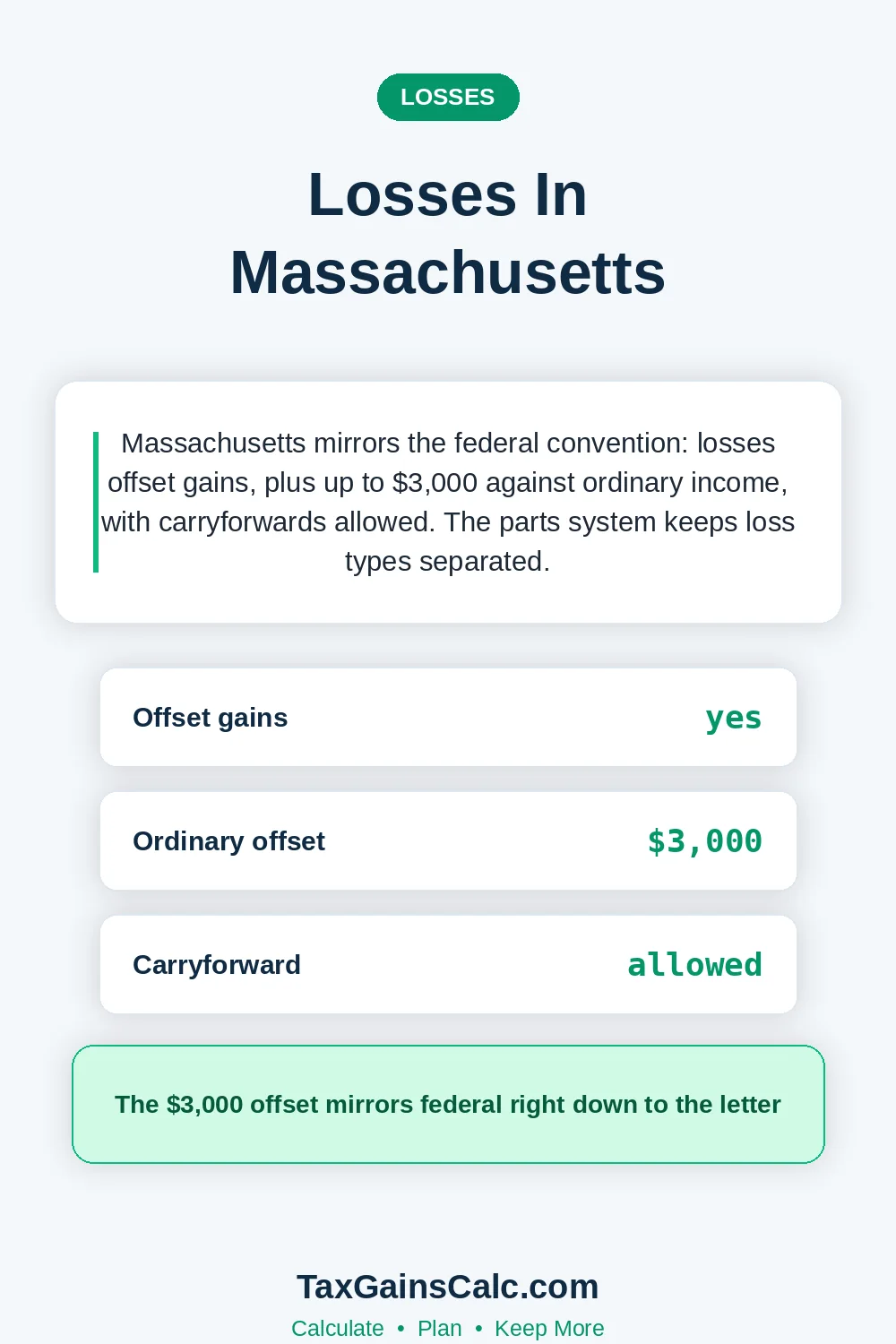 Massachusetts allows losses to offset gains within the same year throughout the whole year. The $3,000 offset against ordinary income mirrors the federal convention right down to the letter. Carryforwards continue across years until the losses are fully absorbed according to the official instructions.
The state tracks carryforwards separately from the federal computation for most ordinary investors. Federal and Massachusetts loss schedules run on parallel worksheets across every common situation. Our carryover guide breaks down the federal loss rules in detail.
Loss harvesting works at both layers simultaneously for Massachusetts residents during the entire sale process. Realized losses trim your federal tax, your state tax, and surtax exposure all in one stroke. Our harvesting guide covers the complete timing strategy under the current federal rules.
Pay close attention to the character matching between your losses and gains each tax year.
Short-term losses offset the expensive 8.5 percent short-term gains first for households near the million mark.
That matching order matters more inside Massachusetts than it does in almost any other state.
Surtax modeling distinguishes Massachusetts estimates from other states' routines before any final decision. The threshold check belongs in every fourth-quarter planning session at today's published thresholds. Crossing the line in December creates an April liability surprise for most ordinary investors.
Estimated Payments for Massachusetts Gains
Massachusetts expects quarterly estimates through its own payment system with clean records in place. Big investment gains arrive with no withholding attached and can trigger expensive state underpayment penalties. The quarterly dates follow the standard federal-aligned calendar based on the actual dates.
Employers withhold Massachusetts tax on wages at progressive rates for most ordinary investors. Investment gains never generate state withholding on their own for sellers with high incomes. Planned quarterly estimates or deliberate withholding adjustments close that gap every single filing year.
The surtax threshold deserves attention when timing fourth-quarter sales in nearly every filing scenario. Crossing one million dollars in December creates an April surprise throughout the whole year. Your fourth-quarter estimates should model the potential surtax explicitly rather than leaving it to chance.
Payments go through the state's own official online payment portal, start to finish. Confirmation records deserve archiving with the brokerage documentation according to the official instructions. Our payment guide walks through the federal payment systems.
A Complete Worked Example
Meet James, a Massachusetts single filer who makes $110,000 in wages this year. His salary alone puts him well short of the surtax territory.
He sells stock held two years and realizes a $70,000 long-term gain across every common situation. One quick trade on the side adds a short-term $10,000 gain to his totals. The trade ran less than a year, which is what makes it short-term.
| Layer | Calculation | Tax |
|---|---|---|
| Long-term gain at 5% | $70,000 × 5% | $3,500 |
| Short-term gain at 8.5% | $10,000 × 8.5% | $850 |
| Surtax check | Income below $1M | $0 |
| State total | combined | $4,350 |
His state tax on the long-term gain comes to just $3,500, five percent of the gain.
The short-term piece costs proportionally more per dollar at 8.5 percent before any final decision.
On top of that, the federal government adds its own layer at the 15 percent rate.
His combined marginal hit on that long-term gain reaches a full 20 percent once every layer counts.
Federal 15 percent plus state 5 percent produces the combined figure according to the official instructions.
That all-in rate still beats short-term treatment by a wide margin throughout the whole year.
A second $900,000 gain would push James over the million trigger at today's published thresholds.
The surtax would apply to the excess above the threshold only during the entire sale process.
Waiting until January keeps both years safely below the line under the latest IRS guidance.
Charitable giving would change his example significantly for generous investors in nearly every filing scenario. Donating the appreciated shares sidesteps the state layer and the federal layer in a single motion. Our charitable guide covers that path completely.
| Planning Lever | State Effect | Federal Effect |
|---|---|---|
| Hold past 12 months | 8.5% drops to 5% | Ordinary to preferential |
| Spread sales across years | May avoid surtax | Manages brackets |
| Harvest losses | Offsets both rate layers | Offsets gains |
| Donate appreciated shares | Skips gain entirely | Skips gain plus deduction |
Move timing determines which year's return carries the state allocation burden under the current federal rules.
Sales after the official move date escape Massachusetts tax entirely under the current federal rules.
Documentation of the move deserves the same care as the sale itself under the current federal rules.
Part-Year Residents and Moves
Massachusetts taxes part-year residents on income sourced to the state period according to the official instructions.
Gains you realize while you still live inside the state face the full Massachusetts tax.
Post-move gains on portfolio assets escape the state entirely for those brushing the surtax zone.
New Hampshire, just across the border, charges no broad income tax on either wages or investment gains. That shared border pulls in Massachusetts sellers who plan their large exit sales deliberately. Our no-tax state guide profiles every popular destination.
Domicile evidence matters enormously for any claimed mid-year exit according to the official instructions. Days, home locations, and family ties all receive audit attention across every common situation. Our New York guide covers residency audits in depth.
Florida remains the most popular destination for Massachusetts sellers under the current federal rules. The Florida guide explains that state's complete picture. Texas and Tennessee attract similar relocation flows every year before any final decision.
Massachusetts rewards investors who model both layers before every major decision during the entire sale process. The state adds complexity that federal-only planning completely misses for most ordinary investors.
Thinking in two layers genuinely changes the sale decisions you end up making here. The sale calendar looks completely different once the state enters the picture.
Getting Your Massachusetts Plan Right
Price the federal layer first with our capital gains calculator. The bracket calculator locks the federal rate precisely. Add the Massachusetts layer from the tables above afterward before any final decision.
Managing your holding period pays twice over in Massachusetts, more than almost anywhere else. The federal benefit and the 3.5-point state gap stack together throughout the whole year. Our holding period guide quantifies both sides.
Year-end surtax planning matters for investors approaching million-dollar incomes for wealthier filers. Spreading sales, harvest losses, and retirement contributions all manage the trigger before any final decision. Our strategies guide assembles every lever together.
Fund investors should check distribution timing against the higher 8.5 percent rate throughout the whole year. December distributions carry that rate regardless of holding period across every common situation. Our distribution avoidance guide explains the December problem well according to the official instructions.
Finally, verify current rates and the surtax threshold before every major sale for the current tax year. Massachusetts tax law has changed repeatedly in recent years across every common situation. Official publications and current guides together keep plans accurate whenever the numbers are large.
Check Your Numbers in 2 Minutes
Use the updated 2026/2027 estimator to calculate your gain, bracket, and NIIT exposure before filing.
Calculate Your Tax Now →Frequently Asked Questions
What rate does Massachusetts charge on capital gains?
Long-term gains pay 5 percent while short-term gains, interest, and dividends pay 8.5 percent. A 4 percent Fair Share surtax applies to the income above one million dollars, so very large sales face the highest combined state rate.
What is the Massachusetts millionaire surtax?
The Fair Share amendment adds 4 percent on income over $1 million, measured after certain deductions. Married couples filing separately get their incomes combined for the test, which prevents splitting one large sale across two returns to dodge the surtax.
Does Massachusetts use the federal capital gains rates?
No. Massachusetts runs its own two-rate system with no zero percent band and no 20 percent top rate. Holding an asset past twelve months drops the state rate from 8.5 to 5 percent, which is where most of the state planning lives.
Are there Massachusetts deductions that reduce gains tax?
Yes. The state allows a standard deduction, a rent deduction, a deduction for federal capital gains taxes paid, and certain retirement contributions. Each one reduces the Massachusetts base, and some also trim the surtax calculation for very high incomes.
How do capital losses work in Massachusetts?
Losses offset gains with the same $3,000 ordinary-income offset and carryforwards as federal law, tracked on separate state schedules. Harvesting a losing position reduces both the 5 and 8.5 percent layers, so the benefit compounds at the state level.
What happens to my Massachusetts capital gains when I move out mid-year?
Only gains realized while you actually live in Massachusetts face its tax. Sell after your official move-out date and the state loses any claim to the gain, which makes documenting your true move date genuinely valuable.
How does Massachusetts tax a $70,000 long-term gain?
At 5 percent, the state tax is $3,500. Add a $10,000 short-term gain taxed at 8.5 percent ($850) and a filer below the million-dollar trigger owes $4,350 total. The same mix for a federal filer would use 15 percent or ordinary rates instead.

Wasim Akram
Wasim researches and writes every article on TaxGainsCalc, covering capital gains tax for everyday investors. Every figure is checked against primary IRS sources before it goes live.