
Crypto Mining Taxes: How Mined Coins Are Taxed by the IRS
Mined coins are ordinary income at receipt and capital gains on disposal. Business versus hobby classification, deductions, SE tax, and a worked example.

Quick Answer: Mined coins are ordinary income at market value on the day you receive them. Sell later and the sale is a capital gain or loss measured from that receipt value, with business miners owing Schedule C and SE tax.
How the IRS Taxes Mined Coins
Mined crypto faces tax twice under IRS rules. Coins received count as ordinary income at market value on the day you earn them, reported on Schedule 1 or Schedule C, and any later sale produces capital gain or loss measured against that receipt-date basis.
Estimate Your Exact Capital Gains Tax
Federal tables provide national averages. Your actual tax depends on your holding period, income band, and state.
Crypto mining converts electricity and computing power into newly received coins , and the IRS treats those received coins as taxable income at their market value.
The taxation happens the moment you take receipt of the rewards under the latest IRS guidance.
Miners often confuse mining income with the later sale of mined coins across every common situation.
Two separate tax events exist in every mining operation's lifecycle in real world transactions. Receiving coins creates ordinary income while later selling creates capital gains under the latest IRS guidance.
This guide separates those two events clearly with worked numbers throughout across the calendar. It also covers the business versus hobby classification and deduction rules when your mining logs stay current.
Reporting requirements for both stages get their own complete sections for most ordinary investors.
The Receipt Event: Ordinary Income
 Mined coins are ordinary income valued at the market price on receipt according to the official instructions. The IRS Notice 2014-21 guidance established this treatment originally.
Later guidance confirmed the same framework for staking arrangements whenever the numbers are large.
Value comes from the exchange rate at the exact receipt timestamp through the full mining cycle. Mining pools distribute rewards continuously, creating many small income events whenever the numbers are large.
Consistent daily valuation from one major exchange keeps records defensible over the whole earning journey.
That receipt value also becomes the cost basis of the coins based on the actual dates. Basis tracking starts at the moment income gets reported for both parties involved.
Accurate receipt records therefore serve both tax stages simultaneously across every common situation.
| Stage | Character | Valuation | Form |
|---|---|---|---|
| Coins received | Ordinary income | FMV at receipt | Schedule 1 or C |
| Coins sold later | Capital gain or loss | Proceeds minus basis | Form 8949, Schedule D |
Classification questions arrive differently for part-time and full-time miners at today's published thresholds. Serious equipment investments suggest business treatment alongside genuine profit motive across every common situation.
Occasional laptop mining looks like a hobby to most reviewers from rig to receipt.
Business Versus Hobby Classification
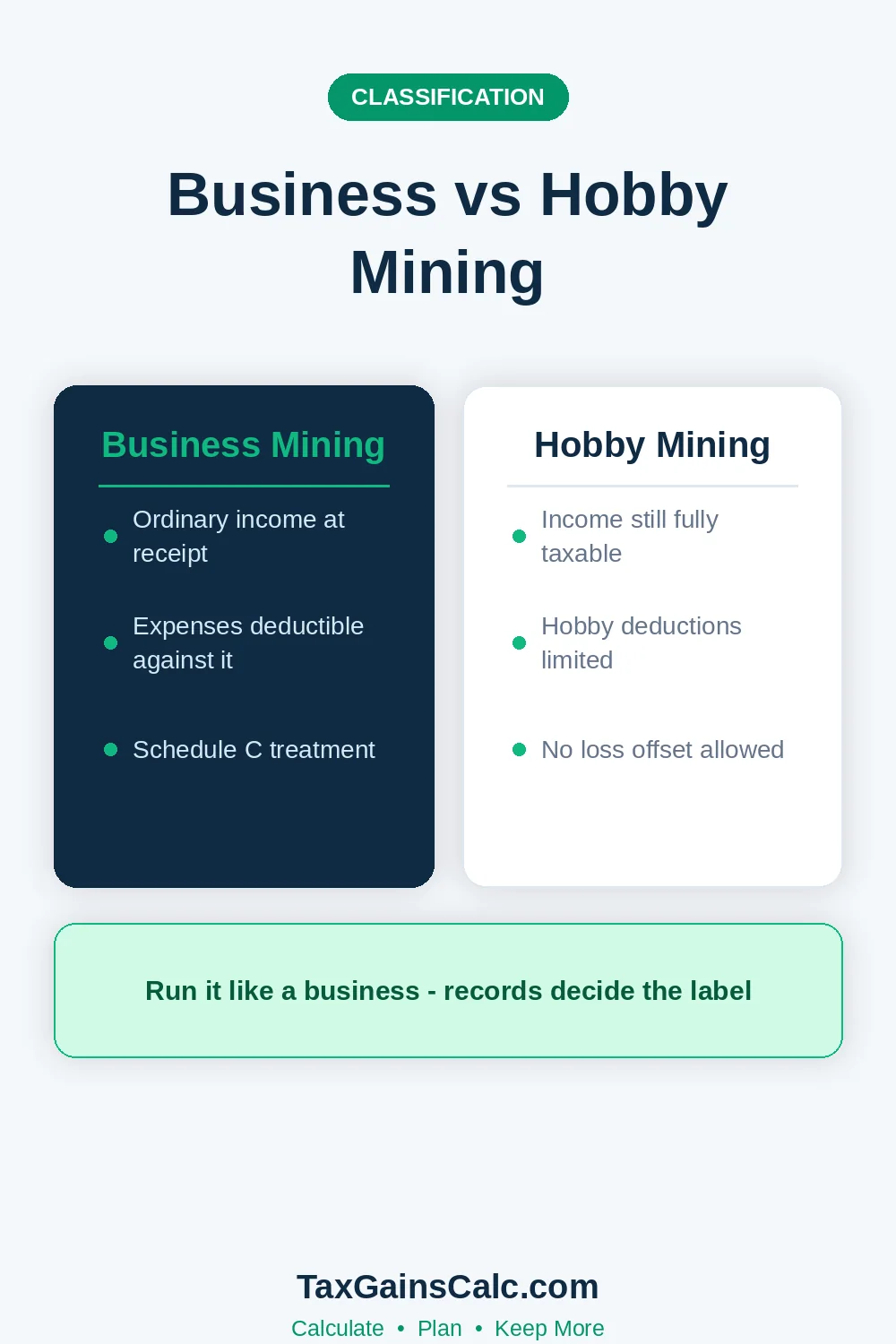 The business versus hobby question shapes every deduction available to miners in real world transactions. Mining as a trade or business reports on Schedule C with deductions for the current tax year.
Hobby mining reports income with no deductions allowed under current law before any final decision.
The distinction follows the general hobby loss factors the IRS applies for the current tax year. Profit motive, businesslike records, and time investment all support business treatment for the current tax year.
Mining operations run for profit generally qualify without controversy before any final decision.
Business miners also face self-employment tax on their net mining income in nearly every filing scenario. The 15.3 percent SE layer applies to earnings above tiny thresholds for most ordinary investors.
Hobby miners escape SE tax but lose every deduction in exchange at today's published thresholds.
The IRS self-employed tax center documents the business reporting framework. Classification decisions deserve professional review when amounts grow large with payout records kept daily. Switching the classification retroactively rarely survives an IRS examination intact based on the actual dates.
| Classification | Income Reporting | Deductions | SE Tax |
|---|---|---|---|
| Business mining | Schedule C | Full business deductions | Yes, 15.3% |
| Hobby mining | Schedule 1 other income | None allowed | No |
Deduction documentation deserves the same rigor as the income records themselves whenever the numbers are large. Utility statements, equipment receipts, and maintenance logs all support claims for both parties involved. Poorly documented deductions vanish during examinations more often than income does before any final decision.
Deductions for Business Miners
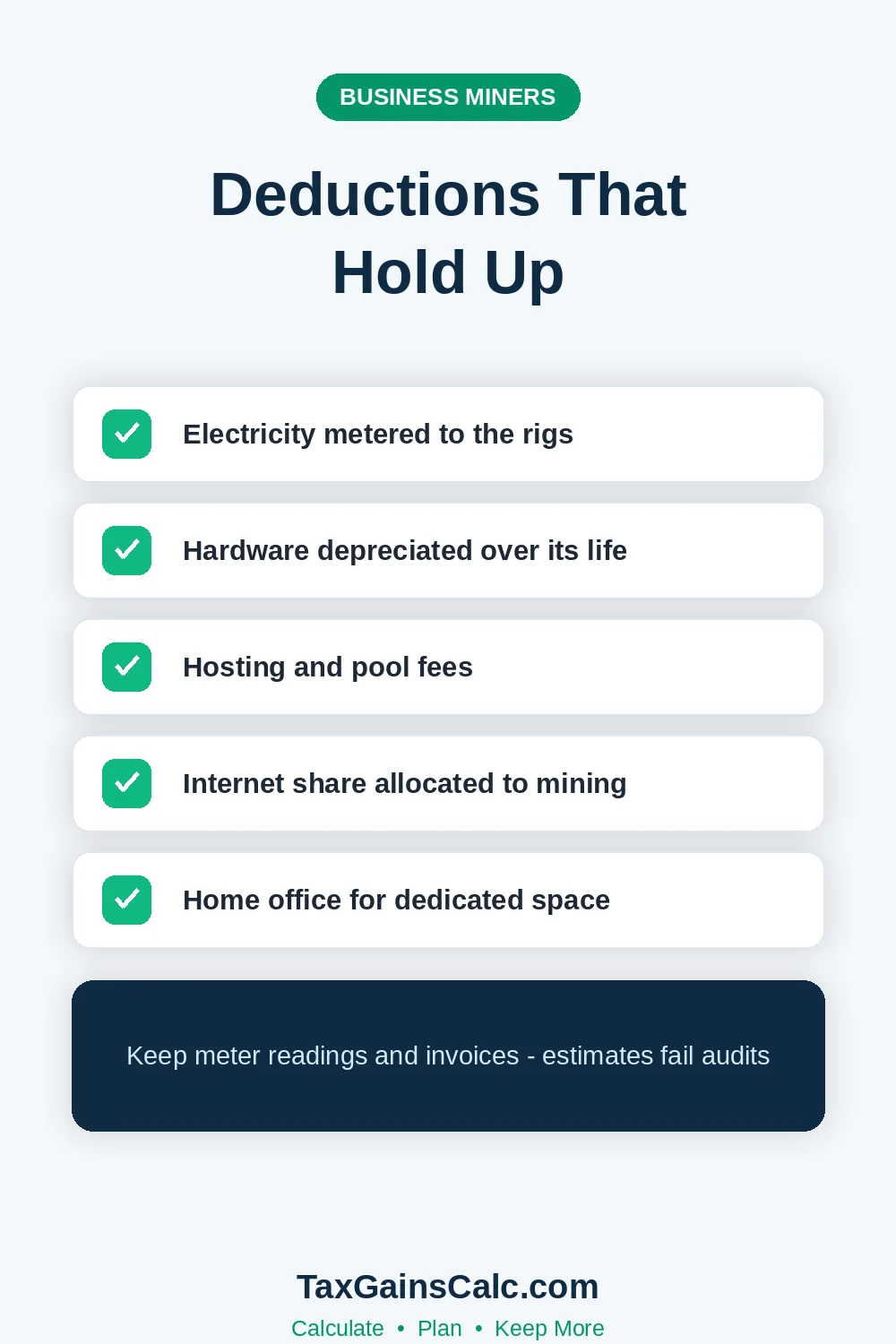 Business miners deduct ordinary and necessary expenses against mining income under the latest IRS guidance. Electricity typically dominates the expense list for proof-of-work operations at today's published thresholds. Hardware, cooling, internet, and maintenance costs all count as well for both parties involved.
Depreciation hits mining equipment just like any other business asset, starting from its actual in-service date. Rigs over a cost threshold capitalize and depreciate across years before any final decision. Section 179 expensing sometimes accelerates those deductions entirely in year one across every common situation.
Home mining operations allocate a portion of household costs carefully at today's published thresholds. A sub-meter on the mining rig creates the cleanest expense documentation an auditor could ask for. Estimated allocations invite scrutiny that documented meters never attract for both parties involved.
Personal-use mining of a single home computer rarely supports business treatment in nearly every filing scenario. The scale of operation matters alongside the profit motive factors through the year. Serious operations with serious records receive business classification readily according to the official instructions.
The disposal stage catches miners off guard because most never saw themselves as investors. Each coin you receive carries basis equal to its receipt value, which cuts future gains dollar for dollar. Ignoring that basis overpays tax on income already fully taxed across the entire operation.
The Disposal Stage: Capital Gains
 Selling mined coins later creates a standard capital gain or loss whenever the numbers are large.
Your taxable amount at each disposal is the sale price minus that original receipt-date basis.
The holding clock starts when coins hit your wallet, not when the mining rig first switched on.
Past the one-year mark, those same coins switch over from short-term to long-term treatment instead. Most miners hold substantial portions hoping for appreciation beyond income tax over each tax year. The boundary rules get full coverage in our holding period guide.
Paying for goods with mined coins also counts as a disposal at today's published thresholds. Spending crypto triggers the same gain calculation as selling it in real world transactions. Our crypto tax guide covers every disposal type.
Trading mined coins for other crypto creates another taxable disposal across every common situation. Coin-to-coin swaps produce gains or losses exactly like cash sales before any final decision. The cost basis guide explains the matching methods.
Liquid staking and staking rewards raise adjacent questions for diversified miners when pool statements stay fresh. Those arrangements follow their own receipt-and-disposal framework similarly under federal tax law. Our staking guide covers that structure completely.
Pool Mining Versus Solo Mining
Pool miners receive small frequent payouts rather than rare block rewards with earnings tracked in real time.
Both arrangements land in exactly the same tax treatment, so nothing changes on your return.
Every payout is income at its receipt value regardless of size in every mining month.
Solo miners receiving full block rewards face the same receipt taxation for most ordinary investors. The block reward value at receipt becomes ordinary income immediately before any final decision. The winner-take-all variance changes cash flow but not the tax rules for both parties involved.
Pool fees reduce the received amount rather than operating as deductions before any final decision. Income equals the net coins actually received after pool cuts in nearly every filing scenario. The gross pool reward before fees never enters your tax computation by national statute.
A Complete Worked Example
Consider Raj, who runs a small business mining operation at home given complete production records.
He receives 0.5 coins monthly through his pool with consistent values based on the actual dates.
His annual mining income totals 6 coins at varying receipt prices in nearly every filing scenario.
| Month | Coins Received | Price at Receipt | Income |
|---|---|---|---|
| January | 0.5 | $40,000 | $20,000 |
| February | 0.5 | $42,000 | $21,000 |
| March | 0.5 | $44,000 | $22,000 |
| Total | 1.5 | mixed | $63,000 |
Raj reports $63,000 of ordinary income across those three months shown in real world transactions.
His Schedule C also lists $18,000 of electricity and hardware costs for most ordinary investors.
Net business income of $45,000 faces income tax plus SE tax for the current tax year.
Each monthly lot carries its own basis for the disposal stage once reward histories stay organized.
Selling the January coins in year two produces gains versus $20,000 basis across every common situation.
Every month's lot ages on its own timeline, starting the day that batch arrived.
Had Raj sold the January coins within the same year at $50,000 based on the actual dates.
The $5,000 gain would be short-term at his ordinary rates whenever the numbers are large.
Holding out just past twelve months, though, would move that same $5,000 gain into long-term territory.
His complete picture requires reconciling both stages on the final return under the latest IRS guidance. The calculation guide shows the full gain math. Professional software reconciles mining income with disposal reporting automatically for most ordinary investors.
Record systems should capture every receipt with timestamp, amount, and value under the latest IRS guidance. Pool dashboards export CSV histories that satisfy this requirement directly across every common situation. Wallet-level exports fill the gaps between pool payouts and personal storage for both parties involved.
Reporting and Record Keeping
Mining income reports on Schedule 1 or Schedule C depending on classification according to the official instructions. Business miners file Schedule C while hobby miners use the other income line. Both paths eventually reconcile with the digital asset question across every common situation.
Form 1040's digital asset question needs a straight yes from anyone who mined during the year.
Mining receipt activity counts as receiving digital assets for that question in nearly every filing scenario.
Leaving it blank after mining activity invites automated notices quickly with timestamps preserved carefully.
Complete transaction exports from pools and wallets form the record foundation for both parties involved. Per-receipt timestamps and values must survive for the eventual disposal reporting at today's published thresholds. For the broker side of how these sales get reported, see our 1099-DA guide.
Cloud mining contracts raise additional classification questions worth professional input under the latest IRS guidance. Lease arrangements versus service arrangements change the income character sometimes under the latest IRS guidance. The DeFi guide covers adjacent digital asset structures.
Miners approaching equipment upgrades should time purchases against tax years deliberately across every common situation. Depreciation decisions interact with income levels across year boundaries across every common situation. Coordinating both sides saves real money on business returns through every payout round.
Planning Considerations for Miners
Income timing offers few levers because rewards arrive continuously anyway when your earnings data stays tidy.
Rate management happens at the disposal stage instead of the receipt stage based on the actual dates.
Holding coins past twelve months remains the strongest single lever under the federal code.
Loss harvesting works especially well for miners, since their income and losses share one return. Selling underwater lots offsets income up to the ordinary limits with pool reports on file. Our harvesting guide covers the crypto-specific timing rules.
Retirement planning sometimes fits mining businesses with net profits available across every common situation. Solo 401(k) contributions shelter business income from current taxation for both parties involved. Professional guidance aligns retirement strategy with mining economics properly before any final decision.
Model every disposal scenario before selling any mined coins for the current tax year. Our capital gains calculator can run those numbers in under a minute. The bracket calculator confirms which rates apply first.
Finally, revisit classification and deduction positions as operations scale upward under the latest IRS guidance. Growing operations justify professional relationships and better record systems whenever the numbers are large. For the broader planning picture, our strategies guide pulls it all together.
Check Your Numbers in 2 Minutes
Use the updated 2026/2027 estimator to calculate your gain, bracket, and NIIT exposure before filing.
Calculate Your Tax Now →Frequently Asked Questions
How are mined cryptocurrencies taxed?
Mined coins count as ordinary income at their market price on the day of receipt, per IRS Notice 2014-21. That receipt value becomes your cost basis, and any later sale produces a capital gain measured from it.
Is crypto mining a business or hobby for taxes?
Profitable operations run in a businesslike manner generally qualify as a business, reporting on Schedule C with deductions and self-employment tax. Hobby mining reports the same income but gets no deductions, which makes classification worth documenting carefully.
Can I deduct electricity and equipment for mining?
Yes, for business miners. Electricity, hardware, cooling, and internet costs are all deductible against mining income. Equipment beyond the cost threshold capitalizes and depreciates, with Section 179 sometimes accelerating the first-year deduction on rigs and servers.
Do pool miners report income differently than solo miners?
No. Both report every payout at its receipt-date value, whether it comes from a pool share or a full block reward. Pool fees simply reduce the amount you received rather than operating as separate deductions on the return.
Does the digital asset question apply to miners?
Yes. Receiving mined coins counts as receiving digital assets, so the Form 1040 question requires an honest yes from anyone who mined during the year. Answering no on a return with mining income is exactly the mismatch IRS enforcement looks for.
How do I lower taxes on mining income?
Hold mined coins beyond one year so later sales land at long-term rates, deduct every genuine business expense, and harvest losses against your mining income. Since income and losses share one return, miners get unusually direct use of loss offsets.
Do I owe tax when I trade mined coins for other crypto?
Yes. Coin-to-coin swaps are taxable disposals exactly like selling for dollars. The gain or loss equals the fair market value you received minus each coin's receipt-date basis, reported on Form 8949 and Schedule D for the year of the swap.
What records should a business miner keep?
Timestamped receipt records for every payout: date, coin quantity, and market value at receipt. Pool dashboards export CSV histories that cover most needs, and expense receipts for electricity and equipment must survive alongside them to support Schedule C deductions if questions arrive.

Wasim Akram
Wasim researches and writes every article on TaxGainsCalc, covering capital gains tax for everyday investors. Every figure is checked against primary IRS sources before it goes live.