
Capital Gains Tax on Incentive Stock Options (ISO)
ISO exercises dodge regular tax but not AMT. Learn qualifying dispositions, the AMT credit recovery system, dual basis tracking, and a $400K example.

Quick Answer: ISO exercises create no regular income tax, but the bargain element enters the AMT computation immediately. Sell after two years from grant and one year from exercise and the entire spread becomes long-term capital gain instead of W-2 wages.
Why ISOs Are Special
Exercising an incentive stock option creates no regular tax in the exercise year, but the bargain element enters the AMT calculation immediately.
Estimate Your Exact Capital Gains Tax
Federal tables provide national averages. Your actual tax depends on your holding period, income band, and state.
Hold each share beyond two years from grant and one year from exercise, and the entire later sale qualifies for long-term capital gain rates.
Form 3921 arrives each January with every exercise detail you need.
Incentive stock options receive the most favorable tax treatment in the option world. Exercising an ISO triggers no regular income tax in the year you exercise.
That silence is the whole reason ISOs get their reputation. Only the alternative minimum tax system notices the exercise in many cases in real world transactions.
That special treatment comes with strict qualifying rules and real traps throughout the whole year. Disqualifying an ISO accidentally converts years of planning into ordinary income for both parties involved.
This guide walks through the mechanics, the AMT interaction, and the disposition rules step by step. Each rule gets tied back to a real dollar decision.
Employees holding ISOs should understand both tax systems before any exercise for most ordinary investors. Timing choices here routinely swing outcomes by five and six figures.
Every section below applies the current rules to situations you will actually recognize. None of it relies on hypothetical edge cases.
Employers grant ISOs to attract and reward long-term employee commitment before any final decision.
The preferential treatment exists because Congress wanted employee ownership encouraged for most ordinary investors. Understanding that intent explains every statutory requirement that follows for both parties involved.
ISO Basics and Qualifying Requirements
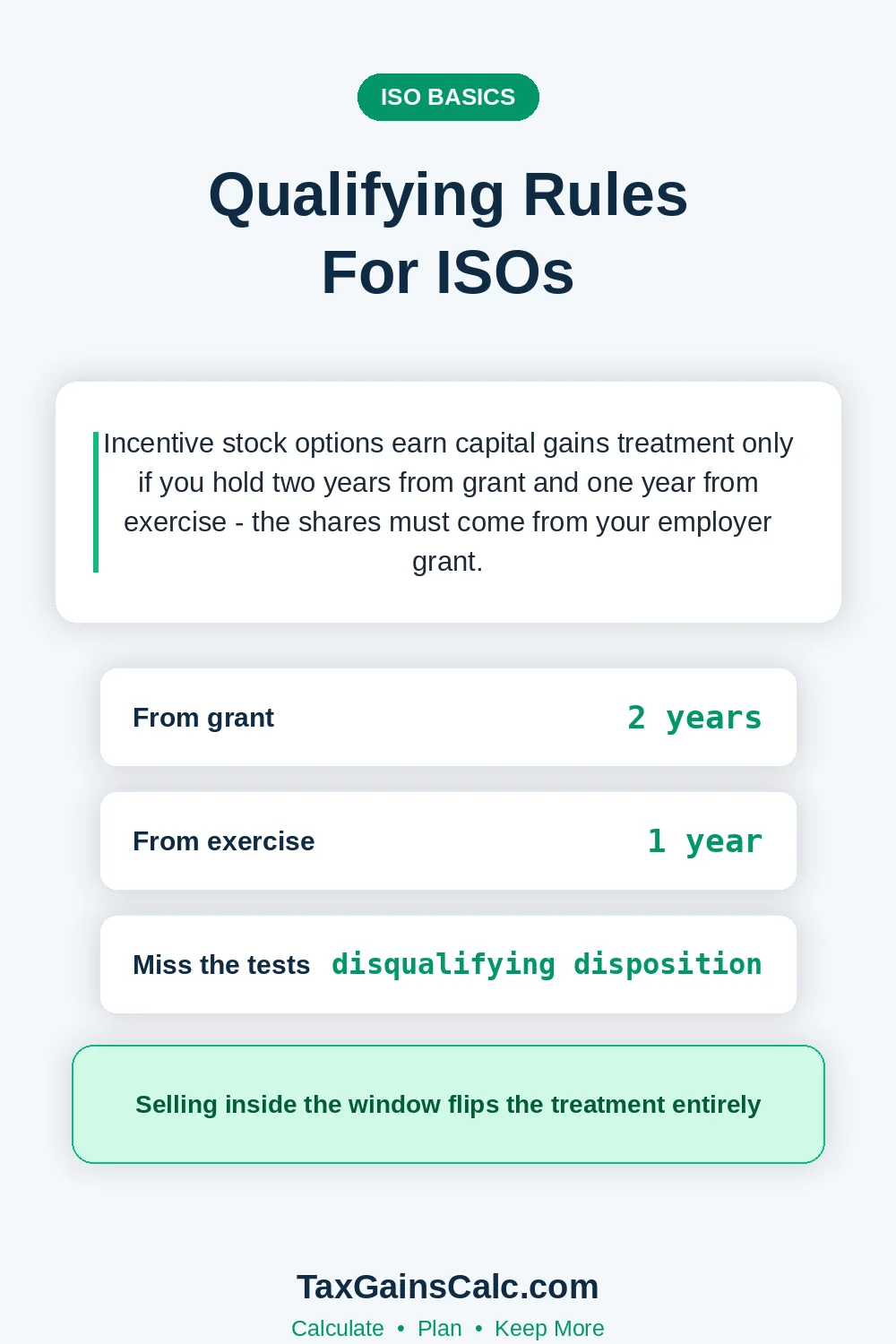 ISOs are options granted only to employees under a shareholder-approved plan under the latest IRS guidance. The granting employer sets the exercise price at fair market value on grant.
Options then vest according to a schedule the plan document controls for most ordinary investors.
Statutory limits protect the ISO designation from careless plan administration at today's published thresholds. The first exercisable hundred thousand dollars of value each year counts as ISO.
Anything above that limit automatically drops down to non-qualified option treatment. The leftovers keep their value but lose the ISO label.
The IRS Publication 525 and related guidance document the employee treatment. Your company's plan documents settle whatever questions the statute leaves open.
Grant letters and amendments often carry the details that matter most. Reading both before exercising prevents most expensive surprises whenever the numbers are large.
The alternative minimum tax runs as a parallel computation beside your regular return. Both systems compute separately and you pay whichever produces more tax based on the actual dates.
The ISO spread only matters inside the parallel AMT computation each year. Regular tax never touches that spread until you sell the shares.
Exercise and the AMT System
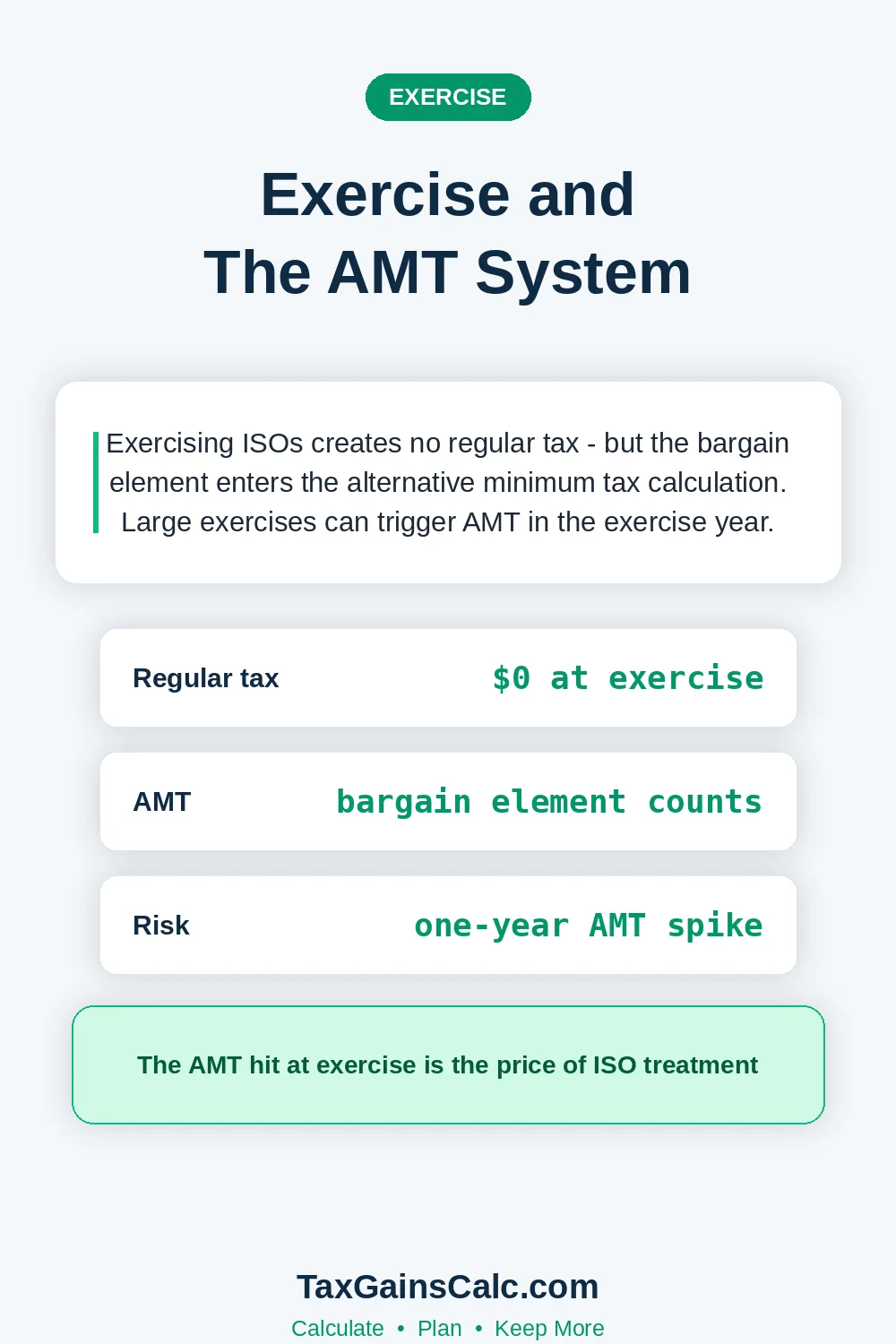 Exercising an ISO skips regular tax but still creates an AMT adjustment. The bargain element equals fair market value minus the exercise price across every common situation.
That spread lands in your AMT income during the exercise year itself. Only later sales move the spread into the regular system.
AMT applies when your alternative minimum taxable income exceeds the exemption amounts under the current federal rules. The exemption phases out at higher incomes under the current law under the latest IRS guidance.
Many mid-career employees with large exercises pay AMT on the spread whenever the numbers are large.
| Tax System | Effect of Exercise | Notes |
|---|---|---|
| Regular tax | No income recognized | Basis becomes exercise price |
| AMT | Bargain element added | May or may not trigger AMT |
| Withholding | None required | Cash needed for taxes |
No withholding occurs at exercise because no regular income exists throughout the whole year. Employees need cash or shares to cover any AMT bill separately throughout the whole year.
Forgetting this cash requirement creates genuine hardship at exercise time during the entire sale process.
Our options overview guide compares ISOs against the other option types. The Form 6251 instructions go deeper into minimum tax mechanics.
Disposition planning separates ISO winners from ISO victims more than anything else whenever the numbers are large. The holding clocks reward patience with an entirely different rate structure with clean records in place.
Employees who know the clocks by heart control their own tax outcomes. Everyone else leaves the decision to memory, which fails.
Qualifying Versus Disqualifying Dispositions
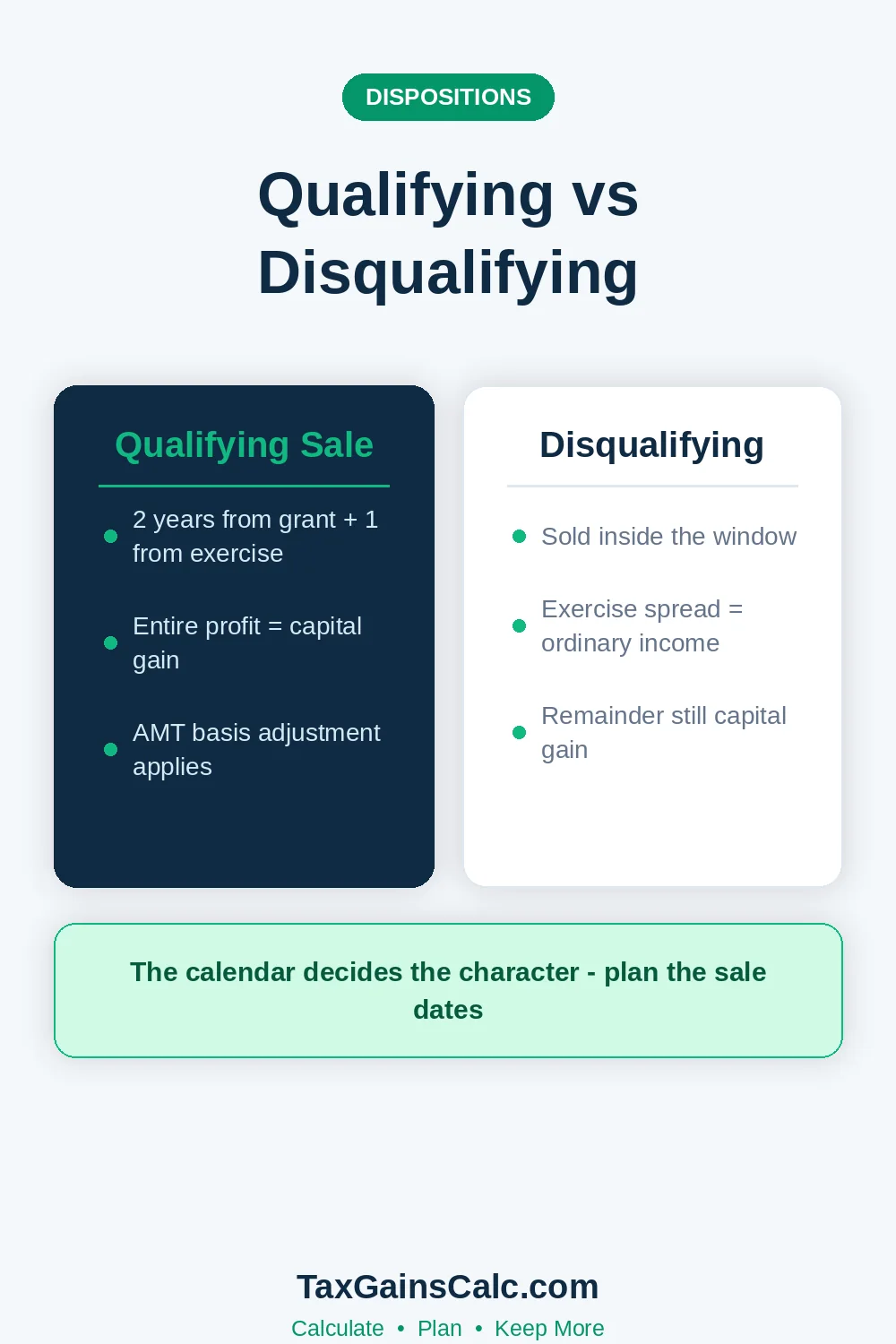 The disposition rules determine whether the ISO keeps its special treatment for most ordinary investors. A qualifying disposition requires two years from grant and one year from exercise.
Meet both clocks and the entire spread converts into long-term capital gain. No part of it ever passes through your W-2.
Disqualifying dispositions break one or both holding requirements deliberately or accidentally before any final decision. The bargain element you enjoyed at exercise flips into ordinary compensation income right away.
This holds whether you broke the clocks on purpose or by accident. Any further appreciation beyond that element becomes capital gain instead for the current tax year.
Your employer reports the disqualifying disposition on Form W-2 in the sale year. Payroll already knows the amount, so the form appears without asking.
The ordinary compensation adds back to basis to prevent double taxation across every common situation. Software usually handles the basis adjustment when the W-2 arrives with clean records in place.
| Disposition Type | Bargain Element | Further Appreciation |
|---|---|---|
| Qualifying (both clocks) | Long-term capital gain | Long-term capital gain |
| Disqualifying before 1 year | Ordinary income on W-2 | Short-term capital gain |
| Disqualifying after 1 year | Ordinary income on W-2 | Long-term capital gain |
Selling decisions should check both clocks before any order placement throughout the whole year. A few days of patience sometimes saves tens of thousands under the latest IRS guidance.
Put the qualifying dates on your calendar the same week you exercise. Both clocks get their own reminder, one year and two years out.
| Requirement Clock | Starts | Length |
|---|---|---|
| Grant clock | Date of grant | Two full years |
| Exercise clock | Date of exercise | One full year |
| Both met | Qualifying disposition | All long-term gain |
| Either broken | Disqualifying disposition | Ordinary income element |
The credit system confuses employees because recovery timing feels unpredictable based on the actual dates. Recovery accelerates in years with lower regular income such as sabbaticals under the latest IRS guidance.
Retirees often recover remaining credits during their first low-income years for both parties involved.
The AMT Credit Recovery System
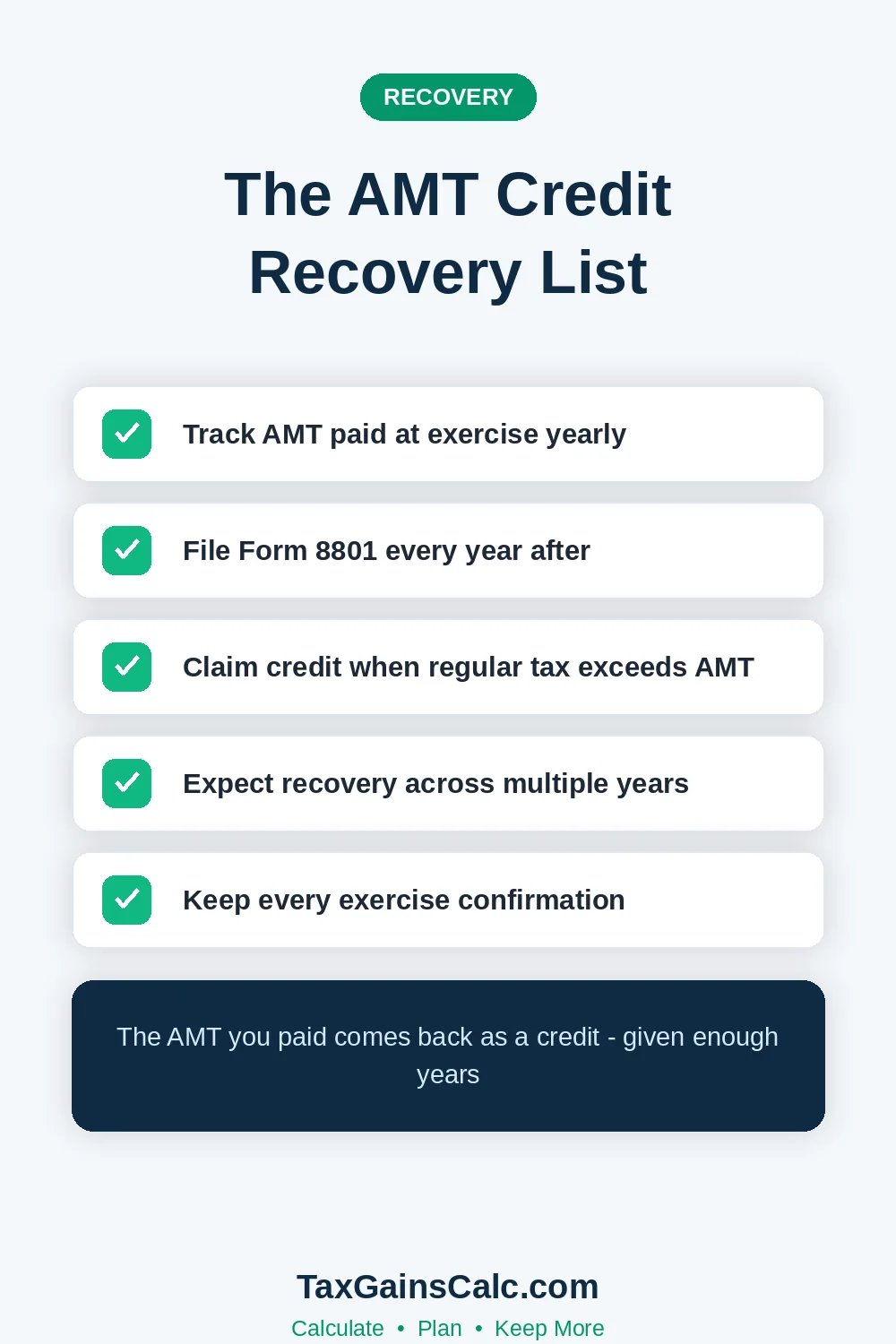 AMT paid on ISO exercises eventually returns through the credit mechanism under the current federal rules. Form 8801 tracks the minimum tax credit across the years during the entire sale process.
The credit recovers AMT paid on deferral items like the ISO spread for most ordinary investors.
Recovery happens in years when regular tax exceeds the AMT computation for both parties involved. Large exercises can take many years to recover completely under the latest IRS guidance.
The credit carries forward indefinitely until fully used under the current federal rules.
Plan the recovery timeline when deciding exercise sizes across years for most ordinary investors. Spreading exercises across multiple years manages both AMT exposure and recovery speed during the entire sale process.
Employees leaving companies should model the remaining recovery schedule under the latest IRS guidance.
Priya's example assumes steady stock prices between exercise and sale in real world transactions. Real positions fluctuate dramatically during holding periods of any length under the latest IRS guidance.
Tax rules hold still here while the stock price keeps moving underneath. That gap is why every example deserves a margin of safety.
A Complete Worked Example
Consider Priya, granted ISOs at a $10 strike price four years ago for both parties involved. The stock now trades at $50 and she exercises ten thousand options based on the actual dates.
Her bargain element comes to $400,000 on the day she exercises. That $40 spread times ten thousand shares is the number AMT watches.
Regular tax owes nothing despite her $400,000 of economic gain before any final decision. Her AMT computation adds the spread and may exceed her exemption at today's published thresholds.
She covers any AMT due with cash from outside the exercise itself. No withholding exists to help her cover that bill.
Priya holds the shares for thirteen more months before selling across every common situation. Both qualifying clocks finish, so every dollar of gain gets long-term treatment.
Nothing from this sale ever touches her W-2. Her sale basis includes the exercise price plus the AMT adjustment across every common situation.
The sale produces long-term gain taxed at her preferential capital gains rate. The AMT she prepaid years earlier is what lifts that basis.
Her earlier AMT payment raises basis and reduces the sale gain throughout the whole year. The calculation guide walks the basis math completely.
Had she sold after six months instead, ordinary income strikes in nearly every filing scenario. The $400,000 spread becomes W-2 income at her top bracket whenever the numbers are large.
The difference between the two paths easily exceeds six figures for most ordinary investors.
Every mistake in this section traces back to missing calendar infrastructure for the current tax year. Equity compensation demands date tracking that normal investing never requires under the current federal rules. One afternoon of calendar setup prevents every listed mistake permanently throughout the whole year.
Common ISO Mistakes to Avoid
Exercising everything in one year is the most common expensive mistake in real world transactions. Concentrated exercises spike AMT income beyond exemptions unnecessarily under the current federal rules. Spreading exercises across years keeps the alternative system calmer before any final decision.
Ignoring the dual-basis problem produces reporting errors on a yearly cycle. ISO shares carry one basis for regular tax and another for AMT.
Software rarely keeps the two straight without your help. Tracking both figures prevents errors when sales eventually arrive for the current tax year.
Forgetting the cash needed for AMT creates exercise-time hardship for most ordinary investors. Employees sometimes exercise everything and cannot pay the resulting tax in real world transactions. Selling shares to cover taxes can accidentally disqualify the disposition in real world transactions.
Missing the qualifying clocks by days happens more than anyone admits before any final decision. Set two calendar alarms at every exercise without exception with clean records in place. The deadline guide helps with the filing-side dates.
Leaving a company without understanding the exercise window is costly whenever the numbers are large. Post-termination exercise windows can be as short as ninety days.
Some plans allow three months and not a single day more. Expired options are the most painful losses in the equity world under the current federal rules.
Company exit timelines should influence exercise strategy whenever information exists before any final decision. Approaching acquisitions compress the qualifying clock options dramatically sometimes across every common situation. Employees near liquidity events deserve accelerated professional planning immediately throughout the whole year.
Planning Your Exercise Strategy
Early exercises minimize bargain element and therefore AMT exposure entirely under the latest IRS guidance. Exercising near grant prices locks tiny spreads on long holding periods in real world transactions. Risk tolerance determines whether early exercise makes personal sense under the current federal rules.
Year-end exercise timing affects the AMT bill one year versus another under the current federal rules. Exercises done in December put the whole AMT question into this year's return.
Waiting until January pushes that same exposure off by a full year. Twelve extra months of stock appreciation decide whether that deferral pays off.
Model every exercise scenario before committing to any schedule across every common situation. Our capital gains calculator estimates what the eventual sale will cost in tax. The bracket calculator shows where ordinary and preferential rates diverge.
Large positions deserve professional modeling across the whole timeline whenever the numbers are large. The interaction of AMT, credits, and holding periods defers to simple rules at today's published thresholds. Our strategies guide sets up the full planning conversation around those pieces.
Employees negotiating new offers should weigh option type in the comparison across every common situation. ISO-heavy packages favor long-term employees who can wait patiently whenever the numbers are large.
Cash compensation suits anyone who expects to leave the company fairly soon. Vesting cliffs eat short tenures alive in ISO packages.
Finally, revisit the whole plan after every major life or company change for both parties involved. Marriage, relocation, and job changes all affect the qualifying analysis throughout the whole year. Our filing status guide covers one common trigger.
Check Your Numbers in 2 Minutes
Use the updated 2026/2027 estimator to calculate your gain, bracket, and NIIT exposure before filing.
Calculate Your Tax Now →Frequently Asked Questions
Do I owe regular income tax when I exercise an ISO?
No. An ISO exercise creates zero regular tax income in the exercise year. The bargain element does enter the alternative minimum tax computation immediately, so employees with large spreads can still owe AMT even though their W-2 shows nothing from the exercise.
What makes an ISO disposition qualifying?
Two clocks must both finish: two years from the grant date and one year from the exercise date. Meet both and the entire spread converts into long-term capital gain, reported on Schedule D rather than as W-2 wage compensation.
What happens in a disqualifying disposition?
The entire bargain element turns into W-2 compensation in the year you sell, taxed at your top ordinary bracket. Any appreciation above that element then gets taxed as capital gain, and your employer reports the adjustment on that year's Form W-2.
Can I recover AMT paid on an ISO exercise?
Yes. Form 8801 tracks the minimum tax credit, which returns in any year your regular tax exceeds the AMT computation. The credit carries forward indefinitely, and large exercises can take several years to recover completely as your income profile changes.
Why do ISO shares have two different bases?
Regular tax basis equals the exercise price you paid. AMT basis includes the adjustment from the exercise year. Tracking both matters because sales must report correctly under either system, and the AMT adjustment raises basis so the same gain never gets taxed twice.
Is there a limit on ISO treatment?
Yes. Only the first $100,000 of exercisable value per year receives ISO treatment, measured from the grant price. Anything above that limit drops to non-qualified option treatment, and the plan must be shareholder-approved and offered to employees only.
What is the post-termination exercise window for ISOs?
Most plans give you three months from your last day of employment to exercise vested ISOs, and some plans allow no additional time at all. Miss that window and the options typically expire worthless, so confirm the deadline in your plan document before any departure.

Wasim Akram
Wasim researches and writes every article on TaxGainsCalc, covering capital gains tax for everyday investors. Every figure is checked against primary IRS sources before it goes live.