
Crypto Staking Rewards Tax: Capital Gains vs Ordinary Income
Staking rewards are taxed twice: ordinary income at receipt, then capital gains on disposal. Learn the 2026 rates, reporting forms, and a worked example.

How Staking Rewards Get Taxed
Staking rewards get taxed twice under current IRS rules. Every reward counts as ordinary income at its receipt-day market price, and selling those tokens later creates a second capital gain or loss. Rates span 10 to 37 percent at receipt, then 0, 15, or 20 percent at sale, with the 3.8 percent NIIT possible at higher incomes.
Staking has become one of the easiest ways to earn passive income from your crypto holdings.
You lock up coins like Ethereum or Solana, and the network pays you fresh tokens. Every reward you receive creates a tax event, though, and many investors completely miss this.
The crypto staking rewards tax rules split your earnings into two separate and consecutive taxable stages.
Stage one taxes every reward as ordinary income at the moment you receive control of it. Stage two taxes your profit a second time when you later sell or swap those tokens.
This two-stage structure surprises a lot of first-time stakers each filing season. They expect one simple tax bill and instead face two distinct calculations.
Understanding both stages keeps your return accurate and your tax bill predictable.
Every remaining section of this guide walks each stage with copyable numbers. Every rule here reflects current IRS positions as of the 2026 filing season.
Keep your exchange exports handy while you read through the worked examples.
Staking Income at Receipt
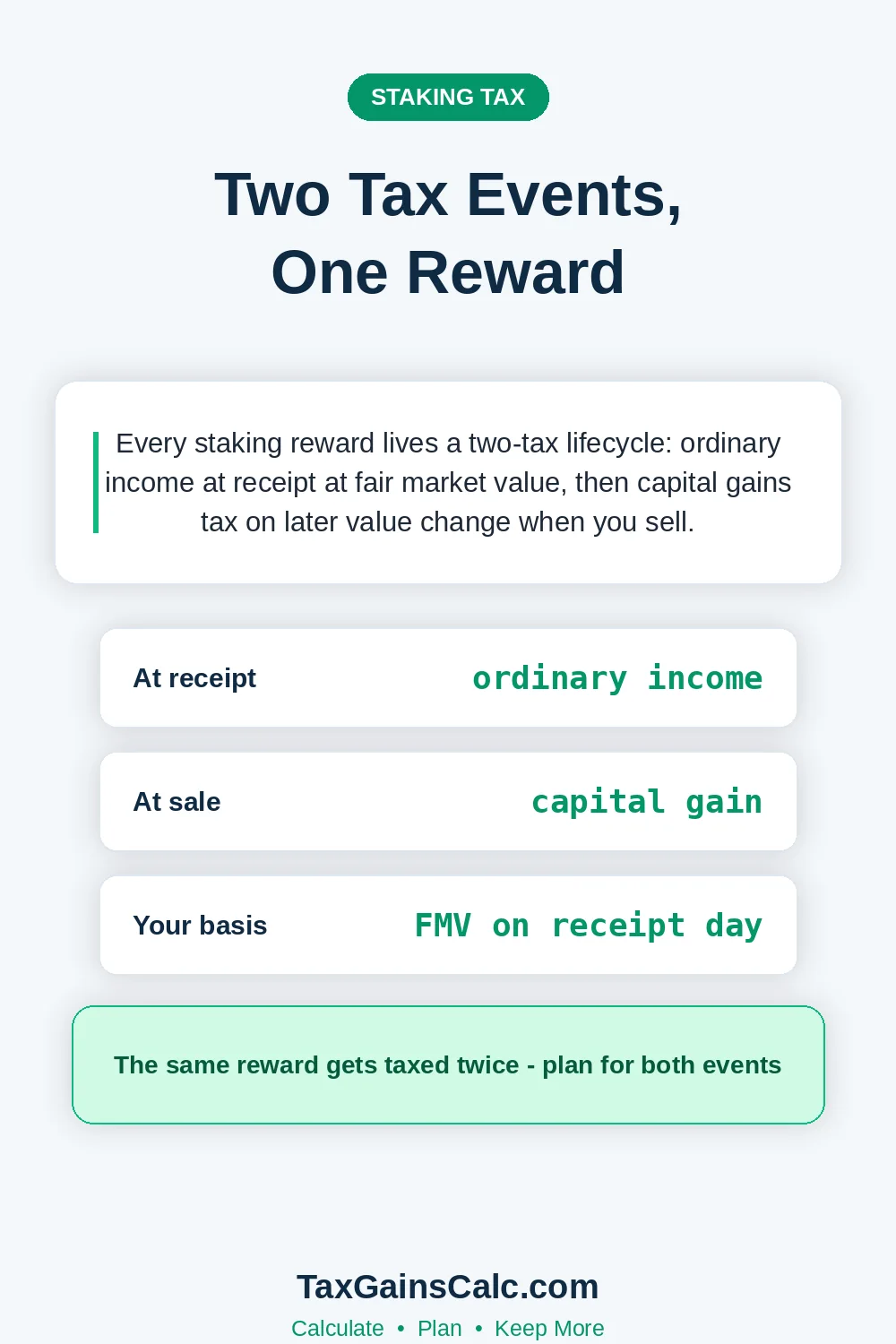 The IRS settled the receipt question in 2023 through Revenue Ruling 2023-14. The ruling holds that staking rewards count as gross income in the year the validator gains control. The IRS virtual currency FAQ addresses staking questions directly in official terms.
Fair market value on the receipt date becomes your taxable amount for that reward.
Fair market value means the token price on a major exchange at the receipt timestamp. If a reward pays out at 3:00 AM, the IRS still expects that exact price.
Consistent daily snapshots from one exchange make this manageable in real practice.
Your reward also starts a fresh cost basis at that same receipt-date value. The receipt amount is not just taxable income, it becomes the basis you subtract later.
Accurate records at receipt time therefore save you real money at sale time.
Delegation does not change the outcome for most everyday stakers either. If you delegate tokens to a validator and receive rewards back, the ruling still applies.
You owe income tax when those rewards first hit your wallet or account.
Liquid staking derivatives add one more wrinkle worth knowing about. A staking receipt token itself generally counts as ordinary income at its receipt-date value. Swapping that receipt token later creates its own separate disposal event to report.
Capital Gains When You Sell
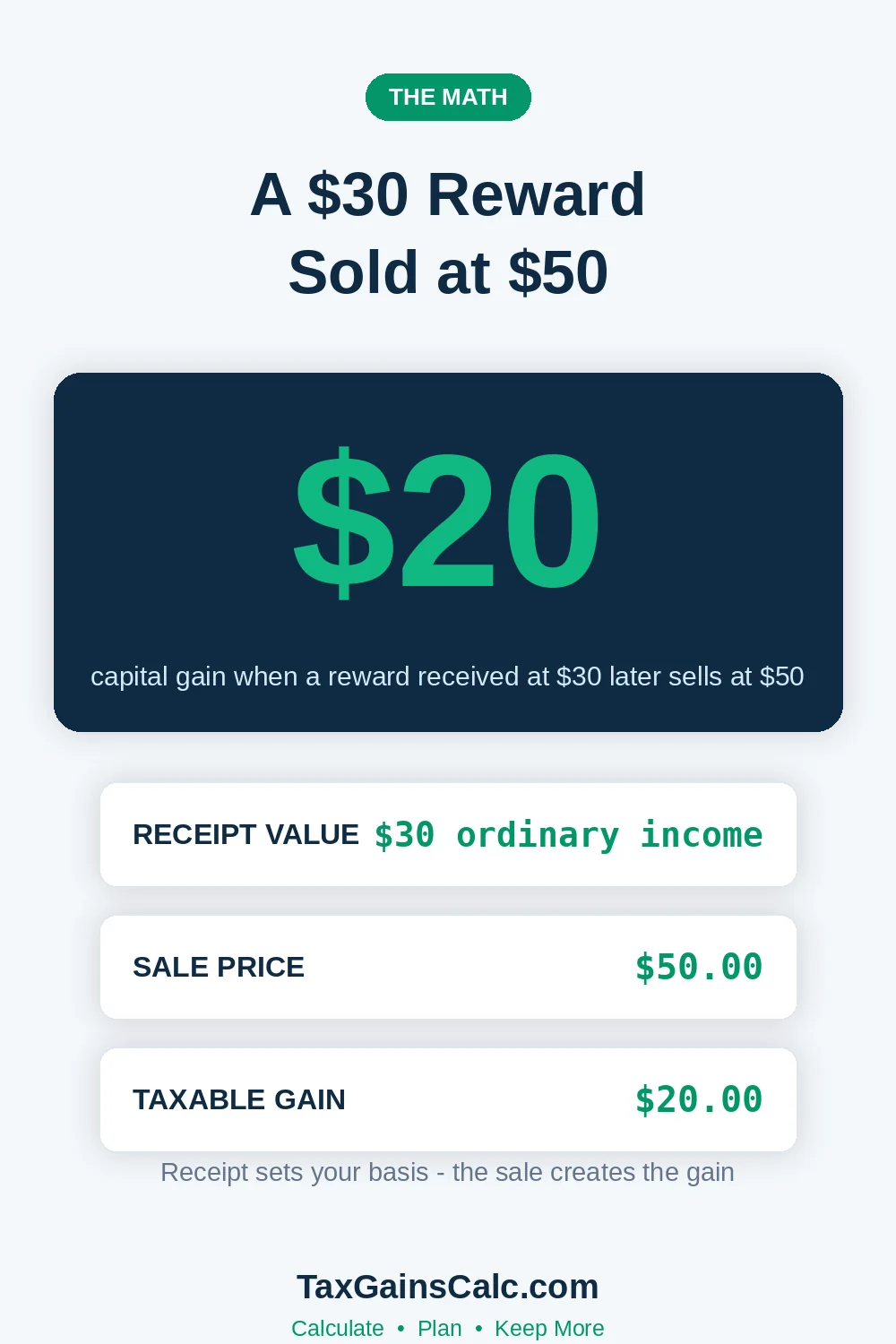 The second stage begins when you dispose of the staked tokens or the accumulated rewards. Selling, swapping, or spending crypto all count as disposals under the current federal rules. Each disposal triggers a gain or loss calculation against the basis you recorded earlier.
Your taxable gain comes from sale price less the basis recorded on receipt date. A reward received at $30 and later sold at $50 produces a $20 gain. That gain then follows the normal capital gains tax on cryptocurrency framework.
Holding period decides which rate schedule applies to that calculated gain. Disposing of tokens before the one-year mark leaves the gain in your ordinary brackets. Positions held past one year qualify for the long-term tiers: 0, 15, and 20 percent.
Since stakers often hold their rewards, the disposal date can land years after receipt. Many investors slowly accumulate rewards and then sell everything in one large batch. That batch sale then needs a careful per-reward basis breakdown to stay accurate.
2026 Rates for Staking Income and Gains
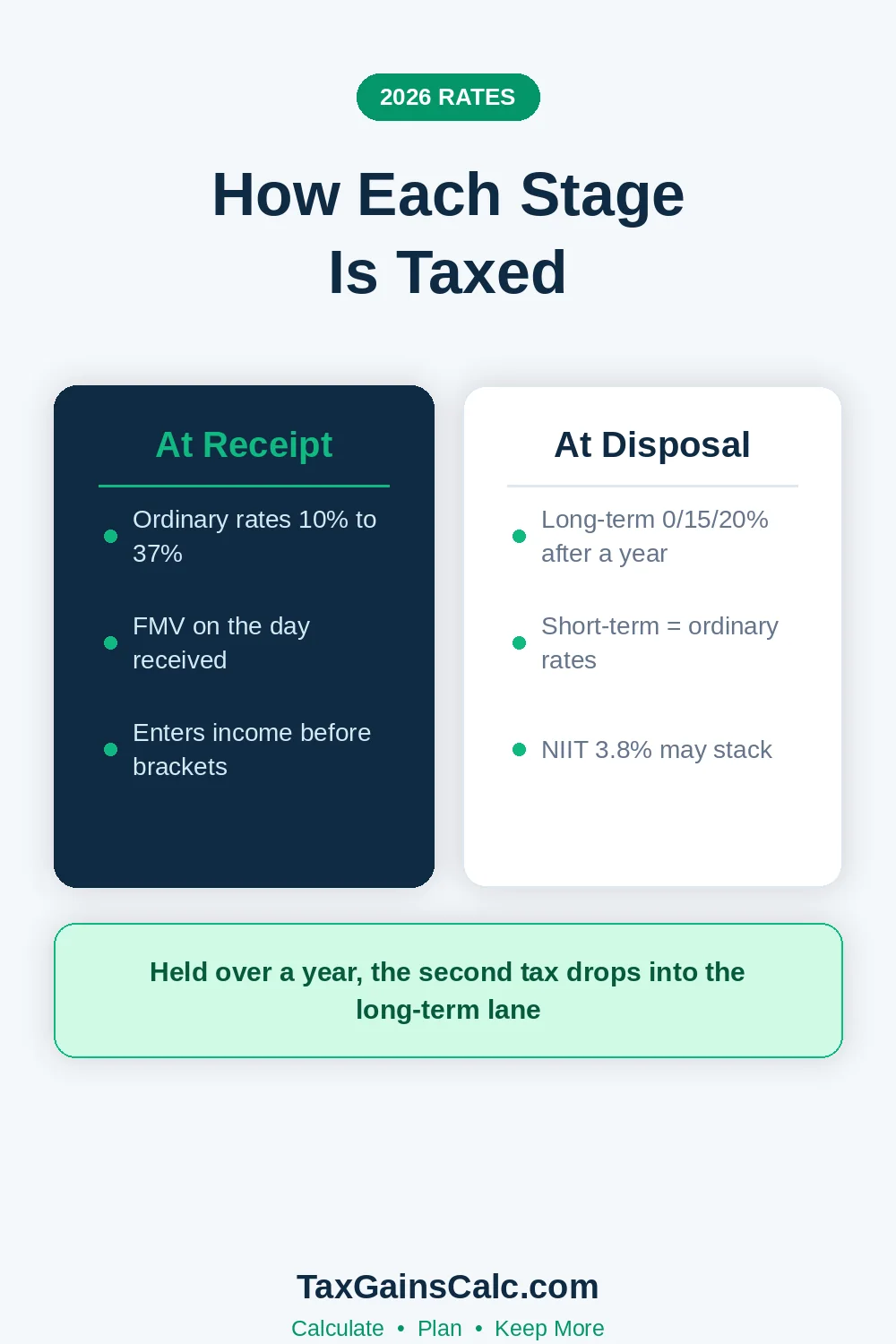 Receipt income lands on top of your wages, business income, and other taxable earnings. It fills your ordinary brackets from the bottom up, exactly the way salary does. Disposal gains instead use the separate preferential long-term schedule shown below.
| Tax Stage | Form of Tax | 2026 Rate Range | Key Thresholds (Single / MFJ) |
|---|---|---|---|
| Reward received | Ordinary income | 10% to 37% | 10% bracket ends $12,400 / $24,800 |
| Token sold within 12 months | Short-term gain | Ordinary rates | 37% applies at top bracket |
| Token sold after 12 months | Long-term gain | 0% / 15% / 20% | 0% up to $49,450 / $98,900 AGI |
| High earners, either stage | Net investment income tax | 3.8% | MAGI above $200,000 / $250,000 |
Patient stakers who leave their rewards untouched capture most of the long-term benefit. The wide 15 percent band covers far more staking income than most holders realize.
The spread between the two holding period schedules can easily top ten full percentage points. That spread is the whole prize for waiting past a year.
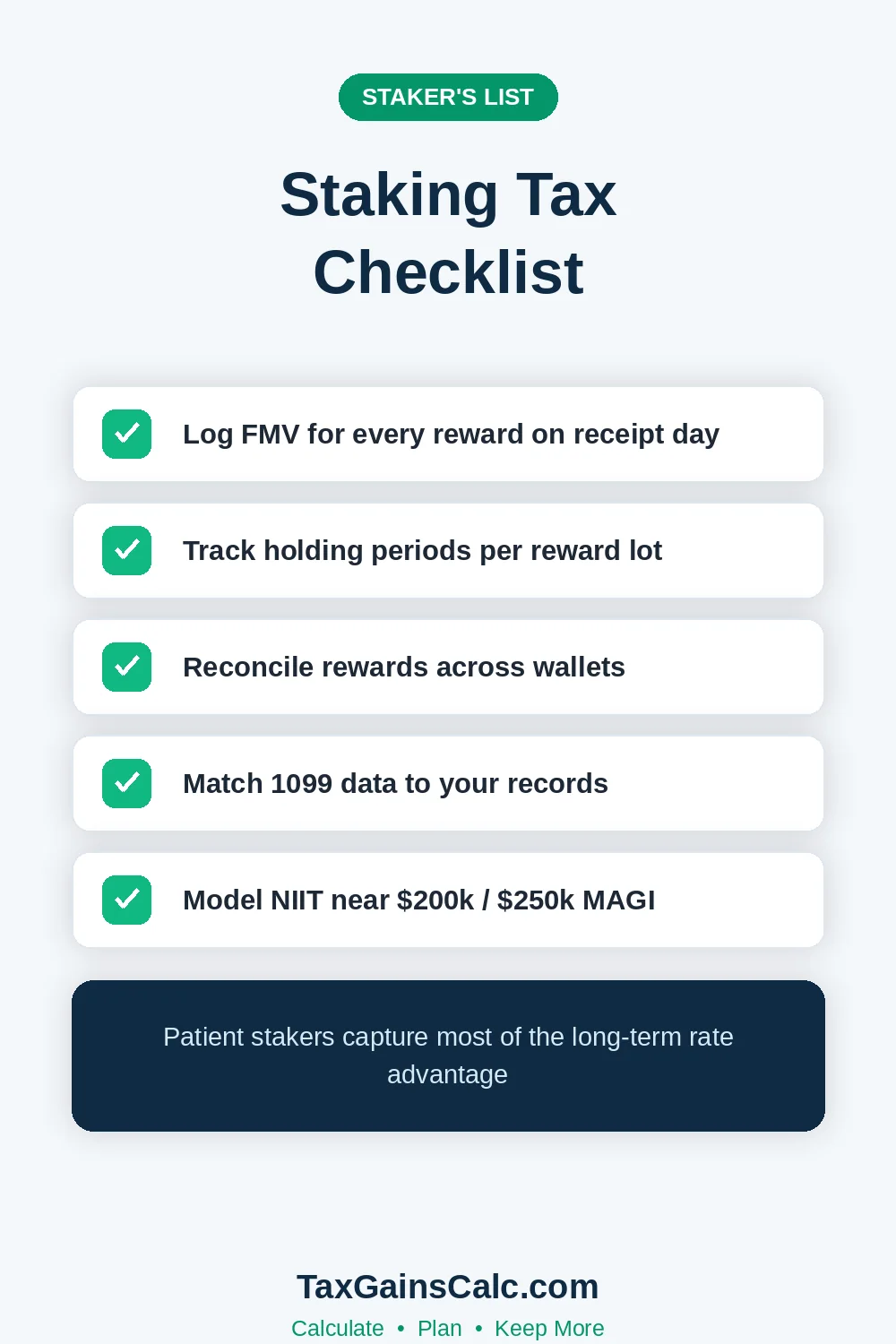
High earners must additionally track the 3.8 percent investment surtax hovering above both stages. Staking income counts as investment income for the flat 3.8 percent surtax. Our NIIT guide details how MAGI stacking pushes filers past those fixed thresholds.
A Worked Example From Receipt to Sale
 Consider Maya, who stakes Solana through a large regulated exchange account. She receives rewards monthly and then sells the whole lot after eighteen months. Her numbers show both tax stages in action with real figures.
| Month | Reward (SOL) | Price at Receipt | Taxable Income |
|---|---|---|---|
| January | 2.0 | $100 | $200 |
| February | 2.2 | $110 | $242 |
| March | 2.1 | $120 | $252 |
| April | 2.0 | $130 | $260 |
| Total | 8.3 | mixed | $954 |
Maya reports $954 as ordinary income spread across those four calendar months. Her per-reward basis records read $100, $110, $120, and $130 respectively. Fourteen months later she sells all 8.3 SOL at $150 per coin in one trade.
Sale proceeds reach $1,245 against a total recorded basis of just $954. Her realized gain therefore equals $291, and the holding period clearly exceeds one year. The entire gain qualifies for long-term treatment at her applicable federal rate.
If Maya stays inside the 15 percent band, her disposal tax runs about $44. The receipt stage already collected ordinary tax on the $954 of income. Two stages, two different rate schedules, and one well-documented trail behind it all.
Every figure here assumed Maya kept clean monthly records from day one. Without those records she would guess at basis and likely overpay. Spreadsheets, tax software, or exchange reports all work if they capture dates and values.
Why the Same Reward Gets Taxed Twice
Investors often describe staking tax as double taxation, and the label is largely fair. The same dollar of value faces ordinary tax at receipt and gains tax at exit. Only the growth between the two dates faces the second tax, though.
| Event | Amount Taxed | Rate Type | Example at 22% / 15% |
|---|---|---|---|
| Reward received at $100 | $100 | Ordinary 22% | $22 due at filing |
| Token sold later at $130 | $30 gain | Long-term 15% | $4.50 due at filing |
| Total over the path | $130 of value | blended | $26.50 total |
The blended burden on the full $130 works out to roughly 20 percent here. That lands far below the 37 percent top rate applied to the entire amount. Appreciation receives the preferential layer, which meaningfully softens the double hit.
Dipping prices can flip the second stage into a deduction instead of a bill. Sell a reward below its receipt value and the disposal generates a deductible loss. Those losses offset other gains plus another three thousand dollars of regular income yearly.
Reporting Staking Rewards on Your Return
Receipt income belongs on Schedule 1 attached to Form 1040 as other income. Exchanges paying $600 or more in staking rewards may issue a Form 1099-MISC. The absence of any form never removes your underlying reporting duty.
| What You Report | Where It Goes | Typical Source Document |
|---|---|---|
| Reward income at receipt | Schedule 1, Form 1040 | 1099-MISC or exchange history |
| Disposal gains and losses | Form 8949, then Schedule D | 1099-DA or exchange records |
| Digital asset activity question | Page 1 of Form 1040 | your own transaction records |
| NIIT exposure | Form 8960 | Form 1040 cross-check |
Disposals belong on Form 8949 with per-transaction basis and holding details. The totals then flow to Schedule D for the final rate computation. Our walkthrough of Form 8949 for crypto covers those entries line by line.
Brokers now report customer disposals on Form 1099-DA for recent tax years. Staking income reporting remains less standardized and varies noticeably by platform. Always reconcile every form against your own complete export before filing anything.
Form 1040's first page asks every taxpayer a yes-or-no digital asset question. Stakers who earned any rewards during the year must check the yes box.
Answering yes is not an admission of anything improper, just a disclosure. Skipping that question after receiving rewards is what actually invites IRS notices.
Tracking Requirements and Common Mistakes
Per-reward basis tracking is the foundation of accurate staking tax reporting. Each payout carries its own date, value, and eventual holding clock. Aggregating rewards into one blended average hides those differences and quietly distorts your gains.
Restaking is the specific mistake that trips up the largest number of filers. Auto-compounded rewards are still received, valued, and fully taxable like cash payouts. The tokens never pass through your bank account, but the tax law does not care.
Moving tokens between your own wallets is not a disposal under any current reading. A transfer to cold storage keeps your basis and holding period completely intact. Selling on a different exchange than the staking platform changes nothing either.
Forgotten small payouts also accumulate into real money across a full year. A modest $4 daily reward becomes roughly $1,460 of taxable annual income. Export complete histories rather than sampling only the larger earning months.
Basis methods also start to matter once rewards pile up across many payouts. First-in-first-out works well for steady reward streams without any extra bookkeeping. Specific identification lets you sell your highest basis rewards first and trim gains.
Our breakdown of crypto cost basis methods compares those two approaches in detail. Pick one method and apply it consistently across every exchange account you own. Switching methods midstream invites reconciliation headaches if the IRS ever asks questions.
Loss offsets deserve special attention whenever markets turn against your positions. The crypto wash sale rule still carries no force for digital asset losses. That gap makes year-end loss sales more powerful for crypto than for stocks.
Reducing Your Staking Tax Bill
Holding rewards past twelve months is the simplest lever available to any staker. The long-term schedule then replaces ordinary rates on the entire disposal stage. Patient stakers routinely save ten points or more on their appreciated rewards.
Timing receipts around lower-income years also reduces the stage-one burden noticeably. A sabbatical or a slow business year drops your ordinary bracket meaningfully. Rewards recognized during that window face a smaller ordinary tax bill.
Charitable giving offers another path for investors holding appreciated reward tokens. Donating long-held crypto avoids the disposal gain entirely at the same moment. The donating appreciated stock strategy transfers directly to crypto donations.
Loss harvesting pairs naturally with staking income at every portfolio size. Selling underwater positions offsets reward income up to the three-thousand-dollar annual ordinary limit. Our loss harvesting walkthrough walks through the full mechanics step by step.
Get a professional opinion before you lock in any filing approach for complicated staking setups. Validators running service arrangements, liquid staking stacks, or cross-border flows face genuine gray zones. The DeFi transactions guide covers several of those recurring edge cases.
Finally, model every scenario before you change your staking strategy at all. Our crypto capital gains calculator estimates both stages in a couple of minutes. The step-by-step calculation guide lays out the full math if you would rather build spreadsheets.

Wasim Akram
Wasim researches and writes every article on TaxGainsCalc, covering capital gains tax for everyday investors. Every figure is checked against primary IRS sources before it goes live.