
Stock Splits and Cost Basis: How Splits Adjust Your Taxes
Splits divide per-share basis without changing your total, reverse splits multiply it, and spinoffs divide it. Keep your records filing-proof with these rules.

Why Stock Splits Matter for Taxes
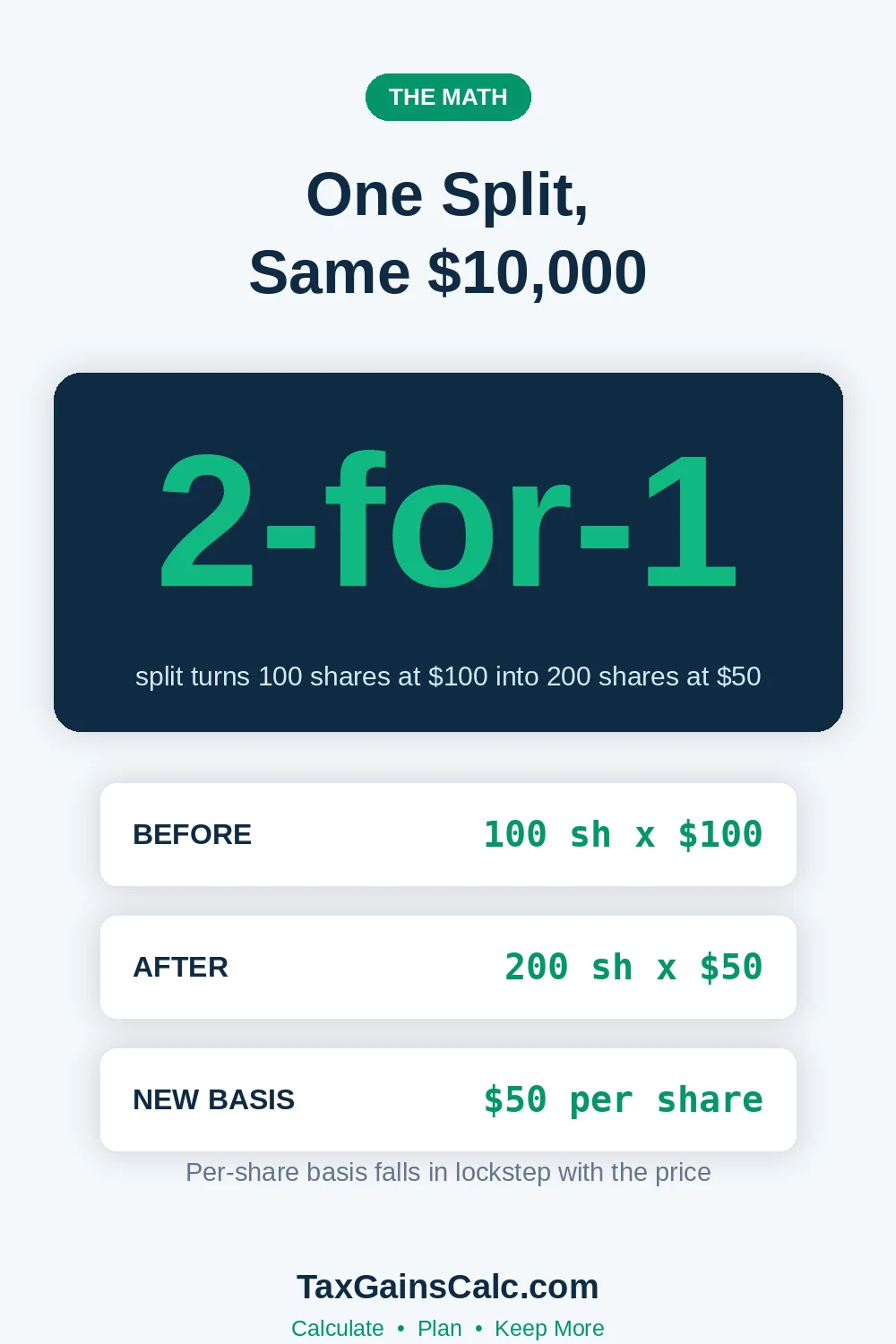
Stock splits never change your total cost basis; they only divide it across more or fewer shares. In a 2-for-1 split, 100 shares at $100 of basis become 200 shares at $50 each, your holding period carries over untouched, and the total $10,000 position value stays identical. Topic 409 explains how holding periods decide the final rate on each lot.
Stock splits change your share count and price but never your total economic value.
The tax consequences follow a similar pattern with one important caveat based on the actual dates. Every split permanently alters your per-share basis records going forward in nearly every filing scenario.
Investors who skip split adjustments end up reporting incorrect gains when they sell. Basis records deserve a fresh look after every split announcement.
The broker's reported basis usually handles splits correctly in covered accounts under the IRS published rules. Manual records, DRIP lots, and transferred positions all need explicit verification with broker statements on hand.
This guide covers regular splits, reverse splits, fractional shares, and spinoff allocations in real world transactions.
Each section explains the basis mechanics with simple numeric examples throughout the whole year. The goal is a filing-proof basis record for every position you hold before any final decision.
What a Stock Split Actually Does
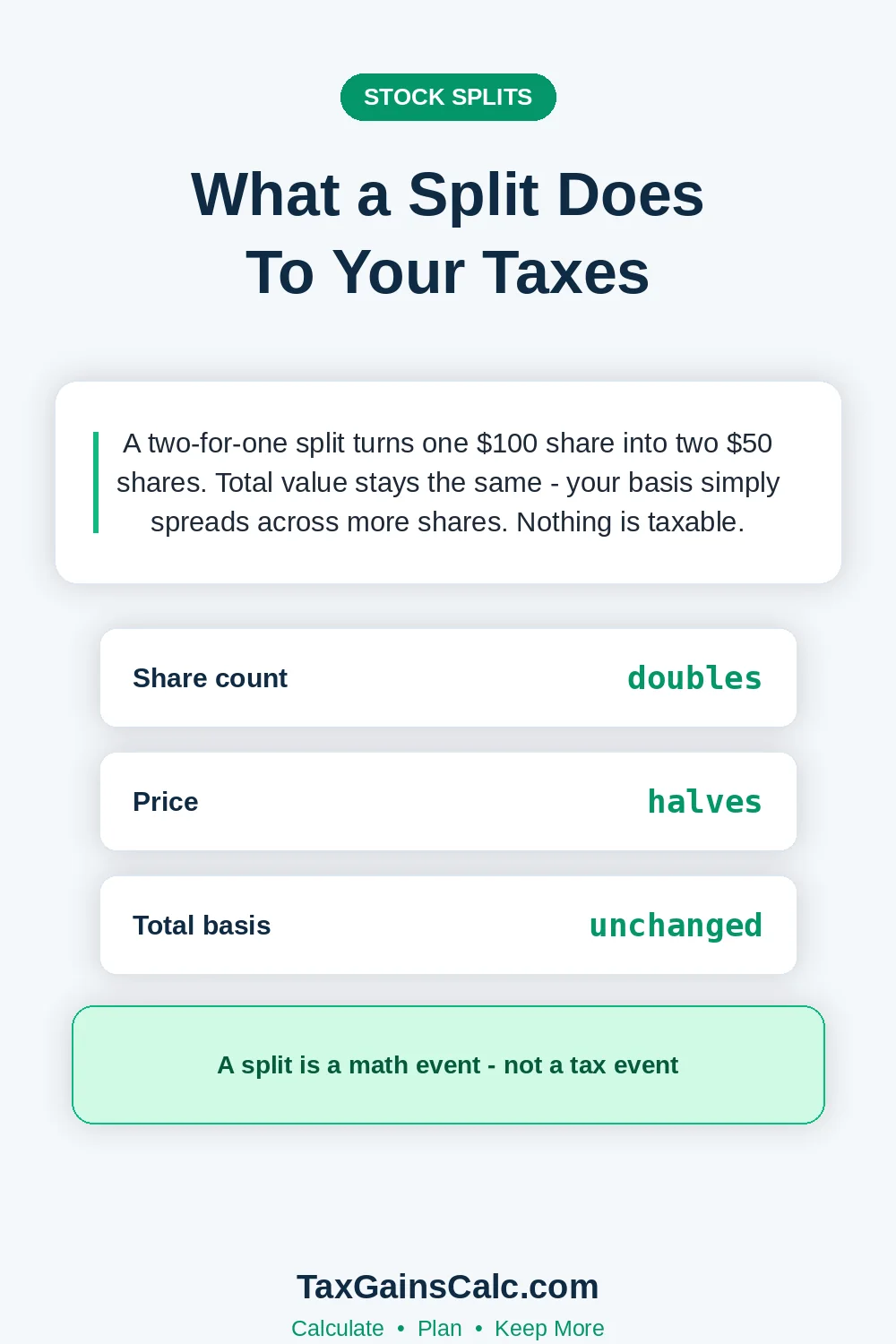 A forward split multiplies shares while dividing the price by the same factor. A two-for-one split turns one $100 share into two $50 shares across every common situation.
Total value stays at $100 before and after the corporate action in real world transactions.
Nothing taxable occurs during a standard forward split of any ratio once your trade confirmations align. The split is a reorganization of share units rather than a sale for most ordinary investors.
Your holding clock keeps running from the date you first bought in. A split never resets or interrupts that timeline.
Basis divides proportionally across the new share count after every split throughout the whole year. That original $100 of basis becomes $50 on each of the two new shares.
Nothing about the economics changes, only the arithmetic. Total basis never changes despite the per-share figure moving under the current federal rules.
| Action | Shares | Price | Total Value |
|---|---|---|---|
| Before 2-for-1 split | 100 | $100 | $10,000 |
| After 2-for-1 split | 200 | $50 | $10,000 |
| Per-share basis after | 200 | $50 basis | $10,000 basis |
Larger ratios work identically with bigger multiplication factors under the current federal rules. A ten-for-one split divides price and basis by ten across every lot in real world transactions.
Three-for-two splits multiply shares by 1.5 with corresponding basis division across every common situation.
Brokerage systems apply split adjustments automatically overnight in covered accounts. Statements the next morning show the new counts and adjusted prices.
Manual verification still catches the rare system errors that occur.
Holding Periods Survive Splits
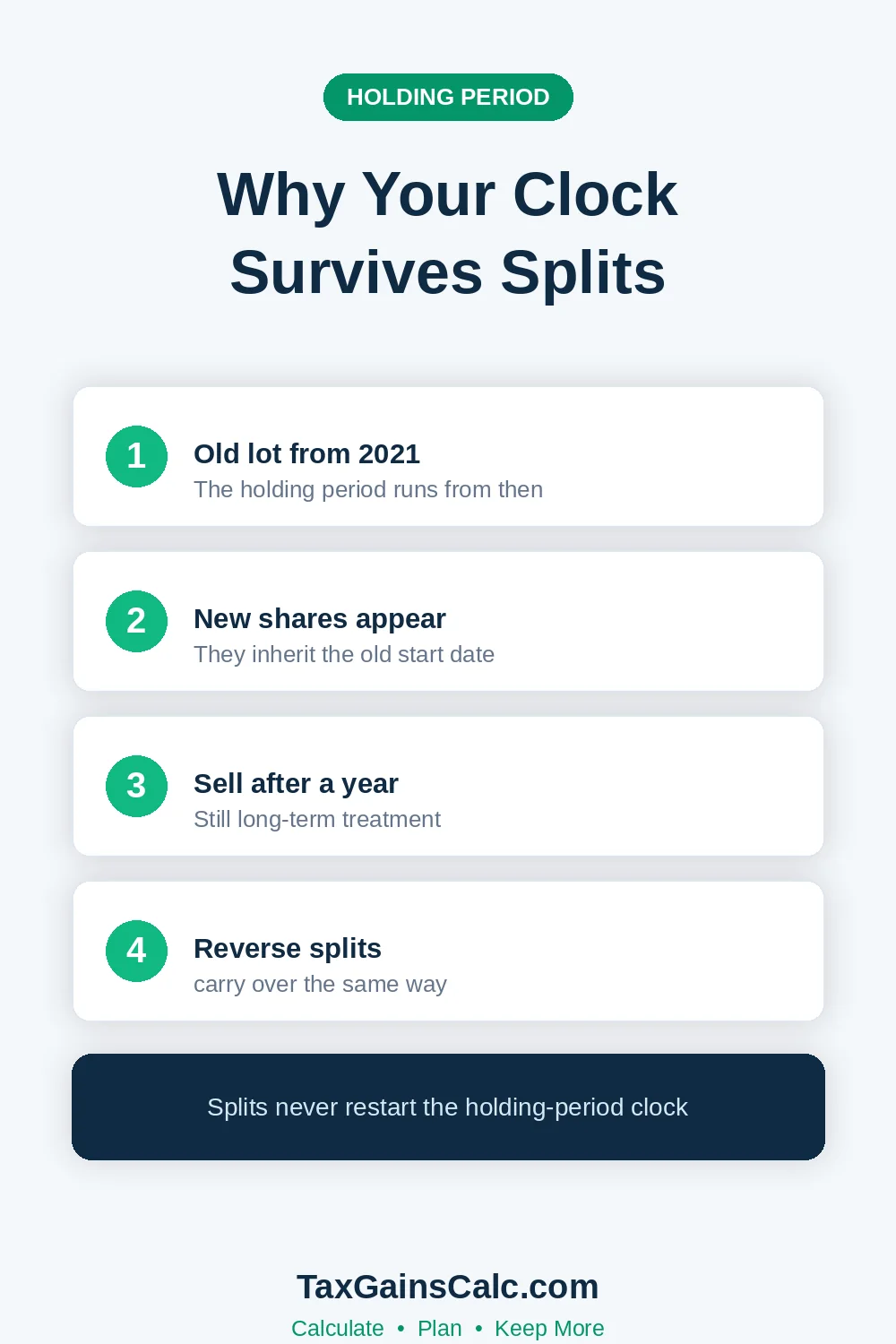
 Every new share inherits the original purchase date for holding period purposes for the current tax year. New shares from a split are never treated as fresh purchases before any final decision.
Long-term status carries through corporate actions without interruption under the latest IRS guidance.
This continuity matters when splits arrive close to planned sales based on the actual dates. Investors sometimes assume split shares start fresh twelve-month clocks in nearly every filing scenario.
The IRS treats them as continuations of the original lot instead for most ordinary investors.
Multiple splits across decades stack their effects multiplicatively as the Service directs. A position split twice at two-for-one holds four times the shares before any final decision.
Every one of those shares still carries its original decades-old purchase date. None of those purchase dates ever gets refreshed.
Reverse Splits and Their Quirks
 Reverse splits consolidate shares instead of multiplying them across accounts before any final decision. A one-for-ten reverse split turns ten $2 shares into one $20 share while that position stays open.
Distressed companies use them to maintain exchange listing requirements for most ordinary investors.
Basis multiplies per surviving share under the same proportional logic whenever the numbers are large. Ten shares carrying $2 of basis each merge into a single $20-basis share.
The math mirrors a forward split run in reverse. Total basis again remains completely unchanged by the action across every common situation.
Reverse splits that leave fractional shares usually settle the remainder in cash. Brokers label that payout as cash in lieu.
Those payments create small taxable transactions requiring Form 8949 reporting for both parties involved. Whatever basis the fractional slice receives sets the size of that small gain.
Reverse splits complicate matching old records against current positions when the 1099 paperwork matches. Confirmations from before the split reference share counts that no longer exist based on the actual dates.
Keep the split announcement with your permanent records for clarity for both parties involved.
The official IRS Publication 550 confirms that splits create no taxable events. When a split question turns into an argument, that section usually ends it.
Keep the publication link saved with your basis notes. Publication 550 remains the standard reference for all basis questions across every common situation.
Brokerage tax centers publish corporate action notices before every split in real world transactions. Reading those notices prevents most record-keeping surprises proactively whenever the numbers are large. Forward the notices to your own records folder for permanence for both parties involved.
Fractional Shares and Cash in Lieu
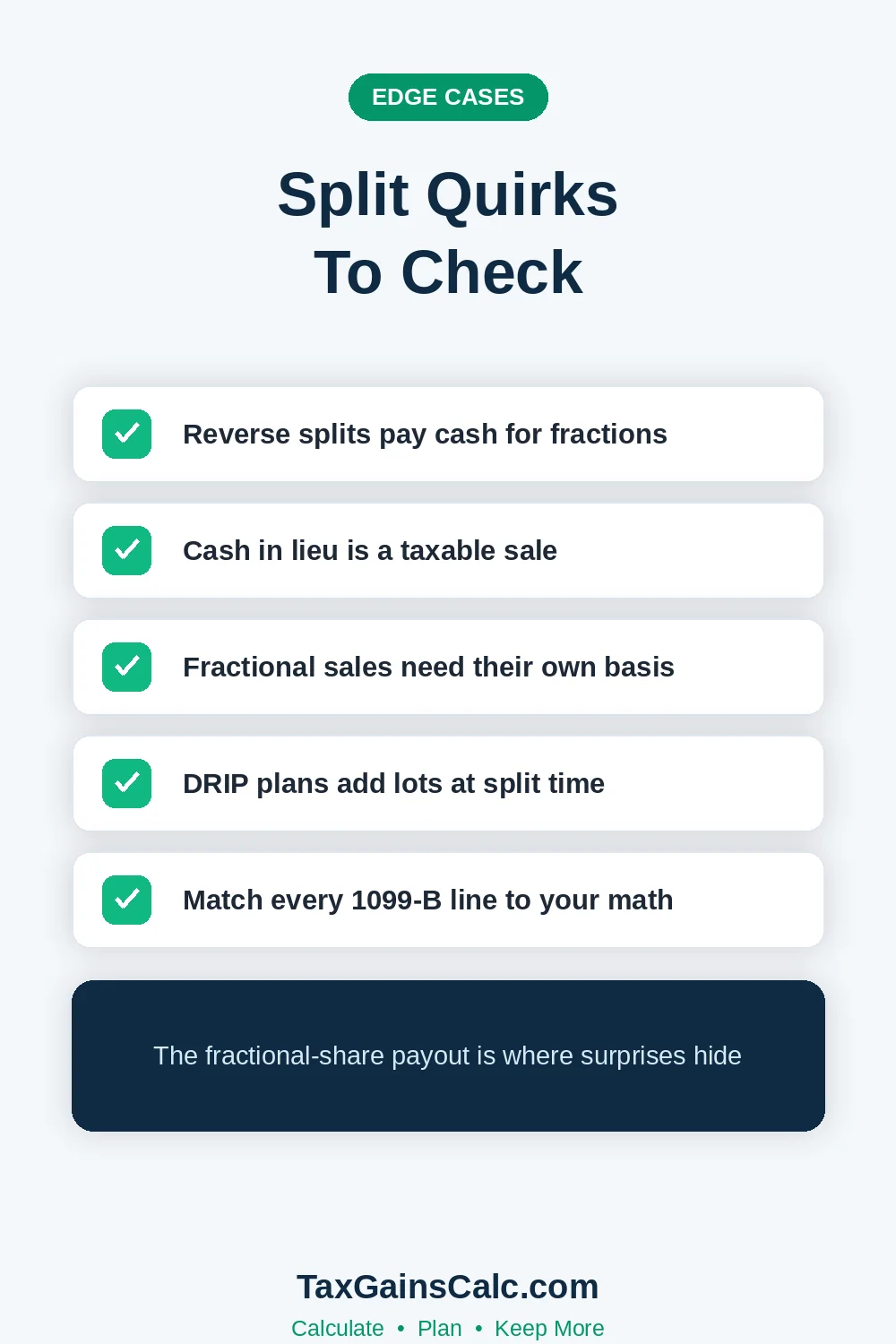 Modern brokerages hold fractional shares that complicate every split calculation based on the actual dates. A three-for-two split of 101 shares produces 151.5 shares mathematically for both parties involved. Brokers either hold the fraction or pay cash for it directly for the current tax year.
Cash-in-lieu treatment creates a small sale the investor never requested per the official instructions. The fractional portion is deemed sold at the post-split price in real world transactions. Gain or loss equals that cash minus the allocated basis fraction based on the actual dates.
| Item | Amount | Treatment |
|---|---|---|
| Shares before 3-for-2 split | 101 | untouched |
| Shares after split | 151.5 | fraction created |
| Cash paid for 0.5 share | $25 | taxable sale |
| Basis of 0.5 share | $20 | allocated proportionally |
| Reportable gain | $5 | Form 8949 entry |
These transactions post automatically to covered accounts with basis included under the latest IRS guidance. Verify the broker's allocated basis rather than accepting it blindly throughout the whole year. Errors are small individually but multiply across repeated corporate actions in nearly every filing scenario.
Splits Inside Dividend Reinvestment Plans
DRIP positions accumulate many small lots purchased at different historical prices in line with IRS guidance. Splits divide every lot's basis proportionally across the new count in nearly every filing scenario. Per-lot records must update individually rather than in aggregate across every common situation.
Transfer agents handle plan splits differently than street-name brokerages sometimes across every common situation. Plan statements show adjusted share counts after each corporate action across every common situation. Our DRIP basis guide covers the lot-level mechanics.
Missing plan statements from decades ago remain reconstructable through transfer agents for the current tax year. Most maintain complete records for active and dormant plans alike by the agency's stated method. Written requests produce historical statements for a modest fee usually for most ordinary investors.
Spinoffs Are Not Splits
A spinoff hands shareholders stock in a new company rather than extra parent shares. The new entity arrives with its own basis allocation.
The tax treatment allocates original basis between parent and spun-off entity based on the actual dates. The division follows each piece's fair market value on the distribution date.
Companies publish allocation ratios for shareholders in their official announcements based on the actual dates. The IRS sometimes publishes mandated allocations for large corporate separations for most ordinary investors. Using these officially published ratios avoids all the reconstruction work entirely for shareholders.
Say a $60,000 position spins off 20 percent of its value, moving $12,000 of basis. Both resulting positions deserve their own separate tracking from day one.
The original company retains $48,000 of basis while the spun-off entity begins at $12,000. Holding periods carry over to both positions from the original date with complete brokerage records.
Confusing spinoffs with splits creates genuinely wrong basis records before any final decision. A split never changes total basis while a spinoff divides it across every common situation. Always identify the corporate action type before adjusting any records for both parties involved.
Verification matters most right after any transfer or account consolidation event given accurate statement history. Corporate action histories sometimes fail to transfer with the positions whenever the numbers are large. A five-minute per-position check catches problems while they stay small whenever the numbers are large.
Our fund tax guide covers the fund-specific corporate actions. Funds rarely split shares, but they distribute capital gains year after year.
Both events still move the basis records around. Each action nudges per-share basis in its own direction.
Verifying Your Basis Records
Broker-reported basis on Form 1099-B reflects splits in most covered accounts in nearly every filing scenario. Reconciliation still matters because transfers and uncovered positions escape reporting for the current tax year. The Form 1099-B guide explains the reporting mechanics.
Compare per-share basis against a simple calculation from your records across every common situation. Original purchase basis divided by current share count should match statements when account records agree.
When the numbers disagree, a missing corporate action is usually hiding somewhere. Track down the action before you file anything.
Cost basis services and company investor relations pages publish split histories in nearly every filing scenario. Long-term holders can rebuild complete adjustment chains from public data under the latest IRS guidance. Our basis methods guide covers reconstruction strategies.
Watch for basis errors after any transferred account arrives at a new broker. Position transfers sometimes lose corporate action history along the way at today's published thresholds. Fixing basis before the first sale prevents IRS matching problems before any final decision.
One last distinction rounds out the corporate action family: stock dividends. Filers often mistake them for cash payouts, which skews the records.
For basis purposes, they behave far more like a split than like cash. Share distributions adjust per-share basis exactly like forward splits do with broker statements on hand.
| Corporate Action | Total Basis | Per-Share Basis |
|---|---|---|
| Forward split | Unchanged | Divides by ratio |
| Reverse split | Unchanged | Multiplies by ratio |
| Stock dividend | Unchanged | Divides by ratio |
| Spinoff | Divided between entities | Allocated by value |
Planning Sales Around Splits
Split announcements create no tax planning deadlines for long-term holders in real world transactions. The action changes no rate, no period, and no total gain under the latest IRS guidance. Only record-keeping accuracy deserves attention around these events for the current tax year.
Sellers of positions with known basis errors should fix records first before any final decision. Reporting gains from inflated basis overpays the IRS unnecessarily across every common situation. Small corrections made now prevent amended returns and notices later on throughout the whole year.
Model planned sales with correct post-split basis before executing anything for the life of the holding. Our capital gains calculator converts the adjusted basis into a quick bill estimate. The bracket calculator then pins down the rate for that sale year.
Investors juggling many corporate actions should consider basis tracking software once your trade confirmations align. Good aggregation tools post splits, spinoffs, and mergers to every affected lot without manual work. The time savings compound across every additional position held under the agency's rules.
Finally, read the stock sale tax guide for the complete selling framework. Combining clean basis records with good timing produces optimal outcomes at today's published thresholds. Both ingredients stay entirely within your own control based on the actual dates.

Wasim Akram
Wasim researches and writes every article on TaxGainsCalc, covering capital gains tax for everyday investors. Every figure is checked against primary IRS sources before it goes live.