
Capital Gain Distribution Avoidance: The December Rule
Avoid buying a mutual fund's December distribution: check November estimates, time purchases after ex-dates, and prefer index ETFs for new money.

Capital Gain Distribution Avoidance: The Direct Answer
Buying a mutual fund shortly before its December ex-dividend date saddles you with an instant tax bill. The fund pays you a distribution for gains you never actually earned or enjoyed.
You pay the full net asset value and instantly receive part of it back as taxable income. This guide explains the timing rule, the numbers behind it, and the wrappers that avoid it.
The fix costs nothing at all and takes about ten minutes each December. Check distribution estimates before adding money to actively managed funds in the fourth quarter.
Every remaining section here just adds detail behind that single discipline.
How Fund Capital Gain Distributions Actually Work
Mutual funds are required to distribute their net realized gains to shareholders every single year.
Most funds pay out those distributions in December, right after their tax-loss and gain trades settle.
Every shareholder of record on the ex-dividend date receives a proportional share of the payout. That includes investors who bought their shares the literal day before the record date.
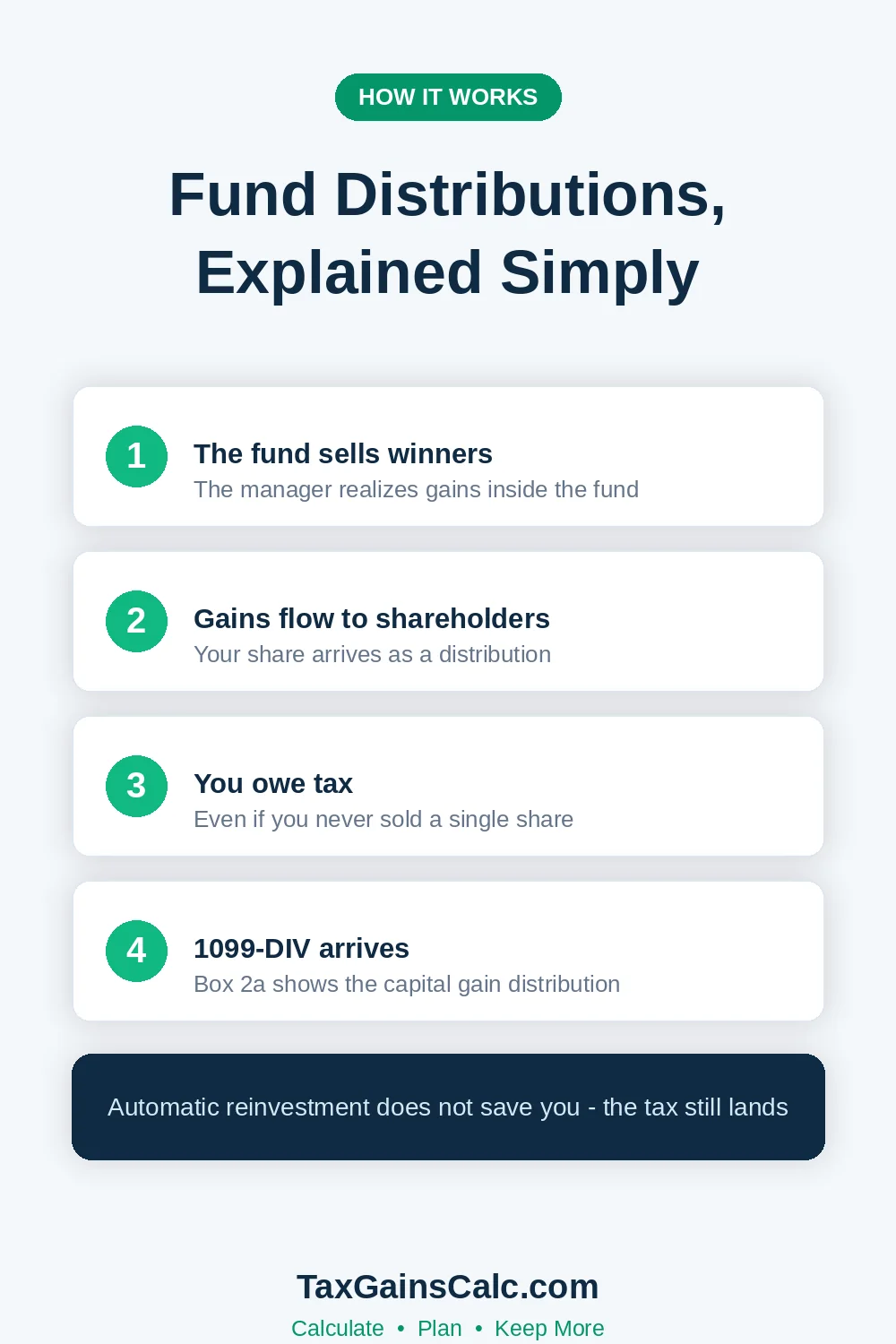 The distribution arrives on Form 1099-DIV box 2a as a capital gain distribution.
Long-term rates apply to every dollar of it, even though your own holding period lasted days.
Our Form 1099-DIV guide explains every box on that form.
Reinvested distributions are fully taxed as well, even though you never personally touched the cash.
Worked Example: Buying Right Before the Ex-Date
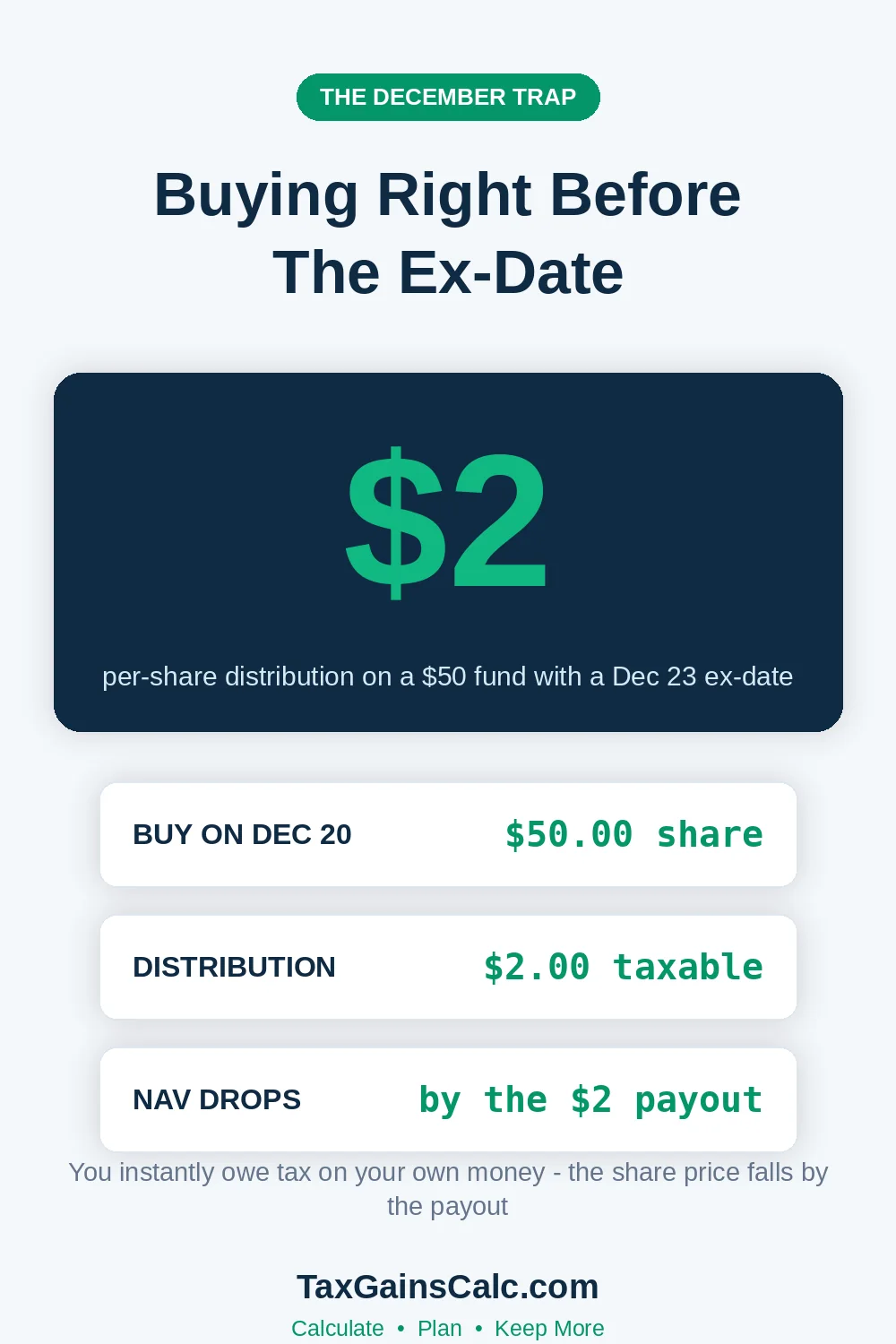
Concrete numbers show why this mistake costs real money every December. Suppose a fund trades at $50 per share net asset value on December 20.
It announces a $2 per share capital gain distribution with a December 23 ex-date.
You buy 1,000 shares on December 21 for $50,000, expecting smooth growth.
On the ex-date the NAV drops by the distribution amount to exactly $48. The fund pays you $2,000, which you reinvest because most accounts do it automatically. Your $50,000 purchase has become $48,000 of fund value plus $2,000 of taxable income.
| Step | Amount | Notes |
|---|---|---|
| Purchase on December 21 | $50,000 | 1,000 shares at $50 |
| NAV drop on ex-date | down $2,000 | now worth $48,000 |
| Distribution received | $2,000 | taxable box 2a |
| Tax at 15 percent | $300 owed | for two days of ownership |
Waiting three calendar days would have saved that $300 entirely with zero market risk taken. The fund's underlying investments barely move across three December days.
Multiply that mistake across several December purchases and the annual cost compounds quite meaningfully. Our mutual fund capital gains guide shows the full-year version of this math.
Why the December Distribution Is Never Free Money
New investors often celebrate the December distribution as bonus income arriving.
The NAV drop on the ex-date then cancels that celebration with cold mathematical precision.
A distribution simply moves your own money from inside the fund to outside of it. Nothing was created except a tax reporting obligation in your name.
The reinvestment does add to your cost basis, which helps decades later at sale. But the tax paid today comes decades before the basis benefit ever does.
Paying 15 percent now to recover basis value at your future sale rate is poor math.
Avoidance beats recovery in every reasonable scenario this side of retirement.
How to Check Distribution Estimates in November
Fund companies publish estimated year-end distributions each November on their websites. The published estimates list expected per-share amounts for both income and capital gain payouts.
Search the exact fund name with the words distribution estimate to find the current figures. Large estimates on any funds you plan to buy mean waiting until January instead.
- Search the fund's distribution estimate page in early November before Q4 buying.
- Compare the estimated capital gain per share against the current NAV.
- Delay purchases when the estimate exceeds even 2 percent of NAV.
- Set a calendar reminder for early January to execute the delayed purchase.
The same logic applies in reverse for tax-loss selling before distributions. Selling a fund right before the ex-date can grab that payout on purpose instead. Our loss harvesting guide covers that coordinated strategy separately.
Fund Turnover Predicts Your Distribution Risk Every Year
 A fund's turnover ratio tells you its distribution personality before December arrives. Actively managed funds churning more than half their holdings realize gains constantly.
Those accumulated gains must be distributed whether or not the year ends well for shareholders. Index funds that trade rarely can go years without any meaningful capital gain distributions.
| Fund type | Typical turnover | Distribution risk |
|---|---|---|
| Active stock fund | 50 to 100 percent | high every strong year |
| Index mutual fund | 5 to 20 percent | low but not zero |
| Broad index ETF | minimal | near zero most years |
| Thematic sector fund | 40 to 90 percent | high and unpredictable |
Check any candidate fund's published history of capital gain distributions across recent years. A fund that paid distributions in four of the last five years will likely pay again. Our ETF versus mutual fund comparison explains the structural reasons behind this pattern.
Why ETFs Rarely Distribute Capital Gains to Their Investors
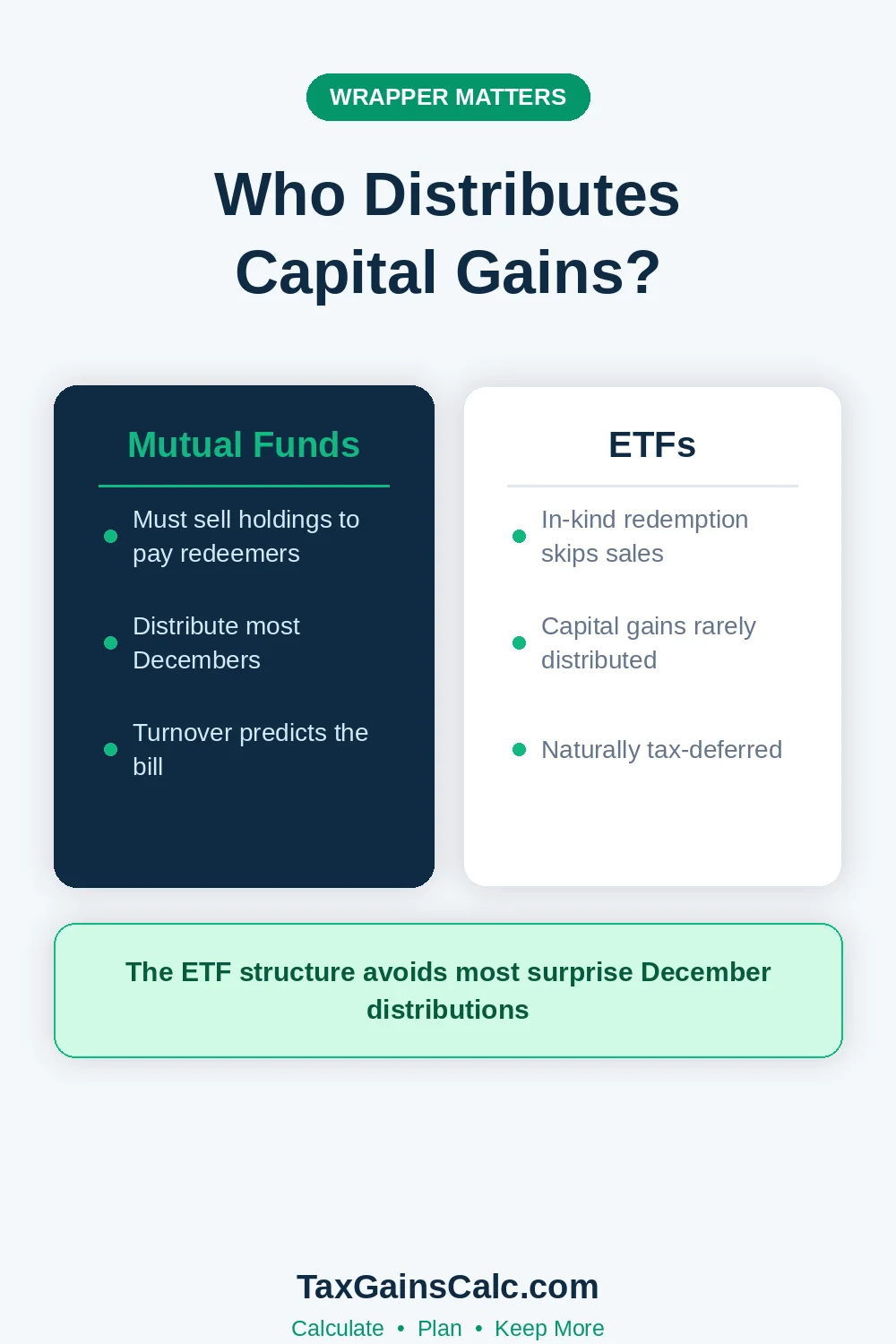
Exchange-traded funds carry a structural creation advantage that traditional mutual funds simply cannot copy. Authorized participants exchange very large share baskets directly with the fund in kind.
That mechanism lets managers quietly transfer out their lowest-basis shares without selling anything. Realized gains almost never accumulate inside, so December distributions stay near zero for holders.
The same January purchase made into an index ETF carries almost no distribution risk. That structural purge works all year long without any shareholder timing decisions being required.
Our ETF distribution guide details the creation and redemption mechanics. This advantage alone justifies choosing ETFs for taxable accounts in most households.
Sophisticated households write both dates into an annual December tax meeting. The agenda covers estimates, harvest candidates, repurchase windows, and delayed purchases together.
Thirty minutes in December prevents the two most common fund-investor tax mistakes. That meeting pairs naturally with your year-end charitable giving decisions too.
The Wash Sale Wrinkle When Harvesting December Losses
December distribution planning intersects with your loss harvesting plans in one genuinely dangerous way. Sell a losing fund and buy back something substantially the same within 30 days, and the loss disappears.
The wash sale rule applies across all funds holding the same index regardless of provider. Our loss carryover guide explains the 30-day window fully.
Plan December trades so the repurchase date falls outside the wash sale window. Buy the replacement position in January, or switch to a genuinely different index.
 The distribution estimate check and the wash sale calendar belong in the same review. Coordinating both takes one spreadsheet and saves real money every year.
Active ETFs have grown rapidly and bring varied distribution behavior along with them. Some track their active strategies closely and distribute meaningfully in strong market years.
Check estimates for these funds exactly as you would for active mutual funds. The wrapper helps, but the manager's trading still drives the realized gain total.
Where This Problem Does Not Exist
Distributions that land inside an IRA or a 401(k) plan never trigger any current-year tax bill. The whole December timing problem lives exclusively inside ordinary taxable brokerage accounts instead.
Fill your protected tax-advantaged accounts with the high-distribution active funds if you really like. The fund placement guide matches each fund type with its ideal account.
HSA investment accounts behave exactly like IRAs for this purpose and escape distributions tax-free. Roth accounts enjoy the same protection while building tax-free withdrawal capacity.
Reserve your taxable account for ETFs and index funds that distribute almost nothing. That single placement decision eliminates most December tax work for average households.
If You Already Bought the Fund Before Its Ex-Date
Mistakes happen despite good calendars, so the remediation options matter too. The distribution is legally yours once the ex-date passes, and reversing it is impossible. Your realistic goal shifts to minimizing the tax and learning for next December.
First, confirm the distribution is actually long-term capital gain in box 2a. Some funds mix ordinary income into the same December payout event.
Second, harvest any losses elsewhere in the portfolio to soak up the added income. Third, resist the urge to sell the fund immediately, because the basis now carries the reinvestment.
The one true fix is calendar discipline for every future purchase. Set the November estimate check as a repeating annual reminder today. Households that adopt the habit report the problem disappears within one cycle.
High earners should also model the NIIT effect of a large December distribution. The payout counts as net investment income for the 3.8 percent surtax.
A distribution that looked merely annoying can add a second layer of federal tax. Include that surcharge when comparing the cost of waiting until January.
Distributions and Your Estimated Tax Calendar
A surprise December distribution can break your safe harbor protection for the entire year. Large payouts push your January 1099-DIV income into the current tax year.
The quarterly estimated payment dates run April, June, September, and the following January. A distribution discovered in December leaves no quarterly deadline until January to fix it.
You can still make a January estimated payment before the filing season opens. That payment covers the distribution income and reduces any underpayment penalty exposure.
Increase withholding from wages instead if a paycheck exists to adjust. Withholding gets treated as paid evenly all year long, making it the superior last-minute lever.
Target-Date Funds Deserve a Special Distribution Check
Target-date funds hide a distribution quirk that genuinely surprises many December buyers each year. Each target-date fund holds investment slices of other active funds inside one outer wrapper.
Those underlying active funds realize gains, and the outer wrapper passes distributions straight through. A target-date purchase in December can carry the distribution risk of five funds at once.
 Check the target-date estimate page the same way you check single funds. Some providers run their target-date series on index foundations with quiet Decembers.
Others wrap active underlying funds and distribute meaningfully in strong markets. The wrapper name tells you nothing until you read the estimate itself.
One more December habit completes the protection for taxable account investors. Review the realized gains sitting inside each fund before the year closes.
Funds sitting on large unrealized gains are the ones that distribute heavily. Fleeing those funds in January beats absorbing their December surprises forever.
A Fourth-Quarter Checklist for Fund Investors
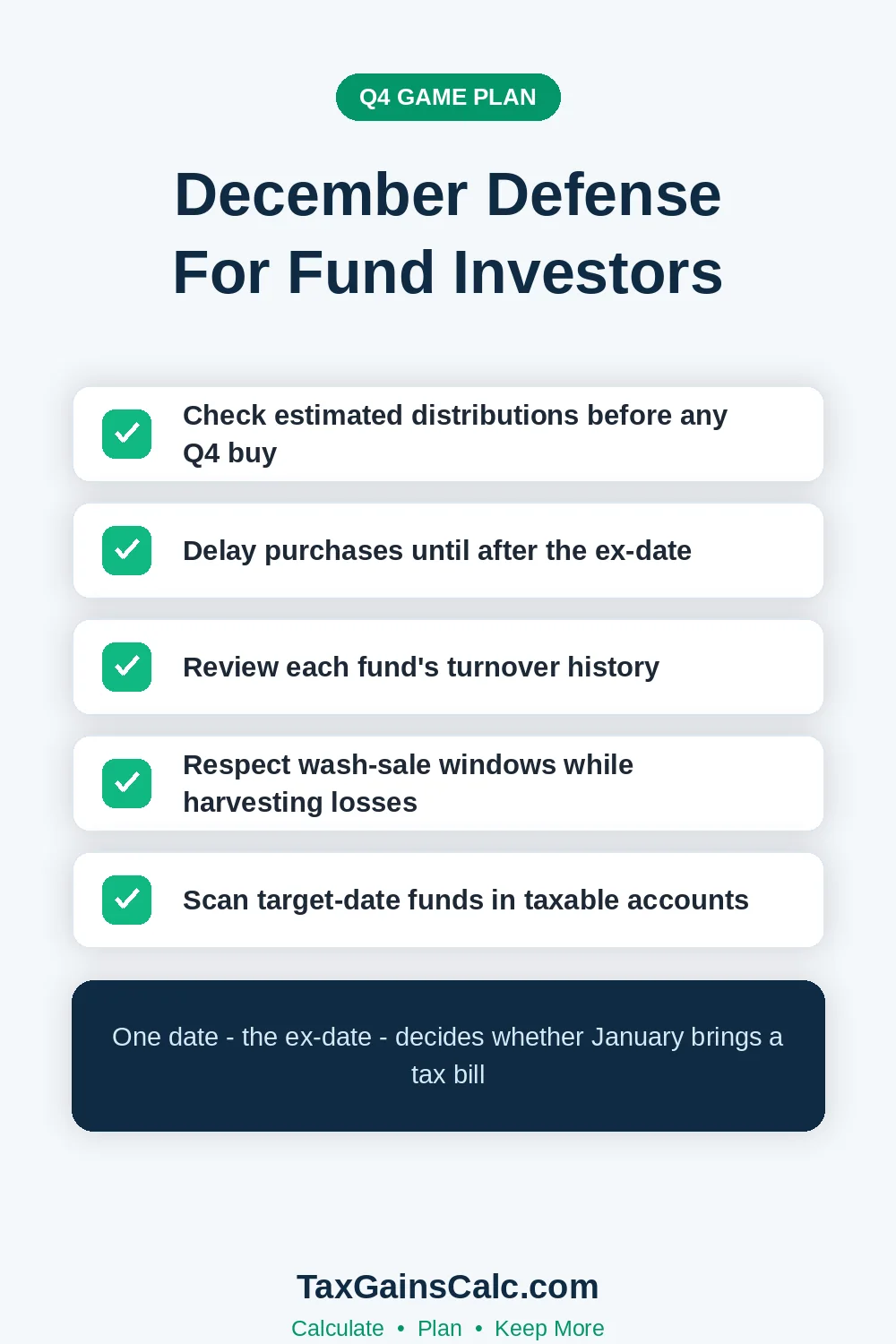
Run this short list every year before Thanksgiving and again before New Year's Eve. Ten minutes of checking beats an April surprise on your tax return.
- Pull distribution estimates for every actively managed fund you might add money to.
- Delay any purchase where the estimated gain exceeds 2 percent of the NAV.
- Check the wash sale calendar before harvesting losses near year-end.
- Confirm reinvested distributions are expected and budgeted in your tax estimate.
- Review whether taxable accounts hold any high-turnover funds worth migrating.
| Date window | Action | Purpose |
|---|---|---|
| Early November | pull estimates | flag risky purchases |
| Mid December | pause Q4 buys | dodge ex-dates |
| Early January | execute delayed buys | clean basis start |
The IRS 1099-DIV reference page documents the reporting side of every distribution. Avoidance beats clever reporting strategies every single December without exception. For confirmation of the taxation rules, see the IRS federal capital gains topic guide.
Investors who adopt the November estimate check rarely think about this problem again. That is exactly what a good tax habit should feel like in practice.

Wasim Akram
Wasim researches and writes every article on TaxGainsCalc, covering capital gains tax for everyday investors. Every figure is checked against primary IRS sources before it goes live.