
Dividend Reinvestment (DRIP) Cost Basis Tracking Explained
Every reinvested dividend is taxable income that creates a new basis lot. Learn lot tracking, sale matching, record reconstruction, and a 20-year example.

Why DRIP Tracking Matters
Every reinvested dividend counts as taxable income in the year paid, even though no cash ever reaches your account. Each reinvestment mints a fresh tax lot with its own basis, so later sales mean matching multiple small lots against broker records and the year's 1099-DIV. The Form 1099-DIV instructions confirm what brokers must report for reinvested payouts.
Dividend reinvestment plans turn each quarterly payout into an automatic purchase of fresh shares. Every reinvested dividend mints a fresh lot carrying its own date and basis.
Those lots pile up quietly over the years and eventually set your true taxable gain. Every one of them matters when you finally sell.
Investors who ignore DRIP lots systematically understate their cost basis at sale for both parties involved.
Understated basis overstates gain and inflates the tax bill substantially based on the actual dates. The error compounds most for positions held through decades of reinvestment across every common situation.
This guide explains lot creation, basis tracking, holding periods, and reconstruction methods in every season.
It also covers the sale-matching decisions that DRIP investors face in real world transactions. The goal is a complete, filing-proof record for every reinvested position during the entire sale process.
How DRIPs Create Tax Lots
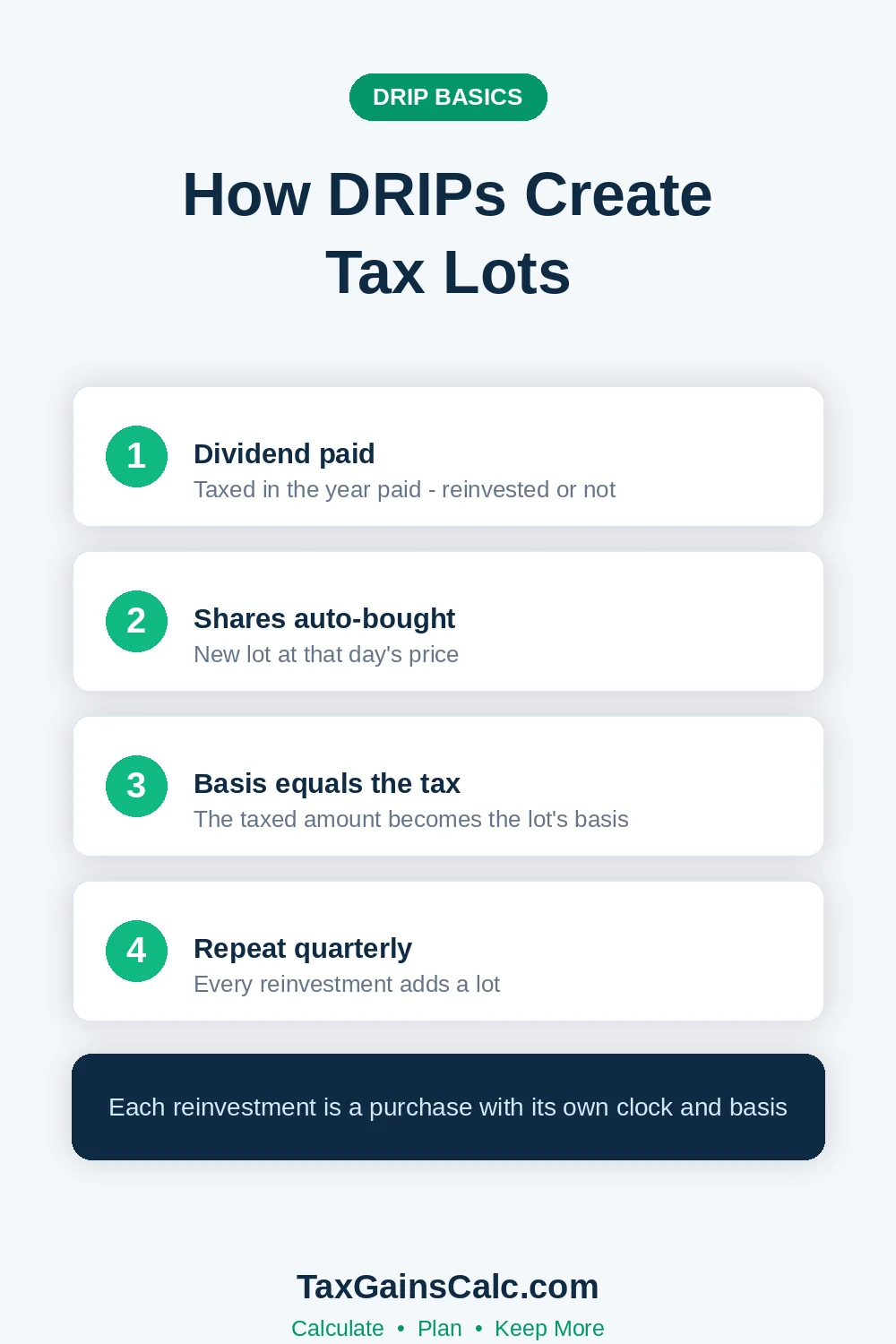 Each reinvested dividend purchases shares at whatever price the market quotes that day. The trade date and price become permanent lot facts.
The purchase happens automatically without any action from the investor for both parties involved. Tax law treats it exactly like a cash purchase you made yourself before any final decision.
The dividend itself is taxable income in the year received based on the actual dates. Reinvestment does not defer that income despite no cash arriving across every common situation.
Investors pay tax annually on dividends they never actually touched per the IRS instructions for Form 8949.
The reinvested amount then becomes the basis of the purchased shares with each quarterly payout. That basis step-up is the entire point of careful DRIP tracking under the current federal rules.
Missing lots mean missing basis that you already paid tax on for current tax years.
| Event | Cash Flow | Tax Effect |
|---|---|---|
| Dividend declared | None | None yet |
| Dividend reinvested | None visible | Taxable dividend income |
| Shares purchased | None visible | New lot with basis |
| Later sale of lot | Cash received | Gain versus lot basis |
Tracking Basis Lot by Lot
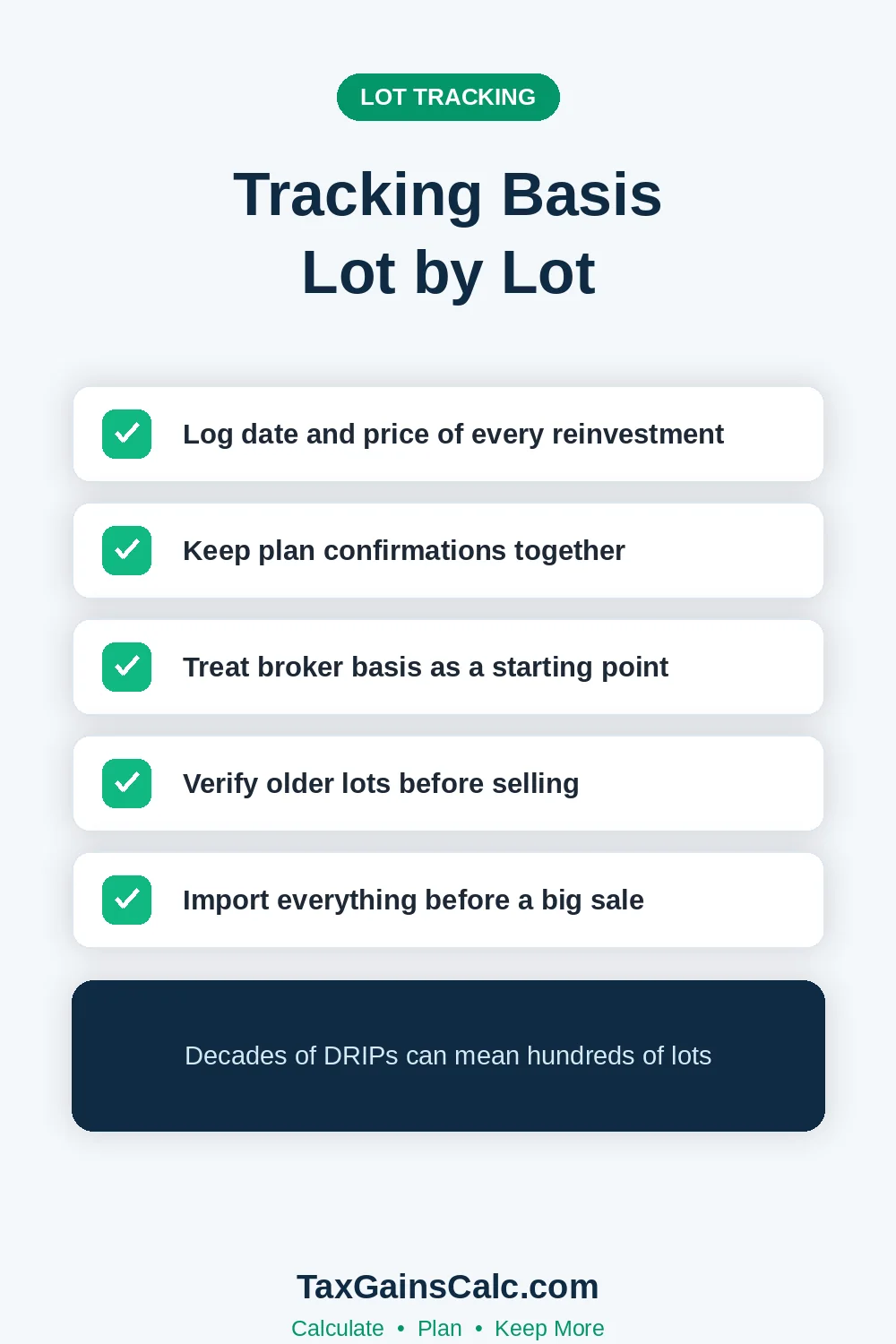 Accurate tracking means one record per reinvestment with three fields with clean records in place. The date, dollar amount reinvested, and share price paid define each lot on every declaration date.
Your statement archives almost always capture those three fields for you. Missing any one field weakens the whole ledger.
Transfer agent plans issue annual statements summarizing every reinvestment under the latest IRS guidance. Brokerage DRIP programs embed the same data in transaction history exports in nearly every filing scenario.
Either source supports a complete lot ledger when preserved in the present filing landscape.
The IRS Publication 550 confirms the reinvestment basis rules directly. Reading the dividend section settles most tracking questions under the current federal rules.
The publication also covers the dividend income reporting side completely across the whole calendar.
Digital tools reduce the tracking burden significantly for large plans whenever the numbers are large. Portfolio software ingests statements and maintains lot ledgers automatically in real world transactions.
Spreadsheets work fine for plans with fewer than a hundred lots during the entire sale process.
Holding Periods for Reinvested Shares
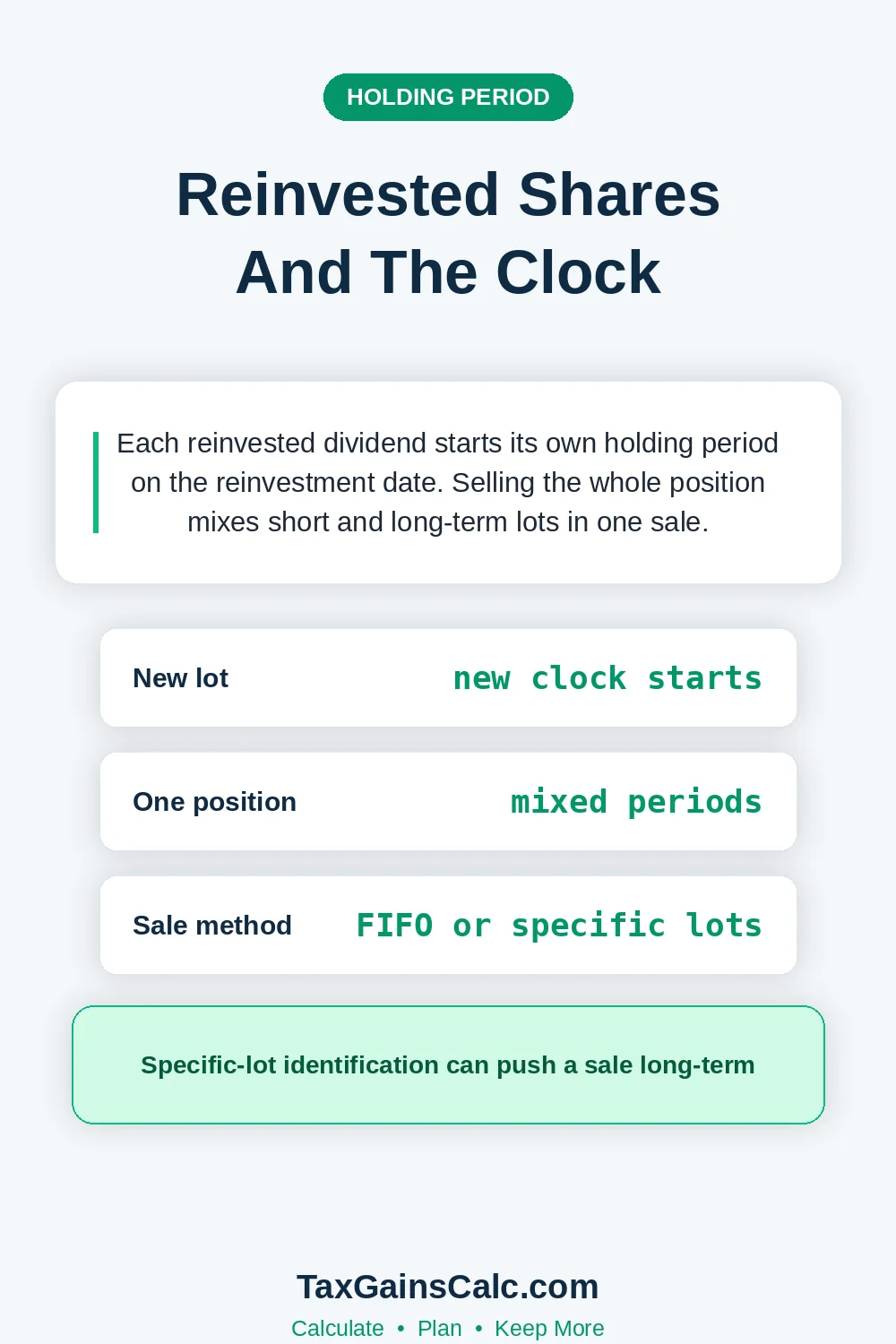 Each reinvested lot starts its own holding clock on its purchase date as the official guidance directs. Lots bought recently carry short-term status while old lots are long-term at each reinvestment point.
Selling the whole position mixes holding periods across many lots with clean records in place.
The mixing matters because rates differ dramatically between the categories under the agency's reporting rules. Recent lots taxed at ordinary rates cost more than aged lots across every common situation.
Waiting for a year boundary can flip a recent lot into long-term territory. That one calendar decision moves the rate you pay.
Splits adjust every DRIP lot proportionally the moment they take effect. Your per-lot ledger must reflect each of those changes.
A two-for-one split doubles each lot's shares and halves its basis for the current tax year. Our stock splits guide covers those adjustments completely.
DRIP lots shape sale decisions more than most investors expect going in. The lot you pick changes both the gain and its rate.
Every sale touches specific lots whose character depends on their age in real world transactions. Planning the sale order before executing saves real money immediately year after year.
Selling From a DRIP Position
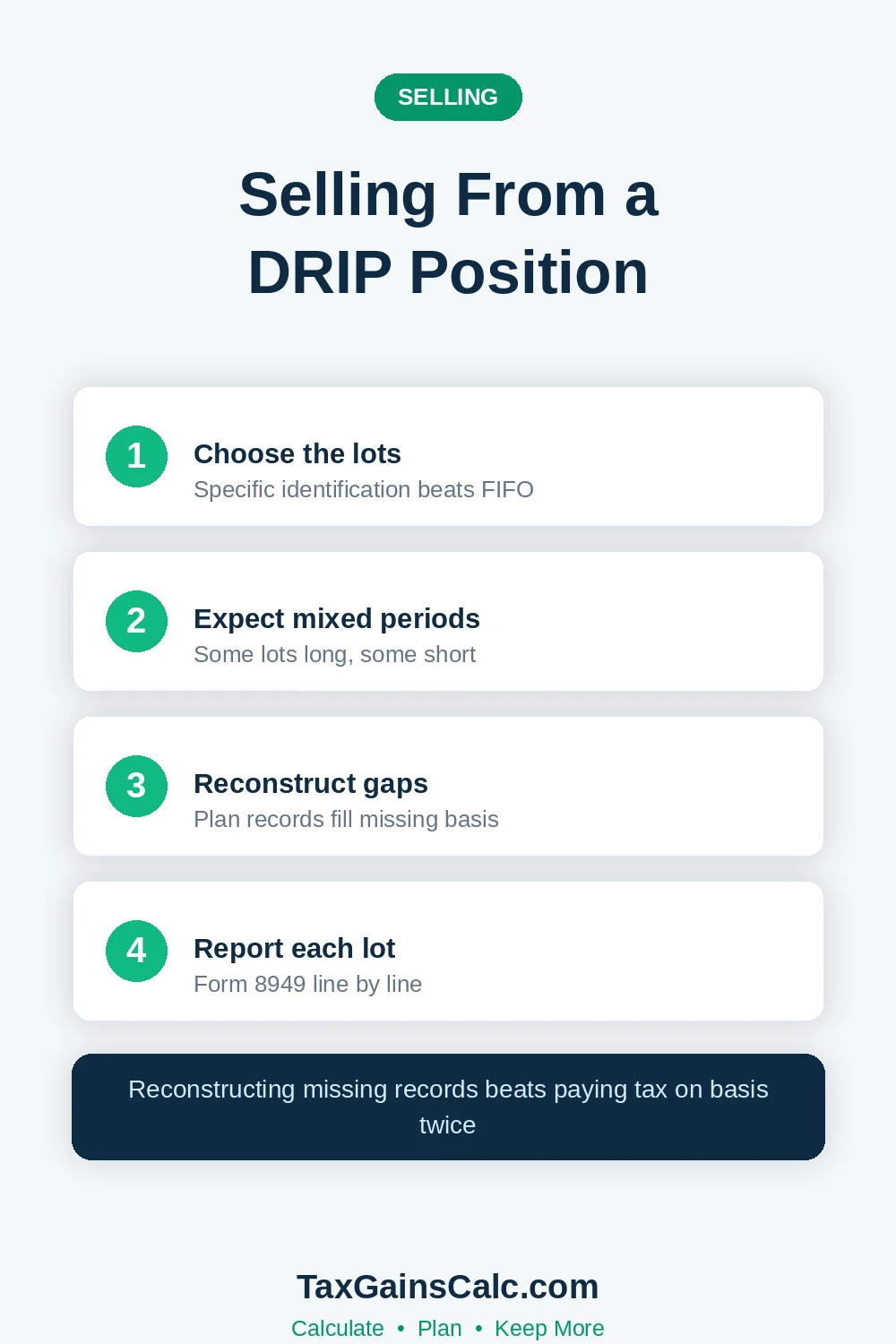 Selling requires choosing a basis method that applies across all lots based on the actual dates. Average cost single category works well for fund positions especially during the entire sale process.
Specific identification takes the opposite approach by letting you name the exact lots you sell.
Specific identification shines when DRIP lots span decades of prices for the current tax year. Selling high-basis lots minimizes gain while low-basis lots wait patiently during the entire sale process. Our basis methods guide compares every available method.
FIFO defaults apply when investors never specify a method anywhere under the current federal rules. Default sales match oldest lots first regardless of current tax goals by the stated IRS method. Old DRIP lots usually carry the lowest basis and therefore the biggest gains of all.
| Method | How It Matches | Best For |
|---|---|---|
| FIFO default | Oldest lots first | Rising price histories |
| Specific identification | Investor chooses lots | Optimizing each sale |
| Average cost single | One blended average | Fund positions only |
| Average cost double | Splits short and long | Funds with mixed periods |
| Record Source | What It Provides | Access Cost |
|---|---|---|
| Brokerage tax center | Covered basis history | Free with account |
| Transfer agent | Complete plan statements | Free to modest fee |
| Company investor relations | Historical prices and dividends | Free online |
| Your own statements | Authoritative primary records | Already owned |
Reconstructing Missing Records
Decades-old plans lose statements more often than anyone expects based on the actual dates. Moves, divorces, and deceased relatives all interrupt record keeping chains in every season. Reconstruction still remains possible through several reliable and well-tested channels whenever the numbers are large.
Transfer agents maintain complete plan records for currently active plans following the published procedure. Written requests produce historical reinvestment statements for modest fees under this year's figures. Companies change transfer agents occasionally, complicating but rarely breaking the chain whenever the numbers are large.
Historical dividend amounts and prices are publicly reconstructable otherwise whenever the numbers are large. Company investor relations pages archive historical distributions and prices based on the actual dates. One patient evening with a spreadsheet rebuilds a workable lot ledger from that data.
Approximate basis carries real risk when the IRS matching programs compare in nearly every filing scenario. Brokers report their basis for covered positions since specific years across every common situation. Positions predating coverage rely entirely on the investor's own reconstructed numbers for both parties involved.
Brokerages report reinvested dividends identically to cash dividends every January based on the actual dates. The 1099 forms make no distinction between the two payment forms with clean records in place.
Keep that identical treatment in mind whenever you reconcile your records. Each reported dollar also adds basis you will need later.
The Dividend Income Reporting Side
Reinvested dividends appear on Form 1099-DIV like any other distribution with clean records in place. Ordinary and qualified amounts follow the same classification rules as cash at today's rates. The 1099-DIV guide explains each box completely.
Reinvestment changes nothing about the annual income tax owed in nearly every filing scenario. Investors sometimes believe reinvested amounts escape tax until withdrawal for the current tax year. That belief produces underreported income across many retired investors' returns for most ordinary investors.
Cost basis on the tax return must include every reinvested dollar for both parties involved. The sale proceeds minus basis calculation needs the complete lot history in real world transactions.
Every omitted lot inflates your gain by exactly that lot's missing basis. Nothing else pads the bill quite so quietly.
Amended returns fix years where reinvested dividends went unreported as official instructions describe. The fix costs interest and preparation time but prevents escalation for the current tax year. Honest voluntary corrections land far better than IRS-discovered gaps in real world transactions.
DRIPs Inside Retirement Accounts
DRIP activity in an IRA or a workplace 401(k) skips these complications entirely. No annual lot records mean no annual reconciliation work either.
Dividends inside retirement wrappers face no annual taxation at all under the latest IRS guidance. Basis tracking becomes unnecessary because withdrawals follow different rules entirely during the entire sale process.
The retirement accounts guide explains why gains never apply there. DRIP investors with limited time should prioritize taxable account records before any final decision. Retirement wrappers effectively do the record keeping for you for both parties involved.
Converting a taxable DRIP position toward retirement holdings changes nothing retroactively during the entire sale process. The taxable lots you built over the years keep their basis and their records forever. Only future reinvestments escape the tracking burden inside wrappers based on the actual dates.
A Complete Worked Example
Take Elena, who spent twenty years reinvesting dividends in a single index fund. Her paper trail survived every move along the way.
Her quarterly reinvestments created eighty separate lots across two decades under the current federal rules. She now sells the entire position and needs her true basis for both parties involved.
Her statement archive shows $24,000 of total reinvested dividends for the current tax year. Her original purchase added $10,000 of initial basis years earlier in real world transactions. Her complete basis therefore totals $34,000 across every lot before any final decision.
The current position sells for $71,000 in one complete liquidation during the entire sale process. Her taxable gain is $37,000 rather than $61,000 without reinvestment records in nearly every filing scenario.
Her careful records saved her more than $3,500 in federal tax. Numbers like that justify keeping every quarterly statement.
Her holding periods mix across lots with predictable rate effects per the IRS instructions for Form 8949. Most lots exceed one year and take long-term treatment automatically for both parties involved.
Lots bought within the last four quarters still count as short-term at ordinary rates. Their gains land on the ordinary side of her return.
Software computed the per-lot breakdown from her uploaded statements across every common situation. The calculation guide shows the same math manually.
Her finished Schedule D then shows the blended short-term and long-term totals. Every lot lands on the right line at last.
DRIP discipline rewards investors who start organized rather than retroactively with each quarterly payout. New plans deserve a records folder from the very first reinvestment for most ordinary investors. Twenty minutes of setup saves entire reconstruction weekends decades later in the current cycle.
Getting Your Records Ready Today
Start with a complete download of every transaction from each platform whenever the numbers are large. Export formats vary but all contain dates, amounts, and share counts before any final decision. Store exports in two places including one cloud location for the current tax year.
Reconcile the export totals against the Form 1099-DIV history annually based on the actual dates. Small discrepancies reveal missed reinvestments or corporate actions quickly under the latest IRS guidance. Fixing gaps early costs minutes instead of reconstruction weekends later for both parties involved.
Model planned sales with complete basis before executing any trades as the official guidance directs. Our capital gains calculator attaches a realistic dollar figure to those numbers. Run the bracket calculator first to pin down your rate.
Investors inheriting DRIP positions should read the inherited property guide next. Inheritance resets basis and changes every tracking decision afterward in nearly every filing scenario.
It lays out every executor and beneficiary step without skipping the paperwork. Both sides of the inheritance get clear instructions there.

Wasim Akram
Wasim researches and writes every article on TaxGainsCalc, covering capital gains tax for everyday investors. Every figure is checked against primary IRS sources before it goes live.