
S Corporation Stock Sale: How the Gains Are Taxed
S corporation stock sale taxation: pass-through capital gains, the built-in gains trap, ordinary income carve-outs, and hybrid deal structures.

S Corporation Stock Sale: The Direct Answer on Taxation
Selling S corporation stock produces one clean capital gain on each shareholder's personal return.
The corporation itself pays no entity-level tax on the sale proceeds received.
Shareholders report their share of gain using their own basis and holding period.
This guide covers the favorable default, the built-in gains trap, and the deal-structure wrinkles buyers create.
The favorable outcome depends on keeping the sale clean of legacy corporate issues.
Businesses that switched over from C corporation status bring legacy rules into the deal. Buyers also push hard for asset deals, which changes the negotiation before any tax math matters.
The Pass-Through Default for Stock Sales
An S corporation is a pass-through entity for federal income tax purposes. Income, gains, and losses all flow through directly to shareholders every single year.
A stock sale therefore creates purely shareholder-level capital gain with no corporate tax layer involved. 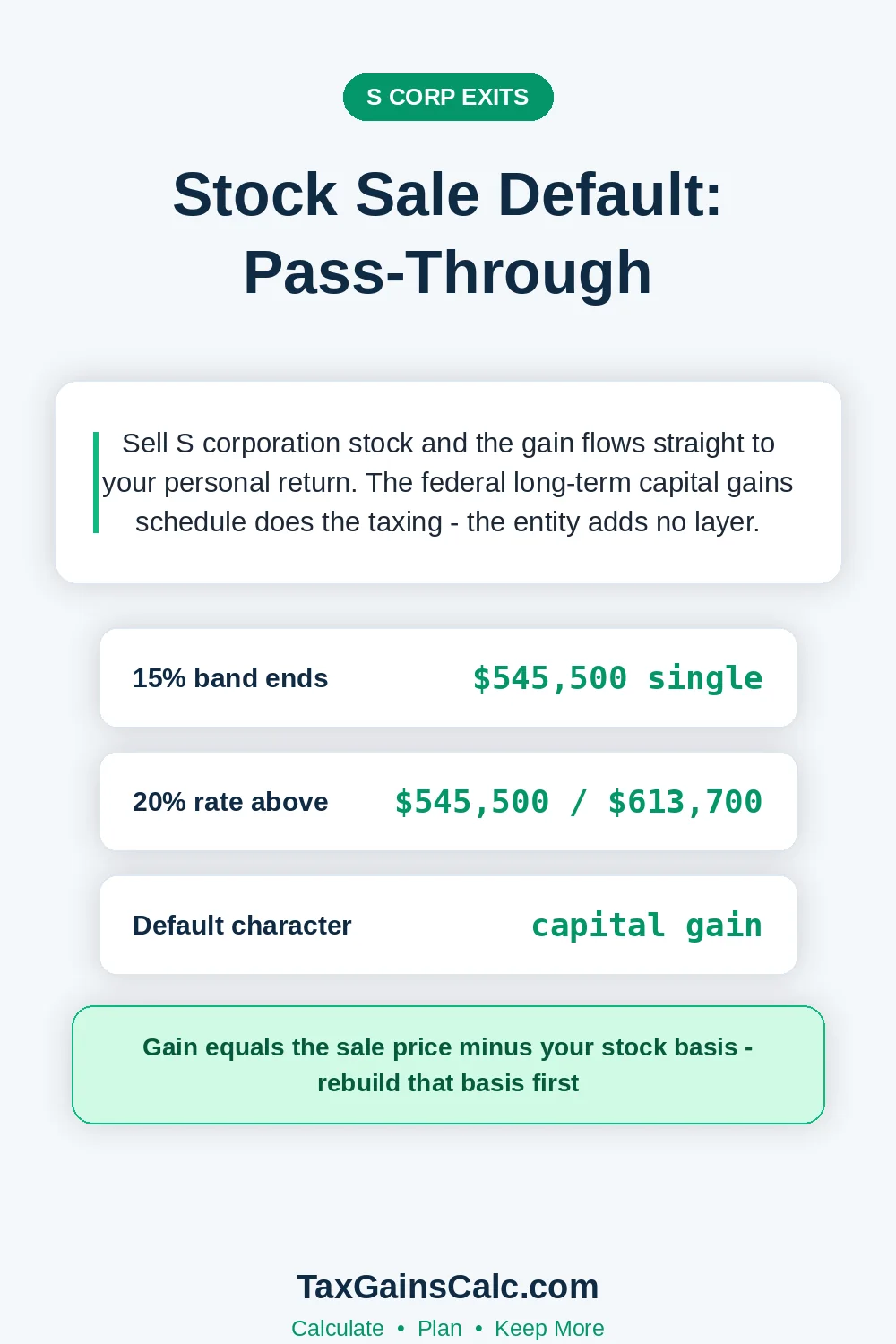 Holding periods over one year produce long-term gain at the standard federal schedule.
The 2026 long-term rates reach 20 percent above $545,500 of taxable income single. Joint filers cross the same 20 percent threshold at $613,700 of taxable income.
The 3.8 percent NIIT then applies once MAGI passes 200,000 for singles and 250,000 jointly.
Our detailed small business capital gains guide pulls the full exit-rate picture together for owners.
Each shareholder's gain follows their own stock basis and their own holding period. Basis tracking matters enormously because S distributions over basis were tax-free when received.
Reconstructing basis from years of K-1 filings takes time but changes the answer materially. The cost basis methods guide walks you through that reconstruction discipline with worked examples.
Stock Sale Versus Asset Sale: The Core Tension
Buyers and sellers systematically want opposite deal structures for well-understood tax reasons.
Sellers prefer stock sales because the exit produces one clean capital gain.
Buyers prefer asset sales because purchased assets receive a fresh, stepped-up basis. The stepped-up basis generates years of depreciation deductions the buyer can actually use.
| Deal element | Stock sale | Asset sale |
|---|---|---|
| Seller outcome | capital gain at personal rates | mixed character by asset |
| Buyer outcome | carryover basis, no step-up | stepped-up basis, depreciation |
| Liability transfer | buyer inherits corporate history | seller retains legacy liabilities |
| Contract complexity | simpler paperwork | asset-by-asset assignment |
The final price often splits the difference between the two preferred deal structures.
Buyers pay premiums for stock deals to cover inherited risk and lost deductions.
Sellers sometimes accept asset deals to close faster with certain buyers.
Our asset versus stock sale guide models both deal outcomes with complete worked numbers.
The Built-In Gains Tax After C Conversions
Section 1374 creates the biggest trap inside otherwise clean S corporation exits. Any former C corporation faces a five-year recognition period after its S conversion.
Gains on assets sold inside that window face a 21 percent entity-level tax. The tax applies to appreciation that existed on the day of conversion.
The recognition period starts on the first day of the first S tax year. Calendar the original conversion date against any planned sale before signing anything at all.
A sale one month inside the window pays the corporate tax entirely. A sale after the window closes produces the clean pass-through result instead.
| Sale timing | Tax treatment | Planning note |
|---|---|---|
| inside 5-year window | 21 percent entity tax on built-in gain | wait if possible |
| after the window | clean shareholder capital gain | full pass-through result |
| conversion year itself | both regimes can interact | specialist review required |
Asset sales by the S corporation trigger the same built-in gains logic. The entity pays the 21 percent tax before any distribution reaches owners.
Stock deals can still inherit the problem when the buyer plans quick asset steps. Thorough diligence should map the full conversion history before any deal gets papered.
Inventory and Receivable Carve-Outs to Expect
Not every dollar of corporate value produces capital gain character for sellers. Gain attributable to inventory can be ordinary income when the corporation sells.
Cash-basis receivables carry very similar conversion rules under the deemed-asset sale provisions. These carve-outs shave the capital gain percentage below what sellers initially model.
The buyer's allocation schedule determines how much price lands in each bucket. Working capital-heavy businesses see more of the price land in ordinary buckets.
Service businesses with thin inventory keep nearly everything in capital character. Model the allocation before the letter of intent locks the headline price.
Worked Example: A $2 Million Stock Sale
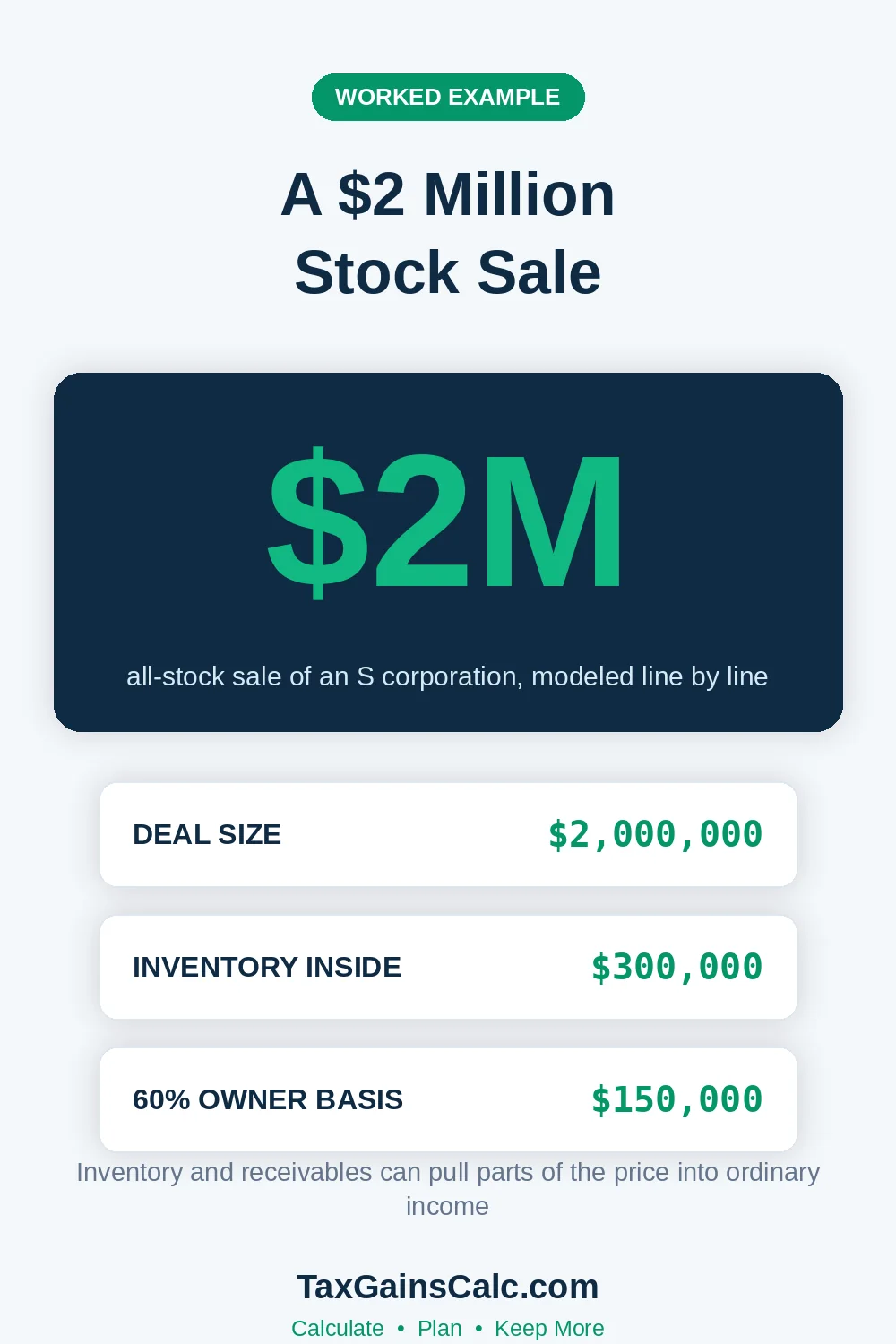
Picture an S corporation with $300,000 of inventory and $1,700,000 of goodwill value. One 60 percent shareholder owns stock carrying a reconstructed basis of $150,000 today.
The buyer purchases all corporate stock for $2,000,000 in a clean deal. No C corporation history exists, so the built-in gains window never applies.
The shareholder's 60 percent share of consideration equals $1,200,000 of proceeds. His basis consumes $150,000, leaving a clean $1,050,000 of long-term capital gain.
 At the top 20 percent federal rate, this shareholder's gain tax reaches $210,000. The 3.8 percent NIIT adds roughly $39,900 when MAGI clears the threshold.
| Line item | Amount | Notes |
|---|---|---|
| Share of sale price | $1,200,000 | 60 percent of $2M |
| Stock basis | $150,000 | from K-1 history |
| Long-term gain | $1,050,000 | held over one year |
| Federal at 20 percent | $210,000 | top LTCG bracket |
| NIIT at 3.8 percent | about $39,900 | MAGI over threshold |
The combined exit tax lands near $250,000 on this shareholder's slice. No corporate layer ever touches the money in a clean stock deal. Our step-by-step calculation guide reproduces this exact math for any deal size imaginable.
Hybrid Structures Buyers and Sellers Negotiate
Section 338(h)(10) elections blend the two deal structures for S corporation targets. The buyer treats the purchase as an asset acquisition for basis purposes.
The seller keeps stock-sale capital gain treatment on their personal return. That election typically gets funded by a price premium the buyer pays for the step-up.
The election requires written agreement between buyer and seller plus specialist tax execution. Negotiated price adjustments usually compensate the seller for any incremental tax cost incurred.
Deals above ten million dollars easily justify the modeling work this election requires. Our deferral strategies guide places this useful election among all the competing structures.
Proper installment treatment spreads the shareholder-level gain across the full payment schedule. Deferred portions carry interest income and principal gain in each payment year.
Escrows and earnouts complicate the timing considerably but rarely change the underlying character. Model the complete payment calendar before agreeing to any long payout tail either.
How Buyer Financing Changes the Tax Outcome
Leveraged buyout structures introduce installment and contingent payment questions into nearly every deal. Negotiated seller notes spread gain recognition across the payment years automatically for sellers.
 Each note payment arrives partially as interest income and partially as principal gain. The interest portion carries ordinary rates while the principal keeps capital character.
Contingent earnout payments depend on the deal's defensible fair market value determinations at closing. Open-ended earnouts can sometimes receive open-transaction treatment that defers gain recognition indefinitely.
Capped earnout structures require a defensible valuation at closing with later contractual true-ups. Deal lawyers and accountants disagree productively about these structures, so get both perspectives early.
Escrow withholdings complicate the closing-year tax reporting for every single shareholder involved. The IRS generally taxes escrowed amounts when the seller's right to them attaches.
Model the after-tax timing difference carefully before accepting any long escrow tail. Shareholders receiving K-1 flow first should coordinate their estimates with the deal calendar.
State Tax Layers on S Corporation Exits
State taxation follows the corporation's business footprint rather than the seller's mailbox alone. States where the company operates may claim sourcing on the sale price.
California and New York both run aggressive sourcing rules for business exit gains. Residency planning before a sale can still move the personal layer legitimately.
Sellers relocating before a planned exit need genuine domicile changes first. Our Texas guide and Florida guide cover the two most common relocation destinations.
Multi-state shareholder groups should model each individual owner's state exposure completely separately. The pass-through structure means each shareholder files under their own address rules.
When QSBS Layers on Top of an S Corporation
Qualified small business stock rules can erase federal gain entirely for eligible shareholders. Stock must be original issuance from a qualifying C corporation to qualify.
S corporation shares generally do not carry QSBS eligibility directly under current law. Conversions between entity types create rare planning windows that deserve careful examination early.
Founders eyeing a future exit sometimes restructure the entity years before any sale event. The restructuring must respect both the QSBS five-year holding rule and conversion rules.
Our QSBS exclusion guide explains every eligibility test in careful detail for founders. Our QSBS rollover comparison guide covers the reinvestment alternative in equal analytical depth.
Early-stage companies also weigh C versus S status against their future QSBS plans. That decision shapes the entire exit tax outcome years before any offer letter arrives.
Our C corporation double tax guide covers the opposite side of that same tradeoff. Early professional advice always beats late restructuring once offer letters already exist on paper.
Common Exit Mistakes S Owners Should Avoid
The most expensive mistake is signing an exclusivity agreement before mapping the tax outcome. Once exclusivity exists, the buyer controls the deal calendar completely.
 Sellers lose the leverage needed to negotiate structure premiums after that point. Carefully model every single tax scenario before granting any exclusivity period to anyone.
Another frequent error involves ignoring basis reconstruction until the closing year arrives. Five years of missing K-1 records take months to rebuild under pressure.
Start the reconstruction during the year before any contemplated sale process. Clean reconstructed basis records also survive auditor scrutiny far better than rough estimates ever do.
Owners also forget charitable planning that could offset a planned gain entirely. A donor-advised fund contribution funded with appreciated business shares changes the math.
The charitable contribution must happen before any sale contract legally binds the transaction. The donor-advised fund guide lays out that pre-sale timing rule in full detail.
An S Corporation Exit Checklist for Sellers
Run these checks before signing any letter of intent for the company. Each item either protects the clean capital gain treatment or flags work needed.
- Confirm no C corporation history exists inside the five-year built-in gains window.
- Reconstruct your stock basis from every K-1 since your original investment.
- Map inventory and receivables exposure to estimate ordinary character in a deal.
- Price the buyer's step-up premium before rejecting an asset deal structure.
- Model installment and 338(h)(10) alternatives against your after-tax proceeds target.
Shareholders who honestly run this checklist negotiate better deals with far fewer surprises. The IRS S corporation guidance documents the entity rules behind each item.
Deals regularly die over avoidable diligence surprises that two weeks of modeling would have caught. Every single dollar of preparation protects far more than it ever costs at exit time. Sellers who skip this checklist consistently leave the largest dollars on the closing table.

Wasim Akram
Wasim researches and writes every article on TaxGainsCalc, covering capital gains tax for everyday investors. Every figure is checked against primary IRS sources before it goes live.