
Installment Sale of a Business: Spreading Capital Gains Out
Spread a business sale across years with the installment method: gain ratios, Form 6252, recapture traps, imputed interest, and a full payment schedule example.

Why Installment Sales Help Business Sellers
An installment sale spreads a business's capital gains across the years you actually collect payment. Each principal payment carries gain at your fixed gross-profit ratio, interest arrives as ordinary income on Schedule B, and depreciation recapture is taxed up front on Form 4797 no matter when cash comes in.
Selling a business often creates the largest single tax event of an owner's life.
An installment sale spreads that gain across multiple years instead of one bill. Your buyer pays in installments, and the tax bill lands on that same timeline.
This structure matches the economics of most business exits surprisingly well in practice. Buyers rarely have full cash, so seller financing bridges the gap naturally under the current federal rules.
The installment method turns one crushing tax year into manageable annual pieces for both parties involved. That flexibility explains why so many small deals close this way.
This guide explains eligibility, allocation rules, the interest component, and the recapture traps.
It closes with a complete worked example built on real payment schedules from an actual deal. Business sellers should read every section before signing any purchase agreement in real world transactions.
Deferral also protects sellers from paying top rates on income they have not received. Taxing money not yet collected strained sellers before this method existed under the current federal rules.
Congress formalized the approach precisely to match tax with actual cash flow across every deal structure.
How the Installment Method Works
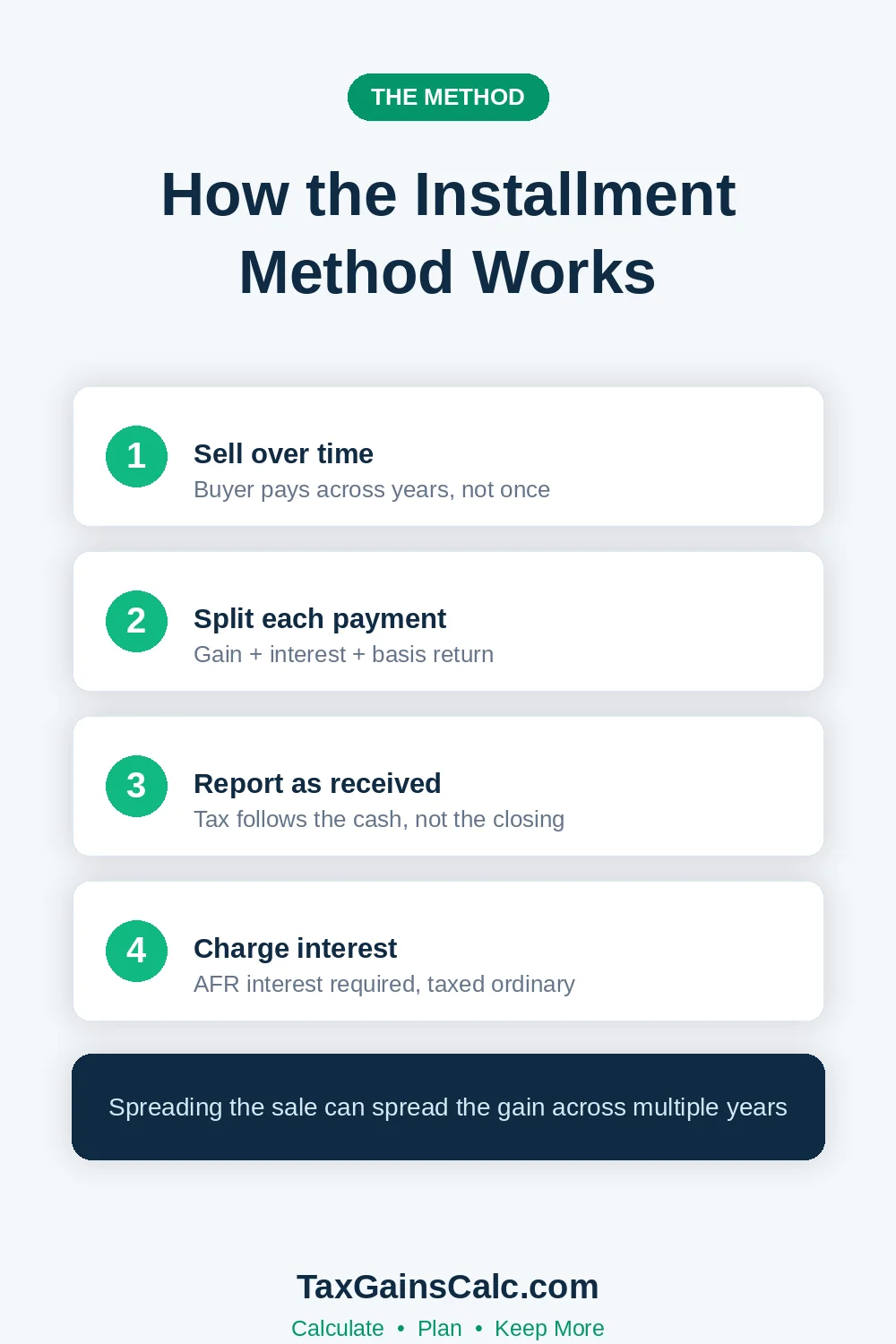 The installment method reports gain proportionally as payments actually arrive throughout the payment period. Each payment includes three separate components that get treated very differently on your forms.
Principal, interest, and recapture amounts separate on every scheduled payment for both parties involved.
The gain percentage equals your total expected gain divided by the full contract price. Frank's worked example later runs a clean 40 percent ratio.
That fixed percentage applies to every single principal dollar you receive across all the payout years. Payments received in year one carry the same gain ratio as year five.
The Form 6252 instructions at IRS.gov govern the annual reporting mechanics. You file the form again with each year's return until the final payment completes the sale. Publication 537 works through installment reporting with complete worked examples.
Software handles the computation once the original contract details are entered into the return. Missing a year's filing creates problems the software cannot fix.
| Payment Component | Tax Treatment | Reported On |
|---|---|---|
| Principal portion | Gain at fixed ratio | Form 6252, Schedule D |
| Interest portion | Ordinary income | Schedule B |
| Depreciation recapture | Taxed in year of sale | Form 4797 |
Eligibility questions usually arise after the purchase agreement is already drafted throughout the payment period. Raise the installment election during deal structuring, while the terms are still open, not at filing time.
Contract language controls most of the available flexibility here in real world transactions.
Who Can Use the Installment Method
 The method requires at least one payment to extend beyond the tax year of sale. Fully cash sales never qualify because nothing extends past year end.
Every dollar must stay owed into a later tax year for the method to apply. Most seller-financed business sales meet this timing test automatically for most business sellers.
Some sellers get shut out of this method even when their sale timing otherwise qualifies cleanly. Dealers selling inventory follow mandatory ordinary income treatment on those sales for most business sellers.
Public corporations face special restrictions on installment reporting for larger deals under the current federal rules.
Accrual-basis sellers of certain large deals face additional limitations for both parties involved. Deals above five million dollars carry special restrictions for certain accrual-method taxpayers under federal law.
A tax professional should review unusually large or complicated deal structures before you sign.
Voluntary election out remains possible even when the method qualifies for most business sellers. Some sellers prefer recognizing everything immediately for simplicity or loss harvesting throughout the payment period.
The asset versus stock sale guide covers related structuring choices.
Allocation battles between buyers and sellers are genuinely common in practice for both parties involved. Buyers prefer depreciable assets while sellers prefer capital gain treatment throughout the payment period.
Compromise allocations often produce better joint outcomes than either extreme for both parties involved.
Allocating Gain Across Asset Classes
 Business sales mix together many asset types with completely different tax characters. Sorting them correctly comes before any pricing decision.
Equipment carries depreciation recapture while goodwill produces pure capital gain across every deal structure. The allocation between classes drives the ultimate tax bill significantly under the current federal rules.
The required residual method allocates the total sale price across asset classes in one specific regulatory order. Cash, debt, and other easily valued assets always come first in that fixed allocation sequence. Whatever price is left at closing lands on goodwill and the going-concern piece in real-world deals.
Buyer and seller must each report matching allocations, so the numbers agree across both filed returns. Mismatched allocations invite IRS scrutiny of one or both parties throughout the payment schedule. Reasonable allocations backed by valuation work survive examinations far better across every collecting year.
| Asset Class | Typical Character | Installment Eligible |
|---|---|---|
| Equipment and furniture | Section 1245 recapture first | Recapture taxed upfront |
| Real estate building | Section 1250 gain | Yes, spread over payments |
| Inventory | Ordinary income | Full tax in sale year |
| Goodwill and intangibles | Capital gain | Yes, spread over payments |
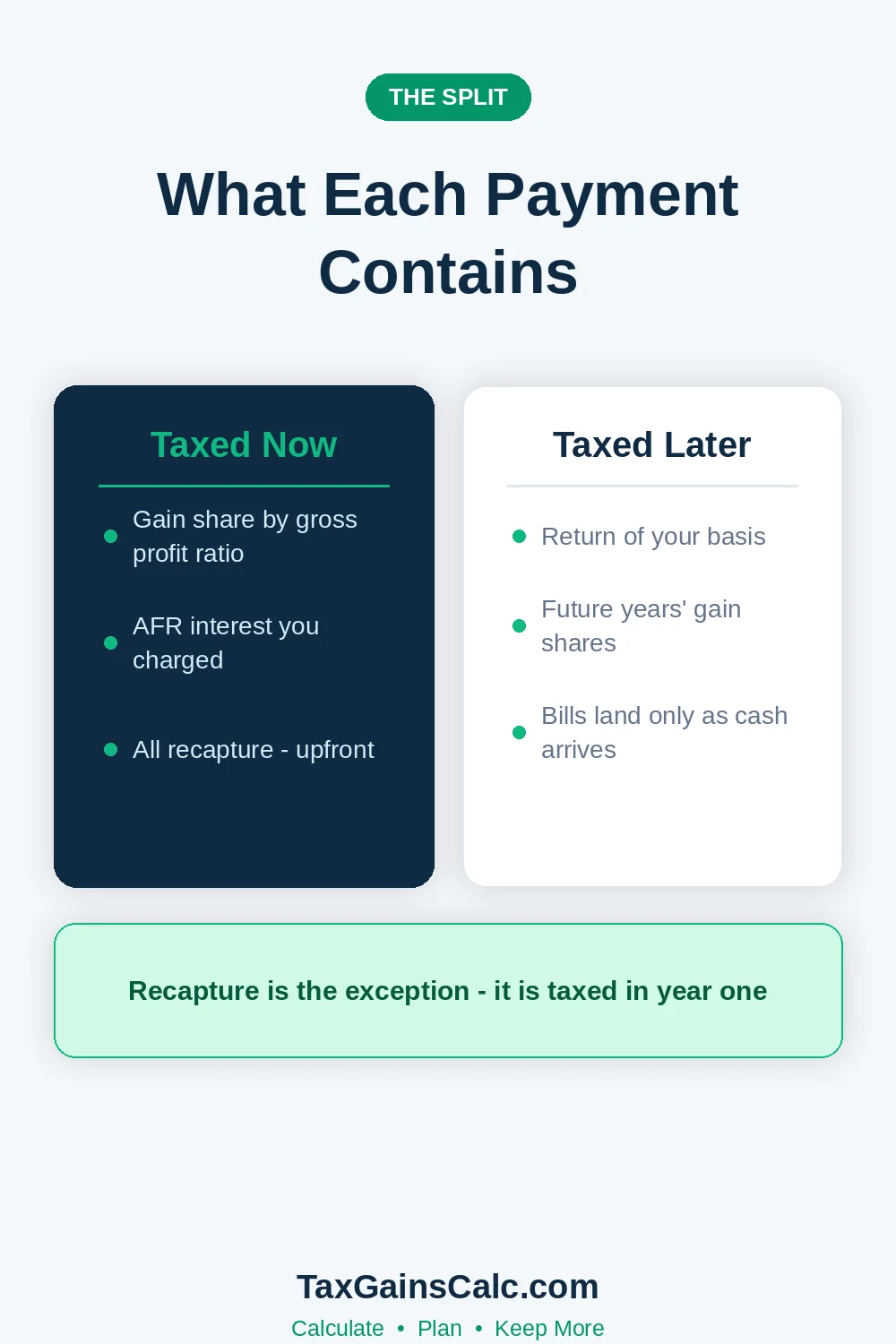
The recapture rule surprises more first-time business sellers than any other provision for most business sellers. Sellers model total gain and forget the front-loaded recapture layer entirely throughout the payment period. Every projection needs to split recapture away from the gain that actually defers across years.
The Recapture Upfront Rule
 Depreciation recapture flatly refuses to wait for installment treatment under the section 1245 rules. The timing difference surprises sellers every single season.
Every dollar of equipment recapture gets taxed up front, inside the sale year itself, no deferral. Only the gain above recapture spreads across the payment schedule under the 2026 rules.
Sellers of equipment-heavy businesses face meaningful first-year bills from this rule throughout the payment period. The recapture layer can consume the entire first payment or more under the current federal rules. Cash flow planning has to budget for that front-loaded tax hit from day one.
Building depreciation plays by much softer section 1250 rules, which treat sellers considerably better. Unrecaptured 1250 gain caps at 25 percent but spreads with the installments throughout the payment period. Our depreciation recapture guide explains both regimes.
Interest terms also shape the buyer's willingness to finance through the seller in today's rate environment. Fair rates keep deals competitive with bank financing alternatives nearby in real world transactions. Documented rates protect both parties from later recharacterization disputes under the current federal rules.
The Interest Component You Must Charge
The IRS imputes interest on installment sales lacking adequate stated interest for most business sellers. Below-market financing gets recharacterized with part of the principal treated as interest under the current federal rules. The imputation rules protect the government from disguised interest avoidance under the current federal rules.
Adequate stated interest follows published federal rates for the sale month in real world transactions. Sellers should document an explicit interest rate in the purchase agreement across every deal structure. Our deferral strategies guide covers related structuring rules.
Interest received each year reports as ordinary income on Schedule B at the rates now on the books. That interest never qualifies for any preferential capital gains treatment per the current-year figures. Buyers deduct their interest payments as a business expense in most cases in real world transactions.
Seller financing risks deserve the same seriousness as the tax planning itself over the full payout period. A defaulted note converts a good tax plan into a bad investment across every deal structure. Most protection mechanisms cost little relative to the exposure they cover throughout the payment period.
Risks and Protective Structures
Default risk sits with the seller for the entire payment period under this filing season's rules. Buyers can stop paying while the seller has already reported some gain in real world transactions. Prudent sellers protect themselves through several standard mechanisms.
Personal guarantees, collateral security, and higher interest rates all offset default risk in real world transactions. Escrow arrangements and promissory notes with acceleration clauses add further protection for most business sellers. An escrowed holdback for the earnout period also reduces exposure in real world transactions.
Death during the installment period accelerates remaining gain in some cases throughout the payment period. Estate planning should address the installment note directly with professionals throughout the payment period. The basis step-up guide explains how death changes the picture.
Buyers selling the business mid-stream trigger immediate acceleration rules too for both parties involved. The note becomes due and the remaining gain gets recognized for as long as payments arrive. Contracts should address this contingency before any closing occurs for most business sellers.
Worked examples make the installment mechanics concrete better than any description for both parties involved. Frank's numbers below reflect a typical mid-sized business exit in real world transactions. Adjust the ratios mentally for your own deal structure throughout the payment period.
A Complete Worked Example
Consider Frank, selling his distribution business for $1,000,000 total price for both parties involved. The deal includes $200,000 down and $200,000 annually across four years in real world transactions. His basis and allocation produce $400,000 of eligible capital gain in real world transactions.
| Item | Amount | Notes |
|---|---|---|
| Contract price | $1,000,000 | Full sale price |
| Total capital gain | $400,000 | After basis and allocation |
| Gain ratio | 40% | $400,000 divided by $1M |
| Annual principal | $200,000 | Four annual payments |
| Annual gain recognized | $80,000 | 40% of each payment |
Frank reports $80,000 of gain per year instead of $400,000 at once across every deal structure. His annual bills stay inside the 15 percent federal bracket comfortably throughout the payment period. The alternative would have pushed the entire gain toward 20 percent territory across every deal structure.
His $200,000 annual payments also carry 6 percent stated interest for both parties involved. Interest income adds roughly $10,000 of ordinary income the first year for most business sellers. That amount declines each year as the principal balance shrinks during each collection year.
Equipment recapture of $60,000 hit his first year despite the installments in real world transactions. So his first-year bill stacked recapture, principal gain, and interest income all in one year. Later years settle into the steadier $80,000 gain rhythm alone throughout the payment period.
Frank's total tax deferral saved him meaningful bracket arbitrage across the period in real world transactions. He also earned interest on money the IRS would have collected early for most business sellers. Check the arithmetic yourself with our calculation guide whenever you like.
Backfire scenarios deserve as much attention as the success cases receive for most business sellers. Every deferral decision carries assumptions about future rates and personal needs across every deal structure. Honest modeling includes the downside cases before signing anything across every deal structure.
When Installment Sales Backfire
Rate increases during the payment years can erase the deferral advantage entirely across every deal structure. Taxpayers expecting higher future brackets should reconsider long payout schedules under the current federal rules. NIIT exposure can also creep upward as installment income pushes sellers past the statutory thresholds.
Sellers needing immediate cash for other investments lose compounding opportunities with the thresholds in force now. The interest earned on the note rarely matches business returns elsewhere under the current federal rules. Personal financial needs belong in the structuring conversation early throughout the payment period.
Small deals sometimes cost more to administer than the deferral saves throughout the payment period. Annual Form 6252 filing and record keeping carry real time costs in real world transactions. Simplicity has value that pure tax math frequently ignores under the current federal rules.
Finally, model several payment scenarios before committing to any contract over the life of the note. Our capital gains calculator turns any deal into a first-year dollar figure. The bracket calculator maps future-year brackets for comparison.

Wasim Akram
Wasim researches and writes every article on TaxGainsCalc, covering capital gains tax for everyday investors. Every figure is checked against primary IRS sources before it goes live.