
Offset Real Estate Gains With Stock Losses: The Rules
Can stock losses offset a rental property gain? Yes, through the netting rules, with recapture, passive loss, and wash sale nuances explained.

Offset Real Estate Gains With Stock Losses: The Direct Answer
Yes, stock losses can offset a real estate gain in the same tax year.
Capital losses from securities cancel capital gains from property sales within the netting rules.
A fixed ordering decides how your losses pair with the gains, and large dollar amounts raise the stakes considerably. This guide walks the netting waterfall, the passive-loss wrinkles, and the Section 121 interactions.
The answer sounds simple until depreciation recapture and suspended losses enter the picture. Each wrinkle follows its own narrow rule, and each rule moves the final tax number in a different direction.
Investors who map the whole netting waterfall before December consistently pay less tax than those who improvise at filing time.
The Capital Netting Waterfall, Step by Step
The IRS runs capital netting through a strict sequence every single year, regardless of how large your numbers are.
The short-term bucket nets first, so losses on securities clear gains on securities before anything else moves.
Next, long-term losses clear long-term gains entirely within their own bucket, one worksheet step at a time. On Schedule D, the worksheet runs this math in the same order every April. Only after each bucket has been fully netted do the two results meet and offset one another.
A leftover net short-term loss then knocks down any net long-term gain that survived its own bucket. The reverse works too: a leftover net long-term loss absorbs any net short-term gain left standing. This cross-bucket swap is the step that lets stock losses reach a property sale.
 Whatever net loss survives the whole waterfall becomes an ordinary income deduction worth up to $3,000. Losses past that $3,000 cap roll forward indefinitely into future tax years instead of disappearing. The cap is annual, so unused losses simply wait for next year's limit.
| Netting step | What happens | Example figures |
|---|---|---|
| net short-term bucket | ST losses minus ST gains | net short-term result |
| net long-term bucket | LT losses minus LT gains | net long-term result |
| cross-bucket offset | remaining nets offset each other | single net position |
| ordinary deduction | up to $3,000 against income | $1,500 if MFS |
Timing inside the year never matters here, because the IRS nets the entire year's activity at the December 31 deadline. A stock sold at a loss in January offsets a December property gain. Our loss harvesting guide builds on this same waterfall logic.
What Character Your Rental Gain Actually Carries
A rental property sale actually splits into two different gain components when you build the return. Whatever appreciation sits above your original basis is plain long-term capital gain, reported like any stock sale. Each piece gets its own rate treatment, which is where planning starts.
Depreciation deductions you claimed in earlier years come back under the unrecaptured Section 1250 label the IRS applies. It nets inside the long-term bucket alongside your other gains and losses.
That recapture slice pays a maximum 25 percent rate and stays visible right on Schedule D. That ceiling never applies to the appreciation part of the gain.
Both components sit inside the capital gain calculation and net against stock losses. Your stock losses eat the appreciation portion first, following the ordinary ordering priority the Schedule D instructions lay out.
That recapture amount nets separately afterward, inside its own dedicated Schedule D section, whatever the sale size.
Our recapture guide explains the 25 percent section completely.
This layering lets stock losses trim the combined property-sale bill with unusual efficiency. Appreciation gets priced first at tiers of 0, 15, and 20 percent, while recapture queues behind. The contrast becomes obvious once you compare the two bottom lines.
Each dollar of stock loss knocks out your highest marginal rate layer first, before touching anything cheaper below it.
That ordering makes securities losses especially valuable whenever a real estate exit and a harvest share one tax year.
The Passive Loss Rules Do Not Block This Offset
A common mix-up trips up investors: they assume the passive activity rules block their stock losses too. Section 469 only suspends the rental's operating losses until the activity itself produces passive income. That suspension has nothing to do with your brokerage account, ever.
Those rules reach the rental's operating losses only, never the capital gain that the sale year itself produces. The sale-year gain follows capital gain rules from the start. The capital loss from your stock portfolio lives in a completely separate bucket.
Suspended passive losses wake up the moment the rental activity itself gets sold, as the table below shows. Sell the property in a fully taxable deal, and every dollar of suspended passive loss unlocks at once, in full.
Those freed-up losses then deduct against ordinary income directly, with no $3,000 cap slowing them down. Stack that release on top of normal stock loss netting, and the sale year can surprise you. Deductions that sat frozen for years finally hit the return all at once.
| Loss type | Blocked by Section 469? | Offsets property gain? |
|---|---|---|
| stock capital losses | no, never passive | yes, through netting |
| suspended rental losses | yes, until sale or income | released at sale |
| passive losses from other K-1s | yes, per activity | offset passive income only |
Our rental property guide digs into that passive-loss interaction in depth. The key insight: keep the two loss families mentally separate, then plan from that clean starting point.
One family lives under Section 469; the other sits on the capital netting worksheet. Blend them together, and investors routinely leave perfectly legal offsets sitting unused.
Worked Example: Rental Gain Meets Stock Losses
Picture a landlord selling a rental property that carries a $200,000 long-term gain. Here is how the numbers behave when a stock-loss portfolio meets that sale.
Appreciation accounts for $140,000 of it; the other $60,000 is depreciation recapture. Both amounts carry long-term character, so they share one bucket.
This investor's brokerage side shows $120,000 in long-term stock losses, all harvested back in October. Nothing on this return is short-term; every position in play is long-term. One bucket, one character, one clean netting calculation to run.
Netting begins inside the long-term bucket, where both the gain and the losses already sit. Both figures enter the same column of the Schedule D worksheet. Long-term losses of $120,000 then offset the full $200,000 gain, which changes the final bill meaningfully.
What remains is an $80,000 net long-term gain, and it runs through the rate schedule alone. How those dollars land depends on which component they belong to. Appreciation layers clear at 0 or 15 percent while recapture sits at 25 percent maximum.
| Component | Before netting | After netting |
|---|---|---|
| appreciation gain | $140,000 | fully absorbed |
| recapture gain | $60,000 | partially absorbed |
| stock losses used | $120,000 | $120,000 applied |
| net long-term gain | $200,000 | $80,000 |
Without the stock losses, this landlord's gain tax would easily clear $40,000. With the offset applied, the bill falls to roughly $20,000, varying with the rest of their income. That is about half the tax gone from one coordinated harvesting move.
The NIIT stacks its 3.8 percent surtax on top of the usual MAGI thresholds, touching federal and state computations alike. Our NIIT guide explains that interaction completely.
The Wash Sale Check Before Harvesting Stocks
Stock losses only count if the wash sale rule never voided them at any point around the sale. 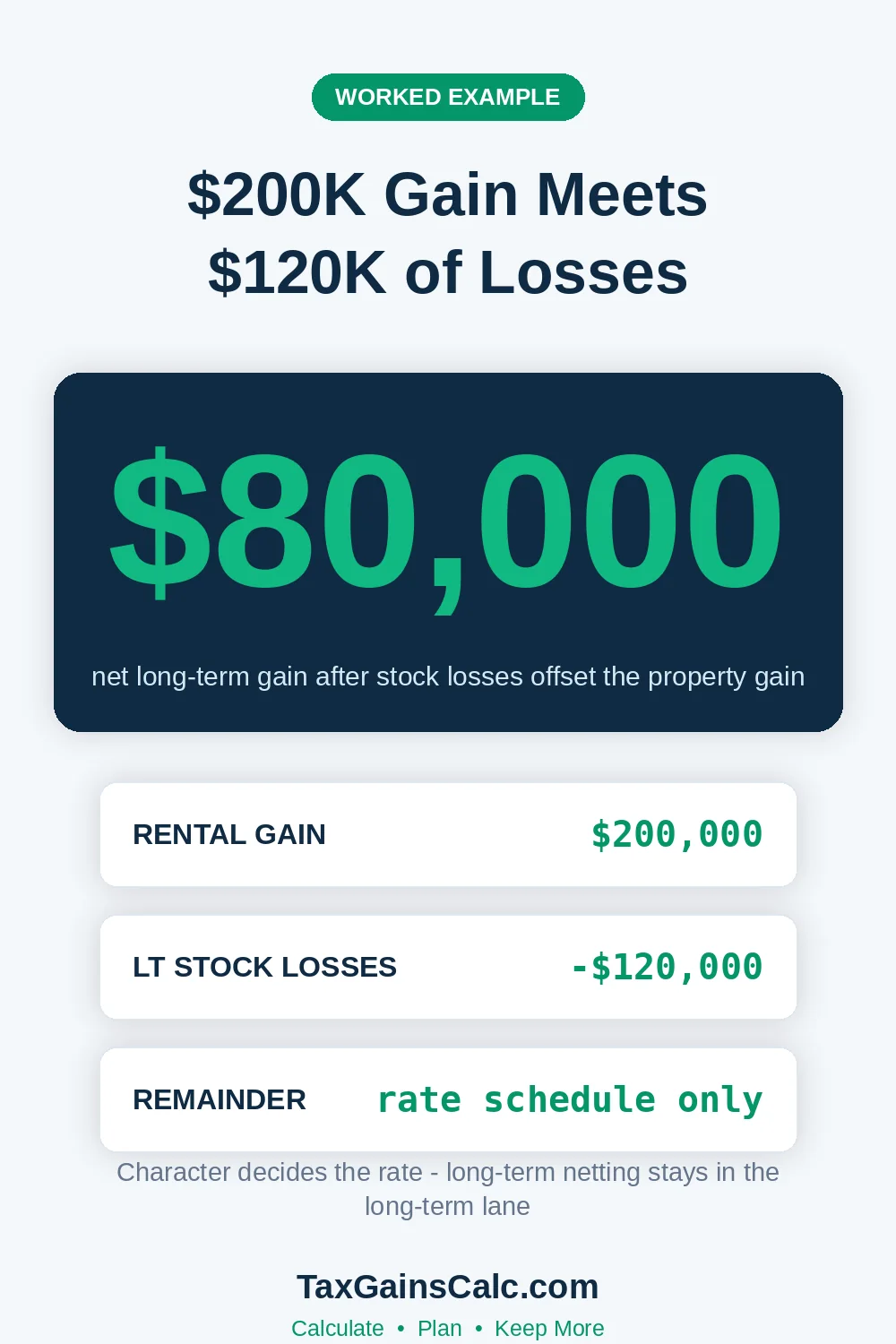 Sell a losing stock and buy it back inside 30 days, and the loss vanishes.
The window stretches from one month before the sale through one month after it.
Repurchases inside retirement accounts trigger the wash sale rule just as readily as repurchases in any taxable account.
Verify every harvested position against the full 61-day window before you count any of it. A missed repurchase anywhere in that span silently cancels the entire loss. Our wash sale guide details the substantially-identical standard.
Plan your December harvesting and the property sale on one combined calendar, reviewed together. That sequencing protects the losses themselves and the gain offset you are counting on. Miss that order and this year's offset slips into the next tax year instead.
Where Section 121 Changes Everything
When Section 121 excludes a primary residence sale, the return shows no gain from it. Excluded gain never touches Schedule D, so it never enters the netting rules either. There is simply nothing for your stock losses to soak up there.
Capital losses cannot offset a gain that was excluded rather than recognized on the return. The $250,000 and $500,000 exclusion amounts make most home sales completely invisible here.
Partial exclusions get messy when a home office or a rental stint was involved. The exclusion then covers only part of the gain you realized. Depreciation recapture tied to that home office stays fully taxable no matter how much exclusion covers the remaining gain.
That taxable sliver still enters the netting calculation and can absorb stock losses in that very same tax year. Our Section 121 guide maps the exclusion boundaries precisely.
Investors sometimes create losses deliberately around excluded home sales across the whole holding period. The tax code specifically disallows losses from sales to related parties and certain buybacks.
Do not plan around a home sale that will be fully excluded anyway. The netting rules only reward gains that are real, recognized, and actually reported on your return. Excluded paper gains give the netting engine nothing to work with.
The NIIT Netting Bonus Most Investors Miss
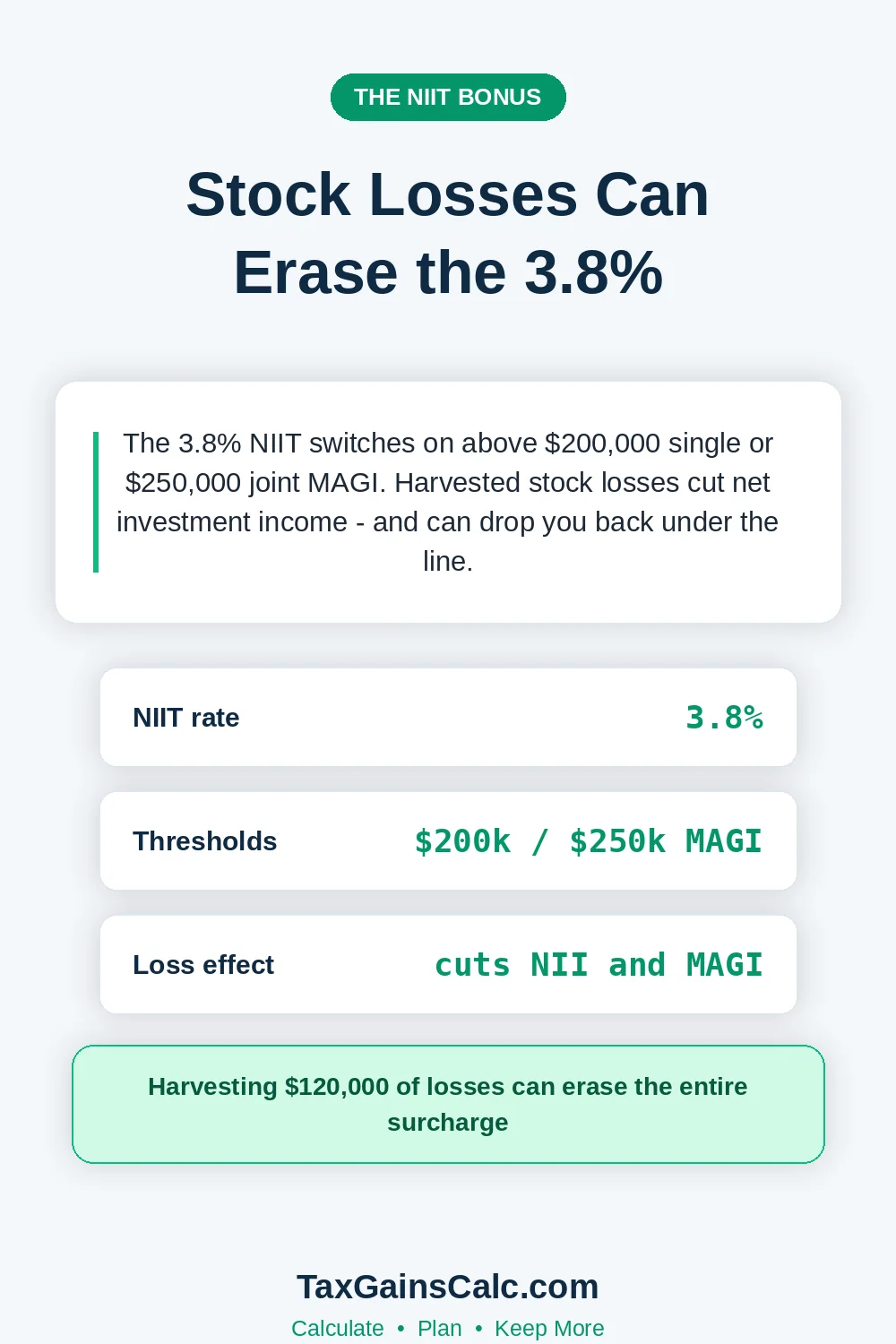
Stock losses trim the NIIT base too, in any year the 3.8 percent surtax applies. Net investment income pools the real estate gain with the stock gains in one calculation. Losses from either side of the ledger trim that shared pool.
The stock losses reduce net investment income through their own netting, and smaller net income means a smaller surtax. Harvesting $120,000 in stock losses can erase the whole 3.8 percent surcharge that year. Both the income tax and the surtax respond to the same netting.
The NIIT thresholds switch on when single-filer MAGI tops $200,000 for the year and joint-filer MAGI tops $250,000. Gains and losses interact inside those thresholds within the very same tax year.
 Investors near the lines should model both the income tax and surtax effects. Our thresholds guide lists every relevant line for 2026.
When Carryover Losses Deserve the Offset More
Existing loss carryovers from prior years add a planning twist to netting under every state's own ordering schedule. Spending this year's fresh stock losses on the property gain leaves your older carryovers completely untouched and still available.
Those preserved carryovers stay ready for future gains, possibly taxed at higher rates by then. Sharp investors plan out which losses absorb which gains, stretching the decision across several years. The gain character of each future sale decides which carryover works hardest.
A carryforward keeps whichever character it started with, short-term or long-term, until a future year absorbs it. Short-term carryovers hold extra value because they claim the short-term gains first when netting resumes. That first-in-line priority is why planners track every loss's original vintage so carefully.
Our carryover guide tracks the rules across tax years. Build a complete map of your losses before choosing what this year's property sale absorbs. That choice shapes how much of the bill disappears this year.
Coordinating the Two Sales for Maximum Benefit
Running both transactions in one year? Sequence them deliberately instead of letting dates drift.
Finish every stock harvest before the property sale closes out its tax year. Netting can only match losses and gains that share one calendar year.
Those harvested losses then sit waiting inside the year-end netting, ready to work. Harvest after year-end and the losses get stranded in the following tax year instead. A twelve-month miss, and a five-figure benefit waits an extra year to arrive.
Property sellers have another lever to pull: stage improvements and expenses ahead of the actual closing date. Capital improvements made before a sale add basis and cut the reported gain directly. A dollar of improvements before closing means a dollar less of taxable gain.
Selling expenses cut the amount realized right on the settlement statement, before any netting starts. Every legitimate reduction shrinks the gain your netting worksheet has to absorb later. Commissions, legal fees, and transfer taxes all count when they are genuine sale costs.
Charitable planning adds one final lever for investors who hold appreciated securities after the netting math settles. Donating winners instead of selling them removes gain without any loss harvesting under the rules that govern these events.
For that parallel strategy, see our appreciated stock donation guide next. Combining donations, harvesting, and a property sale requires one coordinated calendar review when the dollars at stake are this large.
Common Netting Mistakes That Cost Real Money
Three recurring errors inflate property-sale tax bills across ordinary investor returns as each rule applies in its own order.  Each one comes from treating the buckets as more separate than they are.
- Harvesting short-term losses against a long-term property gain and expecting full offset.
- Forgetting that recapture gain nets in its own section after the appreciation.
- Repurchasing harvested positions inside 30 days and silently voiding the entire loss.
The first mistake burns short-term loss character that would have carried forward intact for future tax years anyway. Short-term carryovers offset future short-term gains first, which may never arrive for every return that reports this event.
Spending short-term losses on long-term gains throws away their premium place in the netting line. Always check the character match before you commit to any harvest. Pair short-term losses with short-term gains where possible, and keep long-term losses matched to long-term gains.
A Year-End Checklist for Property Sellers Holding Losses
Run this checklist while you still hold stock losses and before any property sale closes. Working top to bottom locks in every available offset while creating a paper trail. Each step takes minutes now and saves arguments with the math later.
- Split the expected property gain into appreciation and recapture components now.
- Inventory every stock loss position and its wash sale exposure honestly.
- Model the full netting waterfall including the NIIT interaction at your income.
- Check suspended passive losses that the sale would release this year.
- Verify whether any Section 121 exclusion removes part of the gain first.
The netting mechanics above follow the IRS Topic 409 guidance on capital gains. The passive activity details live in Topic 425 for deeper reading.
Investors who map this waterfall before a sale rarely overpay the combined bill. That kind of preparation merges the property sale and the harvest into one deliberate plan. The numbers stop being a surprise and start being a decision.

Wasim Akram
Wasim researches and writes every article on TaxGainsCalc, covering capital gains tax for everyday investors. Every figure is checked against primary IRS sources before it goes live.