
Form 2210: Capital Gains Underpayment Penalty Guide
Missed estimated payments after a big sale? Form 2210 computes the underpayment penalty. Safe harbors, Schedule AI, waivers, and a worked example inside.

When the Form 2210 Penalty Applies
Form 2210 computes the underpayment penalty owed when too little tax was prepaid on capital gains during the year. You escape it by meeting a safe harbor: 90 percent of this year's bill, or 100 percent of last year's, or 110 percent once prior AGI passed $150,000, paid through withholding or estimates. Publication 505 works through every safe-harbor calculation with full worksheets.
Selling an investment for a large profit feels great until the following April arrives. Unlike wages, capital gains have no withholding tax taken out along the way.
The IRS therefore expects quarterly estimated payments as the profit lands throughout the year.
Form 2210 is where the IRS, and you, compute any underpayment penalty for missed estimates. The form walks through each quarterly period and compares required payments against actual payments.
A shortfall in any quarter produces a penalty calculated on that specific gap.
The penalty is not a flat fine but an interest-style charge on the shortfall. It accrues from each quarterly due date until the missing amount gets paid.
Form 2210 capital gains situations usually trace straight back to a big unwithheld sale.
One important floor shields smaller filers from this entire penalty exercise every year. If your balance due after withholding and credits is under $1,000, no penalty applies.
Most one-time modest gains never cross into genuine Form 2210 territory at any point.
A second threshold decides who formally owes estimated payments in the first place. Expecting to owe $1,000 or more after all withholding triggers the quarterly payment obligation.
Projecting that figure after a big sale is the habit that prevents penalties entirely.
Crypto sellers and stock sellers share one structural disadvantage under these quarterly payment rules. Brokerage sales never withhold a single dollar, and crypto exchanges rarely do either.
Only payroll and retirement distributions generate the deemed-evenly withholding that fixes quarterly gaps automatically.
The Three Safe Harbor Rules
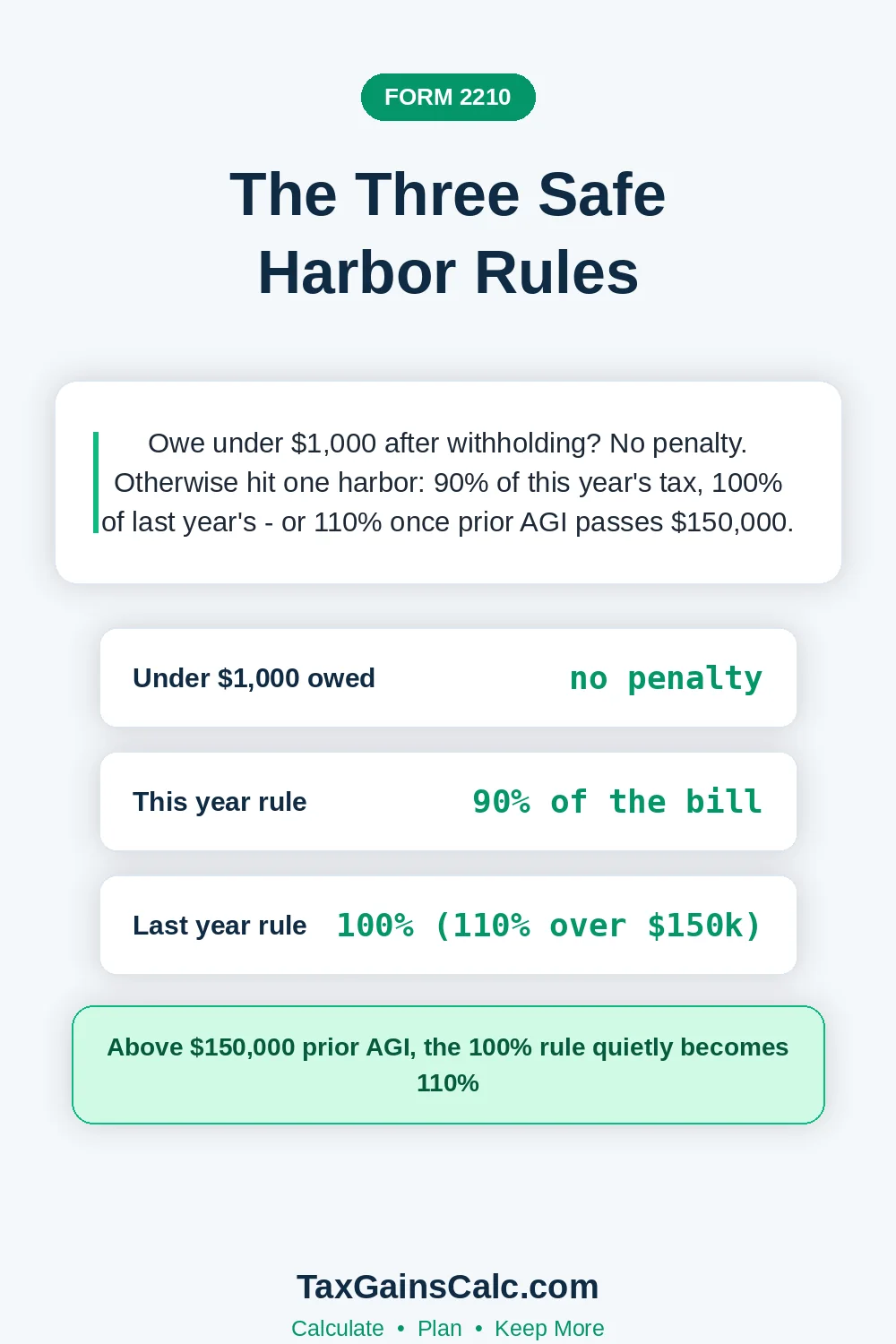 You avoid penalties entirely by hitting any one of three annual payment targets. These targets are called safe harbors, and choosing the cheapest one is a real skill.
The comparison table below shows each safe harbor rule and the situations where it wins.
| Safe Harbor | Payment Required | Best For |
|---|---|---|
| 90% of current year tax | 90% of this year's total bill | Income similar to last year |
| 100% of prior year tax | 100% of last year's total bill | Income jumped sharply this year |
| 110% of prior year tax | 110% of last year's bill | Prior AGI above $150,000 |
High earners must use the 110 percent version of the prior-year lookback instead. The threshold counts your adjusted gross income from the earlier return, not the current one.
Once prior AGI crossed $150,000, the 100 percent rule quietly stops working for you.
Comparing the two cheapest safe harbors takes about one minute with real numbers. Multiply last year's total tax by 1.10 and this year's projection by 0.90.
Pay the smaller figure in four equal installments and the penalty conversation ends.
Prior-year safe harbors also carry one hard eligibility condition you cannot skip. You must have filed a full twelve-month return covering that earlier tax year. New investors with no prior return can only rely on the 90 percent route.
How the IRS Computes the Penalty
 The computation divides the year into four payment periods with fixed due dates. Each period stands on its own, so overpaying early does not rescue a later gap. Each of the four quarterly windows closes on the 15th, in April, June, September, and then January.
For every period, the IRS compares required installments against payments credited by that date. The shortfall amount then accrues the official underpayment rate, which adjusts every quarter. Recent years have run that rate near 8 percent, and it changes with federal rates.
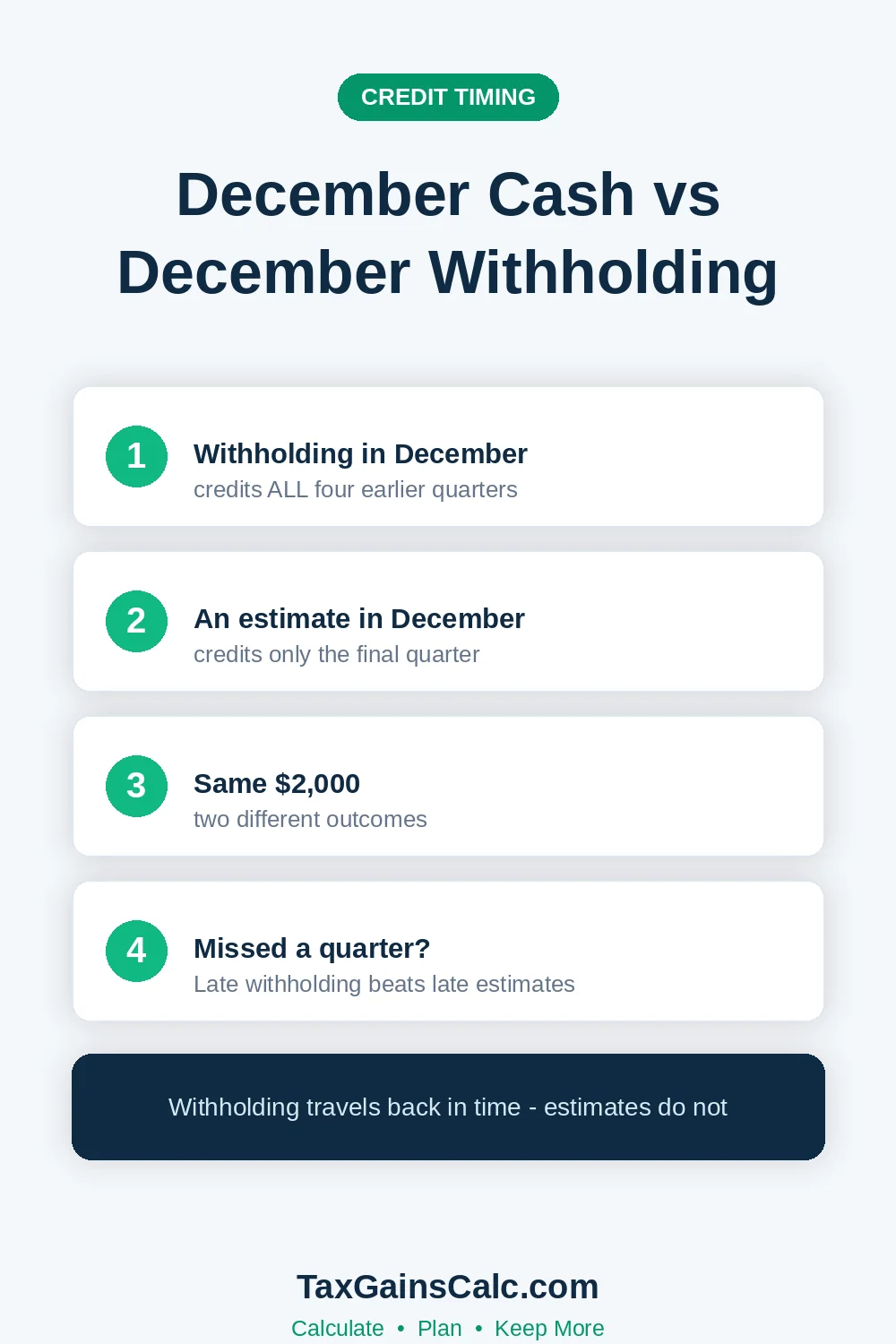
Withholding gets special timing treatment that estimated payments never receive under the rules. Tax withheld from a paycheck or a backup withholding event is deemed paid evenly. A December bonus withholding can therefore patch up every earlier quarterly shortfall retroactively.
Estimated payments never enjoy that deemed-evenly spread treatment under any circumstance whatsoever. A January 15 payment covers only the final period, never the earlier ones. This timing asymmetry is the single most useful fact in all of penalty planning.
The exact underpayment rate for each quarter publishes through the official IRS newsroom. The rates move with federal short-term borrowing rates and reset every three months. Looking up the current figure before calculating gives you the precise accrual amount.
A simple example shows how the deemed-evenly rule plays out in actual practice. Withholding $2,000 in December credits exactly $500 toward each of the four periods. The same $2,000 paid as an estimate in December credits only the final period instead.
Short Method vs Long Method
 Form 2210 offers two separate computational routes, and picking correctly saves real effort. The short method fits filers whose income arrived evenly and whose payments came on time. The long method handles lumpy income through the detailed Schedule AI annualization worksheet.
| Feature | Short Method | Long Method |
|---|---|---|
| Income pattern assumed | Even across all four periods | Actual timing by period |
| Worksheet needed | None | Schedule AI attached |
| Best case for | Simple W-2 plus one sale | Bonus, business, or late-year gains |
| Penalty outcome | Slightly higher, fixed formula | Often lower for late-year income |
A big September stock sale is the classic long-method scenario worth the extra paperwork. Annualizing your income as of August 31 reduces the required installments for early periods. The gain effectively gets measured as if the year had ended in August.
The IRS will compute the penalty for you if you do nothing on the form. Leaving the return to calculate it automatically is the default and often correct. Filing Schedule AI yourself is the only way to claim the lower late-year figure.
The official instructions live on the Form 2210 page at IRS.gov. Skim them once so the strange method boxes stop feeling intimidating at filing time. Ten quiet minutes of reading removes most of the anxiety surrounding this one form.
A Worked Example With Real Numbers
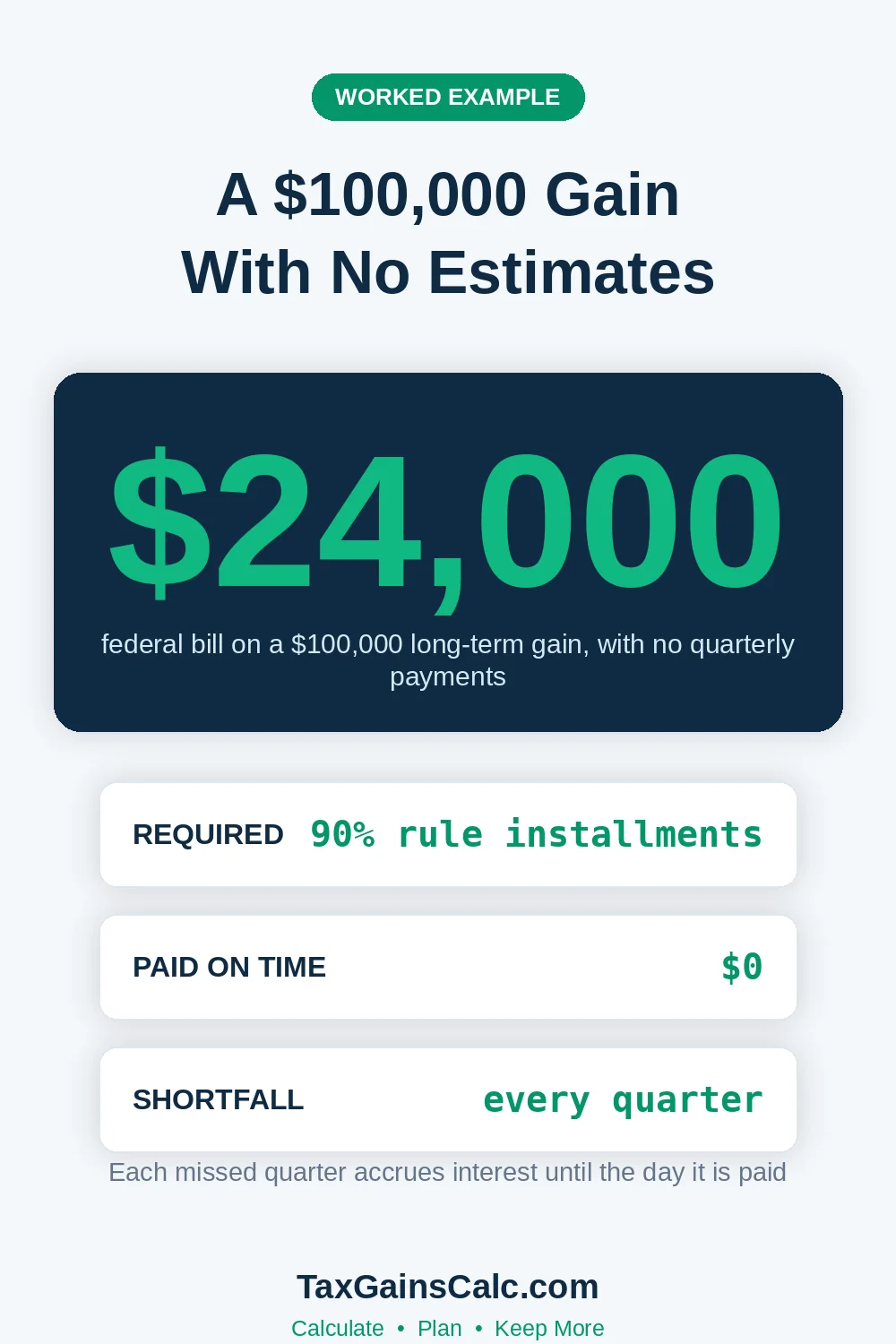
 Consider Daniel, a single filer who sold a long-held stock position in September. The sale generated a long-term gain of $100,000 and a $24,000 federal tax bill. He paid no estimates and fully expected his April payment to settle everything.
| Period | Required (90% Rule) | Paid by Due Date | Shortfall |
|---|---|---|---|
| April 15 | $5,400 | $0 | $5,400 |
| June 15 | $5,400 | $0 | $5,400 |
| September 15 | $5,400 | $0 | $5,400 |
| January 15 | $5,400 | $0 | $5,400 |
| Total | $21,600 | $0 | $21,600 |
His required annual payment is the lesser of 90 percent of current tax or 110 percent of prior tax. Ninety percent of $24,000 equals $21,600, which comes in below the prior-year figure. Each of the four quarters therefore required $5,400 that never arrived on time.
At roughly 8 percent, the penalty accrues near $108 per full quarter on each $5,400 gap. Across four staggered periods the total lands around $700 to $900 by filing time. Paying the moment the sale closes would have cut that penalty figure dramatically.
Daniel's real lesson here is about timing rather than the size of the money. The sale proceeds simply sat in his brokerage account earning nothing meaningful meanwhile. Redirecting a slice into an estimated payment immediately would have stopped the meter early.
A simple withholding workaround could have saved Daniel even more planning effort entirely. Selling shares inside a taxable account creates no withholding, but retirement distributions do. Coordinating a December distribution with voluntary withholding patches every prior quarter at once.
Notice also how the penalty scales with both shortfall size and delay time together. Doubling the quarterly shortfall doubles the interest charge immediately in every single period. Adding two quarters of delay roughly doubles the penalty for that same amount.
Waivers and Relief Options
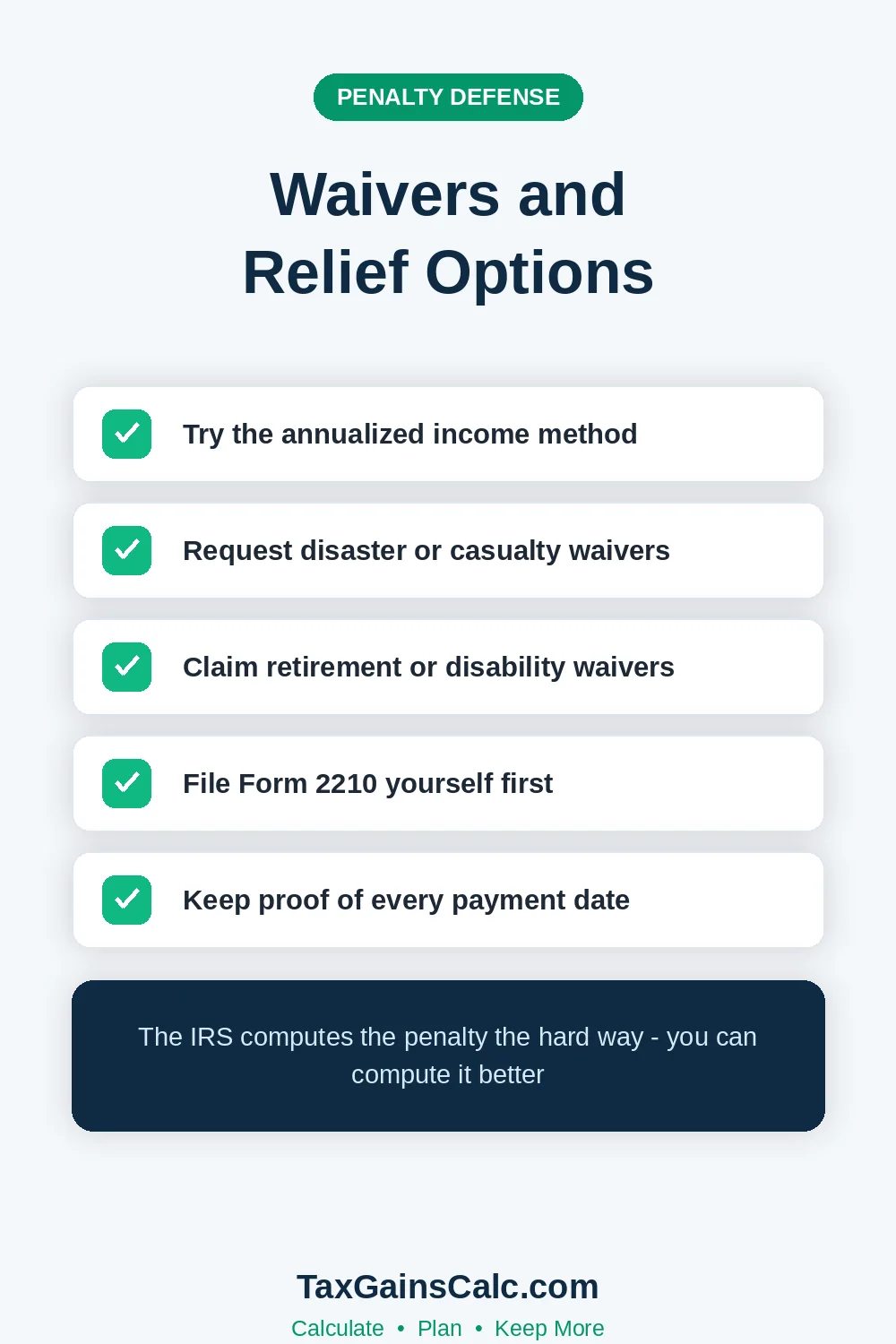
Form 2210 Part II provides formal waivers for causes genuinely beyond your own control. Casualty, disaster, serious illness, and retirement after age 62 can all justify relief. You attach a short statement explaining the facts rather than leaving blank boxes behind.
The IRS also grants relief when a deceased taxpayer's estate pays the balance late. Spouses who had no reasonable knowledge of a filing obligation sometimes qualify as well. Every single waiver request still requires the actual Form 2210 to be submitted first.
First-time penalty abatement works differently and covers this exact situation surprisingly often. A clean three-year compliance history can wipe one year of penalties by phone. Always ask the IRS directly before paying any first-time underpayment penalty amount.
Certain categories of taxpayers never owe the penalty even with a real balance due. Filers who were US citizens with no tax liability last year get blanket protection. Farmers and fishermen follow one single March deadline instead of the quarterly dates.
Federally declared disaster zones receive automatic filing and payment postponements from the IRS. The postponement dates shift every quarterly deadline forward without any penalty accrual at all. Checking official disaster announcements after a major event can erase the penalty entirely.
Fixing Missed Payments Right Now
The first move is always to pay the outstanding tax as soon as possible. The penalty meter finally stops accruing on the date your payment actually clears. Waiting all the way for the April deadline multiplies the damage for zero benefit.
Check whether any remaining withholding can still absorb the gap for this year. A year-end retirement plan distribution with voluntary withholding counts as evenly paid withholding. Some investors use a final paycheck bonus to patch earlier quarters exactly this way.
Filing with Schedule AI can shrink the assessed penalty for genuinely late-year gains. The capital gains estimated payments guide shows the annualization logic in detail. Ten minutes of worksheet math often saves several hundred dollars at filing time.
After paying, verify that your account transcript reflects the correct final penalty figure. The IRS occasionally computes from stale data when payments posted just after periods closed. Discrepancies get fixed fastest through a written response to the exact notice received.
Set up EFTPS or IRS Direct Pay before the very next quarter arrives. Both systems schedule payments days or even weeks in advance without any fees. Simple automation beats human memory once the tax calendar gets busy again.
Watch for a matching interest charge that arrives right beside the penalty itself. Underpaid balances accrue separate interest from the original April due date forward. That interest rarely gets waived even when the penalty itself qualifies for relief.
Preventing the Penalty Next Year
Build an estimated payment habit that triggers on portfolio events instead of dates. Any projected gain above roughly $5,000 deserves an immediate same-quarter payment decision. This single rule prevents most of the surprises that fill Form 2210 filings.
Set calendar reminders a full two weeks ahead of each quarterly due date. Early reminders leave room for cash transfers between brokerage and bank accounts safely. Late scrambling is exactly how otherwise disciplined investors end up paying real penalties.
Use the prior-year safe harbor whenever your income trajectory is genuinely unpredictable. Covering 110 percent of the previous year's total tax removes the need to forecast anything. Big earners value this specific rule precisely because gains are so hard to predict.
Model your full exposure before the tax year closes using real portfolio numbers. Our tax gains calculator and the capital gains calculation guide both project the bill. The pay online guide covers IRS Direct Pay and EFTPS mechanics.
Larger gains definitely deserve their own rate check before the payment gets sized. Our breakdown of gains at $100K, $250K and $500K shows the brackets. The bracket calculator then confirms your precise marginal rate within seconds.
Complex years with business income, RSU sales, and gains together justify professional help. A good preparer runs annualization schedules and safe harbor comparisons in one sitting. The fee usually costs less than a single quarter of avoidable penalty accrual.
Filing-season errors create penalties too, not just the missed quarterly dates alone. The filing deadlines guide lists every date that matters. Day traders juggling dozens of sales should read the day trading tax breakdown before quarter end.

Wasim Akram
Wasim researches and writes every article on TaxGainsCalc, covering capital gains tax for everyday investors. Every figure is checked against primary IRS sources before it goes live.