
Capital Gains on Personal Injury Settlement: What Is Taxable
Physical injury settlements are tax free, but invested money later creates real capital gains. See which components are taxable, with worked examples.

Why Settlement Taxation Confuses People
Most personal injury settlement money escapes federal tax. Damages for physical injuries or sickness are tax-free, while lost wages, punitive damages, award interest, and emotional-distress payouts without physical injury count as ordinary income. Any portion tied to sold property follows capital gain rules and lands on Form 8949.
A personal injury settlement lands like a windfall, and the first instinct is to celebrate. The second question arrives quickly: does the IRS want a share of this money?
The answer depends almost entirely on what the payment is actually replacing in your life.
Here is the counterintuitive starting point that applies in nearly every single case. Money received for physical injuries is generally tax free under long-standing federal law.
The personal injury settlement capital gains question only appears later, once that money gets invested.
The usual confusion comes from accidentally mixing three different layers of taxation together. Settlement components, investment income on the settlement, and asset sales funded by the settlement all follow separate rules.
Sorting those overlapping layers carefully at the very beginning prevents almost every possible filing mistake.
Timing also quietly shapes the final bill far more than most first-time claimants expect. The specific year you receive the money rarely matters at all for excluded damages.
The later years when you sell investments funded by it matter enormously instead.
The Exclusion for Physical Injuries
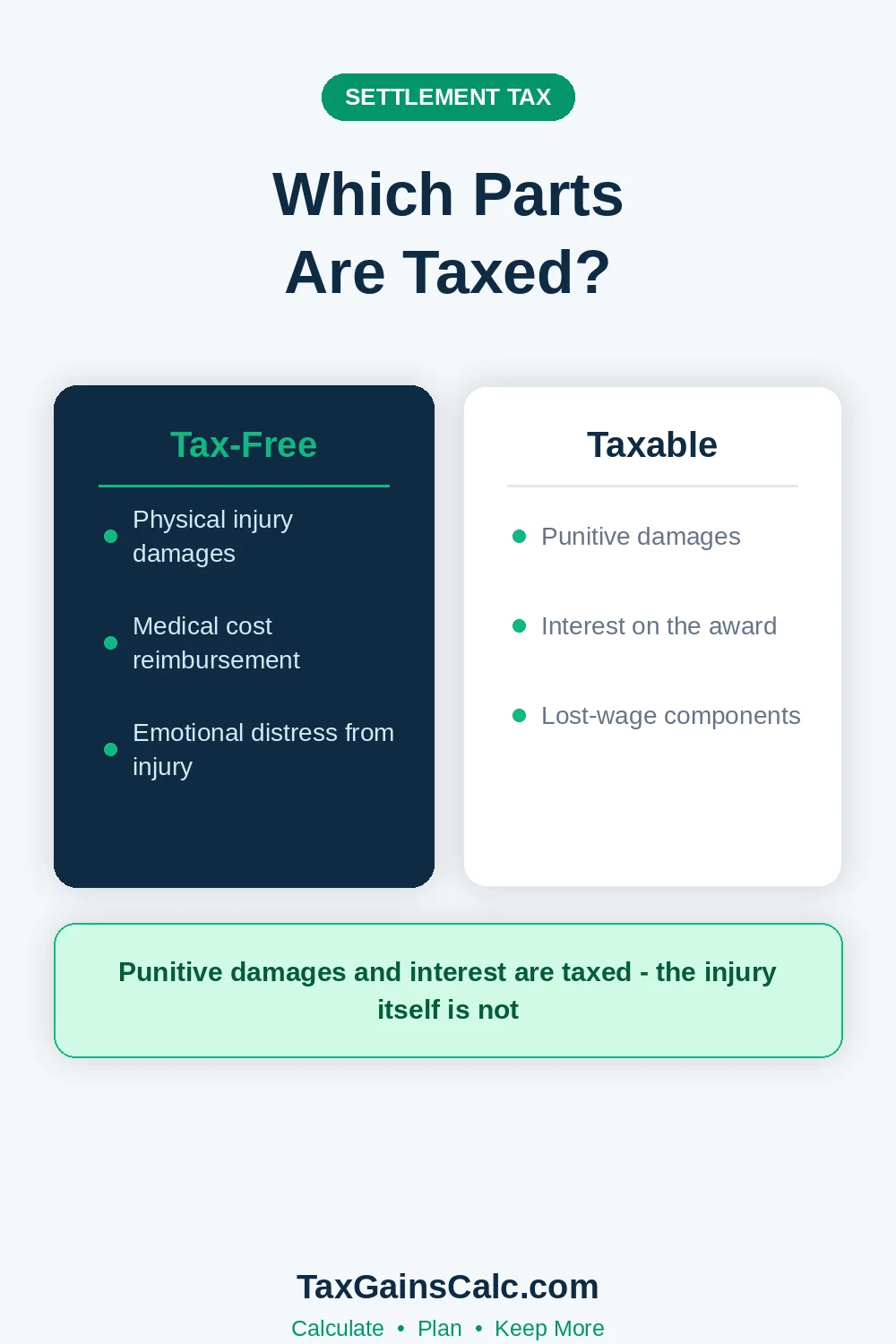 Section 104 of the Internal Revenue Code draws the fundamental line for injuries. Damages received on account of physical injuries or physical sickness are excluded from gross income. Section 104 of the tax code states this rule directly and clearly.
The exclusion also covers emotional distress that clearly originates from the physical injury. Amounts for pain and suffering tied to the bodily harm ride along tax free.
This holds true whether the payment arrives as one check or a structured stream.
Wrongful death awards follow exactly the same logic in most real situations. Survivors receiving damages for a loved one's physical injuries generally exclude the amounts.
State law labels matter far less than the underlying nature of the claim.
The IRS confirms these boundaries in its own published guidance on taxable income. IRS Publication 525 devotes a full section to court awards and damages.
Reading that section before negotiating a settlement can change how you structure allocations.
Workers compensation benefits and veterans disability benefits follow a very similar exclusion logic. Those benefit systems run completely outside the income tax by deliberate long-standing design.
A settlement settling a workers comp claim generally inherits the same protection.
Settlement Components That Are Taxable
 Only certain specific slices of an award ever face income tax at all. The next table lines up the most common components with their default treatment.
Allocation language inside the written settlement agreement controls how each dollar gets classified.
| Settlement Component | Default Treatment | Reported On |
|---|---|---|
| Physical injury damages | Tax free | Nothing |
| Lost wages or lost profits | Ordinary income | W-2 or 1099-MISC |
| Punitive damages | Ordinary income | 1099-MISC |
| Interest on the award | Ordinary income | 1099-INT |
| Emotional distress without injury | Ordinary income | 1099-MISC |
| Property damage over basis | Gain rules apply | Form 8949 |
Lost wages are taxed exactly as if you had earned them at work. Employment taxes can apply on top of income tax for that particular component. The official Form 1099-MISC instructions list every box payers must use for settlement payments.
A settlement replacing a paycheck rarely enjoys any special treatment from the IRS.
Punitive damages remain taxable even when the underlying injury was clearly physical. Congress closed that particular gap decades ago and has never reopened it since. Interest awarded on the final judgment is always taxable as ordinary income.
Previously deducted medical expenses create one more subtle trap for careless claimants. Deducted medical costs reimbursed later trigger the well-known tax benefit rule. Undeducted out-of-pocket medical reimbursements remain tax free just like the injury itself.
Standalone emotional distress claims deserve their own careful warning label at this point. Distress clearly arising from the physical injury rides along comfortably with the same exclusion. Standalone distress claims without any physical harm generally produce fully taxable ordinary income.
Where Capital Gains Actually Appear
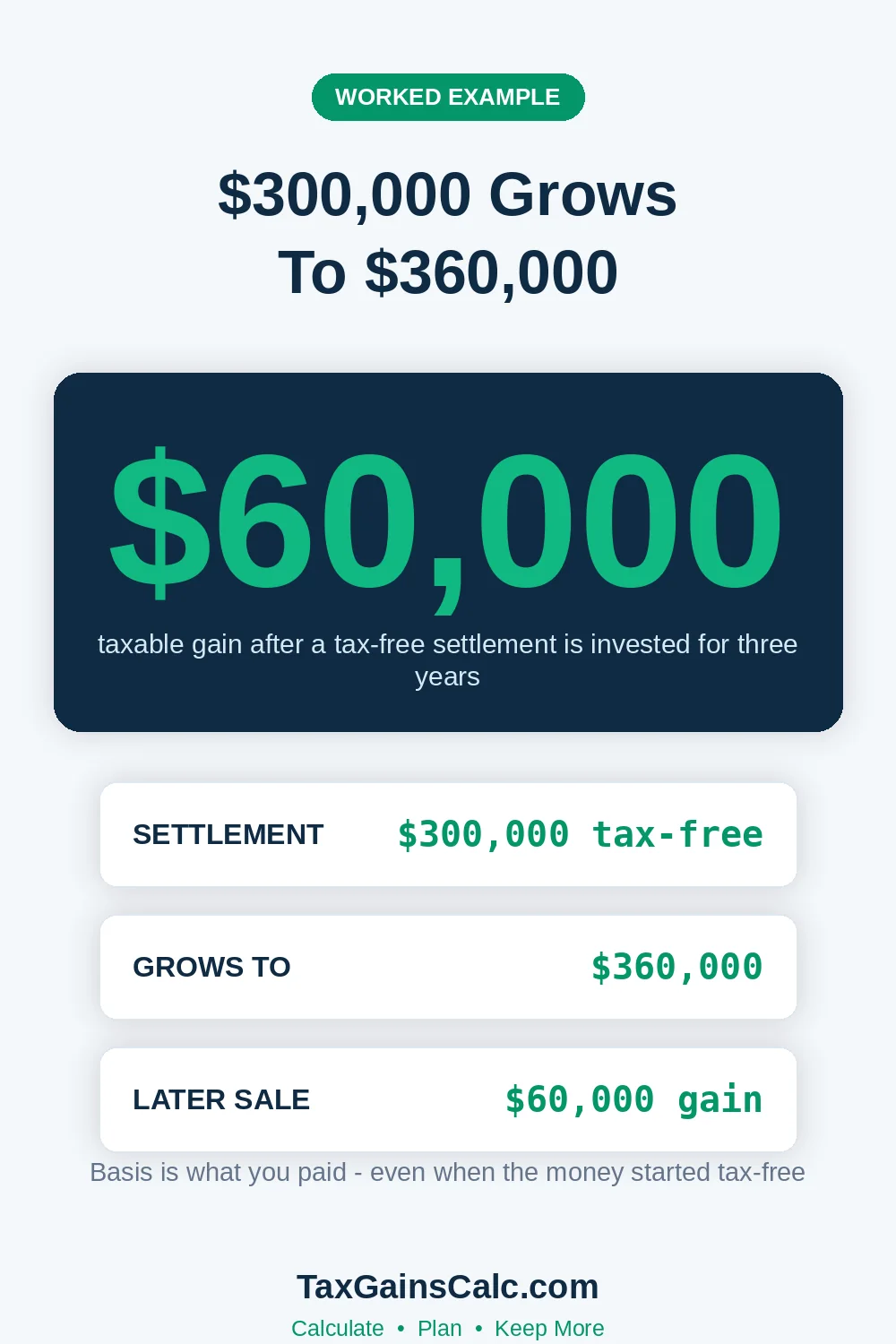 Genuine capital gains enter the picture only after the settlement money starts moving. Invest the award, and every future dollar of appreciation becomes a normal capital gain. The exclusion covered the injury itself, never the investment returns that follow.
Say you receive $300,000 for a physical injury and immediately buy index funds. Three years later that same patient portfolio has quietly grown to $360,000. Selling then produces a $60,000 gain subject to the standard holding period rules.
Property damage claims work differently and produce the most common genuinely taxable gains. Insurance or settlement recovery for damaged property gets compared against its adjusted basis. Recovery above adjusted basis creates taxable gain under the standard property sale rules.
Real estate damage claims add one further wrinkle that is worth flagging early. Casualty gains on a principal residence can sometimes defer through special property replacement rules. The inherited property guide and a tax professional both help here.
A car bought for $50,000 and later wrecked illustrates this mechanic perfectly. The insurer pays $38,000 while depreciation deductions had already reduced basis to $30,000. That $8,000 excess becomes taxable, and business vehicles add depreciation recapture layers.
Restored property follows its own separate basis roadmap after any insurance payout. Repairs funded by the recovery generally reduce the amount included in income. Amounts kept instead of repairing become the taxable portion, subject to basis limits.
A Worked Example With Investment Growth
 Maria received $200,000 in 2024 for injuries suffered in a serious highway collision. Every single dollar qualified for exclusion under the physical injury rules. She reported nothing on her 2024 federal return, which was completely correct.
| Step | Amount | Tax Treatment |
|---|---|---|
| Settlement received 2024 | $200,000 | Excluded entirely |
| Invested in index funds | $180,000 | No tax at purchase |
| Cash kept for expenses | $20,000 | No tax |
| Sold funds in 2026 | $207,000 | $27,000 gain to report |
Her 2026 portfolio sale creates a $27,000 long-term capital gain to report. The gain takes the standard rate based on her total income that year. Nothing about the original settlement changes the applicable rate or the gain character.
Her tax basis is simply the $180,000 purchase price of those funds. Dividends along the way were taxable annually and adjust that reported basis slightly. Good annual brokerage statements make the entire calculation a genuine five-minute exercise.
Her marginal rate on that gain depends on her other income that year. A moderate salary keeps the whole gain inside the 15 percent band. Our rates breakdown shows exactly where each band begins and ends.
Notice how cleanly the two tax layers separate with nothing but real records. The injury layer vanished from her tax life the year it arrived. The investment layer behaves exactly like any other brokerage account she owns.
That clean separation also means loss harvesting works normally on the funded account. Selling a dip inside the portfolio creates deductible losses like anywhere else. The tax loss harvesting guide applies without modification.
Structured Settlements and Investment Income
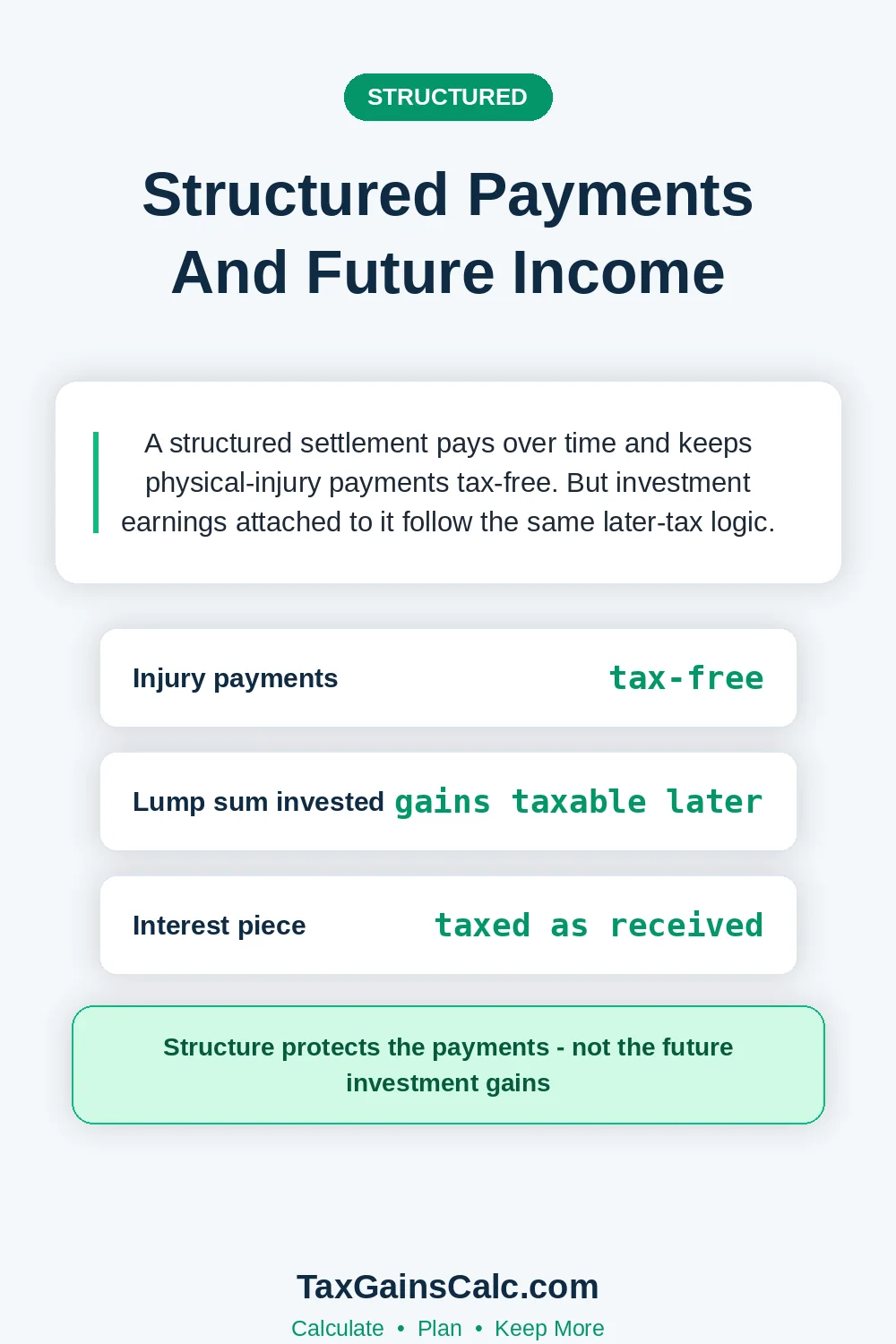
Structured settlements replace one large payment with a guaranteed series of future payments. The periodic payments for physical injury keep the same exclusion as a lump sum. The structure itself adds no extra tax as long as the underlying claim qualifies.
Growth inside the structured arrangement also avoids annual tax for the recipient. The funding annuity grows on the insurer's side without annual statements to you. The payments simply arrive under the original exclusion whenever they are injury-based.
Investing a lump sum instead creates an ongoing annual reporting obligation. Every dividend, every interest payment, and every eventual sale needs annual reporting. Some claimants accept that reporting burden for flexibility that structures simply cannot offer.
Selling structured payment streams to factoring companies creates its own taxable event. The discounted lump sum you receive generally counts as ordinary income. The discount itself becomes an additional economic loss with no deduction.
High earners should model the net investment income tax carefully on this path. Investment growth on settlement money can push MAGI over the fixed $200,000 threshold. Our NIIT guide explains the 3.8 percent surtax mechanics.
Attorney Fees and the Net Amount
Attorney fee treatment has confused claimants since 2018 more than any other issue. The deduction for miscellaneous legal fees was suspended, so fees on excluded damages can become economically painful. Allocation between the fee and the award therefore matters enormously at settlement time.
For fully excluded physical injury awards, the fee question often stays purely academic. There is no taxable income to offset, and most filers simply report nothing. The economic loss feels real but rarely creates any formal reporting requirement.
Fees deducted in earlier years can resurface through the tax benefit rule. Money you recovered for expenses once deducted becomes taxable when recovered. Keep prior-year returns nearby whenever a large reimbursement or award arrives.
Taxable components change the math in ways worth negotiating early. Fees allocated against lost wages or punitive damages reduce recoverable value. Plaintiffs increasingly negotiate gross-versus-net allocation language before signing.
Ask your attorney how the agreement characterizes every component. The written allocation binds the reporting position on your later return. Vague agreements invite the IRS to assume the worst classification.
Reporting the Settlement and Later Gains
Fully excluded physical injury settlements generally require no tax return entry at all. You keep the agreement, the allocation letter, and medical documentation in your records. That file answers any future IRS question without a formal response.
| Money Received | Form You May See | Your Action |
|---|---|---|
| Physical injury damages | Often no form | Keep records only |
| Lost wages component | W-2 | File as wages |
| Punitive or interest amounts | 1099-MISC or 1099-INT | Report as income |
| Later investment gains | 1099-B | Form 8949 and Schedule D |
Investment gains from invested settlement money follow the ordinary securities workflow. Form 1099-B arrives from the brokerage with basis already reported in most cases. The Form 8949 walkthrough covers each reporting entry in careful sequence.
Watch for 1099 forms that arrive mislabeled as ordinary income. Settlements with mixed components sometimes generate one gross 1099-MISC. Reconciling that form against the written allocation may require a revised issuer filing.
State income tax treatment of settlements varies more than the federal layer. Most states simply follow the federal exclusion for physical injury damages. Some states go further, layering extra rules onto punitive damages and awarded interest.
Planning Moves After a Settlement
Slow down before reinvesting a large award into anything at all. Parking proceeds in a savings vehicle for one tax year costs little. That pause lets you plan basis, timing, and rate management deliberately.
Spreading large purchases across two calendar years manages the rate stack. A single December purchase followed by a January sale keeps holding periods separate. Our holding period comparison shows why twelve months matters so much.
Consider directing appreciated purchases toward tax-advantaged wrappers where eligible. Retirement accounts shelter future growth though contributions face their own limits. The retirement accounts guide explains what never faces capital gains tax.
Coordinate the settlement year with other income events where possible. Big capital gains from other sales stack on top of settlement-driven income. Our calculation guide handles the full stacking math, while the ordinary income comparison sorts out rate character.

Wasim Akram
Wasim researches and writes every article on TaxGainsCalc, covering capital gains tax for everyday investors. Every figure is checked against primary IRS sources before it goes live.