
Capital Gains Tax on Real Estate Investment Property 2026: Depreciation Recapture, 1031 Exchanges & What You Actually Owe
Complete guide to capital gains tax on rental and investment property in 2026. Understand depreciation recapture at 25%, how 1031 exchanges work, calculating adjusted basis, and strategies to reduce your tax bill when selling real estate investments.

The Two-Tax Punch That Ruins Real Estate Exit Plans
I sat down with a client named Patricia last month who had just sold a rental condo — an investment property she owned for eleven years. She bought it for $220,000, sold it for $410,000. Nice profit, right? She figured she would owe long-term capital gains rate on the $190,000 difference. At 15%, that is roughly $28,500. Annoying but manageable. Then I ran the actual numbers and her jaw dropped. Her federal tax bill was over $45,000. Where did the extra sixteen grand come from? Depreciation recapture. She had been claiming depreciation on that condo for over a decade, and the IRS wants a piece of that back when you sell. Nobody had ever explained this to her, and she is far from alone.
Here is the thing about selling investment real estate that catches people off guard: you are not just paying capital gains tax on your profit. You are also paying a separate tax on all the depreciation you deducted over the years you owned the property. The depreciation recapture rate is a flat 25%, which is higher than the 15% or 20% long-term capital gains rate most investors expect. And the IRS makes you account for the recaptured depreciation before applying the lower capital gains rate to whatever is left. It is a one-two punch, and if you only planned for one of those hits, the other one hurts.
How to Calculate Capital Gains Tax on Investment Property
Every investment property sale runs through the same five steps, whether it is a condo in Denver or a duplex in Tampa. Work them in order and the final number stops being a mystery. Skip one and you end up like Patricia, budgeting for half the bill.
Step 1 — Find your amount realized. That is the contract price minus selling costs: agent commissions, title fees, transfer taxes, attorney bills. A 6% commission on a $410,000 sale knocks $24,600 off the taxable amount before you even start.
Step 2 — Rebuild your adjusted basis. Original purchase price plus acquisition closing costs plus capital improvements, minus every year of depreciation you claimed or were allowed to claim. Most owners get this wrong because they forget the depreciation part — more on that below.
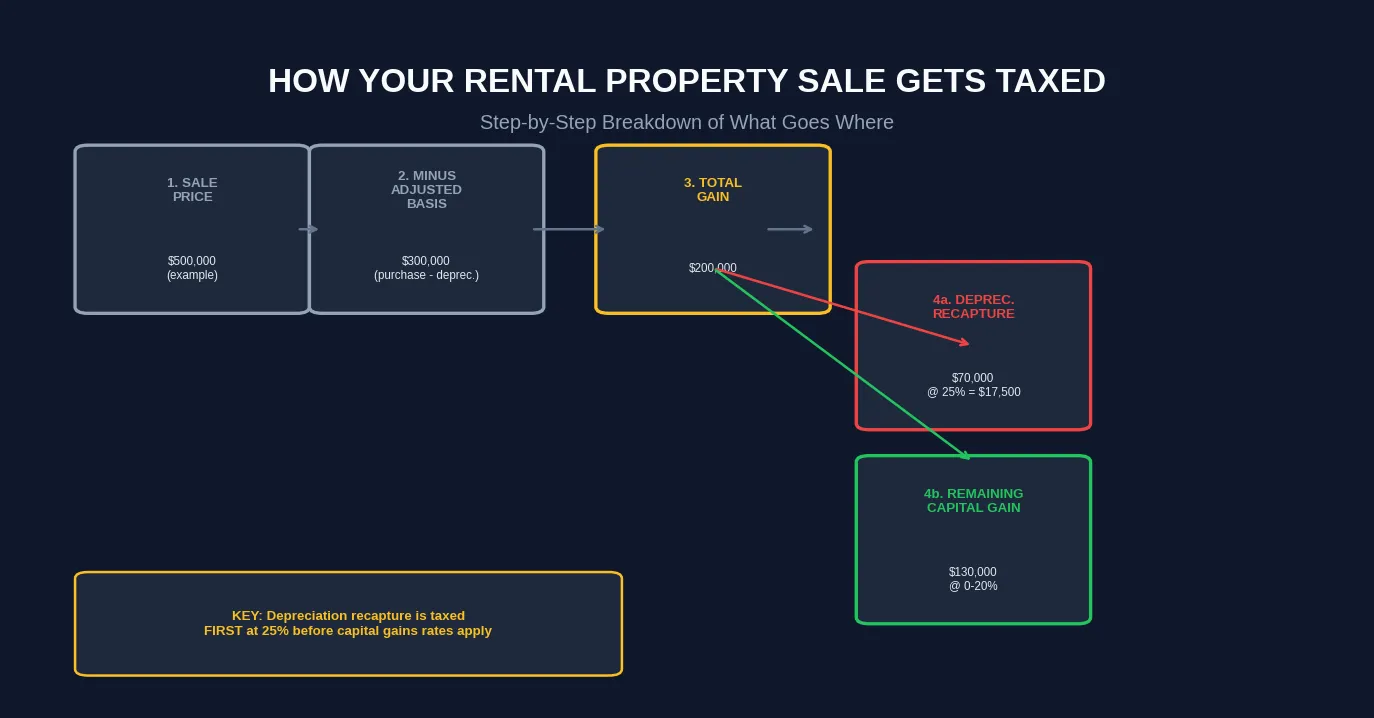
Step 3 — Subtract basis from amount realized. Whatever is left is your total gain. This is the number that gets carved into two different taxes.
Step 4 — Split the gain into its two parts. The chunk that equals your accumulated depreciation gets taxed as unrecaptured Section 1250 gain at up to 25%. The remainder gets the regular long-term treatment: 0%, 15%, or 20% depending on your taxable income.
Step 5 — Stack the extra layers. Add 3.8% NIIT if your modified AGI crosses $200,000 single or $250,000 married filing jointly, then add your state's cut on top. Now you have the real bill.

Here is Patricia's full stack, laid out the way I do it on a legal pad:
| Patricia's sale, line by line | Amount |
|---|---|
| Sale price | $410,000 |
| Original purchase price | $220,000 |
| Depreciation claimed over 11 years | −$66,000 |
| Adjusted basis | $154,000 |
| Total gain | $256,000 |
| Depreciation recapture: $66,000 × 25% | $16,500 |
| Capital gain: $190,000 × 15% | $28,500 |
| NIIT: $256,000 × 3.8% | $9,728 |
| Federal total, all layers | $54,728 |
Run your own numbers before you list anything. Our real estate capital gains calculator does this exact sequence in about a minute, and it is free.
How Depreciation Recapture Actually Works
When you own a rental property, you get to deduct depreciation each year as an expense against your rental income. For residential real estate, the depreciation period is 27.5 years, which works out to about 3.636% of the building's value per year. Land does not depreciate, so you have to separate the land value from the building value when you start. If you bought a property for $300,000 and the land is worth $75,000, your depreciable basis is $225,000, and your annual depreciation deduction is about $8,182.
The problem comes when you sell. All that depreciation you deducted over the years reduced your cost basis in the property. Your adjusted basis is your original purchase price plus improvements minus all the depreciation you claimed (or should have claimed — the IRS uses "allowed or allowable," meaning even if you forgot to take the deduction, they still reduce your basis). When you sell, the portion of your gain that corresponds to the accumulated depreciation gets taxed at 25% as depreciation recapture under Section 1250.
Let me walk through Patricia's numbers because they illustrate this perfectly. She bought the condo for $220,000, with about $55,000 allocated to land. That left $165,000 as the building basis, and over eleven years she claimed roughly $66,000 in depreciation. Her adjusted basis dropped to $154,000 ($220,000 minus $66,000). When she sold for $410,000, her total gain was $256,000. Of that, $66,000 is depreciation recapture taxed at 25% ($16,500). The remaining $190,000 is regular capital gain taxed at her 15% rate ($28,500). Total federal tax: $45,000. That is a lot more than the $28,500 she was expecting.
Recapture has its own reporting life on Form 4797, and the rules have quirks worth knowing before you file. Our depreciation recapture guide walks through the full form-by-form math if you want to go deeper.
What If You Did Not Claim Depreciation?
This is a nasty gotcha. The IRS calculates recapture based on depreciation that was "allowed or allowable," not just what you actually deducted. Skip the deduction for ten years and the IRS still treats you as if you took it, because you were allowed to. Your basis goes down anyway, and the recapture bill arrives anyway. The fix for past years is a Form 3115 change in accounting method, which lets you catch up missed depreciation in the current year instead of amending a stack of old returns. It is tedious paperwork, but it converts a phantom liability into a real deduction before the sale.
Calculating Your Adjusted Basis Correctly
Your adjusted basis is the foundation of everything. Get this number wrong and your entire tax calculation falls apart. Here is what goes into it:
Starting basis: What you paid for the property, including closing costs like title insurance, legal fees, and transfer taxes. Not just the purchase price — the full cost of acquiring the property.
Plus improvements: Capital improvements that add value or extend the life of the property. A new roof, a kitchen renovation, adding a deck — these get added to basis. Routine repairs like fixing a leaky faucet or patching drywall do not count. They are already deductible as expenses in the year you pay for them.
Minus depreciation: All depreciation you claimed or could have claimed over the years you owned the property. This is the big one. If you used our real estate capital gains calculator to estimate your gain, make sure you are entering the adjusted basis, not the original purchase price. The difference can be tens of thousands of dollars.
Minus casualty losses: If you deducted casualty losses from fire, flood, or other disasters, those reduce your basis too. Not common, but worth mentioning.
When Patricia and I went through her records, we found she had replaced the HVAC system in year four for $7,200 but never added it to her basis. That would have increased her basis and reduced her gain by $7,200, saving her about $1,080 in taxes. Not a huge amount, but multiply that by five or ten overlooked improvements over a decade of ownership and you are talking real money.

The Capital Gains Portion: Short-Term vs Long-Term
The portion of your gain that is not depreciation recapture gets taxed as a regular capital gain. If you held the property for more than one year, it qualifies for long-term capital gains rates of 0%, 15%, or 20%, depending on your total taxable income. If you held it for one year or less, it is a short-term gain taxed at ordinary income rates up to 37%. Nobody should be flipping rental properties held less than a year unless the profit is so enormous that the tax hit still leaves them ahead. Almost always better to hold at least a year and a day.
For 2026, the breakpoints look like this:
| Filing status | 0% rate up to | 15% rate up to | 20% rate above |
|---|---|---|---|
| Single | $49,450 | $545,500 | $545,500 |
| Married filing jointly | $98,900 | $613,700 | $613,700 |
| Head of household | $52,750 | $579,150 | $579,150 |
These thresholds come from the IRS's 2026 inflation adjustments and they apply to taxable income, not gross income. A retired couple with modest pension income might actually sell a small rental and pay 0% on the capital gain portion. More commonly, a working investor with a $140,000 salary sits squarely in the 15% band, and only very large gains layered on top of high income reach the 20% bracket. The full bracket logic is the same one behind our capital gains tax bracket calculator.
One thing that confuses people: the depreciation recapture portion and the capital gains portion are calculated separately and taxed at different rates, but they both show up on the same tax return. The recapture goes on Form 4797 (Sale of Business Property), and the remaining capital gain goes on Form 8949 and Schedule D. If you want the full walkthrough of those forms, our guide on how to report capital gains on your tax return covers every line.
The NIIT and State Tax Layers
If your modified adjusted gross income exceeds $200,000 (single) or $250,000 (married filing jointly), the Net Investment Income Tax piles on another 3.8%. Rental property gains count as investment income for this purpose, so a large sale can easily push you over the threshold. On Patricia's $256,000 gain, the NIIT adds another $9,728 (3.8% of $256,000). Now her total federal bill is over $54,000 on a property she thought would cost $28,500 in tax. That is nearly double what she expected.
Your state capital gains tax rate makes it even worse. In California, you could be looking at 13.3% on top of everything. In New York City, the combined state and city rate can exceed 12%. Even in moderate-tax states, you are probably adding 5-6% to your total rate. In a high-tax state with NIIT, your combined marginal rate on a rental property sale can push past 40%.
House Flipping Is a Different Tax Animal
A lot of people land on this page holding a flip instead of a long-term rental, and the tax math could not be more different. Buy a house, renovate it, sell it within eight months — that gain is short-term, taxed at your ordinary bracket up to 37%. No 15% rate, no 0% rate, no long-term anything. Hold it a year and a day and you rescue the long-term rate, but only if the IRS believes you were investing rather than dealing.
Deal in volume and the classification changes entirely. Repeated flips, aggressive marketing, short ownership spells, little actual rental use — the IRS can treat you as a dealer, which makes every dollar of profit ordinary income regardless of holding period, and possibly subject to self-employment tax on top. Dealer inventory also gets no step-up in basis at death and never qualifies for a 1031 exchange, because property held "primarily for sale to customers" fails both tests. Our short-term versus long-term capital gains breakdown shows exactly how much the holding period is worth.

This is why every "house flipping tax calculator" you find online asks about holding period and flip frequency before it quotes a rate. A one-off flip by an investor is a capital gains problem. A string of flips is a business, and the tax math is ordinary income math all the way down. If flipping is becoming your thing, structure and planning need to happen before the second sale, not after the IRS notices the pattern.
1031 Exchange: The Best Way to Defer the Whole Bill
If you are not ready to cash out and you want to keep investing in real estate, a 1031 like-kind exchange lets you defer both the capital gains tax and the depreciation recapture by rolling your proceeds into a replacement property. This is the single most powerful tax tool available to real estate investors, and it is worth understanding thoroughly because the rules are strict.
You have 45 days from the date of sale to identify up to three potential replacement properties, and 180 days to close on one of them. The replacement property must be of equal or greater value to fully defer all gains. You cannot touch the money — it has to go through a qualified intermediary who holds it in escrow between the sale and the purchase. If you take constructive receipt of the funds at any point, the exchange fails and you owe all the tax.

The beauty of a 1031 exchange is that you can keep doing them indefinitely. Buy a property, hold it, exchange it for a larger one, hold that, exchange again. Each time you defer the gain, and the deferred gain plus the new gain compounds in the next property. Some investors build enormous portfolios this way without ever paying a dollar in capital gains tax. Eventually, when you sell without doing another exchange, all those deferred gains come due — but by then you might be in a lower tax bracket, or you might pass the property to heirs who get a stepped-up basis and the entire deferred gain disappears.
What Qualifies for a 1031 Exchange
The property has to be held for investment or used in a business. Rental properties, commercial buildings, land held for investment — all qualify. Your primary residence does not qualify. A property you bought to flip does not qualify if you never held it for investment purposes. The replacement property also has to be real estate held for investment — you cannot exchange an apartment building for a stock portfolio or a coin collection. Both the old and new property need to be "like-kind," which in real estate basically means any real property for any other real property. A condo for a warehouse, a rental house for a strip mall — all fine. The full deadline calendar and the reverse-exchange variation are covered in our 1031 exchange rules guide.
What If You Move Into the Rental Before Selling
Some investors try to convert a rental property into their primary residence to take advantage of the Section 121 exclusion, which shields up to $250,000 (single) or $500,000 (married) of gain from tax. Our home sale capital gains calculator shows you how much you could exclude. This strategy works, but the rules tightened significantly in 2008.
You now have to live in the property as your primary residence for at least two of the five years before selling to qualify for the exclusion. But here is the catch: any depreciation you claimed after 2008 while the property was a rental is not excluded. The IRS calls this "unrecaptured Section 1250 gain," and it is still taxed at 25% even if you qualify for the Section 121 exclusion on the rest. So you can exclude some of your gain, but you cannot exclude the depreciation recapture portion. Still worth doing if your non-depreciation gain is substantial, but it is not the free ride some people think it is.
There is a third squeeze most articles skip: the nonqualified-use rule. Every year after 2008 that the home was a rental — before it became your main home — shrinks the exclusion proportionally. Rent it for six years, move in for two, sell: three-quarters of the gain fails the test, and only the last quarter gets anywhere near the $250,000/$500,000 cap. The math is your nonqualified-use years divided by total years owned. Landlords in no rush sometimes rent one fewer year and occupy one more, because each shift moves real money between the 25% pile and the excludable pile. The landlord-side details live in our capital gains tax on rental property guide.
Selling at a Loss: Not as Simple as You Might Hope
If you sell a rental property for less than your adjusted basis, you have a loss. Whether it is deductible depends on classification. Losses on investment property are deductible as capital losses, which you can use to offset other capital gains. If your total net capital loss exceeds $3,000, the excess carries forward to future years. Tax-loss harvesting strategies work with real estate losses the same way they work with stock losses — you net everything together to minimize your overall tax burden.
However, if the property was considered a personal-use asset rather than an investment — say you let a family member live there at below-market rent for years — the loss may not be deductible at all. The IRS looks at your intent and your rental history to determine classification. Legitimate rental properties with real tenants at market rates generally qualify as investments.
Practical Strategies Before You Sell
Get a cost segregation study done. If you have not already done one, a cost segregation study can front-load depreciation by breaking the property into components with shorter lives — 5, 7, or 15 years instead of 27.5. You cannot retroactively claim more depreciation than you were allowed, but if you have years left to hold the property, a study can increase your annual deductions going forward. The 2025 tax law brought 100% bonus depreciation back for qualifying property placed in service after January 19, 2025, which makes the study-plus-bonus combination genuinely powerful again for newer acquisitions. Just remember that more depreciation now means more recapture later.
Document every improvement you ever made. Go through your records and make sure every capital improvement is added to your basis. I cannot tell you how many sellers forget about the furnace replacement, the new water heater, the fence they put in, the driveway resurfacing. Each one reduces your gain.
Consider an installment sale. If you are carrying a note for the buyer instead of getting all cash at closing, you can spread the gain over the years you receive payments using the installment method under Section 453. This can keep your income below NIIT thresholds and potentially below the 20% capital gains bracket in each year. Works well when the buyer cannot get traditional financing and you are willing to be the bank.

Sell in a low-income year. The capital gains portion of your sale is taxed based on your total income that year. If you are retiring, changing careers, or have a year with unusually low income, that is the time to sell. The difference between the 0% and 15% long-term capital gains rate bracket can save you tens of thousands on a large gain.
Do a 1031 exchange if you are not done investing. This bears repeating because it is the single biggest tax saver in real estate. If the numbers work and you want to stay in the game, exchange into a larger property or a property in a better market. You keep building wealth and you keep deferring tax.
Think hard about holding until death if legacy is the plan. Heirs inherit real estate at its fair market value on the date of death, which wipes out the embedded gain and the recapture exposure in one stroke. A seller sitting on a $400,000 gain who sells today writes a six-figure check; the same property passed to children instead gets sold with zero income tax due. It is not a strategy for everyone — but for older owners whose heirs want the property anyway, doing nothing is genuinely the best move. The mechanics are in our step-up in basis on inherited property guide.
Side by side, here is how the exit options compare:
| Strategy | How it cuts the bill | Best fit |
|---|---|---|
| 1031 exchange | Defers recapture and gain into the next property | Investors staying in real estate |
| Installment sale (Section 453) | Spreads gain across years, manages brackets and NIIT | Sellers financing the buyer |
| Section 121 conversion | Excludes $250k/$500k of non-recapture gain | Small rentals, flexible timelines |
| Cost segregation + bonus depreciation | Front-loads deductions while you still hold | Owners of newer acquisitions |
| Sell in a low-income year | Traps the gain in the 0% or 15% band | Retirees, sabbatical years |
| Hold until death | Step-up erases gain and recapture for heirs | Legacy-minded older owners |
| Qualified Opportunity Fund | Defers gain; 10-year hold sheds tax on fund growth | Investors wanting diversified exits |
Frequently Asked Questions
What is the capital gains tax rate on investment property in 2026?
There is never just one rate. The gain above your depreciation gets 0%, 15%, or 20% based on taxable income — the 15% band starts at $49,450 for singles in 2026. The depreciation portion is taxed at up to 25%, NIIT adds 3.8% above $200,000/$250,000 of MAGI, and your state stacks its own rate on top. High earners in high-tax states routinely see combined rates above 40%.
How is depreciation recapture calculated when selling a rental?
Add up every year of depreciation you claimed, or were allowed to claim, on the building — never the land. That total is taxed at a maximum of 25% as unrecaptured Section 1250 gain and reported on Form 4797. On a $300,000 building depreciated over 15 years, roughly $164,000 of recapture sits waiting for the sale.
Can I avoid capital gains tax by moving into my rental for two years?
Partly. Living there for two of the last five years unlocks the Section 121 exclusion of $250,000 or $500,000, but two carve-outs always survive. Depreciation claimed after 2008 is still recaptured at 25%, and years of rental use before you moved in reduce the exclusion proportionally under the nonqualified-use rule. It softens the bill; it almost never erases it.
If I sell one rental and buy another, do I still owe tax?
Yes, unless you structured a proper 1031 exchange before closing. Buying a new property with your after-tax proceeds does not defer anything — the IRS taxes the first sale and then gives you no credit for the second purchase. The deferral only exists inside an exchange with a qualified intermediary, with the 45-day and 180-day clocks respected.
What happens if I never claimed depreciation on my rental?
The IRS still reduces your basis as if you had claimed it, because the deduction was "allowable." Skipping it only makes your sale worse: same recapture bill, and years of deductions you never actually received. A Form 3115 accounting-method change can catch up the missed depreciation on your current return, which is worth doing well before the property goes on the market.
How do I calculate the cost basis of an investment property?
Start with the purchase price plus acquisition closing costs — title insurance, legal fees, transfer taxes. Add the cost of capital improvements made over the years. Subtract total depreciation claimed or allowable and any casualty losses deducted. That final number is your adjusted basis, and the gain is simply the sale price minus selling costs minus this basis.
The Bottom Line
Selling a rental property is not like selling a stock. You have got depreciation recapture at 25% hitting you on top of regular capital gains. Your adjusted basis is probably lower than you think because of all the depreciation you claimed. NIIT and state taxes stack on top of the federal rates, and in a high-tax state your combined rate can exceed 40%. The 1031 exchange is your best friend if you want to defer the entire bill, but the rules are strict and the timelines are unforgiving. Plan the sale before you list the property, not after. Once the deal closes, most of your tax-saving options disappear.
Fact-Checked & Reviewed
This article was written and fact-checked by Wasim Akram, Founder & Lead Researcher at TaxGainsCalc. Every rate, threshold, and rule referenced is verified against IRS publications and current tax law as of the date published. Tax laws change frequently — always consult a qualified tax professional for advice specific to your situation.
Disclaimer: This article is for informational purposes only and does not constitute tax, legal, or financial advice. Tax laws and regulations change frequently, and the information presented here may not reflect the most current updates. You should consult with a qualified CPA, tax attorney, or financial advisor before making any tax-related decisions. TaxGainsCalc is not responsible for any actions taken based on the information provided in this article.
Continue Reading

Wasim Akram
Wasim researches and writes every article on TaxGainsCalc, covering capital gains tax for everyday investors. Every figure is checked against primary IRS sources before it goes live.