
Best Tax Arrangement to Own or Operate a Car Wash
The strongest car wash tax setup pairs an LLC taxed as an S corporation with 100 percent bonus depreciation and the 20 percent QBI deduction. Numbers inside.
The Best Tax Setup for a Car Wash, Up Front
Most car wash owners keep the most money with an LLC taxed as an S corporation. You get liability protection, a smaller self-employment tax bill, and a clean path to the 20 percent QBI deduction.
Stack 100 percent bonus depreciation on new wash equipment and the first-year savings turn serious. Profit size still decides the details.
A single self-serve bay clearing $30,000 a year may not justify S corporation payroll costs. A tunnel wash clearing $150,000 or more almost always benefits from the switch.
Here is how each piece works, with 2026 numbers you can check against your own wash.
Why Your Business Structure Changes the Bill
The wash itself stays the same no matter how you own it. The tax outcome swings by thousands depending on which box the IRS sees you in.
| Arrangement | How profit is taxed | Best fit |
|---|---|---|
| Sole proprietor | Schedule C, 15.3% self-employment tax plus income tax | Testing an idea, tiny side wash |
| Single-member LLC | Same as sole prop by default | Liability protection first, easy filing |
| LLC filing as S corp | Salary plus distributions, payroll tax on salary only | Profits above roughly $60k |
| C corporation | 21% entity tax, then tax again on dividends | Rare for car washes |
Sole proprietorship is the default when you just start washing cars. You report everything on Schedule C, and the full profit carries self-employment tax.
Liability protection is also weak in that setup. That matters when customers drive through your equipment every day.
An LLC fixes the liability problem without changing your taxes at first. You can later file Form 2553 and have the same LLC taxed as an S corporation. That two-step path is why so many operators start there.

The Self-Employment Tax Problem an S Corp Fixes
Self-employment tax runs 15.3 percent on business profit up to the Social Security wage base. On a $120,000 profit, that is about $18,360 before income tax even enters the picture.
An S corporation splits the same profit into salary and distributions. Payroll taxes apply only to the salary portion, while distributions skip the 15.3 percent layer.
Picture a wash with $120,000 of profit. You pay yourself a reasonable salary of $70,000 and take $50,000 as distributions. Payroll taxes apply to $70,000, saving roughly $7,650 a year compared with full self-employment tax.
The IRS expects that salary to match real market wages for running the wash. Set it too low and payroll audits follow.
Most owners land somewhere between 40 and 60 percent of profit as salary. A local payroll provider keeps the quarterly filings clean.
A Full Year, Three Ways
Numbers make the structure choice real. Take the same tunnel wash with $120,000 of profit and run it through three arrangements.
| Result | Sole prop | S corp | S corp + bonus depreciation |
|---|---|---|---|
| Profit | $120,000 | $120,000 | $120,000 |
| Payroll tax layer | ≈ $18,360 | ≈ $10,710 | ≈ $10,710 |
| Equipment write-off applied | None claimed | None claimed | −$400,000 (creates loss) |
| Same-year income tax on profit | On full $120,000 | On $120,000, less QBI | Offset by loss carryforward |
The third column shows why equipment years feel different. The $400,000 equipment purchase wipes the taxable profit and starts an NOL carryforward.
The S corporation layer already trimmed payroll tax by thousands on top.
Adverse effects deserve a warning. The carryforward only shelters 80 percent of future income, and heavy depreciation shrinks your basis for the day you sell. Model both ends before you buy.
Depreciation: Your Biggest First-Year Weapon
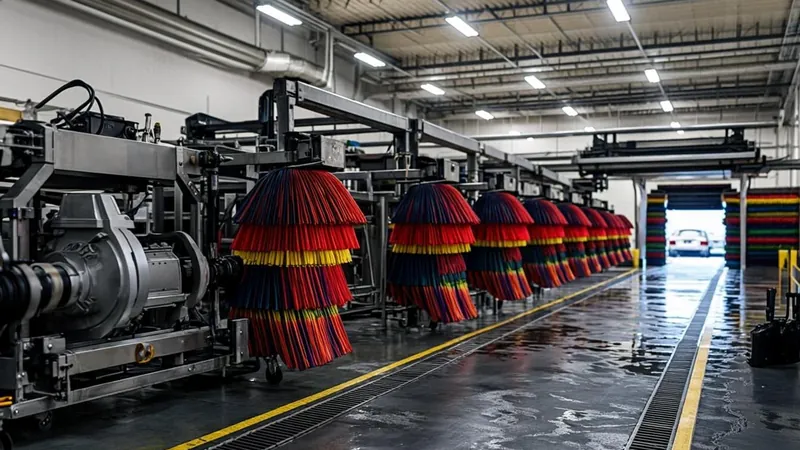
Car wash equipment is where the tax code gets generous. Tunnels, in-bay automatics, vacuums, blowers, and water reclamation systems all fall into 5 to 15 year MACRS recovery classes.
Under the OBBBA rules now in effect, 100 percent bonus depreciation is permanent for qualifying equipment. The rule covers property acquired after January 19, 2025. The IRS Publication 946 chapter lists the dates and property classes in plain language.
Section 179 works alongside it. Business income limits the Section 179 route, while bonus depreciation can create or deepen a loss. Most owners let their preparer blend the two.
| Purchase | Typical cost | First-year write-off |
|---|---|---|
| Tunnel equipment package | $400,000 | Up to $400,000 with bonus depreciation |
| Vacuum stations (8) | $60,000 | Up to $60,000 |
| Water reclamation system | $45,000 | Up to $45,000 |
| Wash building shell | $900,000 | 39 years, plus cost-segregation speedups |
The building itself is a slower animal. Commercial property depreciates over 39 years, so a $900,000 structure gives you about $23,000 a year.
A cost segregation study can pull wiring, plumbing, and paving into faster 5, 7, and 15 year buckets. Real estate investors use this split all the time, and wash buildings qualify often.
The QBI Deduction Most Operators Qualify For
Section 199A lets owners of pass-through businesses deduct up to 20 percent of qualified business income. Car washes are not a specified service trade, so the deduction is fully available at ordinary income levels.
Run your wash as a sole proprietorship or S corporation and the math adds up fast. A $120,000 profit can produce a deduction worth up to $24,000.
At a 24 percent rate, that is real money returned every year. The OBBBA made this deduction permanent, so you can plan around it instead of waiting for each year's extension news.
Wages paid through an S corporation affect the QBI calculation. That is one more reason the salary number deserves care. A CPA can model the tradeoff in a spreadsheet before you file anything.
Deductions Car Wash Owners Commonly Miss
Wash operations generate deductions that many owners never capture. Go down this list before your next filing and check what your books actually record.
- Water, sewer, and electricity, often the largest cost after labor
- Chemicals, soap, wax, and vending supplies
- Merchant processing fees on every card swipe
- Equipment maintenance, brushes, and bay repairs
- Insurance for property, liability, and workers
- Local advertising, signage, and loyalty app costs
- Wages for attendants, including reasonable pay to family members who truly work
Family payroll deserves a mention. Wages paid to your children for real work are deductible to the business. A child under 18 owed wages by a parent's sole proprietorship skips FICA on those wages. Keep timesheets and pay by check like any other worker.

Quarterly estimates are the last habit worth building early. Wash income arrives in seasons, so quarterly estimates catch many new owners off guard. The dates are April 15, June 15, September 15, and January 15.
Our guide to capital gains estimated payments walks through the same safe-harbor math.
Financing, Interest, and the Cash Question
Most washes are bought with debt, and the interest is deductible on business loans. Keep loan statements separate from personal accounts so the interest tracking stays clean.
Financing also stretches the depreciation decision. A bank-funded equipment package still qualifies for bonus depreciation, which can produce a paper loss in a cash-positive year.
That paper loss is useful, but it is not free. It shrinks basis, limits future borrowing power on paper, and starts the 80 percent NOL math. Lenders reviewing your returns will see it.
Owners planning to sell within a few years sometimes decline the full write-off. A cleaner return can support a higher valuation.
Our asset sale versus stock sale guide explains how buyers read those returns.
Sales Tax and State-Level Wrinkles
Federal rules get the attention, but states treat car wash services differently. Texas, for example, taxes car wash and detailing services, while many states leave basic washes untaxed.
Vending machines and detailing upgrades can fall under separate rules inside the same location. Your state's department of revenue page lists the current treatment.
Property tax on expensive wash equipment is another state-level cost that surprises new buyers. Some counties assess machinery separately from land.
Where you locate the wash matters too. Our state-by-state rates comparison is a starting point if you are deciding between sites in different states.
Selling the Car Wash Someday
Every dollar of depreciation you claim today comes back as recapture when you sell. Section 1245 recapture taxes equipment gains at ordinary rates up to 37 percent.
The building portion lands under Section 1250 rules at a 25 percent maximum for unrecaptured gain. Our depreciation recapture guide explains the two layers in detail.
Buyers of washes almost always prefer asset sales, which drives exactly this recapture result. Plan the exit years ahead, because the structure of the deal changes the bill more than any single deduction.
Insurance, Licenses, and the Quiet Cost Stack
Fixed costs rarely make headlines, but they are all deductible when business-driven. Sweep them into your books instead of letting them leak through a personal card.
- General liability, property, and workers compensation premiums
- Business licenses, environmental permits, and water discharge fees
- Alarm monitoring, camera systems, and POS software subscriptions
- Bank fees, accounting fees, and payroll service charges
Document the business purpose the day you pay. A deductible cost you cannot explain is worth exactly nothing on audit day. A receipt with a note attached ends the question before it starts.
Mistakes That Quietly Cost Wash Owners Money
First is skipping the entity conversation until year three. Those are years of self-employment tax that an S corporation could have trimmed.
Second is paying for major equipment in cash and ignoring financing. Debt interest is deductible, and keeping cash liquid helps when a pump fails in January.
Third is mixing personal and business spending in one account. Clean books make the QBI deduction, the salary test, and any future sale far easier to support.
Fourth is forgetting that owners cannot deduct their own commuting or personal vehicle washes. The line between personal and business use of the property needs to stay visible.
One last suggestion before the checklist. Revisit the arrangement every year, because a wash that crosses the $60,000 line changes its own answer.
Growth also changes the depreciation story, the payroll picture, and the QBI math at the same time.
Your Next Steps, In Order
Pick the arrangement that matches this year's profit, not next year's dream. Under about $60,000 of profit, an LLC taxed as a sole proprietorship is usually enough. Above that line, price the S corporation election with a local preparer.
Then build the depreciation file while receipts are fresh. Equipment invoices, installation costs, and the closing statement all feed the first-year write-off.
Photograph the installed equipment too. It takes minutes, and it settles any later question about which items arrived when.
Owners who organize these documents in month one skip the April scramble. The same habit powers every other guide on this site. Start with capital gains tax for small business owners to the tax gains calculator tools on the homepage.

Wasim Akram
Wasim researches and writes every article on TaxGainsCalc, covering capital gains tax for everyday investors. Every figure is checked against primary IRS sources before it goes live.