
Capital Gains Tax on Collectibles 2026: Coins, Art, Antiques & the 28% Rate Explained
Complete guide to capital gains tax on collectibles in 2026. Learn which assets qualify as collectibles, how the 28% maximum rate works, reporting requirements on Form 8949, and strategies to reduce your tax bill on coins, art, gold, and antiques.

The Collectible Tax Trap That Most People Never See Coming
I had a client call me last March in a complete panic. He had sold a small collection of gold coins he inherited from his father — made about $72,000 in profit after holding them for four years. He figured, okay, long-term capital gains rate, 20%, so roughly $14,400 in tax. Not fun but manageable. Then I told him the actual number. Because those coins were collectibles, his tax rate was 28%, not 20%. His bill jumped to over $20,000. That extra $5,700 came out of nowhere for him. And honestly? This happens all the time. People just do not realize that collectibles get slammed with a different — and much higher — capital gains rate than regular investments.
Here is the deal. When you sell stocks or mutual funds that you have held for over a year, you are used to the 0%, 15%, or 20% long-term capital gains rate. That is the standard framework most investors have in their heads. But collectibles? They sit in their own little corner of the tax code, and the maximum rate there is 28%. Eight full percentage points above what you would pay on a stock sale. Congress stuck this rate in back in 1986 during the Tax Reform Act because they decided collectibles were more about personal pleasure than real economic investment. Personally, I think that is a bit ridiculous — plenty of people buy gold and art as serious investments — but nobody asked me, and the rule is not going anywhere.
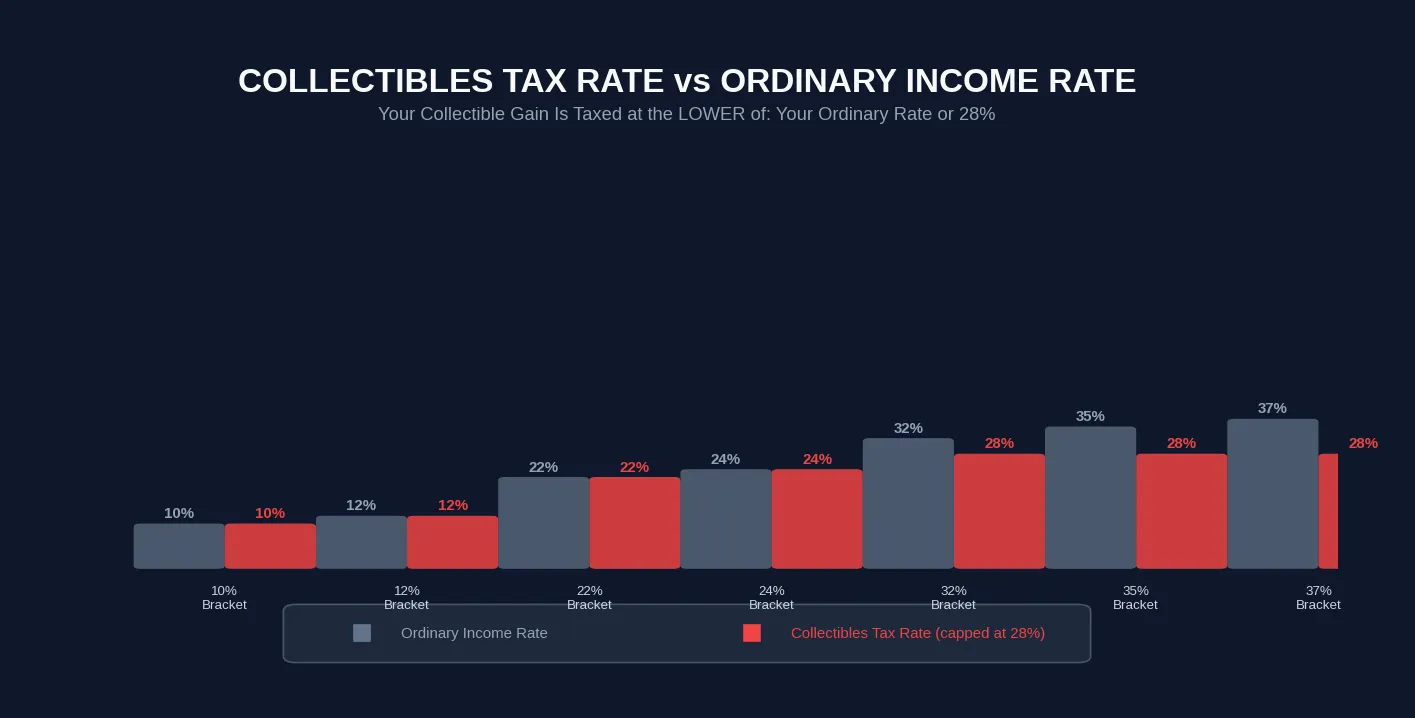
Now, one thing that gets confusing: 28% is the cap, not a flat rate. Your collectible gain gets taxed at whatever your ordinary income rate is, but it cannot go above 28%. So if you happen to be in the 24% bracket, you pay 24% on your collectible gain, not 28%. But if you are in the 32%, 35%, or 37% bracket, you hit that 28% ceiling. Still way more than the 20% you would owe on a regular long-term capital gain. Before you decide to sell anything, plug your numbers into our short-term capital gains tax rate calculator to figure out your ordinary marginal rate — that tells you whether your collectible rate lands at 28% or somewhere below it.
What Counts as a Collectible According to the IRS
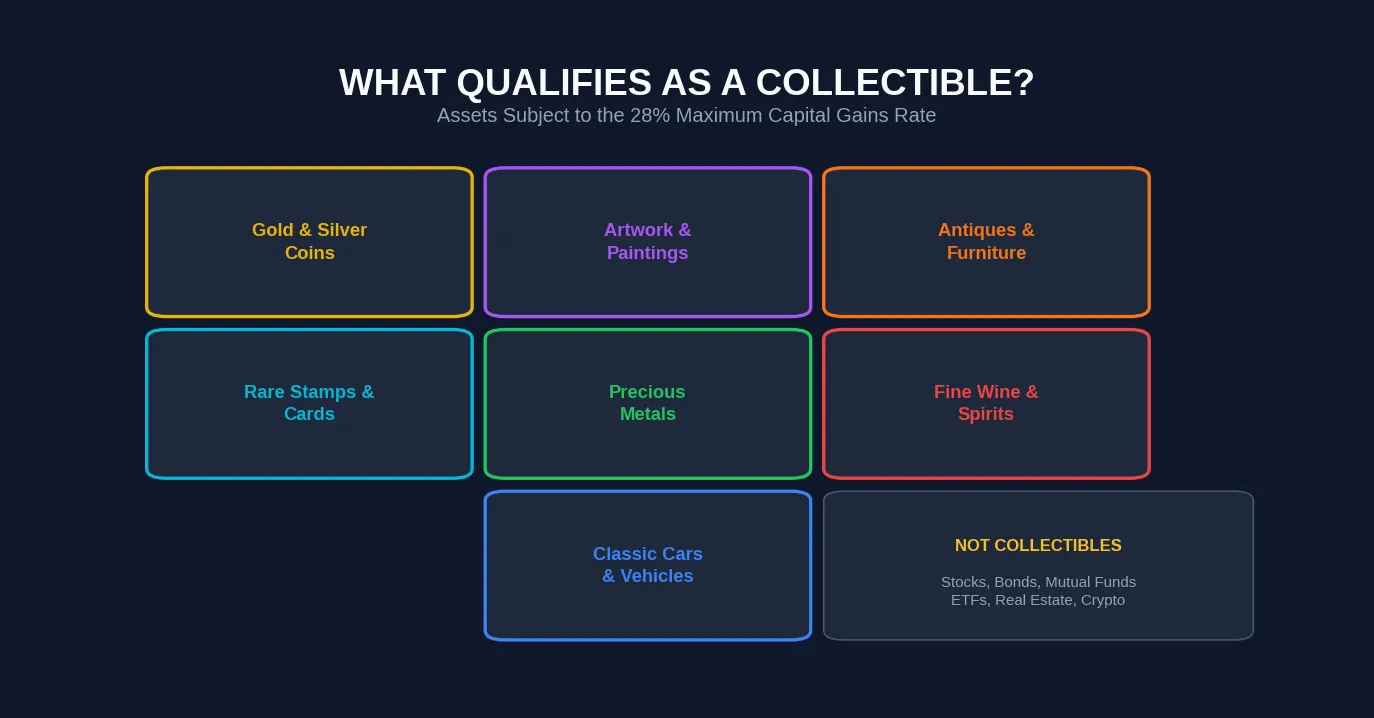
This is where it gets tricky because the IRS definition is wider than most people think. Section 408(m) of the Internal Revenue Code lays it out, and here is what makes the list:
- Art — paintings, sculptures, photographs, prints, basically anything you would see in a gallery
- Rugs and antiques — that old Persian rug your grandmother left you? Yep, collectible
- Metals and gems — with a big exception I will get to in a second
- Stamps and coins — when held as collectibles, not as everyday currency
- Alcoholic beverages — fine wine, rare whiskey, investment-grade spirits
- Historical objects and documents — signed letters, historical artifacts
- Musical instruments — if held as investments rather than played regularly
The IRS does not just look at what the item is, though. They look at how you treated it. A gold Krugerrand sitting in a display case with other rare coins? That is a collectible. The exact same Krugerrand stored in a safe deposit box alongside your other gold investments? You might have an argument that it is not a collectible but a commodity investment. The IRS considers your intent, how you stored the item, whether you displayed it, whether you treated it like part of your investment portfolio. I am not saying you can magically reclassify something just by moving it from a display case to a safe, but the overall pattern matters. And on a big sale, the rate difference can mean thousands of dollars, so it is worth getting right.
The Big Gold Exception You Need to Know About
Okay, here is the one that trips people up the most. Under the Taxpayer Relief Act of 1997, certain gold, silver, platinum, and palladium coins and bullion are excluded from the collectible definition entirely. American Gold Eagles, American Silver Eagles, and bars or rounds that meet specific purity standards — they get treated as regular capital assets. That means they qualify for the 0%, 15%, or 20% long-term rate instead of the 28% collectible rate. The catch is the purity requirements are strict. Gold has to be 99.5% pure, silver 99.9%, platinum and palladium 99.95%. And the form matters — it needs to be coins minted by a sovereign government or bars from a COMEX-approved refiner with proper markings.
If your coin has serious numismatic value — like a rare 1933 Double Eagle worth millions because of its history, not its gold content — it is a collectible no matter how pure the gold is. The IRS looks at what you are really selling: the metal or the rarity.
How the 28% Rate Actually Plays Out With Real Numbers
Let me walk through a couple scenarios because the mechanics catch people off guard.
Say you are single, making about $200,000 a year, and you sell a painting you bought three years ago for a $50,000 profit. Your ordinary marginal rate is 32%. But because it is a collectible, the rate gets capped at 28%. So you owe $14,000 in federal tax on that gain. Not terrible. But if that same $50,000 gain came from selling Apple stock, you would owe $10,000 at the 20% rate. That is four grand gone just because the asset was a painting instead of a stock certificate.
Now scale it up. A $500,000 gain on a valuable artwork. At 28%, you are paying $140,000 in federal tax. At the 20% regular rate, it would be $100,000. The collectible surcharge just cost you $40,000. That is a down payment on a house in most states.
And if you held the item for one year or less? Forget the 28% cap. Short-term collectible gains get no special treatment at all — they just get dumped on top of your ordinary income and taxed at whatever bracket applies. This works exactly like short-term capital gains rates on stocks. The takeaway could not be simpler: if you are sitting on a collectible with a big gain, wait at least a year and a day before you sell. Every single time.
| Asset type | Top federal rate | With 3.8% NIIT |
|---|---|---|
| Collectibles held over one year | 28% | 31.8% |
| Stocks, ETFs, most real estate | 20% | 23.8% |
| Anything held one year or less | 37% ordinary | 40.8% |
Keep the table handy when you decide what to sell in any given year. A $50,000 collectible gain at the top combined rate costs about $3,940 more than the same gain on stock. That gap is the real price of the collectible classification, and it compounds across a large sale.
Collectibles Tax Rate vs Regular Capital Gains: Side by Side
The clearest way to see the collectibles penalty is to put the same gain through both rate schedules. Assume a single filer with $120,000 of taxable income who realizes a $50,000 gain. If the gain came from stocks, it sits in the 15% long-term bracket. If it came from a painting or a coin collection, the same dollars face the 28% collectibles ceiling. The table shows what that spread means at tax time.
| Situation | Stock gain (long-term) | Collectible gain |
|---|---|---|
| Rate applied to $50,000 gain | 15% | 28% |
| Federal tax on the gain | $7,500 | $14,000 |
| NIIT 3.8% (income above $200,000) | Usually $0 at this income | Usually $0 at this income |
| Total federal bill | $7,500 | $14,000 |
| Extra cost of holding a collectible | — | $6,500 |
Two levers close most of that $6,500 gap. Income timing moves the collectible gain into a year when taxable income drops low enough that the 0% or 15% brackets still apply — the 28% rate is a ceiling, not a floor, and modest-income sellers often pay far less. Loss offsetting is the other lever: stock losses wipe out collectible gains dollar for dollar, which is why a high-28%-rate asset should be the first thing you net losses against, not the last.
How to Report Collectible Gains Without Messing It Up
The good news is the reporting process itself is basically the same as for any other capital gain. You still use Form 8949, it still flows to Schedule D. If you want the full step-by-step breakdown of those forms, our guide on how to report capital gains on your tax return walks you through every line. But there are a few collectible-specific things that catch people.
On Form 8949, you list each sale. Description, date acquired, date sold, proceeds, basis, gain or loss. Where people mess up is the basis calculation. If you bought a coin through a dealer and paid a 5% commission, that commission is part of your basis. If you paid PCGS to grade it, that grading fee is part of your basis. If you paid for insurance while you owned it, that is part of your basis too. Every single cost you incurred to acquire and maintain that item gets added to what you originally paid. Skip these and you are paying tax on more gain than you actually have.
Auction sales are even messier. When Sotheby's sells your painting for $100,000 hammer price, the buyer pays a premium on top — but that is not your proceeds. Your proceeds are what you actually receive after the seller's commission comes out. And those commissions run 10 to 25 percent at major auction houses. So your actual proceeds might be $75,000 to $90,000 on that $100,000 hammer price. Keep every single invoice and settlement statement. I cannot stress this enough.
Here is another thing: most collectible sales do not generate a Form 1099-B. Your brokerage is not reporting this to the IRS the way they report stock sales. You are on your own to calculate and report the gain. But do not take that as a free pass — the IRS has been ramping up audits on high-value collectible sales, and they get reports from precious metal dealers over certain thresholds. If you sold $50,000 worth of gold to a dealer, the IRS might already know about it even if you never got a 1099.
The NIIT Stacking Problem
If your modified adjusted gross income is above $200,000 (single) or $250,000 (married filing jointly), the Net Investment Income Tax tacks on another 3.8%. That pushes your effective collectible rate up to 31.8% at the top end. Regular long-term capital gains max out at 23.8% with NIIT included. So you are paying 8 extra percentage points on every dollar of collectible gain compared to a stock sale.
On a $100,000 collectible gain, that is $31,800 in federal tax versus $23,800 on stocks. An $8,000 penalty just for selling the wrong type of asset. And it gets worse from there because your state capital gains tax rate sits on top of everything. In California, where capital gains get taxed as ordinary income up to 13.3%, a high earner selling collectibles can face a combined rate pushing past 45%. Even in a zero-income-tax state like Florida or Texas, 31.8% federal is nothing to shrug at. Run the full numbers before you sell.
Gold Is Its Own Messy Category
I could write an entire separate article on how gold gets taxed, and I probably should. The problem is the same physical metal can be taxed two completely different ways depending on what form it takes, and most people have no idea.
Physical gold in qualifying form — American Eagles, Canadian Maples, approved bars from recognized refiners — gets the regular long-term capital gains rate. That is 0%, 15%, or 20%. But gold in non-qualifying form, like numismatic coins priced for their rarity rather than metal content, or gold jewelry, gets hit with the 28% collectible rate. Same metal. Different tax bill.
Then there is the ETF trap. A lot of investors buy gold through ETFs like GLD or IAU figuring they will get the standard capital gains treatment. Nope. Most gold ETFs are structured as grantor trusts, and the IRS looks right through the trust to the underlying metal. That means when you sell shares of GLD held for more than a year, you get the collectible rate up to 28%, not the regular 20% max. I have seen this surprise more people than I can count. If you want gold exposure at the lower tax rate, you pretty much have to buy physical qualifying bullion and store it yourself.
NFTs: The Collectible Question Nobody Has Fully Answered
Digital collectibles live in a gray zone, and the IRS has been frank about it. Notice 2023-27 told examiners to treat an NFT the way it treats whatever the token represents. A token pointing at digital art gets the collectible look-through analysis, while a game-item token might not.
If your NFT qualifies as a collectible, long-term gains cap at 28% instead of 20%. Final regulations remain pending, so the safest filing posture treats art-backed tokens as collectibles until told otherwise. Our cryptocurrency tax guide covers the reporting side, which is already mandatory regardless of classification.

Actual Strategies That Can Save You Money
Just Hold It for Over a Year
I know I already said this, but it bears repeating because people still mess it up. Short-term collectible gains get no preferential treatment at all. Zero. You are paying your full ordinary rate, which could be 37% plus 3.8% NIIT. Wait one year and a day and your rate drops to a maximum of 28% plus NIIT. On a six-figure gain, we are talking about saving tens of thousands of dollars for the price of waiting a few extra days.
Time Your Sale for a Low-Income Year
Since the collectible rate is the lower of your ordinary rate or 28%, selling when your income is down can make a real difference. Retiring this year? Taking a sabbatical? Had a bad year in your business? That might be the perfect time to cash out that coin collection. Someone in the 22% bracket pays 22% on collectible gains. The same person in a 35% bracket year pays 28%. Timing matters more than most people realize.
Harvest Losses to Offset the Gain
This one is straightforward but underused. If you have losing positions in your portfolio — and who does not these days — sell them to create losses that offset your collectible gains. Tax-loss harvesting strategies work for collectible gains the exact same way they work for stock gains. You net everything together. A $30,000 loss on stocks wipes out $30,000 in collectible gains dollar for dollar — and unlike stock trading, the wash sale rule does not police repurchases here, because it covers only stock and securities. At the 28% rate, that is $8,400 less in federal tax.
Try an Installment Sale for Big Ticket Items
If you are selling something really valuable and the buyer is willing to pay over multiple years, look into the installment sale method under Section 453. This spreads the gain across the years you receive payment, which can keep your income below the NIIT threshold and potentially below the 28% cap in each individual year. There are restrictions — dealers cannot use it, and certain types of property are excluded — but for a one-off sale of a personal collectible, it can work beautifully.
Donate It Instead
Giving an appreciated collectible to a qualified charity means you never pay capital gains tax on the appreciation, and you get a charitable deduction for the fair market value. The deduction is capped at 30% of your adjusted gross income, with a five-year carryforward for any excess. But here is the catch: the charity has to use the item in a way related to its tax-exempt purpose. Donate a painting to a museum that will hang it in a gallery? Full fair market value deduction. Donate that same painting to a food bank? Your deduction might be limited to your cost basis. The rules are picky, so check before you donate.
Do Not Fall for the 1031 Exchange Myth
I still hear people telling collectors they can do a like-kind exchange to swap art for art tax-free. That used to work before 2018. The Tax Cuts and Jobs Act killed it — Section 1031 now applies only to real property. If someone tells you that you can 1031 exchange your Renoir for a Monet without paying tax, they are giving you outdated advice that could get you in serious trouble with the IRS. Penalties and interest on a large unrecognized gain are no joke.
Three Mistakes I See Over and Over
First: applying the 20% long-term rate to a collectible gain. This is the big one. The IRS catches it, sends you a notice, and now you owe the extra tax plus a 20% negligence penalty on top of it. Always double-check whether your asset is a collectible before you pick a rate.
Second: forgetting to include everything in your cost basis. Auction commissions, insurance, appraisals, grading fees, restoration costs — all of it goes into basis. Every dollar you add to basis is a dollar of gain you do not have to pay tax on. I had a client who forgot to include $8,000 in auction fees on a $95,000 gain. That cost him an extra $2,240 in tax for no reason.
Third: ignoring the step-up in basis when you inherit. If you inherit a collectible, your basis resets to the fair market value on the date the previous owner died. Our guide on capital gains tax on inherited property goes deep into how this works. The stepped-up basis can wipe out years of appreciation from your taxable gain, but only if you actually know the date-of-death value and use it correctly. Get a professional appraisal if you need one — it is worth the cost.
Quick Checklist Before You File
Run through this before you submit your return:
- 1Confirm each item you sold actually meets the IRS collectible definition
- 2Check your holding period — over a year or under a year changes everything
- 3Add every single cost to your basis — purchase price, commissions, insurance, grading, the lot
- 4Figure out your actual net proceeds after selling costs
- 5For gold and silver, check whether it qualifies for the regular rate under the 1997 purity exception
- 6Report each sale on Form 8949 with accurate descriptions and amounts
- 7Move totals to Schedule D and make sure the collectible gain lands in the right bucket
- 8Calculate tax at the lower of your ordinary rate or 28%
- 9Run the NIIT numbers if your income is above $200,000 single or $250,000 married
- 10Add your state rate on top — in some states this alone can push you past 40% total
Collectibles are a great investment. I own a few myself. But the tax rules are sneaky, the 28% rate hurts, and the IRS is paying more attention to these transactions every year. Know the rules before you sell, keep every receipt, and when the numbers get big enough, talk to a professional. The cost of good advice is always less than the cost of a big mistake.
Frequently Asked Questions
Do I pay the collectibles rate on gold ETFs?
Shares of gold ETFs count as regular securities, so long-term gains cap at 20%. Physical bullion and most foreign gold coins carry the 28% ceiling instead. The wrapper decides the rate, which surprises people every year.
Are all gold coins collectibles?
Not quite. Coins and bullion that meet the fineness standard, at least .995 fine gold, fall outside the collectible definition. Numismatic coins valued for rarity or age are the ones that trigger 28%.
What is my basis for inherited artwork?
The artwork receives a stepped-up basis at the date-of-death value. Your holding period is automatically long-term. The only open question is which rate applies once the estate appraisal settles the value.
Can stock losses offset a collectible gain?
Yes, and the netting rules work in your favor here. Long-term stock losses can absorb collectible gains after you net within each category. The collectible layer is calculated last, so the remaining gain is the only part taxed at 28%.
How do I value a rare collectible for the return?
Start with documented sales of comparable items, then upgrade to a written appraisal for anything valuable. Auction house records, dealer invoices, and grading certificates all support your number if the IRS ever asks.
Do I owe state tax on collectible sales too?
Almost every state follows the federal gain but taxes it as ordinary income at its own rates. California charges its top marginal rate on collectible gains, which pushes the true combined cost well above the federal 28% headline.
Does the wash sale rule apply to collectibles like art or coins?
No. The wash sale rule is written for stock and securities, so selling a painting or a rare coin at a loss and buying a similar piece back the next day does not trigger it. Losses on collectibles follow the ordinary capital loss rules instead — netted against gains, then up to $3,000 per year against other income. Do not confuse that freedom with the IRS wash sale rule on stocks, which absolutely still applies to any shares you trade around the sale.
Fact-Checked & Reviewed
This article was written and fact-checked by Wasim Akram, Founder & Lead Researcher at TaxGainsCalc. Every rate, threshold, and rule referenced is verified against IRS publications and current tax law as of the date published. Tax laws change frequently — always consult a qualified tax professional for advice specific to your situation.
Disclaimer: This article is for informational purposes only and does not constitute tax, legal, or financial advice. Tax laws and regulations change frequently, and the information presented here may not reflect the most current updates. You should consult with a qualified CPA, tax attorney, or financial advisor before making any tax-related decisions. TaxGainsCalc is not responsible for any actions taken based on the information provided in this article.
Continue Reading

Wasim Akram
Wasim researches and writes every article on TaxGainsCalc, covering capital gains tax for everyday investors. Every figure is checked against primary IRS sources before it goes live.