
Capital Gains and Medicare IRMAA: What Retirees Pay
A large capital gain at 63 can double Medicare premiums at 65. See the two-year lookback, 2026 IRMAA tiers, the SSA-44 appeal, and planning moves.

Capital Gains and Medicare IRMAA: The Direct Answer
A large asset sale at age 65 can quietly double your Medicare premiums two years later.
The program charges income-related surcharges based on your tax return from two years back.
Capital gains stack straight into that calculation, even one-time gains from selling a house.
This guide explains the lookback mechanics, the tier structure, and the appeals route that actually works.
Most retirees encounter IRMAA for the very first time without any warning at all. The surcharge arrives on a Social Security notice roughly a year after the sale.
Planning the sale years with IRMAA firmly in mind prevents the worst of these surprises.
How the IRMAA Lookback Actually Works
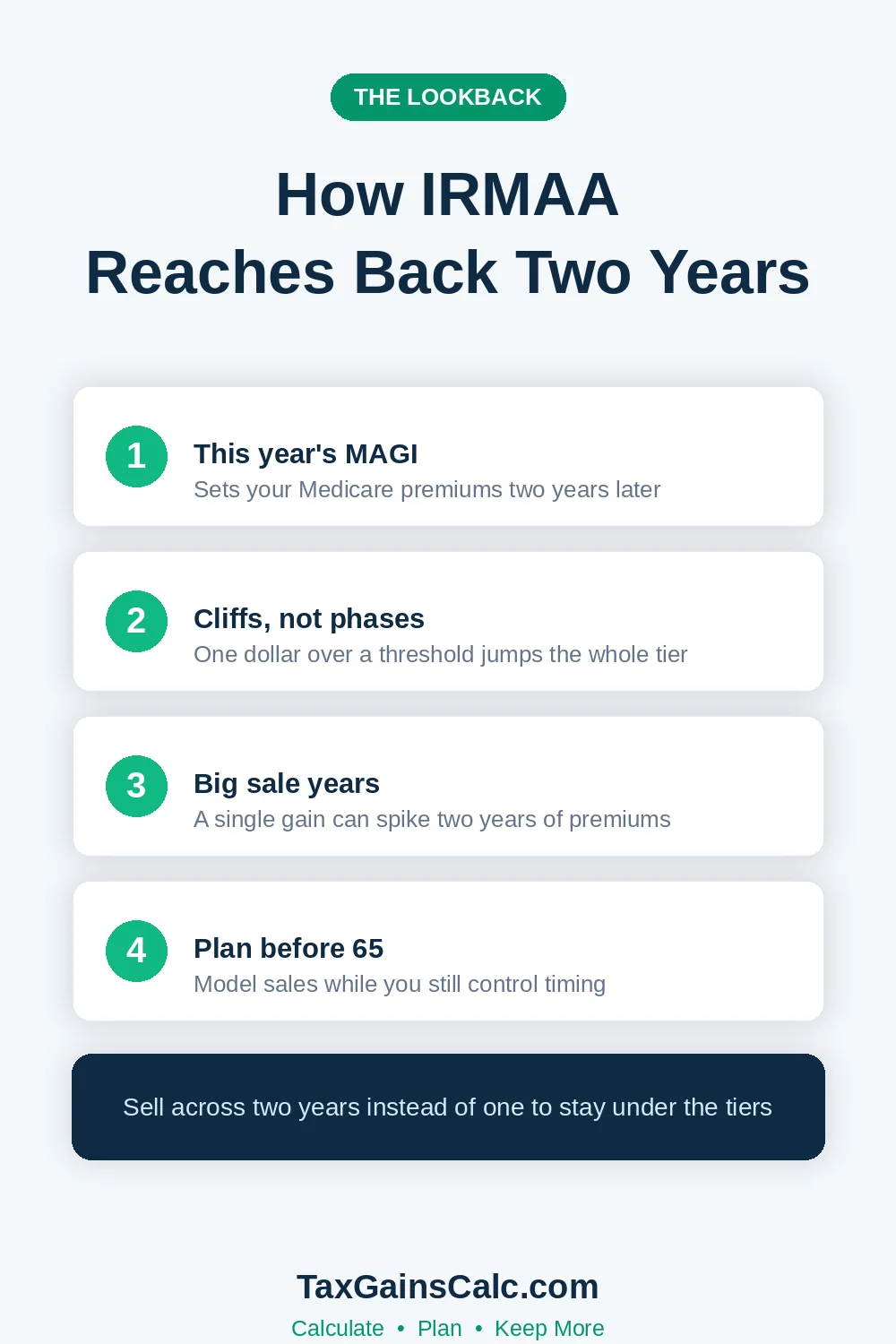
IRMAA stands for Income-Related Monthly Adjustment Amount, a surcharge on Medicare Part B and Part D. The Social Security Administration sets your 2026 surcharge from your 2024 MAGI.
That two-year lag is the mechanical reason fresh retirees get hit so often.
A gain realized at age 63 lands on your premiums at exactly age 65.
 MAGI for IRMAA equals your adjusted gross income plus tax-exempt interest. Municipal bond income counts even though it never touches your tax return as taxable.
The calculation runs off the return you already filed, not your current income. Correcting the record later requires the formal appeal process described below.
The 2026 Tier Structure and Its Cliffs
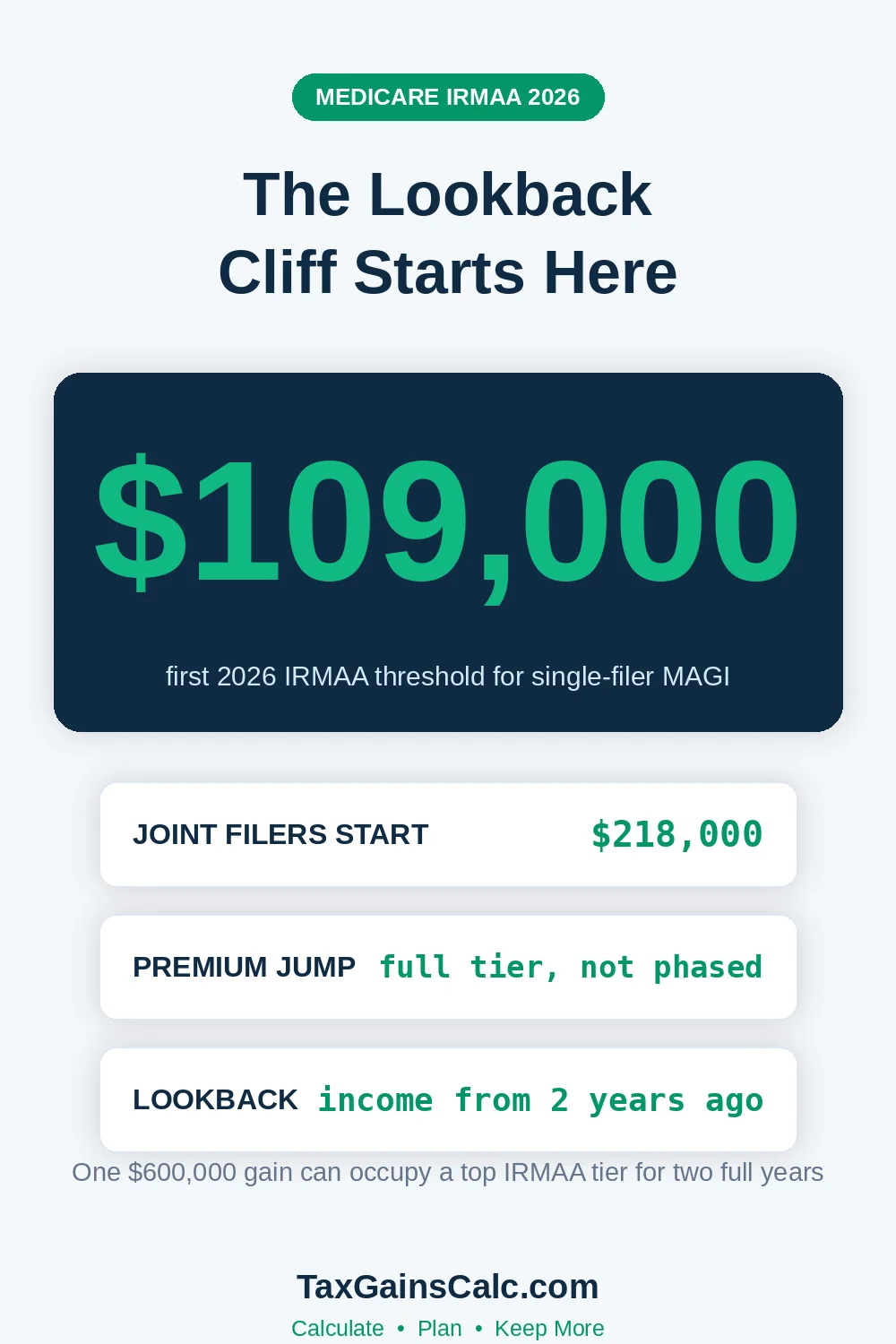
The surcharge schedule uses hard thresholds rather than smooth percentage brackets. Cross a line by one dollar and the entire monthly surcharge applies for that year.
The first threshold for 2026 sits at $109,000 of MAGI on a single return. For joint returns, that opening threshold doubles to $218,000 of modified gross income.
Tiers climb in steps from that first line up to roughly $500,000 single. The highest joint tier begins around $750,000, where the maximum surcharge finally caps out.
Each tier adds a fixed monthly dollar amount to both Part B and Part D. Two spouses on Medicare each pay their own surcharge, which doubles every household number.
| 2026 MAGI (single) | 2026 MAGI (joint) | Surcharge effect |
|---|---|---|
| up to $109,000 | up to $218,000 | standard premium only |
| first surcharge tier | first surcharge tier | modest monthly addition |
| middle tiers in steps | middle tiers in steps | hundreds added monthly |
| about $500,000 and above | about $750,000 and above | maximum monthly surcharge |
The standard Part B premium runs near $200 per month in this period. Top-tier surcharges add several hundred dollars more per person every single month. Our seniors capital gains guide prices these effects against common sale sizes.
Worked Example: A Home Sale at 64
Picture a retired couple with $80,000 of ordinary retirement income each year.
They sell a longtime home in 2024 and realize a $300,000 gain beyond their exclusion.
The gain flows into their 2024 MAGI and pushes them deep into the surcharge tiers.
Their 2026 Medicare premiums then reflect that single year of elevated income.
The couple pays the surcharge for exactly one calendar year before it resets. Their 2027 premiums drop back once their ordinary 2025 return controls the calculation.
One dollar of income over a tier line costs the same as thousands over it. That cliff behavior makes sale timing unusually valuable near Medicare enrollment ages.
The Form SSA-44 Appeal for One-Time Income
Social Security offers a formal reconsideration process for reduced household income. Form SSA-44 lets you request premiums based on a realistic current-year estimate instead.
The form requires a qualifying life-changing event to accompany your request. Work stoppage, retirement, marriage, divorce, and death of a spouse all qualify.
A one-time asset sale qualifies only when it rides alongside a qualifying event. Retirement in the sale year is the classic pairing that many recent retirees can use.
A simple stock sale with no life change does not qualify for the adjustment. File the form with documentation and expect a decision within several weeks.
| Qualifying event | Typical documentation | Effect on appeal |
|---|---|---|
| Work stoppage or retirement | employer letter, final pay stub | strongest common case |
| Death of a spouse | death certificate | automatic household change |
| Marriage or divorce | court or license records | household recomputed |
| Asset sale alone | none | does not qualify |
Part D Surcharges and Spousal Timing
Part D drug plans carry their own IRMAA addition computed from the same MAGI. The surcharge attaches to every Part D plan including cheap standalone options.
Beneficiaries pay it through their plan premium or directly to Medicare each month. Treat the Part B and Part D additions as one combined planning figure.
Spousal age gaps create timing wrinkles that many dual-income couples overlook entirely. The older spouse enrolls first and faces tiers built from joint MAGI alone.
The younger spouse's later enrollment uses the same joint income figure for a different year. Couples with several years of age gap should map both enrollment timelines together.
| Planning item | Who it affects | Timing note |
|---|---|---|
| Part B surcharge | each enrolled spouse | starts with Part B |
| Part D surcharge | each enrolled spouse | same MAGI basis |
| Age-gap enrollment | couples with gaps | map both timelines |
| Survivor status change | widowed spouses | single tiers apply later |
A Note for Early Retirees Before 65
Retiring at 62 gives you a two-year window of deliberately low reported income. Those low-MAGI years are the cheapest time to realize large appreciated gains.
The 0 percent federal bracket may even cover part of the gain entirely. Every gain realized before enrollment also stays off the premium calculation permanently.
Roth conversions raise MAGI deliberately, so time them against the same tier lines. A conversion plan that ignores IRMAA tiers can quietly cost hundreds monthly.
 Model conversions, gains, and deductions together in one three-year projection. Our Roth conversion guide covers the conversion math separately.
Planning Sales Before Medicare Starts
The two-year lookback rewards people who plan gains before enrollment approaches. Harvest gains during your low-income years while you still control every threshold.
Realize appreciated positions at 0 or 15 percent federal rates before Medicare begins. Our zero bracket harvesting guide covers that window in detail.
Investors aged 60 to 63 should map their expected MAGI through age 65. A sale planned at 62 lands on premiums at 64 and 65 differently.
Running a three-year MAGI projection costs one spreadsheet evening before a major sale. Our capital gains calculation guide provides the federal math framework.
Spreading Large Sales Across Years
Spreading a large sale across two calendar years changes the IRMAA picture dramatically. One $600,000 gain can occupy a top tier for two full years.
 Two $300,000 gains may each clear the lower tiers in their own year. The federal capital gains rate stays identical either way under the same brackets.
Installment sale treatment achieves similar spreading when a real installment exists. The buyer pays over time, and gain recognition follows the payments received.
Corporate buyers rarely agree, but family and small-business sales accommodate the structure. Our withdrawal order guide adds the account-side sequencing piece.
The Charitable Planning Lever
Donating appreciated shares instead of selling removes the gain from your MAGI entirely. The charity receives full value, you deduct it, and no gain gets recognized.
A donor-advised fund converts one concentrated gift into years of flexible grants. Our donor-advised fund guide has more on how that arrangement actually works.
Bunching a large gift into the sale year offsets the gain at the AGI level. The AGI reduction can pull your MAGI back below a critical tier line.
Charitable tools work equally well for required minimum distribution planning later. Our RMD capital gains guide covers the required distribution interaction.
NIIT and IRMAA Stack Differently
Investors sometimes confuse the NIIT surtax with the IRMAA surcharge system. The 3.8 percent NIIT is a federal tax on net investment income.
Our NIIT guide covers its $200,000 and $250,000 thresholds in depth. IRMAA instead is a premium surcharge tied to Medicare enrollment and its own tiers.
Both measures use MAGI-style calculations with different threshold structures attached. A sale can trigger both at once for retirees with investment income.
Model the two together, because each adds meaningful cost to the same sale. The combined effect makes timing decisions more valuable than either program suggests alone.
Why the Federal 0 Percent Rate Will Not Save You
Retirees with modest ordinary income often qualify for the 0 percent federal bracket. A large gain filling that bracket still flows straight into your AGI and MAGI.
The IRMAA tiers see every dollar of that federally untaxed gain. Premium surcharges apply even when the income tax itself comes back zero.
Our zero percent retirement guide covers the bracket strategy honestly. Use the 0 percent band for income tax purposes without ignoring MAGI consequences.
The best planning captures both benefits by respecting the tier lines together. That dual awareness separates genuinely optimized retiree plans from partially optimized ones.
Common IRMAA Misunderstandings Worth Correcting
The first myth says selling a home always triggers the surcharge for everyone. Only the gain above your exclusion lands in MAGI in the first place.
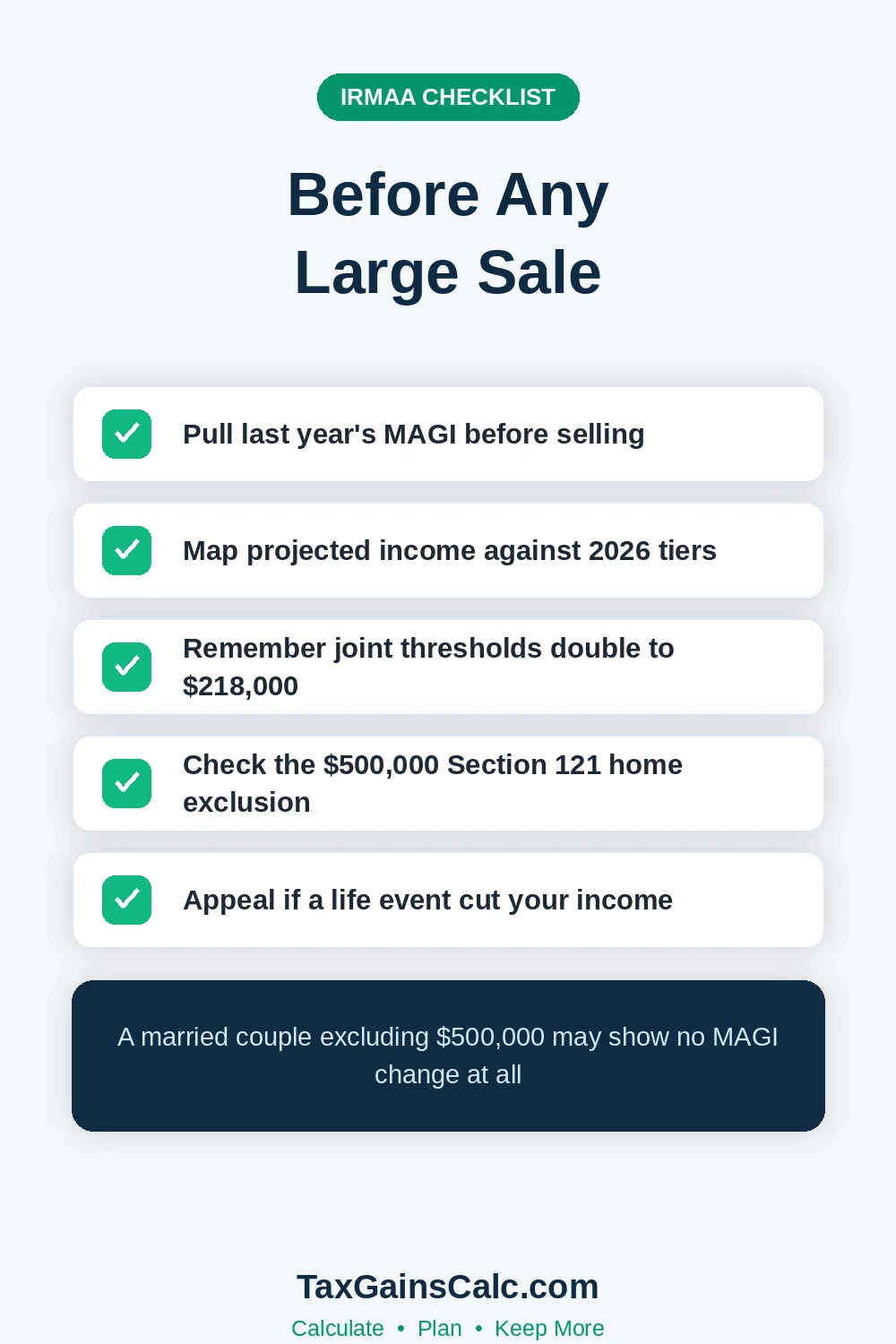
A married couple excluding $500,000 may show no MAGI change at all. Run the exclusion math before assuming the worst about a planned sale.
The second myth claims the surcharge applies forever once a tier is crossed. IRMAA recalculates every single year from the return two years prior.
 One elevated year costs exactly one year of surcharges and nothing more. The cliff design punishes the crossing, not the history behind it.
The third myth says Roth accounts protect you from IRMAA entirely. Roth distributions escape tax, but the conversion itself raised MAGI when performed.
Planned conversions require the same three-year MAGI mapping as sales do. Protection comes from timing, not from the account label itself.
One more practical note belongs in every retiree's December review each year. Pull your year-to-date realized gains and compare them against next year's tier lines.
Adjust December harvesting, charitable gifts, or withholding while the calendar still allows changes. That annual hour keeps the two-year premium pipeline predictable instead of full of surprises. Retirees who skip this review are the ones who quietly fund the surcharge tiers.
An IRMAA Planning Checklist Before Any Large Sale
Run these five checks before executing any major gain realization near Medicare age. Each one either saves money or documents your position for a future appeal.
- Map your MAGI for this year and the next two calendar years honestly.
- Identify which tier lines sit nearest your projected numbers in each year.
- Check whether a qualifying life event makes the SSA-44 appeal available later.
- Consider splitting the sale, an installment structure, or a charitable offset first.
- File the appeal immediately if premiums arrive based on outdated income assumptions.
The official Medicare IRMAA explanation publishes current premium tables each fall. On the tax side, the capital gains topic guide from the IRS fills in the projection.
Retirees who run this complete checklist before a major sale routinely save thousands in surcharges. The premium savings arrive quietly two years later, which is exactly how good planning should always look.

Wasim Akram
Wasim researches and writes every article on TaxGainsCalc, covering capital gains tax for everyday investors. Every figure is checked against primary IRS sources before it goes live.