
CRT vs Direct Gift: Which Charitable Route Wins
Same $1 million of stock, two routes: a full deduction now versus CRT lifetime income. Compare deductions, payouts, taxes, and the 2026 floor.

CRT vs Direct Gift: The Direct Answer
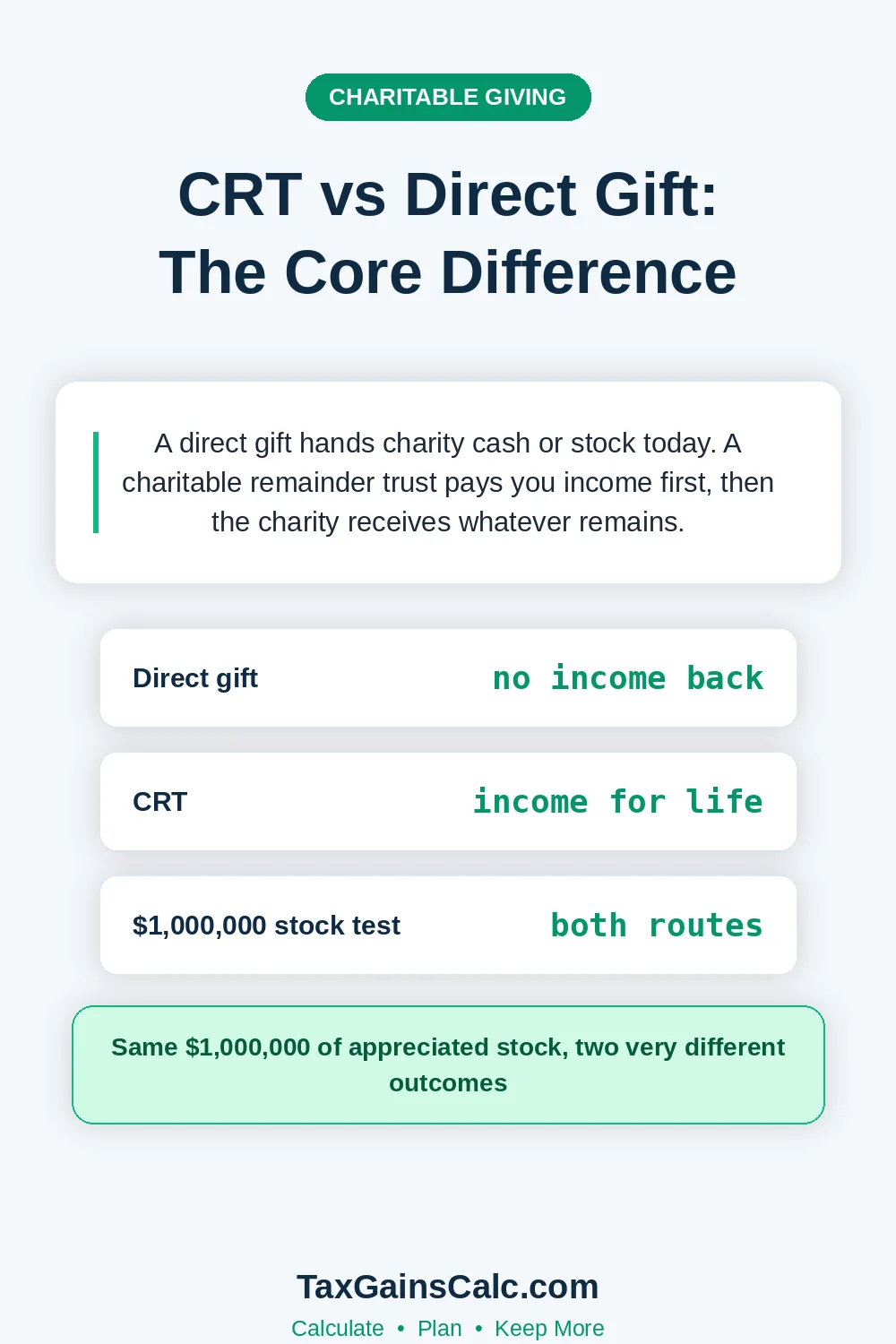
Both routes eliminate your capital gain on appreciated stock, but they pay you very differently over time.
A direct gift deducts the asset's entire fair market value, yet not one dollar of cash returns to you.
A charitable remainder trust deducts only a fraction today, then pays you lifetime income from the proceeds. The right choice depends on whether you still need that money working for your own household.
This guide runs the same $1,000,000 of appreciated stock through both structures with real numbers. You will see the deduction difference, the income difference, and the control difference laid out cleanly.
A decision checklist at the end turns all of that math into a practical same-day choice.
How a Direct Gift Works
Donating long-term appreciated stock straight to a charity remains the simplest possible route. You deduct the asset's entire market value when you itemize, subject to the AGI ceiling.
 The charity sells the shares and pays zero capital gains tax on that sale. You also avoid the embedded gain entirely, which would have been taxed on your own return otherwise.
The deduction ceiling for appreciated long-term property sits at 30 percent of AGI each year. Any excess deduction amount carries forward for five more tax years without expiring early. Our appreciated stock donation guide covers the filing mechanics in careful detail.
How a Charitable Remainder Trust Works
A CRT is an irrevocable trust that sells your contributed assets without paying income tax. Charitable remainder trusts are exempt taxpayers under the Internal Revenue Code sections governing them.
The trust then pays you annual income for life or for a fixed term of years instead. Whatever remains at the end belongs to the charity you named in the trust document.
Two payout styles cover nearly every real-world situation donors encounter. A CRAT distributes one unchanging dollar figure every single year, whatever the trust's investments actually do.
A CRUT pays a set slice of each year's trust value instead, never below 5 percent.
Our CRT capital gains guide explains both structures in greater depth.
The IRS tests every CRT against two hard requirements at the funding date. The charity's remainder interest has to equal 10 percent or more of the funding amount. The annual payout rate must also fall between 5 and 50 percent of trust value.
The Two Routes Side by Side
The table below compresses the real differences into a single quick view. Study the deduction and income rows first, because they drive almost every donor decision.
| Feature | Direct gift | Charitable remainder trust |
|---|---|---|
| Capital gain tax on sale | Avoided entirely | Avoided inside the trust |
| Charitable deduction | Full fair market value | Remainder value, often 10 to 30 percent |
| Income back to you | None | Annual payout for life or a set term |
| AGI deduction ceiling | 30 percent of AGI | Varies with the remainder value |
| Revocable | No, once delivered | No, irrevocable at funding |
| Setup and admin cost | Minimal | Real legal and annual trustee costs |
Worked Example: $1 Million of Stock at Age 65
Picture stock worth $1,000,000 carrying a cost basis of just $200,000.
You are 65 years old, you itemize deductions, and retirement starts this year.
Selling outright would trigger roughly $150,000 of federal tax on the $800,000 embedded gain. That estimate assumes the 15 percent long-term rate plus the 3.8 percent NIIT surtax.
Route one is the simple direct gift of the shares. You deduct the full $1,000,000, capped only by the 30 percent AGI rule.
The capital gain disappears completely, and the charity receives the entire million dollars.
Your cash flow gains nothing from the transaction, but your deduction reaches its theoretical maximum.
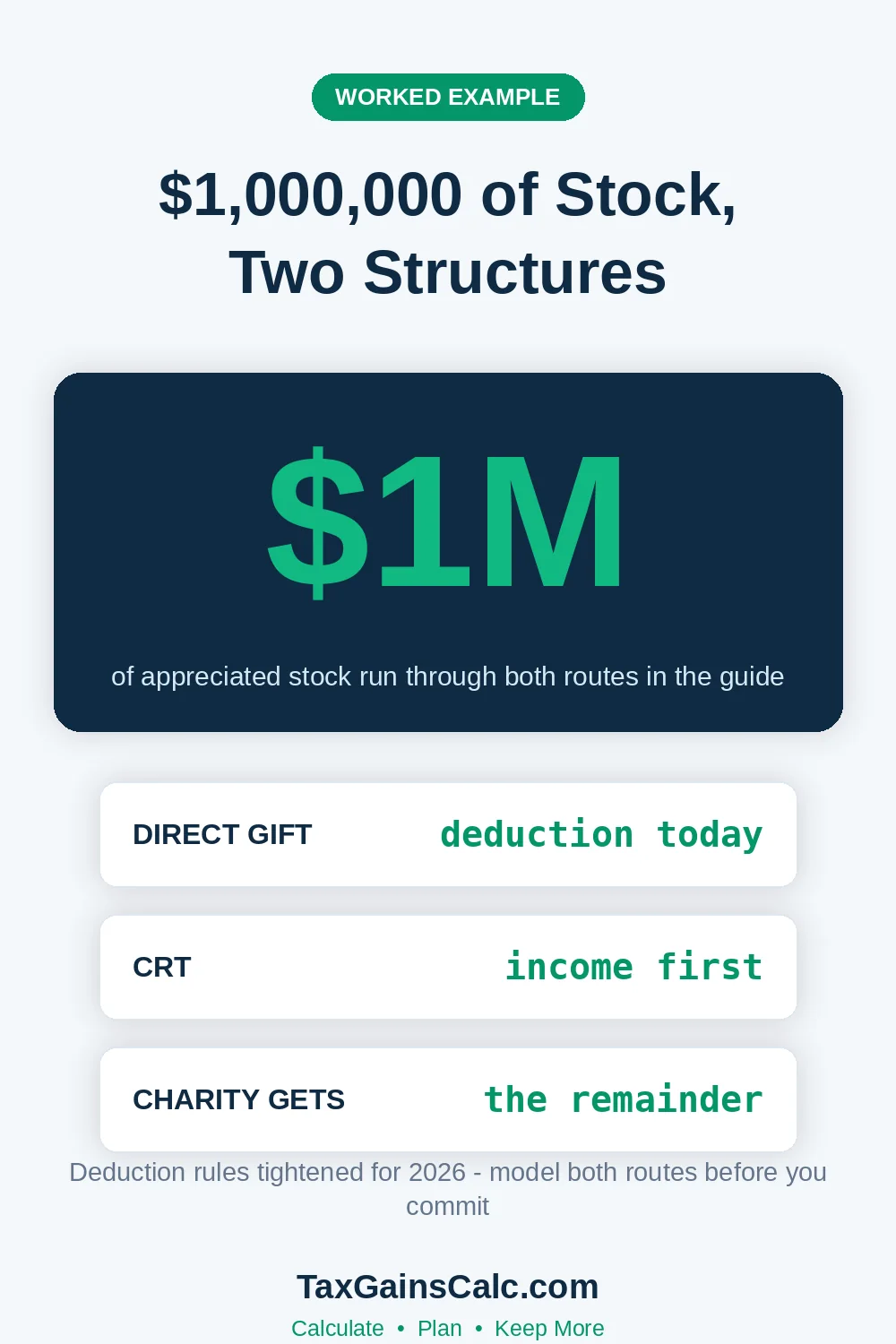
Route two is a 5 percent CRUT funded with those same shares. The trust sells tax-free and pays you about $50,000 during year one. Assume the IRS section 7520 rate produces a $250,000 charitable deduction at funding.
| Outcome | Direct gift | 5% CRUT |
|---|---|---|
| Year-one deduction | $1,000,000 | $250,000 |
| Year-one income | $0 | about $50,000 |
| Gain tax avoided | yes, about $150,000 | yes, deferred and tiered |
| Charity eventually receives | $1,000,000 now | remaining trust corpus later |
The Four-Tier Payout System
The CRUT payouts arrive carrying their own tax character every single year. Trust income flows out under the four-tier ordering rules, with ordinary income first.
Capital gain comes second, followed by other basis and finally tax-free return of principal. The capital gains calculation guide compares those four tiers against a plain outright sale.
In practice the tiers mean your early payouts carry the most taxable character. A trust holding the sold proceeds in bonds pays you ordinary income first for years.
A trust invested for growth may pay more capital gain character over time instead. Ask the trustee to project the tier mix before you commit to a payout style.
The 2026 Deduction Floor Change
OBBBA introduced a new floor for itemizers starting with the 2026 tax year. Charitable deductions now count only to the extent they exceed 0.5 percent of AGI.
That floor applies to direct gifts and to CRT contribution deductions in exactly the same way. Concentrating multiple years of intended donations into a single gift remains the go-to fix.
 The floor trims the effective benefit mainly for high earners carrying large AGI figures. Donors with modest income keep most of their expected benefit under the new rule. Our OBBBA summary guide lists every charitable provision with its effective dates.
Trust Costs and Administration
CRTs carry real costs that direct gifts never impose on the donor. Drafting a compliant trust document typically runs several thousand dollars in legal fees.
Annual trustee fees, tax returns, and actuarial calculations add recurring expense every year. Sponsors of pooled funds reduce these costs, but individual trusts rarely run themselves.
The economics only work when the funded amount justifies the fixed overhead. Most practitioners suggest funding a CRT only with several hundred thousand dollars or more.
Below that line, a donor-advised fund delivers similar benefits at almost no cost. Our donor-advised fund guide covers that comparison completely.
When the Direct Gift Wins
Three fact patterns favor simply handing over the shares and moving on. Each one removes any need for income or for deferral flexibility in your plan.
- You do not need additional retirement income from the donated asset at any point.
- You want the largest possible deduction inside this specific tax year.
- Your chosen charity accepts stock directly and can liquidate it promptly.
A donor-advised fund blends direct-gift simplicity with flexible grant timing over the years. 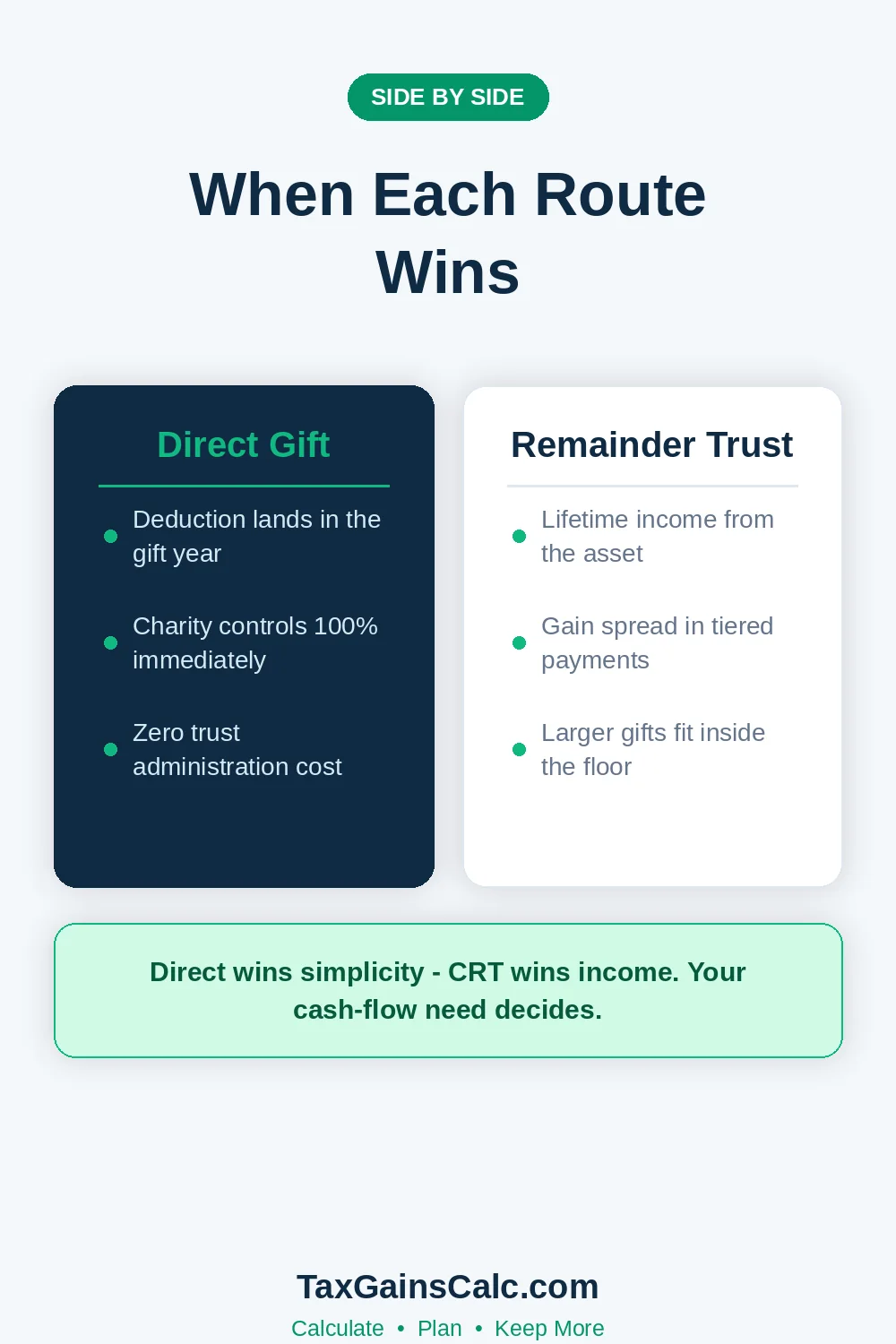 Many donors use a DAF for flexibility and direct gifts for local charities. The wrapper matters less than matching the vehicle to your actual giving habits.
When the CRT Wins
The trust earns its complexity under a completely different set of facts. Each of these patterns involves needing something tangible back from the gift.
- You want lifetime income from a concentrated low-basis position you would otherwise sell outright.
- You plan to sell a business or property and want recognition spread across many years.
- You need diversification inside a tax-free wrapper while keeping a steady payout stream.
Deferral is the quiet superpower of the CRT structure for patient donors. The trust's sale creates no immediate gain, and payouts spread tax across decades. Our deferral strategies guide ranks CRTs against every other deferral tool.
How the Section 7520 Rate Moves Your Numbers
Every CRT deduction depends on the IRS section 7520 rate published monthly. That rate approximates what the trust could earn on safe investments.
Higher 7520 rates produce larger deductions because the projected remainder grows. Low-rate years shrink deductions and sometimes push trusts toward CRUT structures instead.
The rate also shapes the CRAT exhaustion test for older donors. A high payout combined with a low 7520 rate can fail the 5 percent probability requirement.
Trustees model several rate scenarios before locking the payout percentage in the document. Your attorney should run those projections before drafting rather than after.
Timing your funding month changes the deduction without changing the assets. Donors with flexible calendars check the published rate before signing anything. A one-month delay occasionally adds five figures of deduction on large gifts.
Funding Rules and Timing
CRTs accept most marketable assets, with a few consistent exceptions worth knowing. Publicly traded stock and mutual fund shares fund trusts most commonly.
Real estate funds trusts too, but adds appraisal requirements and environmental review. S-corporation stock, collectibles, and unregistered shares raise complications that need specialist review.
The funding timing interacts with your gain recognition in one critical way. Shares must land inside the trust before any sale contract binds you.
A charity or trust that receives already-contracted assets gains nothing tax-wise. Sequence every deal so the trust owns the asset before negotiations begin.
Alternatives Worth Comparing First
Two other structures sit between the direct gift and the full CRT. A charitable lead trust pays the charity first, then returns assets to family.
It suits donors with estate goals rather than income needs, which is the opposite trade. Our charitable lead trust guide covers that inverted structure completely.
Appreciated stock gifts to operating charities skip trust machinery entirely. The charity liquidates promptly and issues a receipt for your deduction file.
Speed and simplicity explain why this route handles most seven-figure gifts nationally. Reserve the CRT for those special situations where the income stream genuinely matters to your plan.
 Run both routes through your own tax software before committing to either path. The deduction difference shows up directly on Schedule A of your return.
The income difference compounds across your retirement years and survives for your spouse. A single one-hour modeling session beats a full decade of second-guessing your irrevocable choice.
A Decision Checklist You Can Run Today
Work through these questions in order before visiting an estate attorney. The first two questions alone eliminate the wrong route for most donors.
- Do you need income from this asset during your lifetime, honestly yes or no?
- Is the asset a concentrated position carrying a large embedded gain?
- Can your cash flow absorb a smaller first-year deduction without hardship?
- Will you realistically fund and maintain a trust with professional help?
- Does your chosen charity accept remainder interests, or do you need a sponsor?
| Your situation | Better route | Why it wins |
|---|---|---|
| Retired, needs income | CRT | Payout stream plus deferred gain |
| Peak earnings, wants max deduction | Direct gift | Full FMV deduction immediately |
| Concentrated stock, philanthropic | CRT or DAF | Tax-free diversification either way |
| Small regular giver | Direct gift | Trust costs swallow the benefit |
Whichever route you choose, act before the asset sale, never after it closes. Once the gain appears on your return, the entire planning window closes permanently. Our legal avoidance strategies guide shows where charitable tools rank among alternatives.
Couples running this analysis before a business sale consistently capture six-figure differences. The IRS charitable remainder trust guidance is the correct starting reference for the trust route.

Wasim Akram
Wasim researches and writes every article on TaxGainsCalc, covering capital gains tax for everyday investors. Every figure is checked against primary IRS sources before it goes live.