
Capital Gains on Life Insurance Proceeds: When Tax Applies
Death benefits stay tax-free, but surrenders, MECs, loans, and transfers can trigger tax. When the IRS taxes life insurance, and why it is ordinary.

Capital Gains on Life Insurance Proceeds: The Direct Answer
Life insurance death benefits are generally income-tax-free for the beneficiaries who receive them.
Section 101(a) keeps the payout out of taxable income no matter how large the policy was. The people named on the policy keep every dollar of it.
Cashing out a policy while living is the event that actually creates tax.
This guide explains when surrender creates gain, how MECs change the rules, and what transfer exceptions exist.
Most policyholders are caught off guard when they learn the taxable slice is never a capital gain. Surrender gains instead hit your return as ordinary income at your normal bracket rates.
Ordinary rates can run noticeably higher than long-term capital gains rates. That one distinction shapes every withdrawal and loan decision a policyholder makes from that point on.
Why Death Benefits Stay Tax-Free
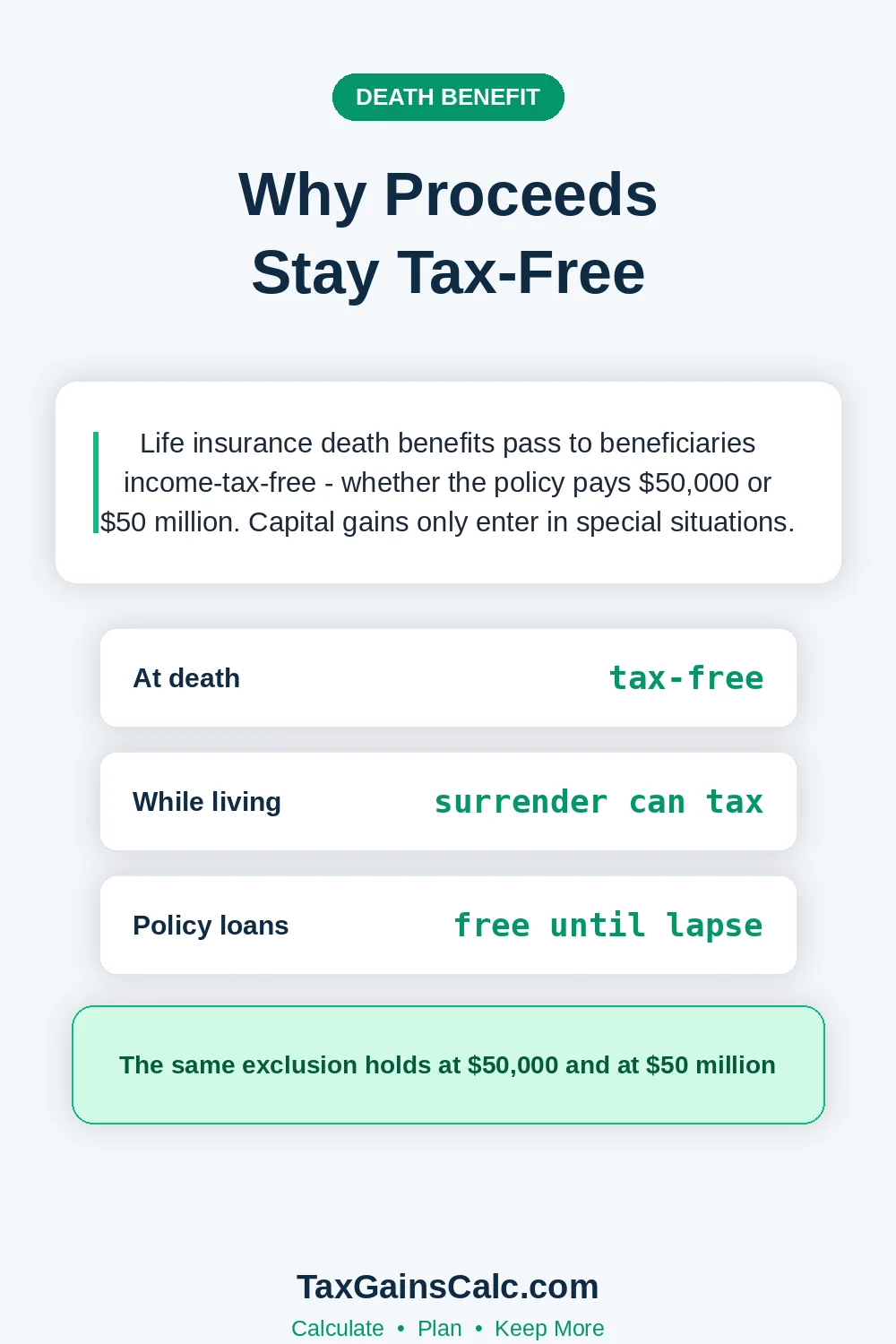
Money paid to a beneficiary at the insured's death arrives without any income tax attached. The same exclusion holds whether the policy pays out $50,000 or $50 million at death.
No bracket, estate size, or payout amount ever changes that protected treatment.
Beneficiaries get the full death benefit with no 1099 reporting to worry about.
This rule has anchored the life insurance industry for more than a century. Insurers built their products around it and Congress has left it standing.
 Interest earned on a delayed payout can make part of the payment taxable. Delays in settlement beyond a reasonable stretch generate interest on the unpaid proceeds.
That interest then lands in your taxable income at ordinary rates in whichever year the insurer pays it.
Installment payout schedules often fold an interest portion into every annual payment. The interest slices count as ordinary income, while the principal portion stays excluded.
Only the taxable slices show up on your return each year.
| Payout element | Tax treatment | Notes |
|---|---|---|
| death benefit principal | income-tax-free | Section 101(a) exclusion |
| settlement delay interest | ordinary income | taxable when paid |
| installment interest portions | ordinary income | principal stays excluded |
| accelerated terminal illness benefit | generally excluded | Section 101(g) rules |
How Surrender Creates Ordinary Income While Living
Surrendering a policy hands your cash value back in a single lump sum. The taxable gain equals cash value minus your investment in the contract.
Anything left over after that simple subtraction is what the IRS taxes.
Your investment in the contract equals the total premiums you paid into the policy. Anything above that premium total gets taxed as ordinary income during the surrender year itself.
Premiums already paid come back out tax-free as a return of basis.
This ordinary treatment differs sharply from how almost every other investment gain is taxed. Stocks and funds earn capital gain rates after just one year of holding. Insurance gains never qualify for those lower long-term rates, at any holding period.
Cash value growth inside an insurance policy turns into ordinary income the day you exit. The gap between the two rate schedules widens in higher brackets. Our rate comparison guide prices that difference precisely.
Partial withdrawals instead follow the exclusion ratio rules rather than simple subtraction. Each withdrawal returns part basis and part gain in fixed proportion. The same ratio keeps applying to every withdrawal until your basis runs out.
Our beginner guide explains the exclusion ratio mechanics. Full surrenders compress the whole calculation into one final taxable event. Basis recovery and gain recognition both settle up on that single date.
Worked Example: Surrendering a $150,000 Policy
Picture a policyholder who has paid $120,000 of cumulative premiums over twenty years of coverage. By the surrender date, the cash value has grown to $150,000. The table below walks through each line of the resulting arithmetic.
The investment in the contract here equals the full $120,000 premium total. Surrendering therefore creates $30,000 of taxable ordinary income. That entire gain lands on the owner's return in the year the surrender completes.
At a 24 percent bracket, that surrender costs $7,200 in federal tax. State income taxes then stack their own layer on the very same gain. Always check your state's rules before assuming the federal number is the whole cost.
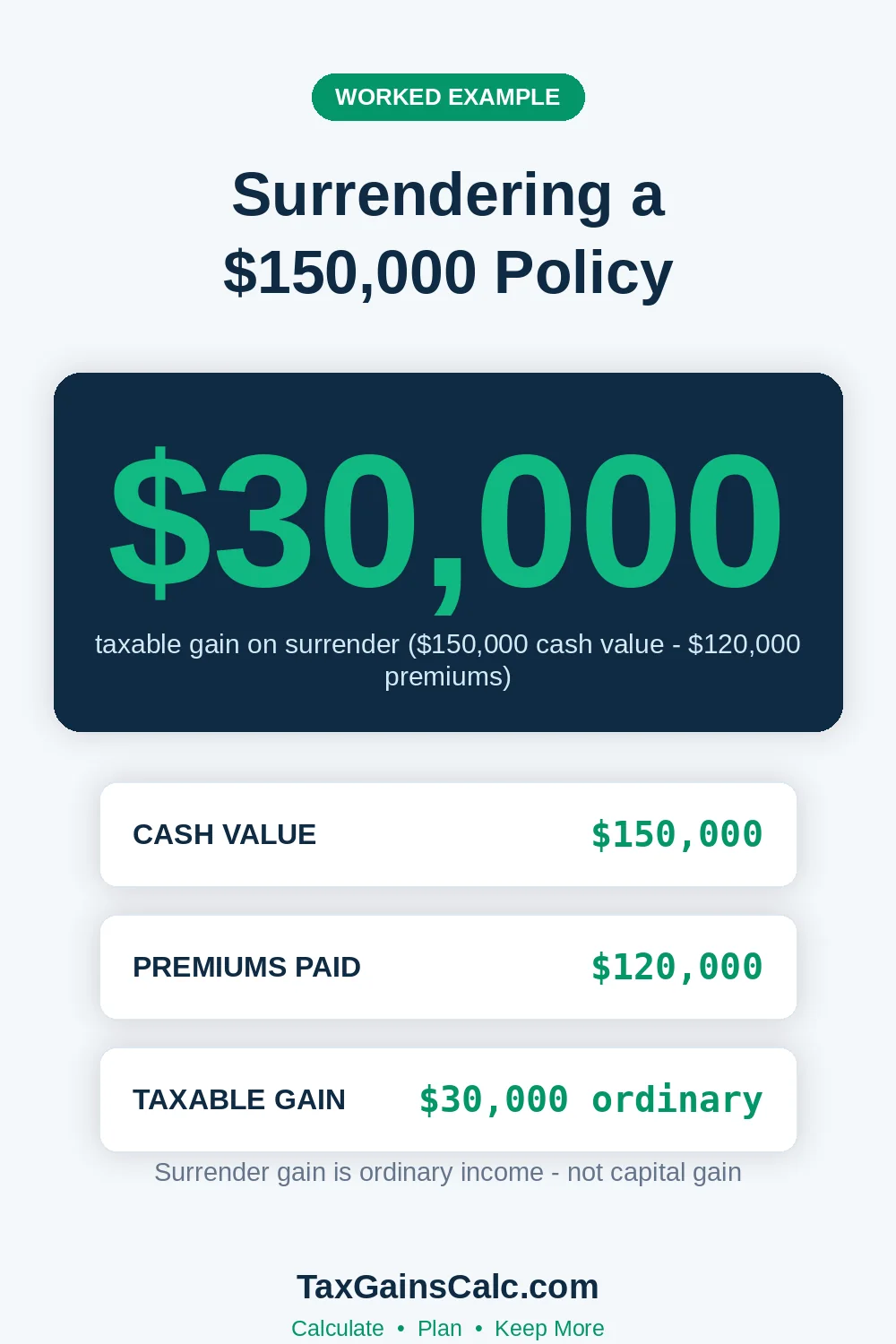 The growth inside the policy never enjoyed capital gain treatment on any dollar at any point. Compare that outcome with identical money invested in a simple low-cost index fund instead.
| Line | Amount | Character |
|---|---|---|
| cash value received | $150,000 | mostly tax-free return of basis |
| premiums paid | $120,000 | tax-free basis recovery |
| taxable surrender gain | $30,000 | ordinary income |
| tax at 24 percent | $7,200 | federal only |
An index fund with identical growth would have produced long-term capital gain treatment instead. The 15 percent federal rate would have cost roughly $4,500 on the same growth instead.
The insurance wrapper traded rate treatment for its other living benefits instead. Weigh the federal cost and your state's cost before surrendering any policy. That rate difference alone often decides which exit route is cheaper.
When a Policy Becomes a MEC
A modified endowment contract fails the seven-pay test under federal law. It compares cumulative premiums paid against a ceiling tied to the policy's death benefit. Funding the policy too quickly relative to the death benefit trips MEC status.
Once assigned, the MEC designation is permanent and cannot be reversed. The favorable withdrawal ordering disappears in the first year MEC status applies. No filing, request, or payment afterward ever flips it back.
MEC withdrawals come out as fully taxable income before any premium basis returns. For these contracts specifically, the law reverses the usual basis-first ordering. Every dollar taken out is treated as gain until the premiums are exhausted.
Taking withdrawals or loans early also adds a 10 percent penalty before the owner turns 59 and a half. Our retirement account guide parallels those early-distribution penalties.
Agents sometimes overfund policies deliberately to build tax-deferred accumulation. Those designs must respect the seven-pay limits to avoid becoming a MEC. Cross that line once and the MEC label sticks for good, so precision matters.
Ask the carrier to confirm your MEC status in writing before paying any large premium. The MEC call is made at funding, never at the withdrawal stage. No later choice about loans, withdrawals, or exchanges can undo that classification.
How Policy Loans Stay Tax-Free Until They Do Not
Loans drawn against a life policy's cash value generally avoid current taxation. The loan proceeds are not income as long as the policy stays in force. You receive spendable cash without owing any federal tax in that year.
Borrowers tap loans for income with no annual tax reporting involved. That flexibility separates insurance from nearly every other asset class. Most other assets force a taxable sale before you can spend them.
A policy that lapses or is surrendered with loans outstanding triggers taxation immediately. The loan balance then counts as a distribution in that same year. Any gain above your basis in that distribution is taxed as ordinary income.
Letting loan balances grow can set up a surprisingly large taxable event. The bigger the balance, the bigger the bill when that moment comes. Keep loans well inside the remaining cash value to preserve the shield across the whole holding period.
On MECs, loans are taxable from the very first dollar borrowed. 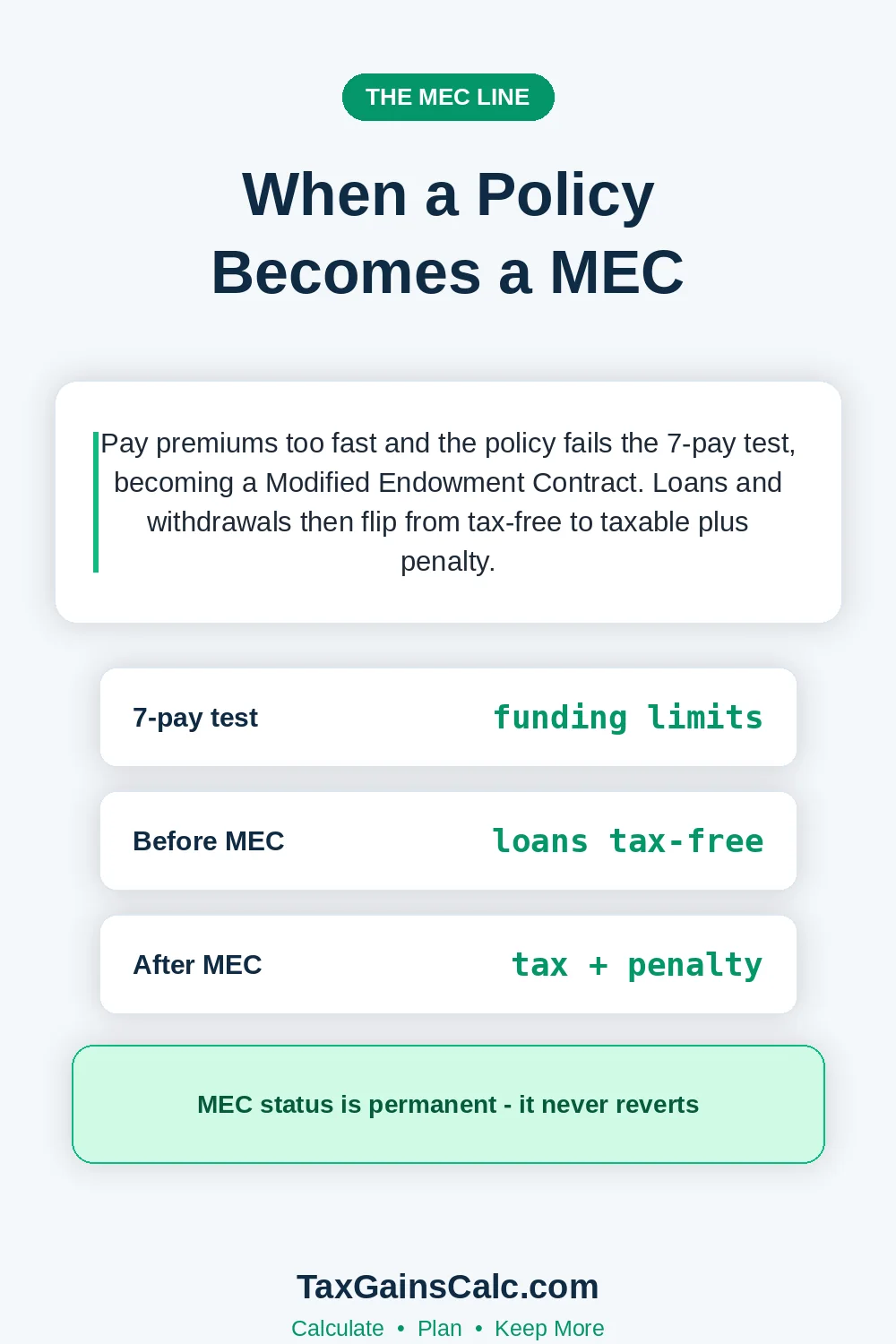 Basis never gets reached, because income comes out first on every loan. The 10 percent penalty applies to taxable loan amounts before 59 and a half.
Our carryover guide has no parallel here because loans are not losses. Track every outstanding loan balance against the death benefit it reduces. That habit keeps the tax shield intact for your beneficiaries later.
The Transfer-for-Value Rule and Its Exceptions
Selling or assigning a policy for valuable consideration changes how its death benefit is taxed. The new owner's exclusion shrinks to whatever that owner actually paid. The code calls this the transfer-for-value rule, which sweeps in most arm's-length sales.
Any gain above that basis becomes taxable income to the beneficiary at death. The rule exists to stop speculators from buying lives and harvesting tax-free payouts. Only the narrow statutory exceptions described below offer any real escape.
Statutory exceptions preserve the tax-free death benefit in several common situations. Transfers to the insured, to a partner, or to a partnership always qualify. Each exception exists because the new owner already had a stake in the life.
Transfers to a corporation where the insured is an officer or shareholder also qualify. Buy-sell arrangements lean on these exceptions constantly, and quite legitimately. Partnership and corporate planning depends on that relief every single day.
| Transfer type | Exception applies? | Death benefit result |
|---|---|---|
| gift back to the insured | yes | stays fully excluded |
| transfer to a partner | yes | stays fully excluded |
| transfer to the partnership | yes | stays fully excluded |
| sale to an unrelated buyer | no | taxable above buyer's basis |
Viatical settlements and accelerated benefit arrangements carry their own separate exclusion rules. Terminally ill and chronically ill insureds can receive accelerated payments tax-free. Section 101(g) governs both categories and applies much stricter limits to chronic illness cases.
Our survivor guide covers the beneficiary-side planning. Employer-owned policies follow their own notice and consent requirements instead. Skipping the consent paperwork can cost the employer its exclusion.
Alternatives to Surrendering an Unwanted Policy
Surrender is the most heavily taxed exit from an underperforming policy. Every gain inside gets recognized at once, at ordinary rates. A 1035 exchange moves the value into an annuity or new policy tax-free.
The exchange itself recognizes no gain at the moment of transfer. Basis and holding period carry over to whatever you acquire. Our deferral guide explains the exchange rules broadly.
Reduced paid-up status stops premium payments without surrendering any part of the policy. The death benefit shrinks, but the policy and its tax shield stay alive. No gain is recognized in the conversion, and no check ever arrives.
Life settlements sell an unwanted policy to outside investors above its cash value. The proceeds carry their own tax rules, so model them first. Always compare the after-tax settlement result against plain surrender before signing anything.
- Consider a 1035 exchange before accepting any taxable surrender.
- Check reduced paid-up options that preserve some coverage tax-free.
- Price a life settlement against the surrender value honestly.
- Model partial withdrawals using the exclusion ratio before full surrender.
 Beneficiary designations deserve one final review during any policy audit. Outdated designations route proceeds to ex-spouses or deceased relatives unintentionally.
The death benefit exclusion only helps when the right people receive it. Confirm the primary and contingent designations match your current intentions today.
A Policy Review Checklist Before Any Exit Decision
Run through these checks before surrendering, lending against, or exchanging any policy. Each item either protects the tax shield or surfaces a cheaper exit. The whole list takes only a few minutes, but skipping it can cost real money.
- Confirm the policy never became a MEC with the carrier in writing.
- Compute your exact investment in the contract from premium records.
- Check outstanding loan balances against current cash value today.
- Price the 1035 exchange, reduced paid-up, and settlement alternatives first.
- Model the ordinary income tax at your exact bracket before surrendering anything at all. The comparison usually reveals at least one better exit.
The taxable and nontaxable income publication documents the insurance rules used here. The capital gains topic guide clarifies why surrender gains are not capital gains.
Policyholders who work through this checklist rarely meet a surprise tax bill. That diligence protects the policy's core promise to the people listed on it.
The family that genuinely understands these rules keeps the full protection the policy was bought for. Beneficiaries receive their death benefits undisturbed while living owners avoid the ordinary income surprises.

Wasim Akram
Wasim researches and writes every article on TaxGainsCalc, covering capital gains tax for everyday investors. Every figure is checked against primary IRS sources before it goes live.